
The Double Refuge ☠️ Ars Moriendi
The Readiness is All
Flight 666 - Death, Be Not Proud - Solving the Problem that Can't Be Solved - That Undiscovered Country
☠️
Flight 666
The plane is going down. You wondered how you would face the final moment, whenever it came. You figured there's no point in panicking, no point in turning your last moments on Earth into a blubbering, cringing spiral of fear. So, you prepared yourself for whenever it came, knowing that sooner or later it would come.
You’ve stamped into your mind Hamlet’s response to Horatio, after Hamlet tells him that he feels (quite prophetically it turns out) a deep foreboding about his upcoming duel with Laertes:
Horatio: If your mind dislike anything, obey it. I will forestall their repair hither, and say you aren’t fit.
Hamlet: Not a whit. We defy augury. There is special providence in the fall of a sparrow. If it be now, ’tis not to come. If it be not to come, it will be now. If it be not now, yet it will come — the readiness is all. Since no man of aught he leaves knows, what is’t to leave betimes? Let be. (Hamlet V. ii. 217-224)
Hamlet is saying that since we don’t really understand ourselves or the world around us (since no man of aught he leaves knows), it doesn't matter if we leave early (what is’t to leave betimes?). One might add that since we don’t understand what, if anything, happens after death, then we can’t say what it means to go from life to death. We don’t know the ultimate meaning of what we do here, and we don’t know what we might do, if anything, there.
The mystery that lies beyond our days — whether it’s Heaven or Hell, Purgatory or Bardo, another life on Earth or a life on some distant world — is the same as the mystery that surrounds us all the time. Keats makes this point in his “Sonnet Written Upon the Top of Ben Nevis,” where he gazes into the heavy mists that surround him:
I look into the chasms, and a shroud
Vapourous doth hide them, — just so much I wist
Mankind do know of hell; I look o'erhead,
And there is sullen mist, — even so much
Mankind can tell of heaven; mist is spread
Before the earth, beneath me, — even such,
Even so vague is man's sight of himself!
Keats doesn’t say that the mist applies to Heaven and Hell only, or to the murky realm of dreams, but to our lives here and now.
☠️
From a double refugee point of view, death shouldn't be feared — or desired. At the moment of death, agnostics wait with bated breath to see what comes next. Or, they continue to breathe. Open theists wait with a deep sense that there will be something next, something more: they are about to enter some new realm or they will merge into God. Either way, open refugees waits to find out.
Being made of flesh and inhabiting for a time this physical world, we can’t completely shake fear. As Sartre puts it, He who's without fear isn't normal; fear has nothing to do with courage. The body plummeting eight thousand feet and then being crushed to bloody pieces can't be considered without fear.
Yet we can forego the fear of a crushing metaphysical punishment. And we can try to forego the fear of death itself — at least if we can follow the advice of Shakespeare's Cesar:
A coward dies a thousand times before his death, but the valiant taste of death but once. It seems to me most strange that men should fear, seeing that death, a necessary end, will come when it will come" (Julius Cesar 2.2).
The theist who stresses Grace and Redemption is less fearful than an old school fire-and-brimstone theist, who has cause to worry that the brimstone might burn. The agnostic also has more hope than the atheist, who can’t avoid the oblivion that awaits the death of his physical body. The agnostic can at least dream of something else. He can at least hope that his worldly journey isn’t the end of his journey.
☠️
Death, Be Not Proud
Double refugees are skeptical that belief, or lack of it, will change the outcome of death, which remains a mystery to everyone. The ancient Jews didn’t believe in a complex or positive afterlife, nor did the early Mesopotamians or Greeks. In something this basic, this foundational, it’s hard to see how we could base our religion on one view and then later decide (like the Egyptians decided earlier) that there is in fact a different outcome — an afterlife judgment and possibly eternal life, rather than a mere quarter-life in the dust.
If you’re an atheist, then it doesn’t make any difference if you return to molten fire or black lead, to dirt beneath the woodchuck’s paw or to the retina of an alien’s eye. Byron put this succinctly in his “Stanzas to the Po” when he wrote, “To dust if I return, from dust I sprung.”
If, on the other hand, you believe in a Merciful God — the only God worth believing in — then the afterlife is more like a party, and everyone’s invited. Everyone. Saints, sinners, agnostics, surprised atheists, and everyone else who couldn’t see what couldn’t be seen. Believing that somehow you’re the only one who got an invitation is like wearing angel wings at a formal dress event.
Double refugees have no clue about what will come, if anything, after life. They wait and see, seizing the day. They dress like a penguin and drink each moment as if the champagne was at their lips. They see Keats’ beaded bubbles winking at the brim and note that Death is half in love with easeful life, not the other way around. They may even imagine that Death is a release from this world of struggle, as if you might fly into the woods on the notes of the nightingale:
Darkling I listen; and, for many a time
I have been half in love with easeful Death,
Called him soft names in many a musèd rhyme,
To take into the air my quiet breath;
Now more than ever seems it rich to die,
To cease upon the midnight with no pain,
While thou art pouring forth thy soul abroad
In such an ecstasy!
All that double refugees know in the meantime is beauty and truth. They forget about patience, for it presupposes that the atheist is wrong and that there is in fact an afterlife party. Patience also presupposes that the party will serve their brand of beer. In any case, they seize the day. They see the beauty that’s around them, and revel in the truth, without pretending that it’s anything more, or anything less, than it is. Without pretending that they know what it is, or that they know what it will be. Without pretending that they know the meaning of it all right now, or the meaning of whatever’s to come. Without pretending.
☠️
Solving the Problem that Can't Be Solved
Death presents us with a problem that religion solves. Yet there's no solution to this problem. No one knows what happens after we die. The refugee admits this, while the traditional theist says, You'll go to Heaven or Hell, and the atheist says, You'll go nowhere at all. Isn't it more honest to say that we really don't know what will happen?
Traditional theists, who are certain they’ll go to a better world, may well rejoice at the thought of death. For them, the downward flight of the plane is, in spite of all topographical fact, an upward flight. If they're Christian or Muslim, this flight will take them to Heaven; if they're Hindu or Buddhist, it will take them to another life or to a heaven such as Krishnaloka.


The belief in an afterlife is so attractive that many may even convert — quickly! — on the way down. One can hardly blame them, and perhaps they're right to do so. Yet from a double refugee perspective it's a seeming belief. It doesn't stare reality in the face. It lacks authenticity. To adapt Hamlet’s words to a different context, double refugees know not seems.
Atheists who believe they'll go nowhere at all once they hit the surface don’t fare so well. They're left face to face with their materialist certainty — and with the concomitant meaninglessness of it all. Some atheists might enjoy the final plunge, living their last moments as resolutely as they lived their lives. Yet the logic of atheism leads, eventually, to a certain type of hopelessness — that is, to the abandonment of any hope that there'll be anything to experience after death. While a fearful Dante sees the words Abandon Hope All Ye Who Enter Here once he reaches the gates of Hell, atheists have already abandoned all fear and all hope, and can't even imagine a gate.
In his play God and the the Good Lord, one of Sartre's characters says, I prefer despair to uncertainty (Le Diable et le Bon Dieu, 1951). The double refugee, on the other hand, prefers uncertainty. The existentialist thinks of disbelief as authentic, the agnostic sees doubt as authentic, and the open theist sees doubt as a way of staying open to whatever God has in store for us. The atheist fares the worst here, at least according to Sartre, who writes in his autobiography Words (Les Mots, 1963) that meaninglessness and suffering are directly proportional: The more absurd life is, the less bearable death is.
Curiously, once Sartre's characters are in Hell they no longer experience fear. Garcin asks Inès, You really don't have any fear? Inès responds, Why would I? Fear was fine earlier, when we had hope (Huis Clos, 1944). The double refugee understands this fear and hope, yet the uncertainty of the situation creates a delicate irony: at the very moment when we're closest to death, we still don’t know if there's anything on the other side. Our brief lives will come to an end — and perhaps at once a new beginning. Then, as always, che sarà, sarà. The open theist leaves it in the hands of God, while the open agnostic leaves it in the hands of the universe.
The ancient Greeks may have got it right: above Zeus, Time, & Chaos hovers inexorable Fate, with his endless scroll that no one can see, as in the agèd male figure by Walter Crane — or the three youthful female figures tugging at the stars by Elihu Vedder:


In the Classical Stoic tradition, starting with Zeno of Citium (early 3rd century BC) and ending with the Roman emperor Marcus Aurelius (late 2nd century AD), Fate is an integral part of the meaning of life and death. Fate operates in Nature, which has its own designs that we don't understand, even though we ought to bow to It. Classical Stoicism is in this way close to open agnosticism, although it adds an element of faith in a benevolent Force that created life and underlies its apparent chaos. The famous Roman orator Cicero (106-43 BC) writes,
The universe itself is God and the outpouring of God's soul; it's this world's guiding principle, operating in mind and reason, together with the common nature of things and the totality that embraces all existence (De Natura Deorum 1. 39).
Marcus Aurelius recommends seeing the universe "as one living being." He recommends noticing "how all things are the cooperating causes of all things that exist; observe too the continuous spinning of the thread and the structure of the web" (Meditations 4.40). He suggests a 'going-with-the-flow' attitude that's strikingly similar to the Classical Taoists Laozi and Zhuangzi:
How small a part of boundless and unfathomable time is assigned to every man, for it's soon swallowed up in the eternal. And how small a part of the whole substance. How small a part of the universal soul. On what a small clod of the whole earth we creep. Reflecting on all this consider nothing to be great, except to act as your nature leads you, and to endure that which the common nature brings. (Meditations 16.32)
Aurelius imagines, like Shakespeare did on several occasions, that life's like a play. If someone dies too soon, we may feel that they were dismissed from the stage mid-play. Yet the play is determined by Nature, with its nebulous benevolent Fate, and not by us. In this there's nothing to be worried about:
"But I have not finished the five acts, but only three of them," you say. Yet in life the three acts are the whole drama. A complete drama is determined by Him who was once the cause of its composition, and now of its dissolution. You are the cause of neither. Therefore, depart satisfied, for He who releases you is satisfied. (Meditations 16.36)
From an agnostic point of view, this seems like a very fine, very desirable philosophy, yet it also seems like wishful thinking. It would be wonderful if such a Playwright existed, but agnostics aren’t convinced. They are, however, inspired by the equanimity encouraged by this type of critical and integrated thinking.
This is one of the many reasons that open agnostics stay open to the idea that the universe is in fact controlled by a benevolent Force. They may not yet mention the word God, but in imagining It they straddle the line between open agnosticism and open theism.
Double refugees argue that there isn’t really a line, much less a dividing line. If it is a line, it's invisible. Or it’s more like a golden plane or moment, the thinnest wall ever. The plane is transparent, has no weight or magnetism to hold you back, and gives light all around.
☠️
That Undiscovered Country
In Hamlet, Shakespeare likens the afterlife to a fearful dream:
To die, to sleep,
To sleep, perchance to dream; aye, there's the rub,
For in that sleep of death, what dreams may come,
When we have shuffled off this mortal coil,
Must give us pause. […]
For Hamlet, death's dream (the afterlife) may end up being a nightmare. We're better off living a painful life than killing ourselves, since the act of self-murder would ensure that if there were in fact a sleep of death, this sleep would be a nightmare:
Who would these fardels [bundles or burdens] bear,
To grunt and sweat under a weary life,
But that the dread of something after death,
The undiscovered country, from whose bourn
No traveller returns, puzzles the will,
And makes us rather bear those ills we have,
Than fly to others that we know not of. (III.i)
Like Hamlet, double refugees believe that despite what priests claim, no one's travelled back from the other side. Death is an undiscovered country. As far as it's reasonable to assume, the accounts of the afterlife are merely stories. Refugees will wait and see what happens. If anything. They have what John Keats called negative capability, which he defined in a 1817 letter as the ability to remain "in uncertainties, Mysteries, doubts, without any irritable reaching after fact & reason."
Double refugees aren’t tourists expecting shady palapas on the warm sands of Playa de los Muertos — Puerto Vallarta's Beach of the Dead. If they're destined to become travellers to an undiscovered country, they've no maps of the place. They've no way to make a hotel reservation. They don’t even know where the airport is. Yet they concede that they may end up on the warm sands after all. Or they may move like a blurry green wave through portals of ether. Or they may move like water into a powerful current that flows down the falls into a jungle, the iridescent eye of a jaguar blinking as they pass. Or their bodies may end up six feet in the ground, and their minds may end up nowhere at all.
Those who believe in a Heaven or Hell afterlife, yet aren’t sure how they'll be judged after they die, are perhaps in the most precarious situation of all. They've every reason to be apprehensive — to pray and cringe before the hooded figure of Death. Or to fear what might be written about them in the scroll of Fate.

Likewise, those who believe in reincarnation will wait apprehensively. Will they be reborn as slum children or in a palace with servants and air-conditioning? As cockroaches scurrying into the sewer, or eagles soaring above the peaks?
Theists may find equanimity in the notion of Heavenly Judgment or in the sow-as-you-reap justice of karma-samsara. Yet the more confidence theists have in their own goodness, the more spiritual pride they may have — and most religions teach that pride is Enemy Number One. In Christianity, it's the worst of the deadly sins. Pride comes before a fall. In Sufism (Islamic mysticism) pride and selfishness are the main obstacles to mystical union. The higher opinion believers have of themselves, the more likely they are to be disappointed.
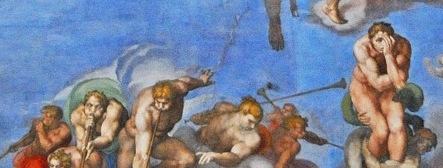
Double refugees neither buoy themselves up by believing that there is special providence in the fall of a sparrow, nor drag themselves down by dreading the undiscovered country beyond whose borne no traveller returns. They don’t see why a loving God would punish humans for having lived imperfectly, that is, for having lived within the limitations of the human condition. They do, however, whole-heartedly agree with Hamlet when he says, in one of the world's most succinct expressions of free will, We defy augury.
Double refugees don’t predict the outcome of an event about which they have no reliable information. Dante says he has been to the next world, but refugees see his journey as literary and symbolic. Open theists hope that the spirituality they believe in will cross from this world into the next, but they can’t be sure. Their earliest writers weren’t. Open agnostics likewise can’t be sure, and maintain that the chances are exactly 50/50. In both cases, the refugees wait. They take a last look about them, seizing the final moment. The readiness is all.
The jet's falling from the sky, the people in the cabin are praying calmly, whining, crying, or blubbering in fear. For some, the ghosts of sins long past project themselves eerily into the future. Their sins will cling to them, like bad faith, like heavy karma, all the way through Purgatory, ripe with Dantean twists toward the gnawing deep or rosy skies. Or they will travel across the Egyptian Duat, full of terrors. Or through the Buddhist Bardo, the confusing state of existence between two lives.
To double refugees these scenarios of Purgatory, Duat and Bardo are so dreamlike that they bring us back to Shakespeare and to what we might conclude from Hamlet's metaphors: we know nothing about death and the afterlife, and the best we can do is imagine them in terms of sleeping and dreaming. Yet just because we fear nightmares, does this mean that we must fear death?


The wind's blasting through an open corner of the jet. It may be the last time the wind will flow through your hair. The last time you'll see the colours of this sun or the blackness of this sky. The last time you'll think your thoughts. Feel your feelings. The last time you'll remember those who made you think and laugh, or made you smile when you were in pain. The last time to breath in the air and say, I'm alive. The last time to look out the porthole into the open sky and ask yourself, with your eyes wide open, What, if anything, comes next?
☠️
Nest: Beyond Whose Bourne