
The Double Refuge 🍏 Agnosticism
Finn McCool
Possibilities - Bridges of Myth
🍏
Possibilities
Hard agnostics say that no one can know whether or not a spiritual realm exists. Open agnostics say that they don’t know, but that other people might. They’re also open to the possibility that atheists and agnostics will know in the future. But until that future comes, agnostics remain puzzled by those who profess to know that there is — or isn’t — a spiritual realm.
Double refugees are in a curious position, since part of them shares the feelings of the open theist. They have a taste of belief, a sense that it’s a reality, yet what exactly that reality is they can’t say. It’s a Mystery they can feel but can’t define. It’s for this reason that they often resort to the nebulous language of the mystics and to the metaphors and extended metaphors of the poets. Metaphors like a bridge or a border are extremely helpful because they are by definition at a distance: the thing the poet talks about is beyond articulation, so they use a metaphor instead, admitting that the metaphor lies at a distance from that thing. Which is fine for them because that thing can’t be grasped or understood anyway. And yet it is part of their thinking, part of their language, part of the symbols and linked ideas they use to see the world.
🍏
Bridges of Myth
Like agnostics in general, the double refugee has a hard time accepting fixed concepts of belief and disbelief. This is because 1. even in the moment doctrines can’t get at the theist truth of God or the atheist untruth of God, and 2. because the truths of religion and and science have constantly changed throughout history and across geography.
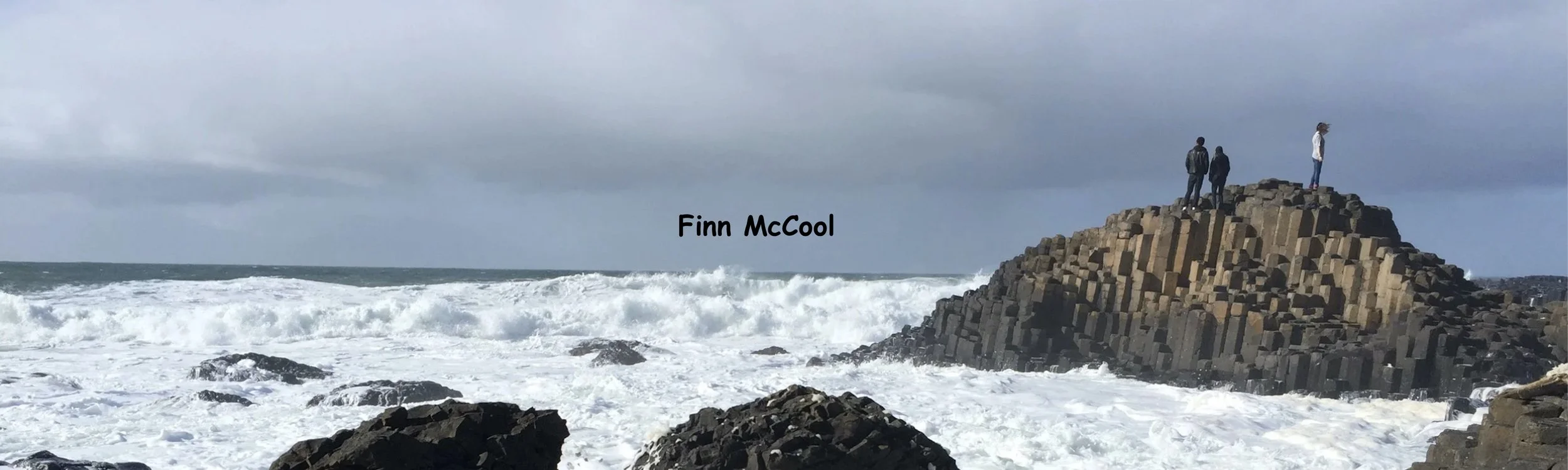
Take one small example: the Irish figure of Finn McCool (a.k.a. Fionn mac Cumhaill). Finn’s story comes from a Gaelic culture full of folklore and myth, yet this same culture allows for the superimposition of another set of stories. These other stories are about a man who can walk on water, who traces his lineage to a Middle Eastern tribe, which traces its lineage to a man and woman in a garden with a tree in it. In this garden there’s a magical apple that they’re not supposed to eat. The Irish figure of Finn is from a pagan culture, yet he travels across time, from a world of druids and naturalistic geometric designs to a world of priests and crucifixes.

“Image of Folio 27v, with the four evangelist symbols from the Book of Kells, a 1200 year old book. Scanned from: Meehan, Bernard; The Book of Kells': an illustrated introduction to the manuscript in Trinity College Dublin. London: Thames and Hudson, 1994. p. 8. Source: Book of Kells.” (From Wikimedia Commons)
Irish narratives undergo a metamorphosis, as the old Gaelic stories get modified by the new Christian ones, and as the old pagan gods dwindle into fairies and the old folk heroes expand into Giants. Wikipedia’s entry on the Giant’s Causeway notes:
in Irish mythology, Fionn mac Cumhaill is not a giant, but a hero with supernatural abilities, contrary to what this particular legend may suggest. In Fairy and Folk Tales of the Irish Peasantry (1888), it is noted that, over time, "the pagan gods of Ireland [...] grew smaller and smaller in the popular imagination until they turned into the fairies; the pagan heroes grew bigger and bigger until they turned into the giants.”
As a giant, Finn builds a causeway of rocks from Ireland to Scotland in order to fight the giant Benandonner. In one of the stories, Finn hears that Benandonner is very big and strong, so Finn’s wife disguises him by dressing him up as a baby. When the Scottish giant sees the baby — and the ‘baby’ bites his finger! — he thinks, If this is Finn’s baby, how big is Finn? Benandonner then flees back to Scotland, en route destroying the causeway. The remains can be seen along the coast about 100 kilometres north-west of Belfast:

Photo by RYC.
These splintered hexagonal rocks are a wonder of nature, yet mythic stories give them meanings that have nothing to do with science.
Humans do this everywhere. For instance, a river is a hydrological fact, yet the Jordan becomes sacred, the Ganges becomes a goddess, and the Styx becomes the underground border between life and death. A mountain in the Sinai desert is a geological fact, yet it becomes sacred when Moses climbs it and God gives him the ten commandments. Elsewhere, Shiva shakes the cosmos when he makes love with his consort Parvati on Mount Kailasa, and Attar’s birds convene their mystical conference on the peak of Mount Qaf.
For agnostics — and for many poets and geomorphologists — these are wonderful stories about rivers and mountains. But for believers these stories constitute a sacred geography, the divine plan of deities superimposed on the topography of Earth. For double refugees, these stories are both. Yet for double refugees the superimpositions never stop: 20 thousand years ago there were other stories and in 20 thousand years there will be others.
🍏
E.M. Forster notes something similar in his 1924 novel A Passage to India. He notes that the Ganges has a religious meaning which is intertwined with geography, yet both the religious moment in time and the geographic moment in time are superseded by the larger dimensions of time and space:
The Ganges, though flowing from the foot of Vishnu and through Siva’s hair, is not an ancient stream. Geology, looking further than religion, knows of a time when neither the river nor the Himalayas that nourished it existed, and an ocean flowed over the holy places of Hindustan.
Looking at the larger currents of religious history, we can see that Mesopotamian religion preceded Judaeo-Christianity, and that astronomy and geology preceded evolution and genetics. These are deep and complex shifts in time, space, and understanding. Tracing the influence of one thing on another is no easy matter.
For instance, it was only in 1872 that an English philologist named George Smith discovered that the story of Noah and the Ark derives from a polytheistic narrative that was common in the Mesopotamian world in the 2nd millennium B.C. Smith’s philology, combined with Copernicus’ astronomy, Hutton’s geology, and Darwin’s evolution made many late 19th century thinkers conclude that history and science held the most plausible explanation for our existence. The question remained, and remains: Is science — especially in light of neurology, psychology, and history — the most plausible explanation for systems of belief?
The case for science is a strong one, given that, unlike religion, it hasn’t much changed its fundamental principles over time and across space. The empirical method was articulated by the Ancient Greeks, and by Medieval scholars like Hasan Ibn al-Haytham and Roger Bacon. This method leads directly into the astronomy, geology, and natural sciences, which then coalesce into the general theory of evolution in the mid-19th century, and are further corroborated by neurology and DNA genetics in the late 19th and early 20th centuries. Given its deep roots in observation and evidence, it seems clear that evolution is far more than just an unproven theory among other theories about the origins of life on Earth. Indeed, I would call it The Evolutionary Explanation. The more physical detail we learn, the more the basis of observation and evidence provides a solid foundation.
Yet in the case of religion, truths merged and diverged throughout history. They also developed very differently according to their geography, the religions of the West differing markedly from those of the East.
In the West, Christianity diverged from Judaism to become the Early Church, which whittled down the variety of Classical belief systems into two categories: false heresies and true beliefs. This Early Church later diverged into three groups: Orthodox, Catholic, and Protestant. The Catholic and Orthodox Churches diverged in the 11th century, and Protestantism diverged from Catholicism in the 16th century. Protestants soon splintered into countless denominations; Lutherans, Calvinists, Anglicans, Anabaptists, Pentecostal, Methodists, Unitarians, Mormons, Quakers, etc. Islam likewise diverged from Judaism to make one religion, which then diverged into Sunni and Shia, and into various sub-categories of each.
In the East, Daoism and Confucianism developed by themselves in China, whereas Buddhism derived from Hinduism. Some refer to a Chinese religion, which is a fusion of Buddhism, Confucianism, and Daoism. Daoism strays farthest from an organized religion with a strict set of doctrines. It’s elusive version of God (the Dao or the Way) resembles a mix of Mother Nature and Shelley’s Neoplatonic One:
The everlasting universe of things
Flows through the mind, and rolls its rapid waves,
Now dark—now glittering—now reflecting gloom—
Now lending splendour, where from secret springs
The source of human thought its tribute brings
Of waters—with a sound but half its own,
Such as a feeble brook will oft assume,
In the wild woods, among the mountains lone,
Where waterfalls around it leap for ever,
Where woods and winds contend, and a vast river
Over its rocks ceaselessly bursts and raves.
— from “Mont Blanc,” Part I
Hinduism started off as mystical utterances of Vedic poets along the Saraswati River, named after the goddess of writing, music, language, and art. Hinduism later splintered into six main schools, two of which are most dominant today: non-dualism, which focuses on a Deity that pervades everything in the physical universe and in the transcendental Beyond; and qualified non-dualism, which focuses on specific deities such as Krishna, Shiva, or Kali. These two groups merge in the notion that however many expressions of gods and powers there may be, they all converge in the greater concept of Deity (or Brahman), which subsumes absolutely everything that exists.
🍏
Double refugees see these religious ideas change across time and space, and then marvel when they hear believers call their faiths a solid Rock. If these faiths are rocks, then they are rocks that jut out of the earth, rising and falling in the surges of Time — like the stepping stones Finn McCool built on the Irish shore.

Photo by RYC.