
The Double Refuge ❤️ Three Little Words
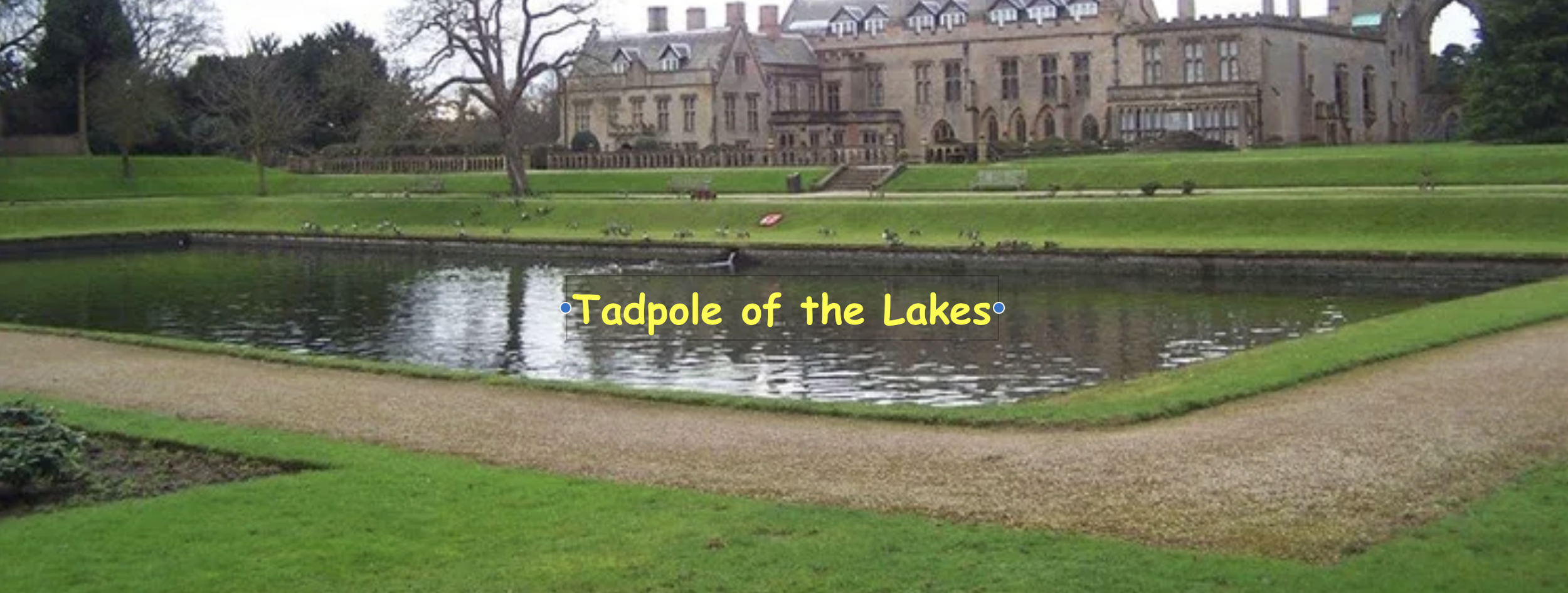
Tadpole of the Lakes
❤️
The second-generation Romantics (Keats, Shelley, and Byron) were especially well-placed to accept reason and science and yet remain open to faith and theology. Living after the Age of Reason and during the first wave of the Industrialization Revolution, they were witnesses to the way science took potent form in the real world. They saw the drawbacks — the dark satanic mills Blake warned about, and the displacement of jobs that workers revolted against (Byron defended these workers in the House of Lords) — yet they also saw the immense advancements in areas such as medicine. For instance, only in the decade after Keats’ death from TB (1821) did we learn that it was caused by a specific disease involving tubercules (while Keats lived people thought it came from too much masturbation!).
While the Romantics didn’t have the benefit of Darwin’s theory of evolution, they had every reason to believe that science was explaining more and more of their existence every day. And yet they also had their fill of Reason with a capital R, and wanted to make room for the exploration of emotion and for the re-assessment and reconsideration of aspects of religion thrown out with the bathwater.
❤️
In regard to philosophy and art, Byron, Shelley, and Keats take different directions and have very different sensibilities. Byron and Shelley use the grandeur of Nature, especially the archetypal Mountain, to suggest an Infinity that lies beyond human conceptions of Truth or God. From the slopes of the Jungfrau, Byron’s Manfred (1817) champions free will, even in the face of damnation. In Prometheus Unbound (1820), Shelley asserts the human right to question everything, and asserts that Prometheus is a Christ-like hero who stands up against a controlling God.
Like Byron and Shelley, Keats is in favour of questioning established systems (one might remember here that another name for the Romantic Age is the Age of Revolution). Yet Keats takes a more humble, human-scale approach. Shelley may have written about equality and atheism, yet he thinks in grand neoplatonic terms. Byron may have undermined the epic tradition throughout Don Juan, yet his poem ends up being the longest poem in the English language, with an epic sweep and depth that anticipates Joyce’s Ulysses in its mix of the epic and a comic deflation of the epic. In contrast, Keats’ rejection of the epic mode is more definitive: in rejecting the Miltonic language he uses in his two unfinished plays on Hyperion, he also drops the idea of locating his quest for meaning in grand or epic terms.
In two 1819 letters, Keats writes, “I have given up Hyperion — there were too many Miltonic inversions in it”; “I have but lately stood on my guard against Milton. Life to him would be death to me.” Instead, Keats goes back to his earlier, earthier position, where even though he’s on the top of the highest mountain in England, all he can see is crag and mist:
Thus much I know that, a poor witless elf,
I tread on them, — that all my eye doth meet
Is mist and crag, not only on this height,
But in the world of thought and mental might!
❤️
Keats also came from a humble background. Unlike Byron, he didn’t go to Harrow and Cambridge, and unlike Shelley he didn’t go to Eton and Oxford. Unlike Montaigne, he didn’t have a chateau, and unlike Byron he didn’t have an ancestral abbey.

Chateau de Montaigne and Newstead Abbey (both from Wikimedia Commons)

Newstead Abbey, January 2007. Transferred from en.wikipedia to Commons by Oxyman using CommonsHelper. Author: Kev747 at English Wikipedia.
Unlike Montaigne, he didn’t have clavichords and zithers to provide him with background music for his day. He didn’t have money to travel around Europe, or to meet on the shores of Lake Geneva, as did Shelley and Byron in 1816, around which time Mary Shelley wrote Frankenstein, Shelley wrote “Mont Blanc,” and Byron wrote the third canto of Childe Harold. Keats couldn’t afford to be a poet so he studied to become a doctor. But he didn’t practice medicine because all he really wanted was to write poetry — and to marry Fanny Brawne, although he didn’t feel he had enough money to do that either.
Byron and Shelley are liberal democrats, yet at times are prey to their own wealth and privilege. And yet I’m sure that Byron, could he read by candlelight in his burial vault, would regret calling Keats ‘a tadpole of the lakes,’ that is, a lowly imitator of Wordsworth and Coleridge. In Byron’s first speech in the House of Lords (1812), he sympathized with the workers whose jobs were being replaced by machines. In his second speech, he sarcastically attacked those who would deny Catholics equality. Keats had none of these opportunities, and he was far, far less well-known. Among the two, only Shelley understood Keats’ talent. In the final (55th) stanza of his sublime eulogy, Adonais (1821), Shelley flies like Dante to the heavens, where Keats is found among the immortals:
The breath whose might I have invoked in song
Descends on me; my spirit's bark is driven
Far from the shore, far from the trembling throng
Whose sails were never to the tempest given.
The massy earth and spherèd skies are riven!
I am borne darkly, fearfully, afar!
Whilst, burning through the inmost veil of heaven,
The soul of Adonais, like a star,
Beacons from the abode where the Eternal are.
Keats of course would have been flattered, but he was unlikely to have dreamed of such a posthumous status, especially as he sat quarantined in his ship off the coast of Naples (1820), or as he lay coughing up blood in his little room on the Spanish Steps. And yet this tadpole of the lakes may have got at the human condition as powerfully as either Shelley or Byron. In the following poem, I imagine Keats reminiscing about his climb up to the peak of Ben Nevis:
❤️
Tadpole of the Lakes
I stood on a mountain top, deep within the white folds of mist
yet I didn’t (like Shelley) see Demogorgon rise,
nor (like Byron) did I see devils circling on the rim
of some gigantic crater, somewhere near Interlaken,
or where the gates to Tartarus lie.
I stood atop Ben Nevis, where others might have seen spirits —
where Shelley, kind Percy, would have seen a phalanx of satyrs,
and a chorus of nymphs,
and where Byron (my caustic unmet friend George Gordon Byron,
6th Baron Byron, descended from James I of Scotland)
would have twirled Mephistopheles seven times round Ixion’s wheel.
There on the mountain top, neither Olympia nor Jungfrau,
I saw mist, nothing but mist.

From the Skagway-Yukon tourist train (photo RYC).