The Double Refuge 🍏 Agnosticism
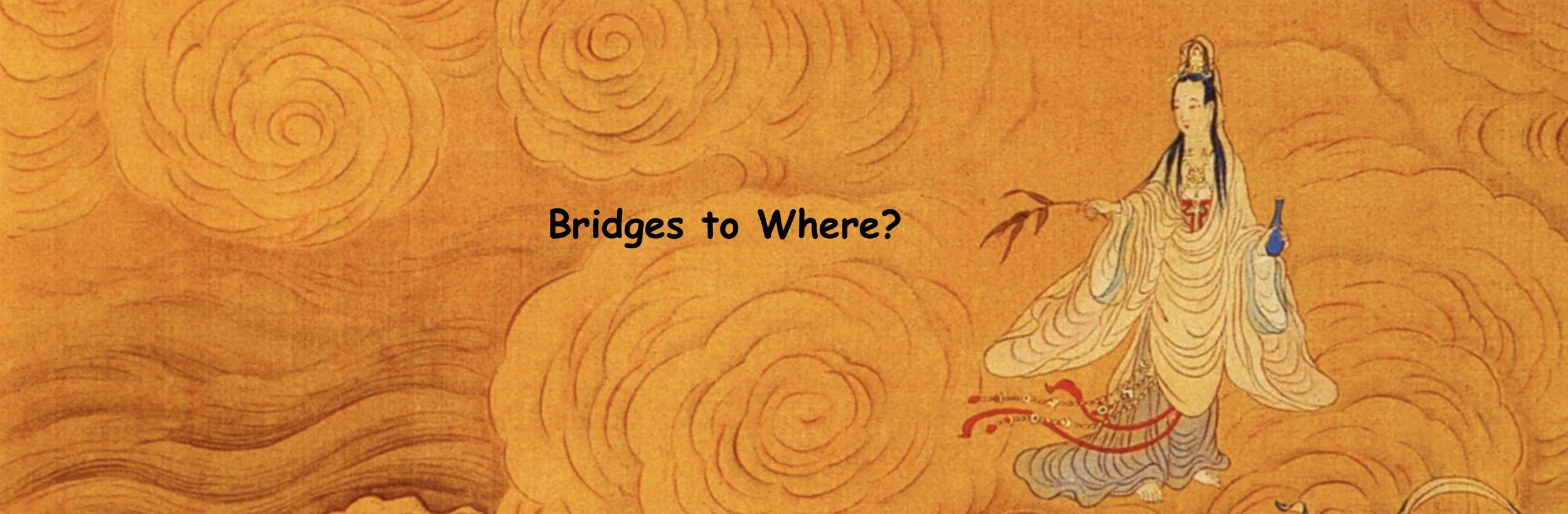
Bridges to Where?
Greater Than Thunder - Borders
🍏
Greater Than Thunder
Are religious myths bridges that unite people? Or are they like the bridge Finn McCool built to fight his Scottish neighbour? Religion is often blamed for so many intractable animosities between people, whether individuals or groups. Yet religion often prevents people from killing each other. It counsels us to love our neighbour and to exercise forbearance and charity. And yet how many battles have been fought over this or that version of Christianity, and over this or that version of Islam? How many crusades have been waged over which is the true faith, Christianity or Islam? How many people were killed during the Partition of the Indian subcontinent, simply because people identified with Hinduism, Islam, or Sikhism? Double refugees watch the tragic battle of theologies and wonder, What the hell?
But it isn’t only religion that shakes the air with thunder and rains down catastrophe from the sky. Science, pride, and materialistic greed too often combine to create glide bombs and genocides. The vicious strains of human culture take each technology and find a way to blast their neighbours with death. Jonathan Swift got this right when he mockingly marvels, with his idiot Gulliver, at the invention of gunpowder:
In hopes to ingratiate myself further into his majesty's favour, I told him of an invention, discovered between three and four hundred years ago, to make a certain powder, into a heap of which, the smallest spark of fire falling, would kindle the whole in a moment, although it were as big as a mountain, and make it all fly up in the air together, with a noise and agitation greater than thunder. That a proper quantity of this powder rammed into a hollow tube of brass or iron, according to its bigness, would drive a ball of iron or lead, with such violence and speed, as nothing was able to sustain its force. That the largest balls thus discharged, would not only destroy whole ranks of an army at once, but batter the strongest walls to the ground, sink down ships, with a thousand men in each, to the bottom of the sea, and when linked together by a chain, would cut through masts and rigging, divide hundreds of bodies in the middle, and lay all waste before them. That we often put this powder into large hollow balls of iron, and discharged them by an engine into some city we were besieging, which would rip up the pavements, tear the houses to pieces, burst and throw splinters on every side, dashing out the brains of all who came near. That I knew the ingredients very well, which were cheap and common; I understood the manner of compounding them, and could direct his workmen how to make those tubes, of a size proportionable to all other things in his majesty's kingdom, and the largest need not be above a hundred feet long; twenty or thirty of which tubes, charged with the proper quantity of powder and balls, would batter down the walls of the strongest town in his dominions in a few hours, or destroy the whole metropolis, if ever it should pretend to dispute his absolute commands. This I humbly offered to his majesty, as a small tribute of acknowledgment, in turn for so many marks that I had received, of his royal favour and protection.
Swift wrote three hundred years ago, yet it only gets worse. Together, the worst of religion and science scratch their traces across the holy ether and the secular air, as our gods glide downward to avenge our enemies, and our high-tech missives of hatred fly downward to the cities of Gaza and Kiev.
🍏
Borders
The more double refugees look into the depth and variety of the histories and geographies that lead to specific versions of religion, the more they wonder how anyone can insist on one version of ultimate theological Truth. Add to this that the universe is mind-bogglingly enormous, and that there are likely millions of versions of religion out there. We may be like New World shamans in 1491, yet to see a colourful flag on a high mast.
In its lack of doctrines and borders, the double refuge shares much with ❧ literature, which mirrors reality in all its possibilities, with ❧ science, which explores the universe in all its forms, and with ❧ free-thinking mysticism, which explores all states of psychology, spirituality, and consciousness. Hard agnostics might wince at my inclusion of mysticism, which could be defined as the merging of the self with an imminent or transcendental God, with what Marcus Aurelius calls the Universal Mind, or with the Spirit or Mystery of Nature. Yet open agnostics entertain such possibilities, especially if the theological framework is liberal — that is, if it’s open to exploring different experiences, thoughts, and beliefs.
Double refugees who have mystical experiences generally don’t know what to conclude from their experiences. Just because they feel an expansive unity, does this mean there’s a God, a Heaven, an eternal soul, or even some vague otherworldly fifth-dimensional realm? Experiences of oneness or cosmic connection may be functions of our animal state, or they may be linked to some theological design. Who really knows?

For instance, let’s say that you have the type of experience William Blake describes in “Auguries of Innocence.” You feel that you are holding Infinity in the palm of your hand. Double refugees would note that this isn’t a common or scientific way of expressing a deep feeling of connection and expansiveness. They understand that it’s a poetic way of trying to articulate a feeling or state of mind. And when Blake suggests that you can see Heaven in a Wild Flower, they would wonder what this means. They’d withhold comment and wait for further insight and context. They’d question the notion of a Heaven. They’d ask, “How do you know that your experience connects to a place called Heaven?”
This suggests the following double refuge principle: the less a mystical experience is linked to a specific theology, the easier it is to see it as part of a continuum or an overlapping of physical and metaphysical worlds. For instance if you articulate your experience in terms of Krishna or Christ, you evoke theological systems which many see as incompatible with history or with each other. It becomes hard to see how one of these systems can operate, let alone the two of them at the same time. On the other hand, if you articulate your experience in terms of a feeling of oneness or love, this is more easily reconciled with the love that mammals share or the divine love that religions promote.
The thing that most distinguishes open from hard agnosticism is that the open variety assumes that we can’t know whether other people’s experiences are illusions or whether they exist as a metaphysical Truth. Hard agnostics would be very skeptical of someone who paired Infinity with anything so specific as a Heaven. Hard agnostics would say that no one can know such specific things about Infinity, or about the way it might connect to a spiritual realm. Yet open agnostics wonder if Blake’s Heaven can also be Krishnaloka or Devaloka, all versions of Heaven that might operate within the superstructure of reincarnation. Or perhaps the notion of Heaven is just a poetic way of pointing toward Infinity. In this sense, it would echo the more general opening line, “To see a World in a Grain of Sand.” Open agnostics approach the question from all angles, giving other people the benefit of the doubt? Who knows? perhaps they’re right.
🍏
Double refugees don’t use doubt to separate themselves from what others believe or don’t believe. Rather, they use doubt as a lever to free themselves from fixed and restrictive ideas, and to launch themselves into the unknown. Sometimes they find that realism and science lead most reliably to truth. Sometimes they find their version of a capitalized Infinity in the contemplation of space, from the subatomic to the astronomic.
And yet I imagine an astronomer being so dazzled by the immensity of the starry heavens that he starts mixing the scientific with the mystical. I imagine him five thousand metres above the Atacama Desert, spellbound in the thin air of Chile’s ALMA observatory. He looks again and again at the acronym for the Atacama Large Millimeter Array. He notes to himself that alma means soul in Spanish.

From Wikimedia (colour-enhanced by RYC):
A crystal-clear sky on any night is always a joy to behold. But if you are on the Chajnantor Plateau, at 5000 metres altitude in the Chilean Andes and one of the best places in the world for astronomical observations, it could be an experience that you’ll remember for your whole life.
This panoramic view of Chajnantor shows the antennas of the Atacama Large Millimeter/submillimeter Array (ALMA) against a breathtaking starry night sky.
In the foreground, we can see some of ALMA’s antennas, working together. The plateau appears curved, because of the effect of the wide-angle lens used. ALMA is the world’s most powerful telescope for studying the Universe at submillimetre and millimetre wavelengths. Construction work for ALMA will be completed in 2013, and a total of 66 of these high-precision antennas will be operating on the site. At the moment, the telescope is in its initial phase of Early Science Observations. Even though it is not fully constructed, the telescope is already producing outstanding results, outperforming all other submillimetre arrays.
In the sky above the antennas, countless stars shine like distant jewels. Two other familiar celestial objects also stand out. First, the image is crowned by the Moon. Second, outshone by the glow of the Moon, it is possible to distinguish the Milky Way as a hazy stripe across the sky. Dark regions within the band are areas where the light from background stars is blocked by interstellar dust.
This photograph was taken by ESO Photo Ambassador, Babak Tafreshi.
17 September 2012, 10:00:00. Source: http://www.eso.org/public/images/potw1238a/. Author: ESO/B. Tafreshi (twanight.org)
Refugees may find wonder in the universe of facts, or in the magic of Krishna on his chariot, Christ on the water, or Guanyin on her mountain in the sea:

Guanyin in the Tidal Sound Cave at Mt Potala, from the book In Celebration of the Amitabha Buddha (無量壽佛會慶圖冊). She waves a willow branch to sprinkle the water from the vase and reduce the suffering of people. The other figure is Sudhana. Qing Dynasty (1644-1911). National Palace Museum, Taipei. (From Wikimedia Commons)
Perhaps religion is just a trick that language and symbol play on our desire for a magical realm. Perhaps it’s just a function of our desire to escape this hard world of facts and wars and greed. Or perhaps the magic is real in some mysterious way…

Photos by RYC (from Murnau am Stafflesee)
Perhaps there really is a spiritual realm that lies deep in outer space, in a place called Heaven of Krishnaloka. Perhaps there’s a divine spark inside our human flesh and bone, somewhere deep in the blood of our hearts, or in the currents and waves of the human brain. Perhaps the Kena Upanishad is right when it asserts that God isn’t what we think, but rather that by which we think. That is, God isn’t our conception of Deity, but rather the greater Power that allows us to imagine the concept of Deity. Perhaps what’s important isn’t what we see but rather that by which we see; isn’t what we know but rather that by which we know; isn’t what we believe but rather that by which we believe. Perhaps one day we’ll find that God is that toward which the mind moves, as it were, that by which it is ever aware and that which forms its purpose. Or perhaps we won’t find any such thing. The main point about the double refuge isn’t that we find or don’t find a specific spiritual dimension. It’s that we remain open to the possibility.
🍏
Next: 🍏 A Middle Position