The Double Refuge 🍷 Bubbles Winking at the Brim
Sections, Chapters, & The Scarlet Pimpernel
Sections - Chapters - Objective & Subjective - Globalism - The Scarlet Pimpernel
🍷
Sections
The five introductory chapters are followed by two main sections: Pathways to Doubt and Currents of Religion.
The eight chapters of Pathways to Doubt emphasize the effect of science on religion, especially the way astronomy and natural science dismantled Medieval literalism, and led to Deism, agnosticism, and existentialism. I also look at examples of how existential and religious paradigms can complement each other, and sometimes merge.
The nine chapters of Currents of Religion emphasize the diverse history of religion, as well as aspects of mysticism that survive the collapse of certainty. I take a look at the clash between Mesoptamian and Judaic religion, the fusion of doubt and belief in Daoist and Transcendentalist writers, and the clash between secularism and fundamentalism in Rushdie’s early novels. Throughout this section I argue that the double refuge, with its open borders and its lack of doctrine, can act as a conduit between doubt and belief, and can also act as a refuge from the ravages of both.
Throughout The Double Refuge I use historical timelines, yet my arguments are more about the nature of doubt and belief than about the historical development of either. I highlight literature that’s especially relevant to the relation of doubt to belief. For instance, in 🦖 At the Wild & Fog I look at proto-agnosticism and Christianity in Dickens’ Bleak House, and at Modern agnosticism and mysticism in Forster’s A Passage to India.
🍷
Chapters
The first section, PATHWAYS TO DOUBT, follows a rough chronological order. I start by looking at the revolutionary impact of astronomy in 🔭 The Sum of All Space, and at the parallel rise of science and skepticism from the 16th to 20th centuries in 🔬 Science & Mystery and in ♒️ A River Journey. I then look at the skeptical and empirical strains in agnosticism, from the Greeks to the 19th century (❤️ Three Little Words), after which I look at the shift from pre- to post- Darwinian thinking in Dickens’ England in 🦖 At the Wild & Fog, at the relation between agnosticism and theism in the 20th century French existentialists Sartre and Camus in 🎲 Almost Existential, and at a mystical version of the contemporary existential heroine in the song, “A Lighter Shade of Pale” in 🧜🏽♀️ The Mermaid: Existential & Then Some.
The second section, CURRENTS OF RELIGION, also follows a rough chronological order, beginning with an overview of religious history in 🌎 Many Tribes. I then look at the influence of Mesopotamian civilization on Judaism & Christianity in ♒️ The Currents of Sumer, at changing religious paradigms in ⏯ Systems and in ✝︎ St. Francis, at mysticism in Classical China & Whitman’s 19th Century Transcendentalism in 💫 Believing in the Mystery, at the battle against dogma in the Indian subcontinent in the 20th century in 🇮🇳 The Fiction of Doubt, and at the age-old puzzle of death in ☠️ Ars Moriendi.
For a list of contents for each page of each chapter, see Detailed Contents.
🍷
Objective & Subjective
For the sake of convenience, one might divide the chapters into two types: non-fiction which aims at objectivity and fiction which stresses subjectivity.
First, there’s the non-fiction of history, geography, natural science, astronomy, philology, politics, and philosophy. For instance, in 🔭 The Sum of All Space and 🔬Science & Mystery I look at how astronomy and science approach the notions of doubt and infinity. In 🔬Three Little Words I look at the development of skepticism, focusing on Montaigne’s three little words, which aren’t I love you, but What know I? or Que sais-je? In 🌎 Many Tribes and ♒️ The Currents of Sumer I look at the history of religion, and at how Judaeo-Christianity has borrowed from, and, all too often, belittled other philosophies and cultures, including the Mesopotamian civilizations from which it largely derived.
While much of The Double Refuge is focused on non-fiction, I also bring in creative writing, literary criticism, and autobiography. In particular, I use literary criticism in four chapters. In 🦖 At the Wild & Fog I argue that Charles Dickens is a sort of proto-agnostic, and that his novel Bleak House is a powerful reflection of the years immediately prior to Huxley’s coining of the term agnosticism. In 🧜🏽♀️ The Mermaid: Existential & Then Some I explore the mix of existentialism and mysticism in the lyric “A Lighter Shade of Pale.” In 🇮🇳 The Fiction of Doubt and 💫 Believing in the Mystery I look at how the mysticism of Whitman and Zhuangzi includes doubt, and at how the skepticism of Rushdie includes mysticism.
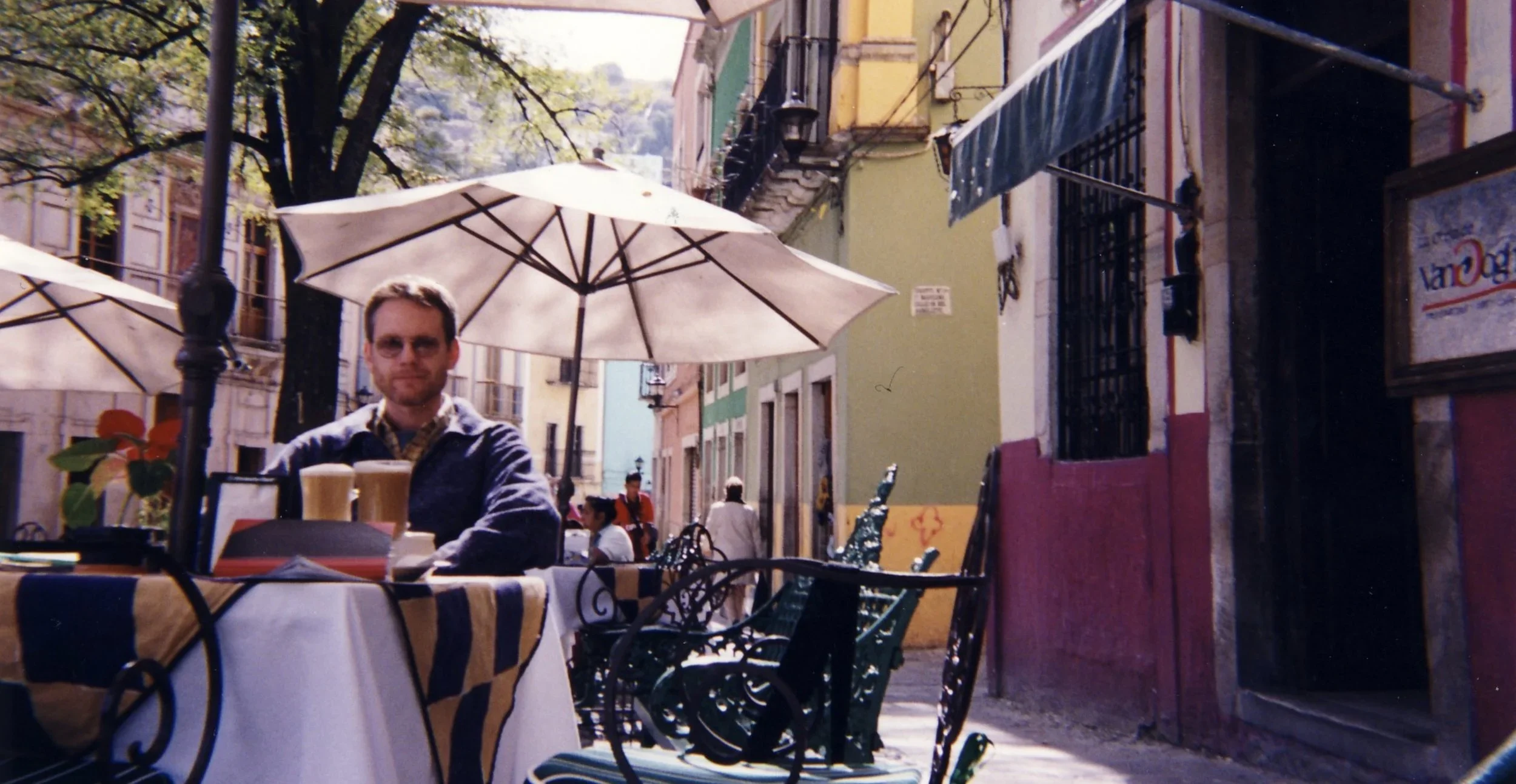
Autobiography is the dominant mode on many pages and in several chapters: ☠️ Ars Moriendi reflects on the death of my father and brother; ⛱ Señor Locke and ☯️ Herr Jung use Locke’s empirical theory of the mind to illustrate the relation between belief, doubt, and sense impressions. Drinking coffee in a colourful square in Guanajuato, I wonder how unbiased my thinking about religion can ever be, having been abused by a counsellor at a so-called ‘Christian’ camp. I also wonder if I can ever be free from fear, having been robbed at knifepoint in Mexico City and held captive briefly in Istanbul. Have such experiences made me less open to belief, or more willing to try new forms of belief?
This fictional and autobiographical veering away from exposition & argument is in keeping with my notion that while open agnosticism and open theism have abstract philosophical dimensions, they are primarily based in personal experience.
This is especially true for open agnosticism: at its heart it isn’t as much a system or doctrine as it is an open mode of operating and being. It urges us to think and feel critically, openly, and eclectically. Of course, religion can work in this open, critical way too, which is why I think of open agnosticism and open theism as the double refuge. Christian ecumenicalism goes some way in this, yet it often remains within the sphere of Christianity rather than becoming part of a global religious sensibility. Notable exceptions to this can be found in the writings of Walt Whitman, Ralph Waldo Emerson, Thomas Merton, Raimundo Panikkar, Bede Griffiths, or, more recently, Robert Capon and Richard Rohr.
🍷
Globalism
The following poem I wrote exemplifies what I mean by a global religious sensibility. In it I try to combine this sensibility with the desire to burn away the chaff, that is, to remove whatever stops us from connecting more broadly, from exploring and empathizing, from loving and forgiving, from reaching the grain or valuable substance which is protected yet also hidden by the chaff. In my poem the names of God are many. God thus becomes Shiva, the God of destruction and creation, as well as Christ, the God who is killed and resurrected. In both agnostic and mystical thought, it doesn’t matter what the name is; it’s the principle of improvement and the experience of reconstruction that counts:
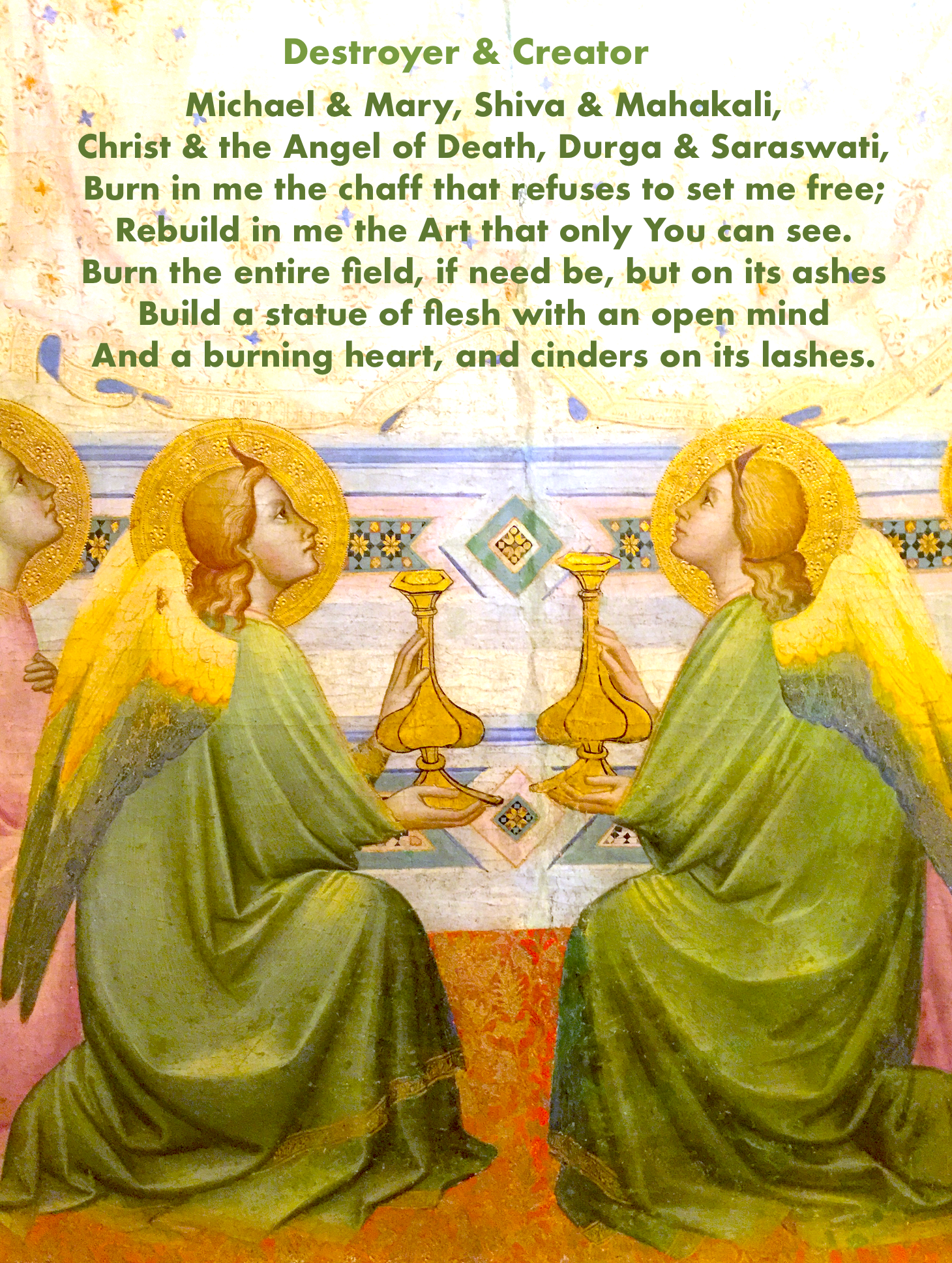
By and large religion is dominated by those who tend to think in exclusive terms, often promulgating the notion that their religion is the best. They set Christ against Krishna, even the mercy of Mary against the mercy of Guanyin. Personal experience too often gets subsumed by the doctrine of a particular church, sect, or school — just as it does by the atheist doctrine of positivism, which argues that the only verification we can rely on comes from the scientific method. Agnostics, by the very nature of their philosophy, are loathe to make such claims to exclusivity and superiority. It’s why agnostics aren’t bothered in the least if an agnostic embraces faith or leaves it altogether — that is, if they stop being an agnostic and become a theist or an atheist. It’s the sincerity of the search and the honesty of the appraisal that counts.
🍷
The Scarlet Pimpernel
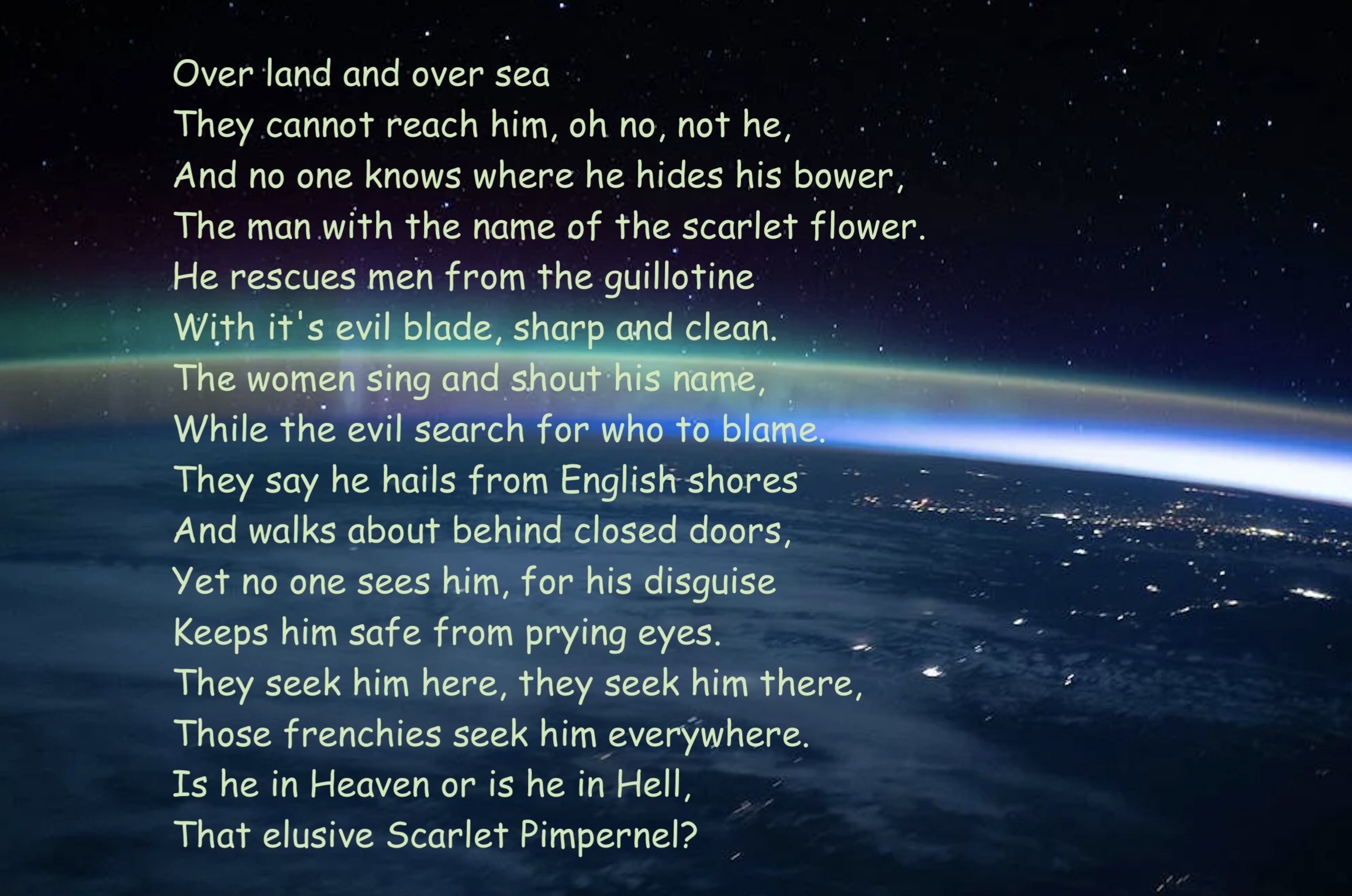
While The Double Refuge has themes and threads, I have a laissez-faire attitude in the pages themselves, taking tangents wherever I think they might yield some insight. A certain amount of latitude seems appropriate in exploring the relation between poetic agnosticism and mystical theism, since both are rather sliding, floating endeavours. It may be that if you’re willing to explore everything, you’re likely to keep shifting your bearings, and at times quite abruptly. Even to include humour, as when I see God as the Scarlet Pimpernel. I see this as having fun with rather than making fun of what’s so often seen as exclusive, serious, and generally out-of-bounds:
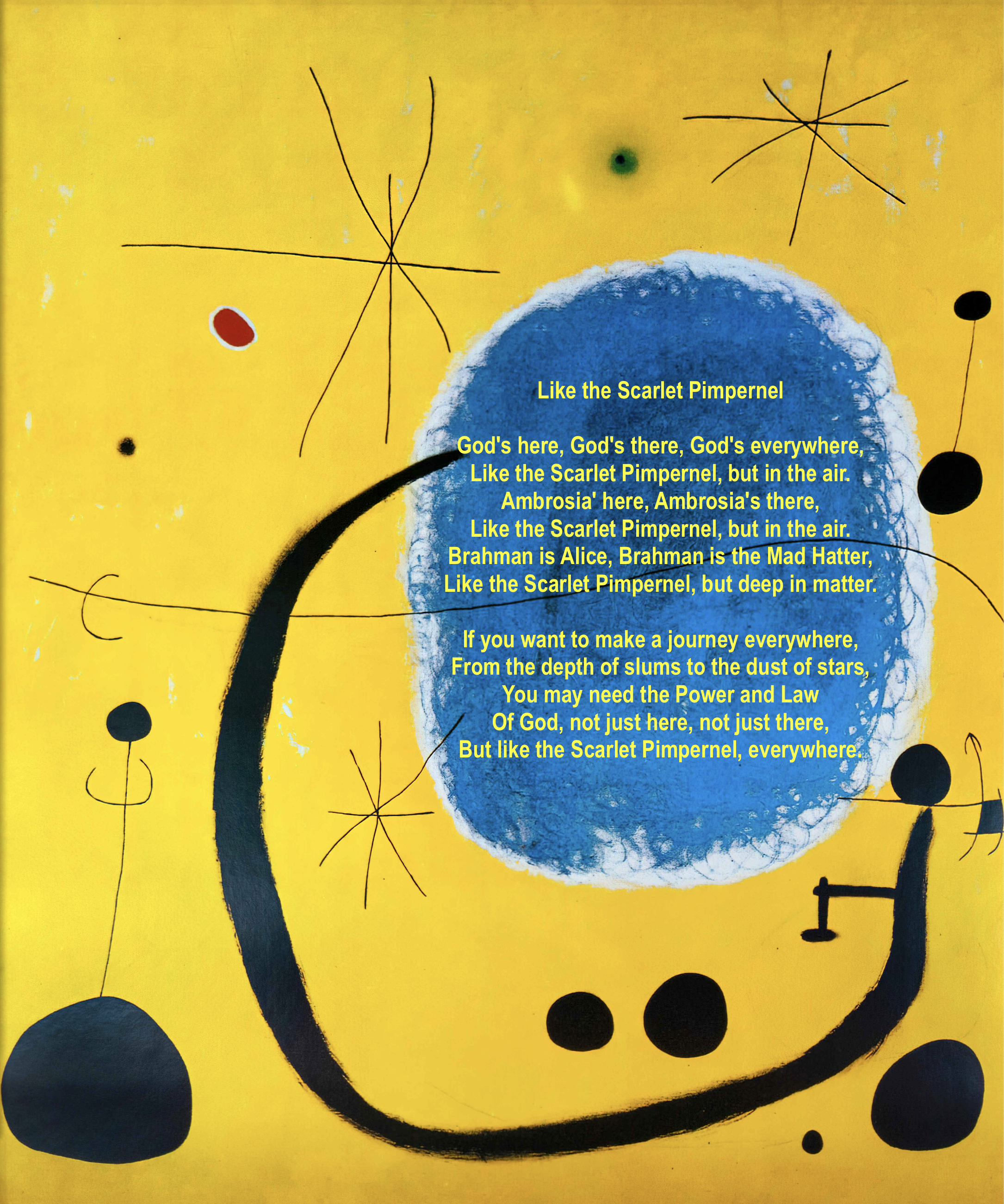
Gold of the Azure, 1967, by Joan Miró (clipped by RYC, from Wiki of Infinite Art).
In my exploration of doubt & belief I follow timelines and threads, but beyond these there are other trajectories and fabrics — much as beyond Miró’s blue blob there’s a galaxy of gold and black lines with hints of stars and justice, of upside-down smiles and beings on faraway planets.
The lines we type onto the page or screen stretch so far from us that eventually they become other, our scheme intersecting with other schemes, until we suspect that the universe is full of infinite patterns and schemes. To impose a pattern or gospel on the universe says more about us than it does about the cosmos.

“In this image taken on Oct. 30, 2021, an aurora dimly intersected with Earth's airglow as the International Space Station flew into an orbital sunrise 264 miles above the Pacific Ocean before crossing over Canada. Image Credit: NASA” (link here).