
The Ring 💍 Paris
All Roads Lead to Paris
💍
Albert soon grew tired of the gap between ideals and practices. He even grew tired of the promises of Vatican II. He wasn’t interested in historical attractions masquerading as religion, however beautiful Saint Peter’s or Notre Dame may be. He wasn’t interested in doctrine or catechism, but in the compassion behind them.
He also wanted to measure the distance between possibility and probability. Anything might be true, but what was likely to be true? He was suspicious of any religion that tried to hide the mathematical calculations behind the Trinity, the Trimurti, or the Four Noble Truths. Why construct immutable doctrines if your aim is the Numberless Ether or the Uncountable Love?
Albert couldn’t help distrusting abstraction. You see, he grew up in the Canadian province of Alberta, in downtown Edmonton, on Jasper Avenue. These are very down-to-earth places, with very few of the etherial beauties of Paris or Rome. Nor was Edmonton overburdened with history:
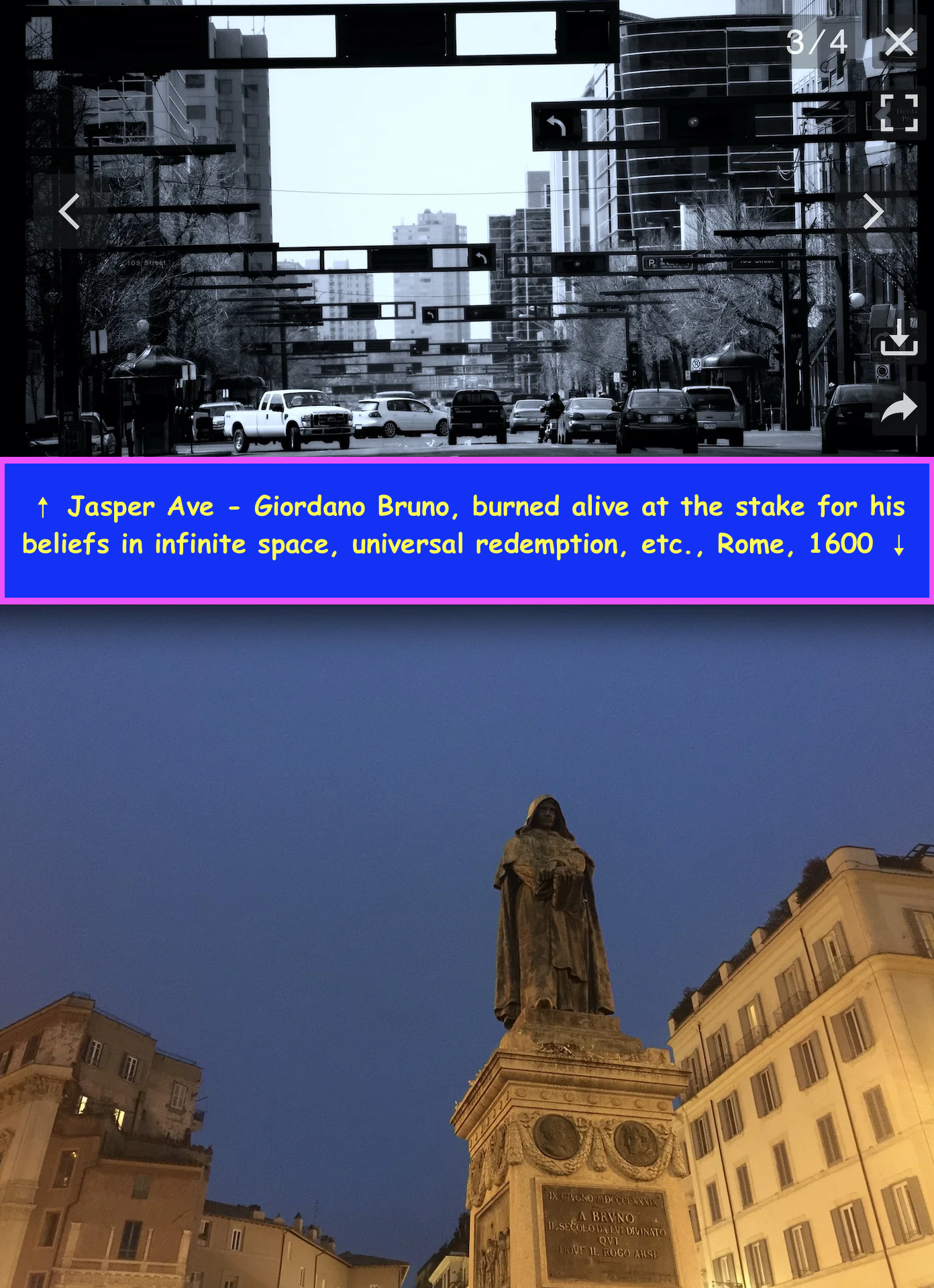
Albert was a small c catholic coming up against the big C Church. He believed that the Church ought to be open to everyone, and ought to be open to all forms of belief. He reasoned that the probability of integrity lay with liberalism and charity and not with conservatism and doctrine. What was God more likely to approve of, helping those in need or debating the Trinity? He saw the homeless and the drug addicts on the fringes of Jasper Avenue, and wanted to do something. 800 years ago Saint Francis would have given them shelter, would have opened the doors of his humble church on a cold winter night. Today, the charities of Saint Vincent de Paul and Sant'Egidio continued to rescue them from the frozen sidewalk, and give them something to eat. When they got old and frail, the brothers and sisters would nurse them till their broken hearts no longer beat.
💍
Albert first came to England to study at St.Mary’s in Birmingham. He was drawn there by its immense Glancey Library, and by the chance to spar with the ghost of Cardinal Newman. The Cardinal believed in critical thinking, yet not in liberalism. Albert couldn’t figure out how that made sense, even in theory. Surely the odds were in favour of liberal charity, given to whoever needed it rather than to those who had inherited the luxury of doing without it.
He thought of the Jesuit priests struggling in the freezing Québec winters and the torrid jungles of Brasil. He thought of the Liberation Theologists and how they stood up to the slavers and their wealthy backers. He thought of Bartolomé de las Casas, who saw firsthand the brutal rape of the Indies. De las Casas then listened to a Dominican sermon, after which he turned against the whole rampaging conquistadorial disaster. He wrote A Brief History of the Destruction of the Americas, which, luckily, caught the ear of the King and the Pope.
Albert knew that the Church was guilty of many abuses, but it also had its heroes and saints.
After a year of wrestling with the ghost of Cardinal Newman, Albert felt a strong pull toward the continent, and skipped across the Channel to France. He was lured by Rabelais and Montaigne, Montesquieu and Rousseau. He understood what Newman said, but he felt that Montaigne had arrived at a deeper truth 300 years before him. Unlike Newman, Montaigne left a huge space for doubt, and for other philosophies to enter the realm of possibility. To Albert this space was a necessary precondition for spiritual freedom, for no belief system could ever be probable without being possible first. If certain beliefs were ignored and therefore impossible, however true or false they might be, then it was improbable that we’d arrive at truth. We’d all be trapped in our little bubbles and watch them float up above trees and into the clouds, popped, and then fall back to earth.
Perhaps Montaigne allowed for doubt and possibility because the air in France was more philosophical, more influenced by Italian thinkers like Pico della Mirandola and Giordano Bruno. Or perhaps it was because François Rabelais had already cleared the way for such French doubt. Both priest and doctor, Rabelais had shaken and liberated Humanism. He had also unified religion & reason in a way that was both rational and visceral. Rabelais’ outrageous and free-ranging stories created a tremendous creative space for the French 🔺 to reconcile their practical lives with their abstract hopes, 🔺 to accept their bodies as well as their souls, 🔺 to stand up to authority, and 🔺 to freely mix Antiquity with Modernity. While Newman insisted that traditional religion provided the best way forward, Rabelais said, Fay ce que voudras, Do what you want.
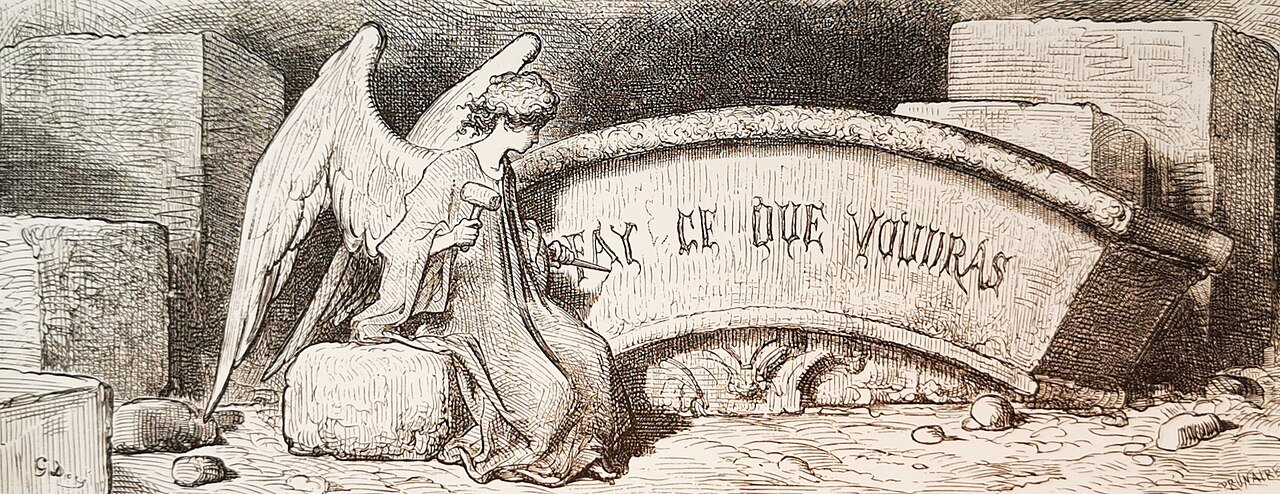
Gustave Doré's illustration of the inscription above the Thélème Abbey (DO WHAT YOU WANT). Author: SashiRolls. (From Wimimedia Commons)
💍
Albert was perhaps also drawn to Paris by the memory of the French spoken by his parents, who died in a car crash when he was 18 years old. He and his sister were the final fringes of a scattered family line that started around the time of Louis XIV, when the French left in droves to populate New France. His parents were also part of the westward diaspora, from Québec up the Ottawa River, to Saint Boniface in Winnipeg, and to the far-flung communities of the West.
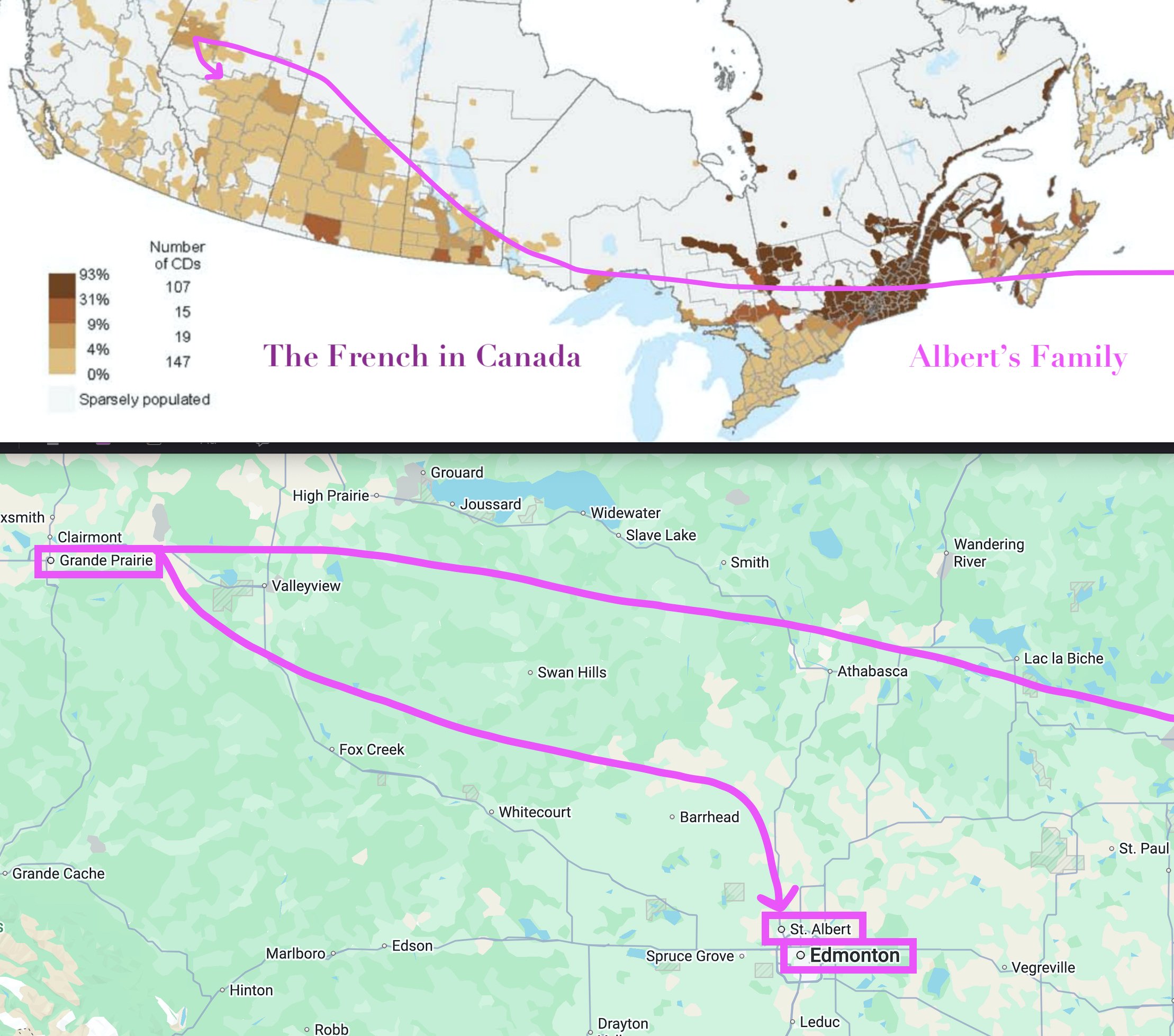
His parents were born in the furthest flung of these communities, Grande-Prairie, yet here the trajectory reversed itself: his parents moved back eastward to Saint Albert (where Albert got his name) and finally to Edmonton, the provincial capital.
Perhaps Albert’s years in Europe were a way of completing the return journey. Yet he was always dubious about roots. Could you ever find out where you came from? Doesn’t everything come from something else? Even his surname, Musca, was a mystery he’d never solve. The name may have come from the Greek moskhos (young calf or bullock), from the Persian mushk, (the fragrance made from the glands of the male deer), or from the Sanskrit muṣka (testicle).
He thought the earthy Rabelais might like that. Instead of finding his place of origin in the valves which opened in his heart, it was more likely in his genitals. Religion had covered genitals with fig leaves and banished them from the Garden of Delights, yet for Rabelais they were its most pleasing fruit. And, if only the scribbling doctor could have known it back in the 16th century: testicles were also the storehouse of DNA, that strange little molecule that the Church had yet to explain.
And if it couldn’t explain DNA, how was it ever to explain humanity?
Albert liked that his name couldn’t be traced to one place, much like religion itself. Was he “really” from Quebec, France, Persia, or India? Where did the cardinals in Rome get the concepts of the soul, the afterlife, forgiveness, and Grace?
He told himself he’d come to Paris not to go back in time, but to go forward. But he also knew that just because he didn’t look at the prints his feet made on the beach didn’t mean that they hadn’t been there, even though the waves had washed them away.
💍
Next: 💍 Rivers
Contents - Characters - Glossary: A-F∙G-Z - Maps - Storylines