
[🚜 This page is in progress 🛠]
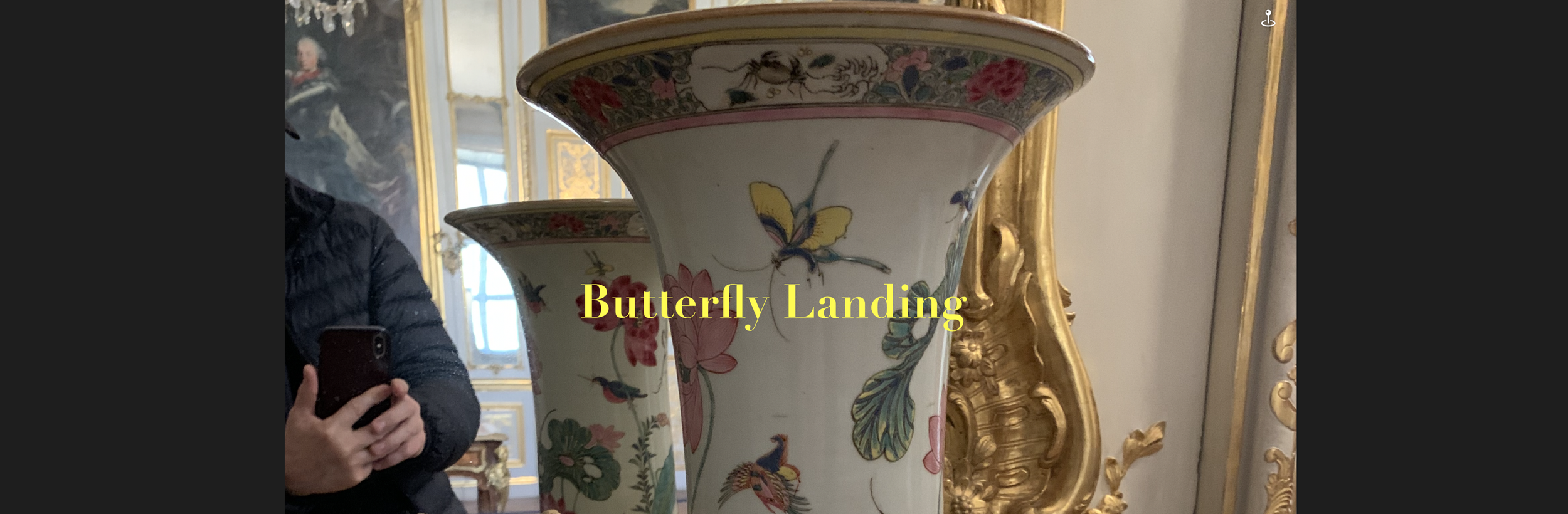
Butterfly Landing
Stairway to Heaven - On the Ground Floor
🦋
Stairway to Heaven
My notion of the double refuge can be seen in the long poem which forms the first part of Nabokov’s Pale Fire (1962). In the poem, Nabokov's wit and humour is at times punctuated with a pathetic depth so precipitous one might call it an abyss. Yet he skillfully — and ambiguously — inverts this abyss, as if we were all heading for the grave and perhaps also for the skies.
In Canto Two his poet John Shade paints a brief portrait of his mother, the eighty year-old Maud Shade. Her anguished attempt to speak coherently foreshadows the grim portrait we may all make some day: “She paused, and groped, and found / What seemed at first a serviceable sound,”
But from adjacent cells impostors took
The place of words she needed, and her look
Spelt imploration as she sought in vain
To reason with the monsters in her brain.
Shade then takes a break between stanzas, perhaps to prepare us for four lines of questions, ✴︎ starting with the relation between time and death, ✴︎ continuing with the optimistic notion that resurrection will raise our plummeting heads, ✴︎ sidetracking into the mechanics of God’s stopwatch and tape, and ✴︎ ending with the double ideal advanced by Origin, Zoroaster, and bodhisattva: eternal life and universal salvation:
What moment in the gradual decay
Does resurrection choose? What year? What day?
Who has the stopwatch? Who rewinds the tape?
Are some less lucky, or do all escape?
Into the abyss of Time, toward which we’re all falling, Shade throws these unanswerable questions. They’ve been asked for millennia, perhaps ever since Old Father Time first wondered who his parents were.
His hands unsteady, Shade throws the questions like dice across the gaming table of our existence, and wonders if they’re loaded. If the game is in fact fixed, is it fixed by Knowledge or Magic? By Nature or God? Is there a double meaning to the word fixed? Either way, Shade’s answer doesn’t take the form of theology or atheism; rather, it takes the form of love and understanding.
In the three stanzas that follow, Shade comments on ✴︎ how brief and weird our existence is, ✴︎ why it doesn’t make sense to reject off-hand the possibility of life after death
So why join in the vulgar laughter? Why
Scorn a hereafter none can verify?
and ✴︎ how instead of “poetry divinely terse” (like that of Dante?) we now have “Disjointed notes, Insomnia’s mean verse.”
Shade ends his incursion into the ideal, his leap of poetry into faith, with a return to earth. That is, he descends from “the future lyres” and the “seraph with its six flamingo wings” to “Disjointed notes” and to an all-enveloping darkness of unknowing: “Life is a message scribbled in the dark. / Anonymous.” He comes back down to this prosaic planet and his life, unable to forget the day his daughter died, consoled by the sound of his wife’s footsteps on the floor above: “And so I pare my nails, and muse, and hear / Your steps upstairs, and all is right, my dear.”
His concluding, consoling, anticlimactic words may be a response to the overblown enthusiasm of Pope’s famous crescendo:
All Nature is but Art, unknown to thee;
All Chance, Direction, which thou canst not see;
All Discord, Harmony, not understood;
All partial Evil, universal Good:
And, spite of Pride, in erring Reason's spite,
One truth is clear, "Whatever IS, is RIGHT."
In the Greater Design all things may be right, “All Chance, Direction,” “All Discord, Harmony.” But here on earth it’s the connection to his wife that helps him cope with the death of their daughter. Yet, as he has made clear earlier, none of that precludes the hope that their daughter may be waiting for them, at the top of some other stairs.
🦋
On the Ground Floor
The same pattern is repeated in the first five stanzas of the poem, and in the remainder of the poem.
From line 1 to line 57, we go from the tragic flight of a waxwing into a window pane to white butterflies turning lavender in the sunset. The waxwing’s death is a natural yet mysterious symbol of life violated by what seems unnatural — a violent and premature death. Yet change, death, and mystery are as natural as the butterfly, with its short life, and perhaps even to its deep link to Zhaungzi’s butterfly, which symbolizes the radical change from one form of existence to another.
Shade’s nature symbolism is also seen in his inability to see his garden, and by the way he reconciles himself to his daughter’s death. He can’t understand why he can no longer make out his house or “its square of green” from the lake (where she committed suicide). For a moment he thinks it “some quirk in space,” some rupture in the space-time continuum, but then sees the garden more clearly with the help of his memory.
What he sees, however, is drenched with the sadness of her death, which subtly echoes the death of Ophelia as described by Gertrude. Ophelia’s distracted yet intent trajectory to the willow that grows “askant the brook” is echoed in Shade’s focus on a single tree, a focus that verges on a description of a human form, just as the willow that dips into the brook in Hamlet becomes the confused and abused girl who can’t cope with the rough manipulations of the world. Shade remembers his “favourite young shagbark there / With ample dark jade leaves and a black, spare, Vermiculated trunk.”
Ophelia’s “fantastic garlands” and her imminent death are then prefigured in the “setting sun” and the “black bark, around which, like undone / Garlands, the shadows of the foliage fell.” His daughter has been undone, like Ophelia, “incapable of her own distress.”
After righting his vision and drenching it with sad memory, Shade brings everything into focus in a way that doesn’t negate the sadness yet gives it a poetic beauty, anticipating much later in the poem (lines 970-3) where he says, “I feel I understand / Existence […] only through my art”:
[The trunk] is now stout and rough; it has done well.
White butterflies turn lavender as they
Pass through its shade where gently seems to sway The phantom of my little daughter’s swing.
🦋
From the first line to line 246, Nabokov’s poet John Shade gives us a roller-coaster ride of visionary and cosmic possibilities, ending on line 246 with the pairing of nails and the sound of his wife upstairs; from lines 247 to 999 he takes us on an even wilder and more varied ride, yet on line 999 he leaves us with the image his wife in the garden and a butterfly landing on the sand.
One might see Shade’s sensibility in terms of Theodore Roethke, who seems a kindred spirit to this poem. In “The Waking,” Roethke praises the ground, acknowledges those who are beside him walking there, and suggests that all of the things we imagine are so important need to be felt and lived. Echoing Eliot’s notion of unified sensibility, he states: “We think by feeling.” Implicitly, both Roethke and Shade suggest that we need to connect to those around us and we need to connect to life, if we are going to live deeply enough to make our thoughts rich and worth cherishing:
Of those so close beside me, which are you?
God bless the ground! I shall walk softly there,
And learn by going where I have to go.
At the end of the poem Shade underscores this grounded notion when he hears the wind shake the house. He also uses the ground, rather than some abstract mystical flight, to find his way, to end up where he began. In this final Canto, Nabokov brings to mind the figure of J Alfred Prufrock, who dreams of hearing the siren’s song yet ends up drowning in his own irrelevance instead. In Nabokov’s version however Prufrock actually does get to enter into his own love song. John Shade tries all the ways and means, all the theology and abstract justifications and explanations, yet he can’t quite get at the overwhelming question, let along answer it. In this way Nabokov suggests that the only answer is to live a full rich life, with the woman you love.
At the end of the third Canto Shade suggests Prufrock… [🚜🛠]
At the beginning of the fourth Canto he begins with a grand announcement, like we find at the beginning of The Love Song of J. Alfred Prufrock. He says, “Now I shall speak of,” and keeps coming back to the notion that he will tell us something grand. Yet after each beginning he makes a revision, or rather a U-turn back to where he is, sitting in his bath, or walking around his house, the only constant being his very being in his house, his being himself, and his being in love with his wife.
In the third Canto he tried every way of trying to get over the death of his daughter. But never really succeeded. And hence he calls these attempts by bizarre names, and gives them bizarre descriptions, marking as odd these philosophy that try to explain our lives. [🚜🛠]
Shade finally rejects these heroic and scientific explanations, much as Prufrock finally rejects the notion that he can act like Odysseus or Hamlet. Like Prufrock, he is let down by myth and pierced by realism — in Prufrock’s case, the the X-ray machine throws his internal patterns like rocky proofs upon a screen and yet yields nothing in the doctors office. Yet unlike Prufrock, Shade finds a great consolation in the here and now. After each escape he arrives at an open refuge, and admits that we don’t know the grand answers to the mystery of our existence.
This larger pattern of exploring the cosmic possibilities and then admitting that only the present condensed moment exists, might be called phenomenological. Given its context of reaching for rational and theological possibilities, it might also be seen called living in the double refuge. Nabokov goes from the grandiose possibilities that “now he shall tell” to shaving in the bath, finally to see the world around him as a limited reflection of the contours of his face. The epic journey turns into a short ramble around his house. The epic vision that Prufrock sees but can never attain — of the mermaids singing each to each, and his life opening out into the adventures of Ulysses — contracts. And yet at the same it time expands into the vision of a bird and his wife, as if they were the same thing, both listening, smelling, breathing in the beauty of the golden sunset.
🦋
Next: 🔭 The Sum of All Space - Third Spinning Rock from the Sun