

The Ring 💍 Paris
Pinpoints of Light
~ 10 Years Ago ~
Sitting in his small room at the seminary, Albert on occasion looked up doubtfully at the twin pictures of Saint John Paul and Saint Francis. This type of mood made him restless, so he’d get outside as quickly as he could. Once on the streets he’d find himself walking toward the Collège de France, which was only a few blocks away. The lectures there were free. He didn't even need to sign up or reserve a seat. Like the first shot of heroin, he thought to himself.
At times Albert could barely believe where he was — in a lecture-hall with a professor reading a strange text in Akkadian or hieratic! This is what he loved about Paris: you could walk down a street lined with creamy limestone buildings (that only Haussmann could align with such beauty and precision) and then find a Roman amphitheatre on one block and a Gothic church just down the street. And just when you managed to grasp the timeline, a man reads a 5000 year-old Sumerian text, written in a script that looks like a thousand thumbtacks blasted into a clay wall.
On the street it’s the Modern world and where it came from, and inside the auditorium it’s a world so old that you don’t know how to begin to understand where it came from. And yet, as the speaker makes more and more clear, this other world lies at the root of our most basic conceptions: numbers, letters, trade, war, religion, astronomy, etc.
Albert wanted to become a priest, but a priest of what? How could Christianity claim to be the Alpha and the Omega, the be-all and the end-all 🔺 when it so obviously came from earlier beliefs, 🔺 when it clashed with other beliefs, and 🔺 when it remained trapped between faith and science?
Albert was determined to face up to the facts. Or, at least, to what he suspected were the facts. He was determined to come to terms with the gap between the Church’s eternal truths and the truths of the other religions. If Christ was all about love, why wasn’t Krishna too? What motivated the bodhisattva, who was willing to forego Heaven in order to help the beleaguered souls of Earth? If we prized the cosmic speculations of Augustine and the poetry of Saint Francis, why not read the speculations of the Upanishads and the poetry of the whirling Sufis, the Vedic seers, and the Bhakti saints?
Albert was equally determined to confront the gap between religious doctrine and the science of Darwin’s evolution. And yet he suspected that while Darwin was a challenge, philology was a greater challenge. When it came to timelines, the threat of the Assyriologist was more serious than the threat of the Naturalist. Darwin gave the Church a new timeline to deal with, from 13.8 billion years ago to the Modern world. Despite this, however, theologians could still argue that God lay behind the Big Bang and that evolution was proof of a positive force in the universe. Yet the findings of philologists and Assyriologists weren’t so easy to accommodate: their timeline proved that key notions in the Bible weren’t original.
The Assyriologists at the front of the auditorium of the Collège de France and the Sorbonne examined case after case — from Hebrew words and phrases that were rooted in Akkadian, to legal terms and codes that were carved into clay centuries before the Ten Commandments.
Being so close to the Louvre, Albert knew that this wasn’t a matter of speculation. The cuneiform texts weren’t given fantastic dates, and didn’t fit into a mythical timeline beginning with the Garden of Eden. Rather, the Code of Ur-Nammu could be seen today in Istanbul, on a tablet from 2100 BC. The more famous Code of Hammurabi could be seen today in the Louvre, on a stele from 1753 BC. By contrast, the first extant version of the ten commandments (or decalogue) is dated 2000 years later.
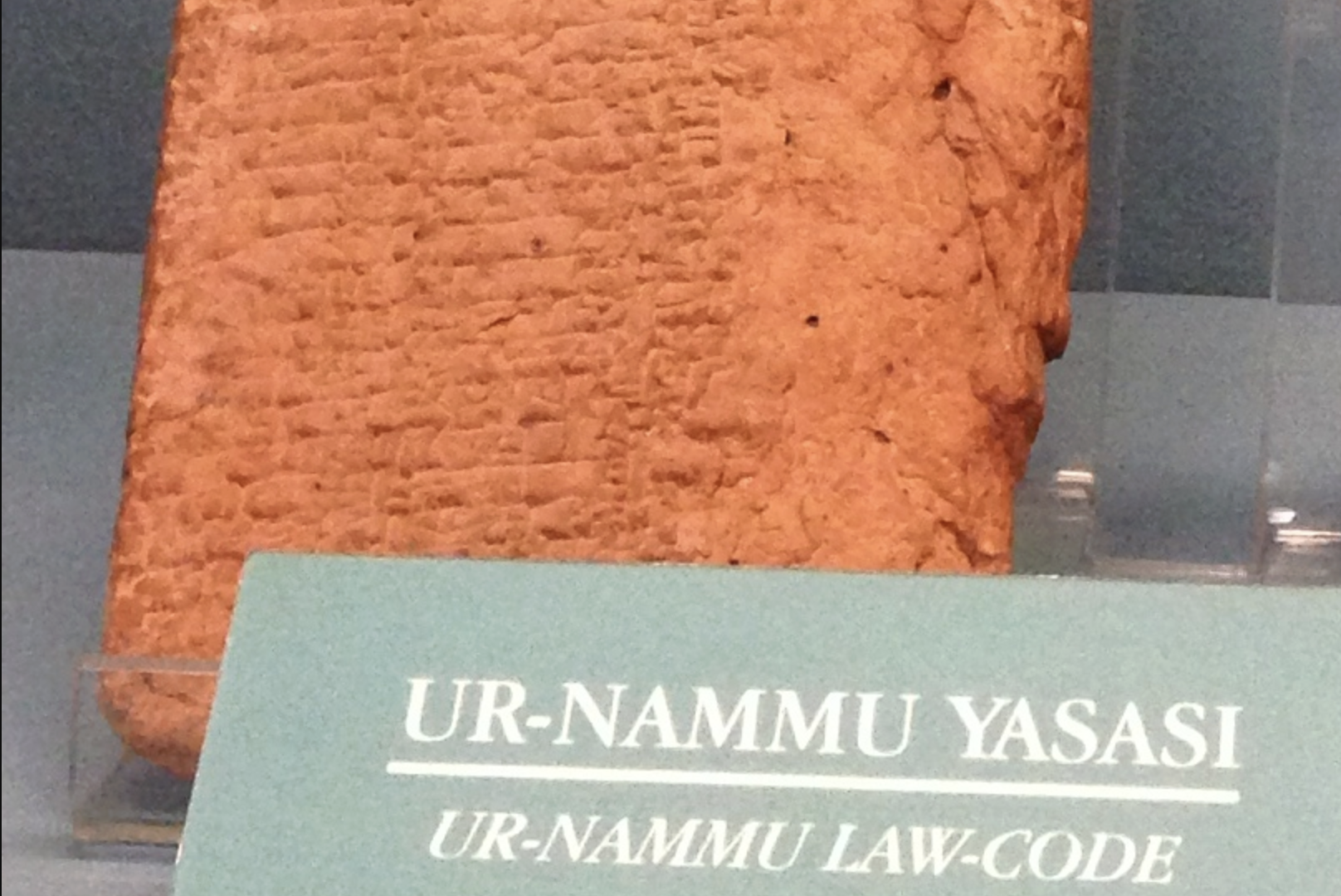
Above: the first known legal code in the world, c. 2100 BC, with contents such as, “[Ur-Nammu] standardized the stone weight of a shekel of silver in relation to one mina ... The orphan was not delivered up to the rich man; the widow was not delivered up to the mighty man; the man of one shekel was not delivered up to the man of one mina.”
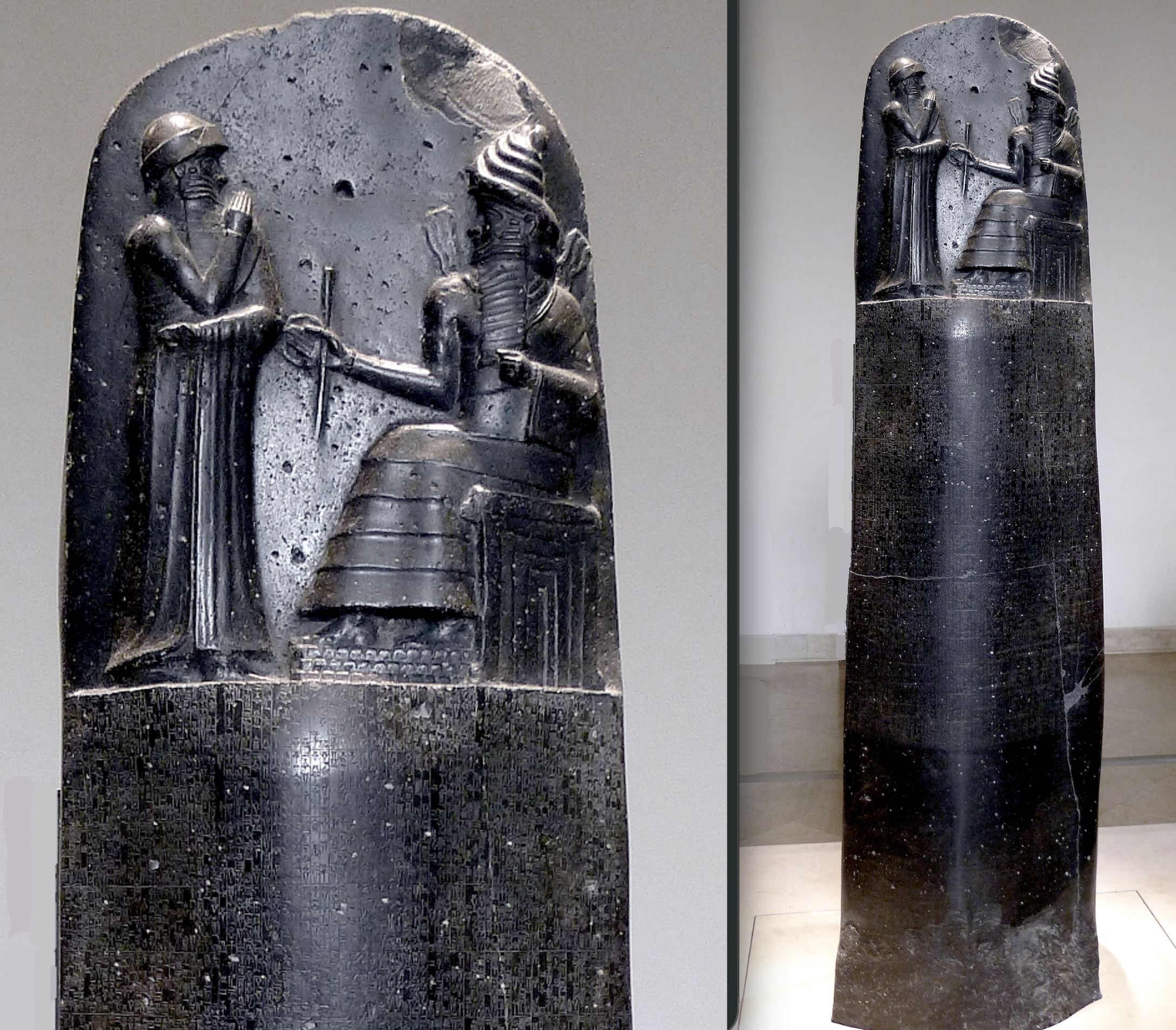
Code de Hammurabi, roi de Babylone. Author: Mbzt (From Wikimedia Commons).
Above: The Code of Hammurabi, 1753 BC. Hammurabi and Shamash (the sun god of Justice) are positioned above 4130 lines of text, which contains such well-known gems as, “If a freeman should blind the eye of another freeman, they shall blind his eye.”
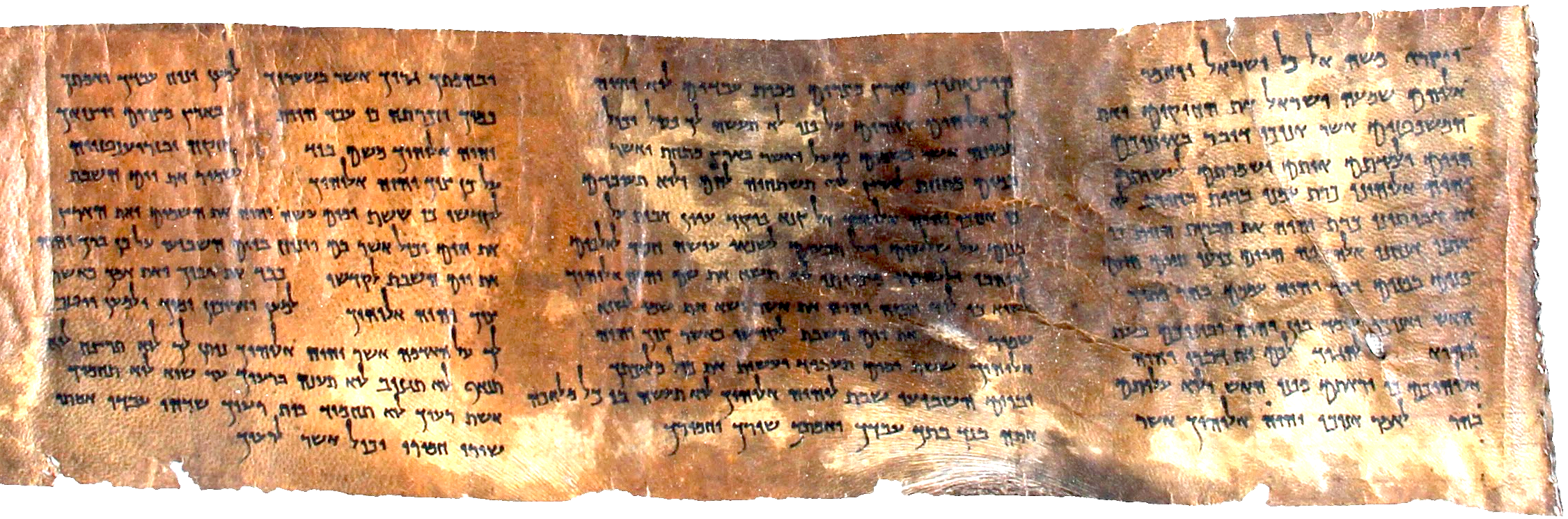
Part of the All Souls Deuteronomy, containing the oldest extant copy of the Decalogue. It is dated to the early Herodian period, between 30 and 1 BC. Source. Photograph by Shai Halevi. (From Wikimedia Commons)
Above: the earliest copy of the ten commandments, c. 30 BC.
Perhaps the most difficult challenge of Assyriology came in the form of an old Sumerian and Akkadian story about an angry god, a Flood, an ark, and a sacrifice. In his provocatively named book, The Birth of God, the Parisian Assyriologist Jean Bottéro summed it up:
It was on the 3rd of December 1872 that the Bible lost forever the immemorial prerogative of being "the oldest book known," "a book unlike others," "written or dictated by God Himself."
C'est le 3 décembre 1872 que la Bible a perdu à jamais sa prérogative immémoriale d'être << le plus ancien livre connu >>, << un livre pas comme les autres >>, << écrit ou dicté par Dieu en personne >>.
Jean Bottéro was eventually forbidden to return to the priory of Saint-Maximin, where they considered him to be a danger to the youth. Albert thought to himself. Is the Church still in the business of forbidding? Visions of the trial of Socrates, of the Inquisition, of Galileo forced to recant, of Bruno burning at the stake, swam into his head. This only furthered his resolve.
Albert was determined to sound the depth of his doubts, come hell or high water. If l'Ecriture Sainte was true, then there was indeed high water: there was a flood, an ark, and a covenant with God. Yet what if the biblical account was only borrowed from the Mesopotamians, or if it could be explained away by geologists? Then believing in Noah and his giant Ark was like believing in a second-hand myth or fairy tale. He loved literature and mythology, yet he didn't want either masquerading as history.
To Albert, this was also the problem with Vatican II. To square the modern world with the heavenly circles of the Middle Ages was an impossible task. It was like trying to fit the angular geometry of a doric temple into the circular heaven of the saints.


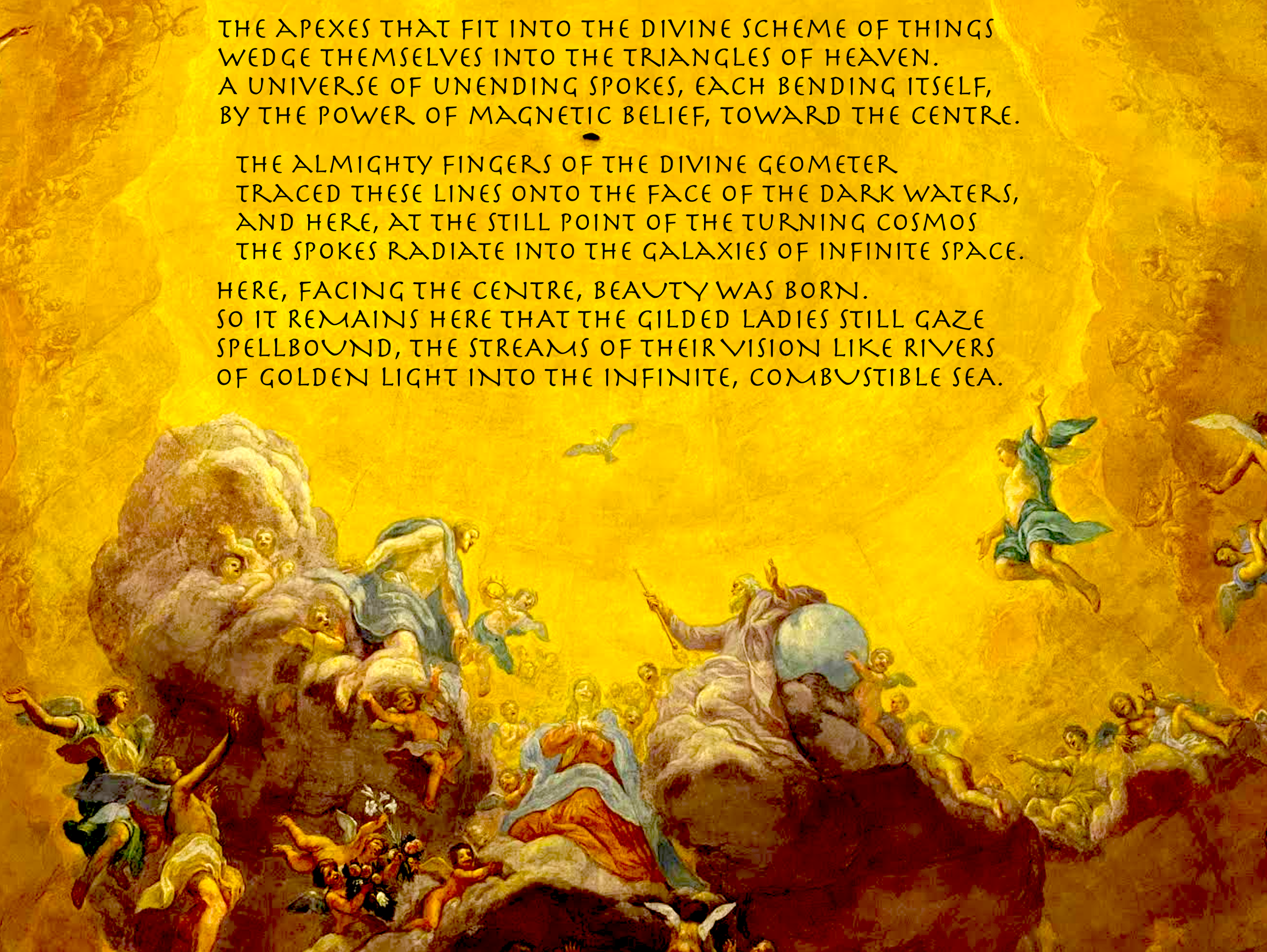

Albert tried to convince himself that at the centre of the cosmos lay Dante's Blessed Rose, and his overlapping triple circle of the Father, the Son, and the Holy Ghost. Yet the geometrical perfection of this construction exploded when Albert considered the merest facts of astronomy. The fine triple circle into which all the angles pierced, and into which all the angels rose, blew open, like at the Big Bang, when he considered that the heavens above don't come together at all. There's no single radiating point, unless Christian Time and Space and the Big Bang were one, which no one in the Church was willing to say.
And if there's no single point holding the universe in place, a point like Heaven or God, then what's the point?
Albert thought of the article he read this morning, "Stanislas Breton: Questioning the Essence of Christianity," written by Joseph O'Leary:
While the scientific study of Scripture causes a retreat of Christian origins, no longer as secure, massive, unitary as was thought, the scientific study of the cosmos and of evolution causes the figure of the Creator to withdraw into a discreet distance, to become something like the Neoplatonic One, ungraspable, yet close at hand.
The study of Neoplatonism has helped Breton and others of his generation to avoid a troubled theological scene and to cultivate instead a path of thought that requires one neither to clutch at dogma nor to tilt at it, and that offers no basis for niggling about points of orthodoxy whether in doubt or in defense.
And yet always niggling at Albert was the notion that the more he knew, the more he knew he didn't know. Like the cosmos, and the God who controlled it, the world of his understanding seemed to get bigger and further away all the time. And yet, paradoxically, the further away He got, the more Albert saw the enormity of the cosmos over which He reigned.
At times, his God started to seem like a glowing emanation from afar, more gamma ray than sunlight. Albert’s predicament was like that of Ungaretti in his poem "Pietà," scrawled in angst on a galaxy that spiralled in outer space with no end in sight:
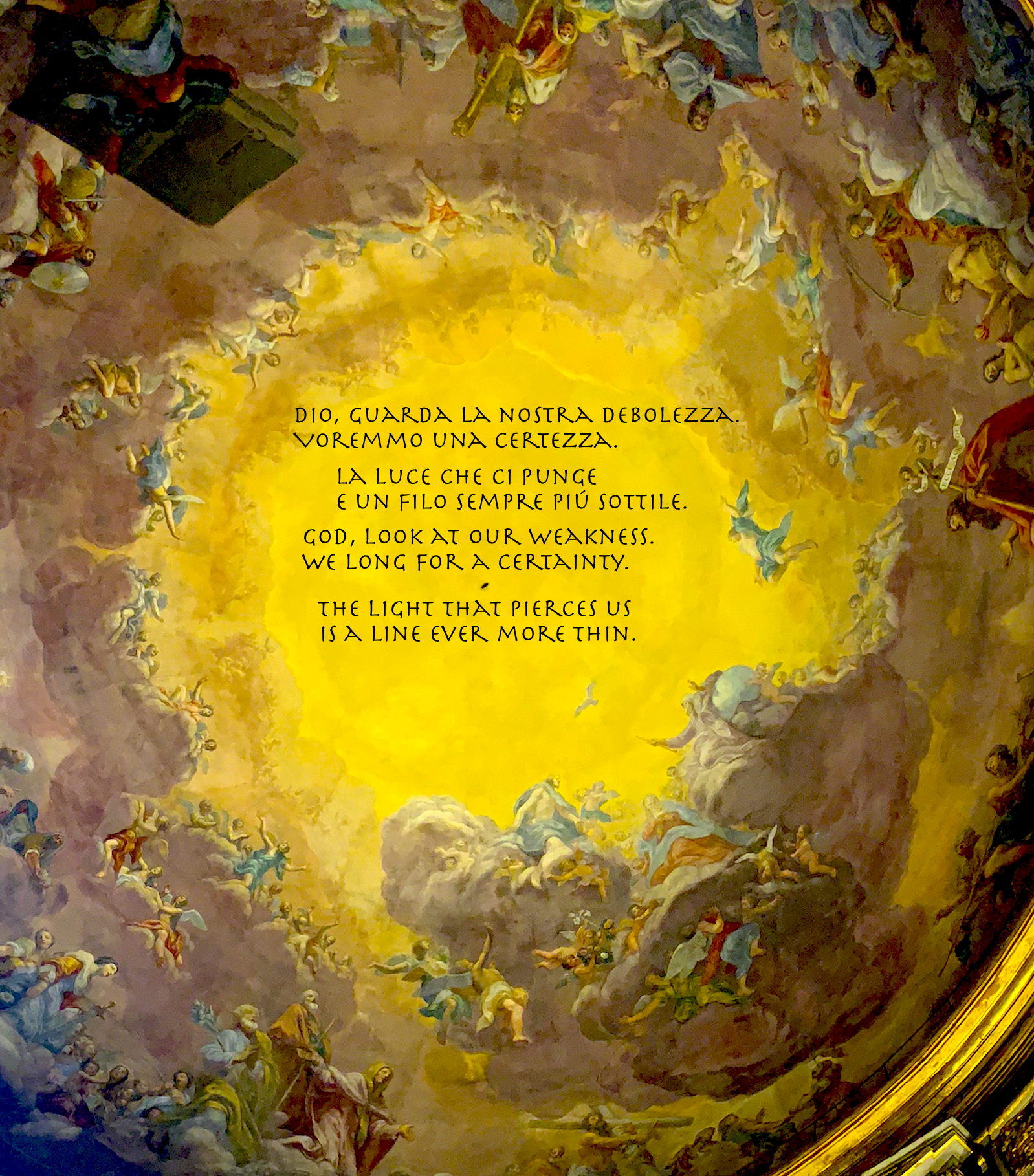
Albert was determined to confront, rather than avoid, Breton’s troubled theological scene. He hoped to use his unorthodox training at le Collège not to confirm what he already knew about Divine Love — that thin light that still pierced him, despite the expanding darkness all around — but to test what he feared about Divine Writ.
At some point he would ask even more inconvenient questions. Had he devoted his life to Jesus, or to some deep complex of emotion and intellect that Jesus represented, hallowed over millennia? Were all his feelings about divine love, forgiveness, and the beauty of the transubstantiation merely a function of his need? Were they only hopes, dressed up in the ecclesiastical garments he felt destined to wear? Were Calvin and Zwingli right to say that the bread was only bread, and the wine only wine? Was the Christian Scheme of Things what he wanted it to be, or was it really there? Was his belief in Christ a hope rather than a belief? Was love — not belief, but love — really at the bottom of it all? Could he simply say that he believed in love? Could he dispense with the rest?
If he couldn't answer these questions truthfully, he was truly lost. And if he couldn't be truthful to himself, he had no business preaching the Truth.
💍
Next: 🎲 Naptha & Saphaltus
Contents - Characters - Glossary: A-F∙G-Z - Maps - Storylines