

The Ring 💍 Paris
In the Latin Quarter
💍
~ 10 Years Ago ~
In his little room one block from the Seine, Albert knelt in front of a small altar to the Mother of God. He recited the ancient, inevitable words. Not the newfangled German tacked up on a church door in Wittenberg. And certainly not the English slogans so fashionable now on the bursting t-shirts of the dancing Madonnas and Our Lady of the Gaga dolls.
No, his words went back to the Latin and Greek, to the Hebrew scriptures, the Aramaic script, and the Phoenician that gave it birth. Yet even that, he feared, wasn’t the beginning. Before Byblos was Akkad, and before Rome and Jerusalem were Thebes and Uruk.
Long before culture flowed along the banks of the Jordan and the Tiber — and later the Seine and the Thames — it flowed along the banks of the Nile, the Euphrates, and the Saraswati.
💍
At first, Albert was eager to take in everything the Church told him about holy rivers and holy waters, from the flood that destroyed the world to the flood of faith that washes away all sin.
Elijah took his cloak, rolled it up and struck the water with it. The [Jordan River] divided to the right and to the left, and the two of them crossed over on dry ground.
In the sight of Pharaoh and in the sight of his servants [Aaron] lifted up the staff and struck the water in the Nile, and all the water in the Nile turned into blood.
The Egyptians were fleeing […] and the Lord swept them into the sea. The water flowed back and covered the chariots and horsemen — the entire army of Pharaoh that had followed the Israelites into the sea. Not one of them survived.
The stories were exciting, but why kill the army? Why assume the land on the other side of the river is promised to you? In what universe could it be God’s plan to smite everyone who lived there?
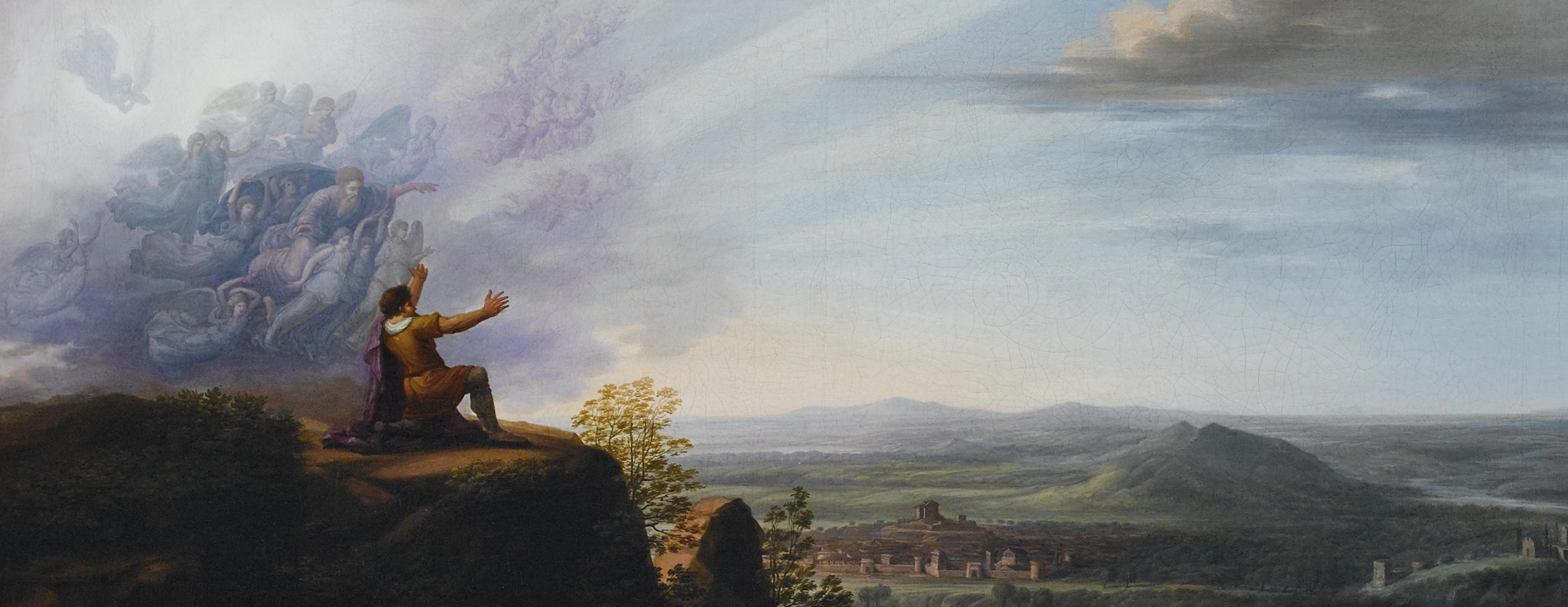
God showing Moses the Promised Land from the top of Mount Nebo. C. Kuhbeil, 1818. Source: Bonhams, New York, 03.05.2017, Lot 59 (From Wikimedia Commons; image cropped by RYC)
Albert preferred to focus on Jesus walking on water, and on the water that turned into wine. To him, the greatest thing of all was the wine that turned into His blood. The Holy Eucharist! The incarnation of God in human form, so that He could see the way we see, could suffer the way we suffer, could rise the way we want to rise. To Albert, the Eucharist got at the meaning of Jesus more directly than all the stories people told about him.
Albert loved the stories, and he believed them to the core, but the core — that is, the words of Jesus — didn’t seem very well served by the authors. Where was the magic in their words, which were, after all, about the most elevated magic of all? Instead, their narratives were straightforward, even dull, not at all like the genesis of the world, or the adventures in Egypt and across the Red Sea, or the challenging parables of Jesus.
For instance, when Albert read about the fishermen of souls — a wonderful metaphor in itself — the narrative seemed like the entries in a diary:
As Jesus walked along the shore of Lake Galilee, he saw two brothers who were fishermen, Simon (called Peter) and his brother Andrew, catching fish in the lake with a net. Jesus said to them, “Come with me, and I will teach you to catch people.” At once they left their nets and went with him.
He went on and saw two other brothers, James and John, the sons of Zebedee. They were in their boat with their father Zebedee, getting their nets ready. Jesus called them, and at once they left the boat and their father, and went with him.
Albert couldn’t help thinking that Leonard Cohen said it more effectively in his poem “Suzanne.” Cohen makes the moment of salvation — when Mystery calls to you and takes your hand — seem open, ambiguous, and magical:
Cohen’s version isn’t historical or convincing. It’s more a personal invitation, a living moment of shared experience. A woman taking your hand and leading you to a river, versus “Come with me” and they “went with him.” A woman dressed in rags and feathers from a bargain store, versus a man dressed in, well, whatever.
But the message is the same. We may have nothing to give, but that doesn’t stop the spirit of love from giving nevertheless:
Albert felt that ideas increase in power the more we can connect to them, even in our limited, idiosyncratic, personal way. In this case, it was personal indeed, since he once knew a French-Canadian girl whose name was Suzanne.

To Albert, Cohen was writing about his Suzanne, his Mary, his Lady of the Harbour. Of course, the poet had someone else in mind, or he was creating a love-child character, crazy with connection, in order to create a fantasy of worldly and spiritual love, a kaleidoscope of beauty & humility.
Turning the kaleidoscope, we see the bright rags and feathers, and then the tea and oranges. The odour swirls up into our nostrils, more rich and pungent, sensual and yet common than wine or host. In the end it all dissolves into the great sea, the metaphor of death, yet with an ambiguity, a mix of divinity and crushed humanity, that only deepens our appreciation of the fisherwoman of souls:
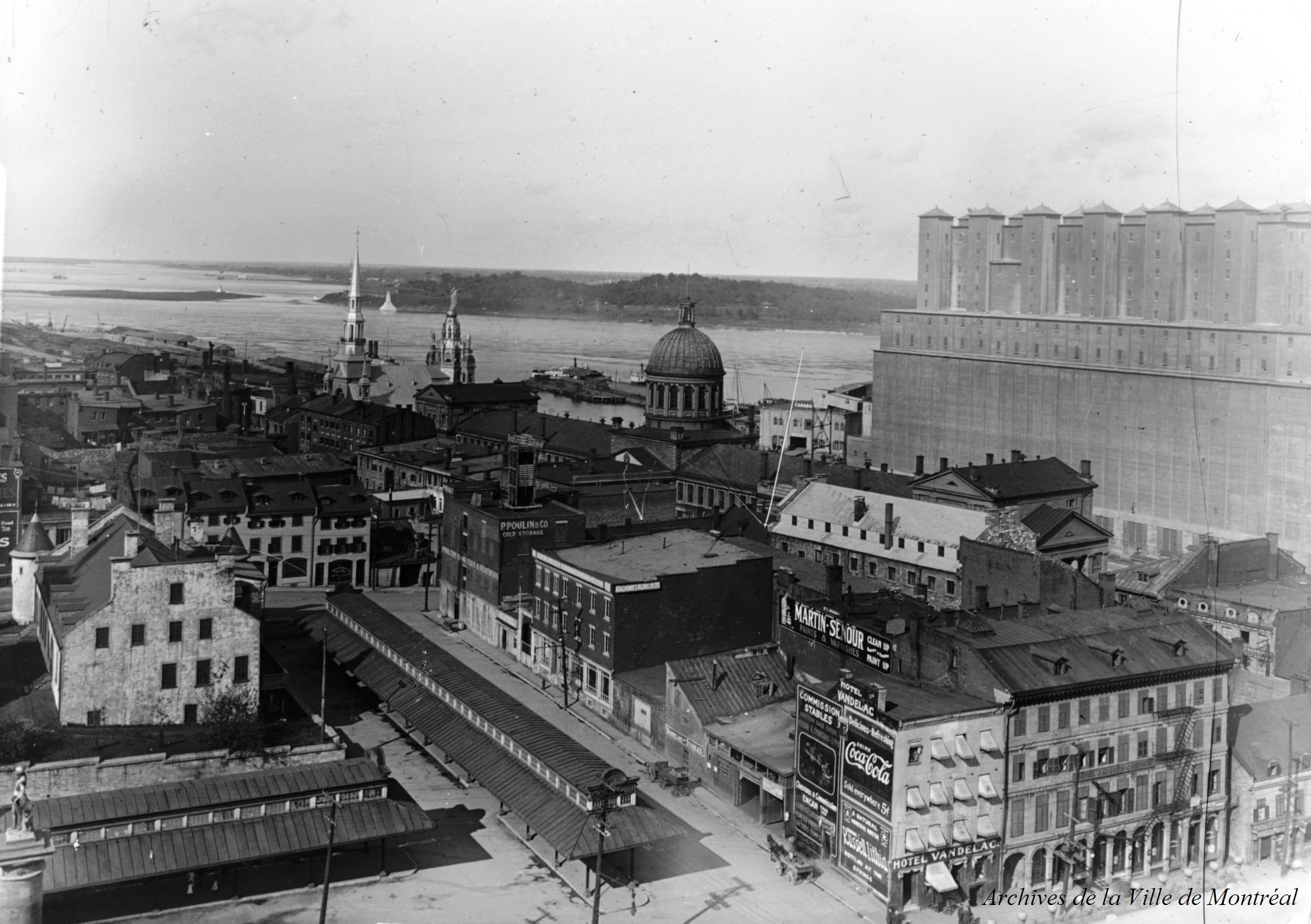
Cohen opens up emotional connection and allows for multiple interpretation, which allows us to make the poem our own. His Suzanne takes us down to the river, the Saint Lawrence. Along its banks is the Lady of the Harbour, the Church of Notre Dame de Bon Secours, Our Lady of Good Help, seen here in 1848, 1897, & 1915:
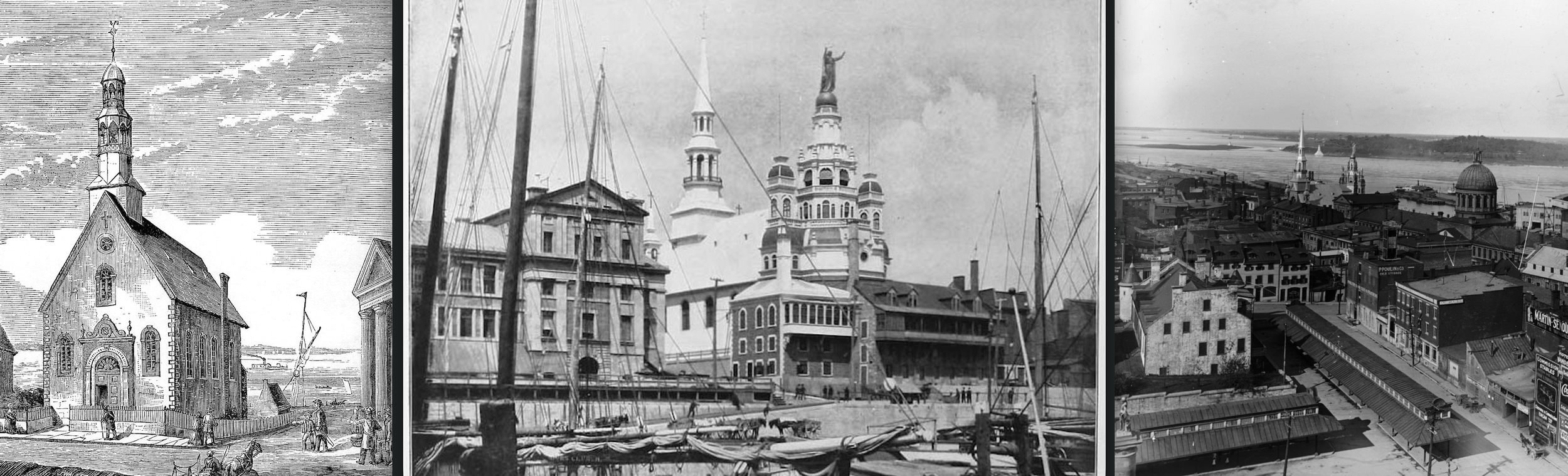
Montreal’s Notre Dame c. 1848, 1897, & 1915.
Left: Chapelle Notre-Dame-de-Bon-Secours, Montréal, vers 1848. Gravure tirée d’une aquarelle du Père Félix Martin, S.J. Musée Marguerite-Bourgeoys. Centre: entre 1897 et 1899, from The Queen's Empire. Volume 2. Cassell & Co., London. Right: Le Vieux-Montréal pris de l'édifice de la Sauvegarde
Vue de la rue Le Royer en 1915 depuis l'édifice de La Sauvegarde en direction est; 1914, from archivesdemontreal.com - - photographie d’Edgar Gariépy. (All from Wikimedia Commons; the last image is cropped from a larger image).
But we don’t have to be Leonard Cohen, or to have been in Montreal, or to have had a friend named Suzanne in order to see the beauty of the images and the meaning of salvation.
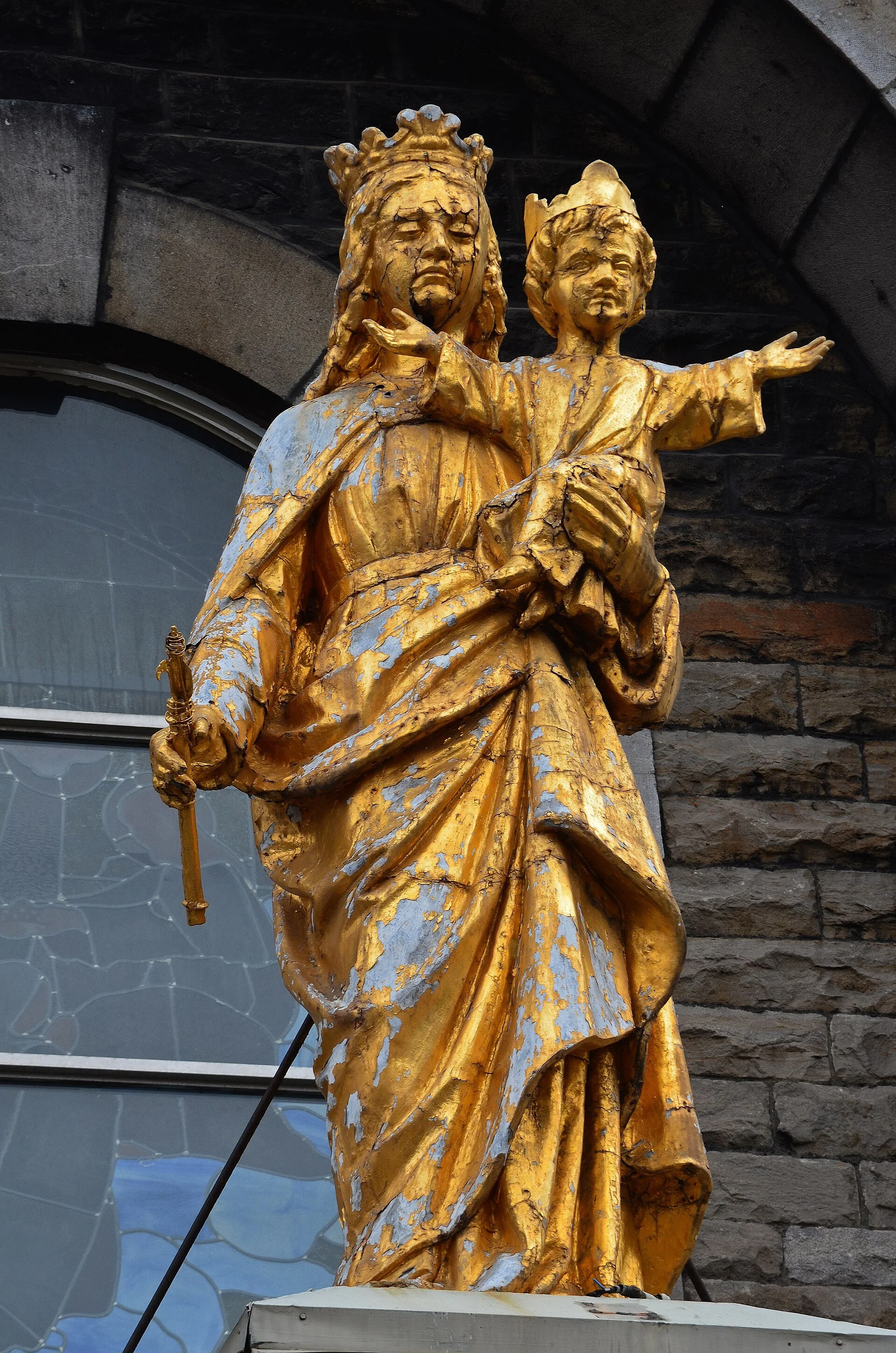
Statue dorée de la Vierge à l'enfant, portail de la Chapelle Notre-Dame-de-Bon-Secours - Montréal, Québec, April 2012, by Selbymay (Wikimedia Commons)
The church by the river can be honeyed in sunlight, banked in winter snow, or cast majestically against a clear blue sky. The Lady stands in our mind, Mary, the Mother of God, on the banks of The River. She is the saviour wandering in the street, taking your hand and leading you down to the river, deep in the temple of your mind.
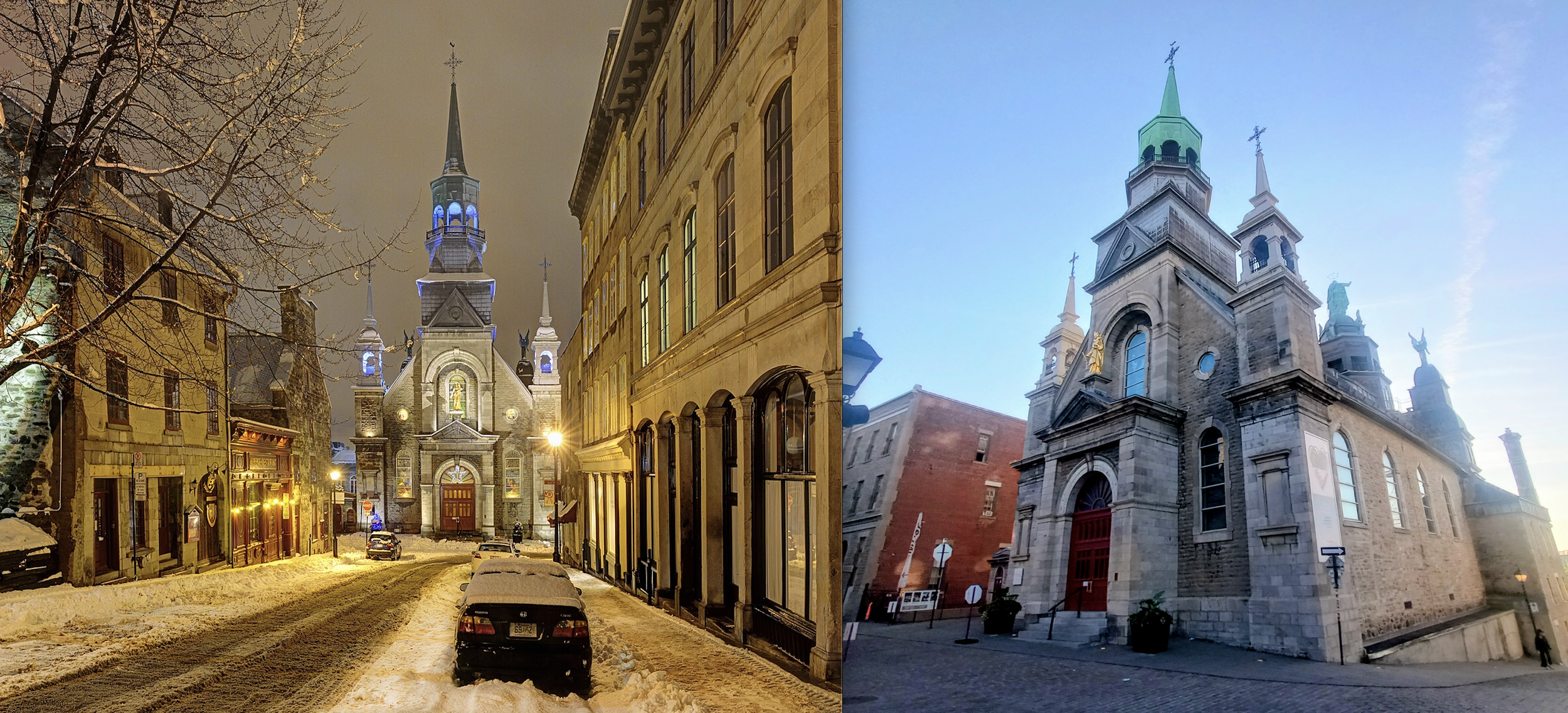
Photos from Wikimedia Commons: Left: Chapelle Notre-Dame-de-Bon-Secours, Vieux port, by Jazmin Million. Right: Notre-Dame-de-Bon-Secours Chapel in Old Montreal, August 2025, by Daniel Di Palma.
💍
Albert wasn’t confusing Jesus with Suzanne. Yet Cohen’s vision of Suzanne got him closer to the feeling of salvation than the stories he was told were true, but which seemed contrived to make us believe them to be transcendent, on a higher level. Like Cohen, he wanted to extract the symbols from the gospels, and then throw them back into a story laden with ambiguity and mystery, with reality that no one could escape, and with a great beyond that nobody would want to escape. He wanted to make the original seem more humble, more in line with a saviour who understands the diverse, dangerous currents of the sea.
Albert felt that if religion is crammed with question marks and tiny dots in place and time, why not connect the moments with colourful lines and fill the corners with golden sparks? So he wrote a poem that he dared not show to his fellow novices, a fear that made him think twice about why he was where he was.
💍
Neither Frankincense Nor Myrrh
He wrote nothing down, left no record
no footprint in the sands of time.
He was a small town nobody
from a northern hamlet of hay and barnyard mud
who stumbled like a stray lamb through the eye of the needle
with all the other vagabonds, camels, and tents
through the gates of Jerusalem.
He wasn’t particularly handsome
so the women paid little attention
until he talked
and they saw something in his eyes
in his hands
in the way he spoke
barely audible amid the loud hawkers
and the lofty syllogisms of the Greek philosophers
who talked about the Good and the Beautiful
as if they were the same thing.
He seemed a lamb among the market goats
content to be ignored
as if to breathe were Heaven enough,
yet when he spoke about the farmer in a drought
or a child lost before it learned to crawl
and the mother’s shattered heart
his very pores wept pity.
And when he talked about the elite
and the indifference of the wealthy
a still anger rose in his voice
so that even his great sympathy
couldn’t erase the wages of their sin
nor could it abate his disdain for the foolish and the blind
who pulled behind them the long blind chain of humankind.
He told his thoughts to a man all men despised
as if he and the jailer had common cause
wandering free about the world
while other men sat wretched and chained to the stony floor
looking up at the window, unable to imagine
a feast, or to even knock at the door.
With a vacant look in his eye
he told the jailer “I am nothing.”
After taking a deep breath he added
“if not my father’s son.
Whatever you might make of me
the fiery planets will change it
and the stars themselves will be undone
in the place you once called Hell
in the cauldron of love
where everything is one.”
He was the spark of all time and space
made manifest in flesh and blood
so that the etherial Father could better see
how humans see, and feel what humans feel:
the broken rose
the thorn upon the brow
the humiliation of the flesh
and the slow pulse dying in the veins.
There was so much pathos behind his words
that everyone felt compelled to ask questions
which he answered in metaphor and parable
as if the truth were too insubstantial
or as if those around him needed to understand
by other means the things no one can understand.
The jailer sat astonished
like a diamond stone, transparent.
Yet neither the Roman nor the Jewish authorities took kindly
to the disturbing promises of the northern stranger
who they dispatched without a French regret to the dungeon
where the other prisoners complained
that he babbled night and day
while the jailer listened.
Forty nights Jesus slept in that rat-infested bed of thorns
until the stars and sun were extinguished in his eyes.
Two drunk centurions dragged him through the town
and up a dirty hill
where the spirit finally left his flesh
not a moment too soon
nor a moment too late.
The jailer followed him across the street and up that fatal hill
saw what no one ever saw
and heard his dying word.
On his way home he told his neighbours
who told their cousins what he had heard.
💍
To Albert, Christ meant a refuge from the grim reality of the suffering that lay at the heart of the story. Not some glorious golden crown of this world. Not some sweet frankincense or myrrh, but the smell of cows and sheep. Why else was Jesus born in a manger? Why else was He the son of some carpenter in some small town that nobody had heard of?
Albert asked himself, Why else do we have so little record of his existence, save for the stories that people told much later? And weren’t these embellished by all sorts of mythic charms and miracles, The three wise men saw a star and came from the East. But did they have to?
Albert also wondered, Do we really need to believe in the biblical version of the Flood? Or in the New Testament notion that Jesus walked on water? Did he need to do this? Didn't it make just as much sense to see Jesus as the ultimate sacrifice in this hard world of facts and suffering, rather than as some magic being who could walk on water and could feel nails piercing through his hands and feet and but not really feel the pain? Do we need a fable story to make our belief solid, when this belief is about the least solid thing possible? It flexibility, obscurity, and ambiguity what made it powerful, and made it applicable everywhere?
So for Albert the water metaphors soon took on the aspect of oar and sail, and he couldn’t help himself from rowing toward the open sea. Or toss the metaphor away and row into a port. The houses there were made of stone and wood. The bars were full of people. It was a world apart from the waves and open sky.
💍
Next: 💍 All Roads Lead to Paris
Back to Top
Contents - Characters - Glossary: A-F∙G-Z - Maps - Storylines