
The Double Refuge 🍷 Bubbles Winking at the Brim
The Epic
🍷
While literature is a diverse collection of genres and styles that change from century to century, there’s one form of literature that brings together styles and flavours from different time periods: the epic. While the epic changes, it also consistently gives us deep insights into culture and religion in the Ancient, Classical, Medieval, and Modern Ages, from India to the Middle East and Europe.
In Hamlet, Shakespeare calls drama “the mirror up to nature.” He says that drama shows “virtue her feature, scorn her own image, and the very age and body of the time his form and pressure.” Drama explores many aspects of life (love, friendship, murder, death, religion, etc.) and is a huge category, especially if we include films and TV shows and series. Like other literature it can reach deep into the past, especially when we look at Greek drama. Yet drama remains a theatrical instance of literature, which is a larger category; literature also includes poetry, the short story, and the novel, as well as particular categories such as epic poems, sonnet cycles, and linked short stories. Literature also includes novels that are linked in what can become a very wide exploration of psychology and sociology, as in Balzac’s Comédie Humaine. In this way, the novel takes on the expanded scope that we associate with the epic.
The epic is especially important in terms of the double refuge, since it aims at a larger view of reality, complete with love, struggle, and the quest for meaning. For instance, in Hamlet when the bodies pile up on the stage at the end of the play, the machinations of the evil king come to a spectacular end. Thoughts about wasted love, fratricide, a mother betrayed, and the country beyond whose borne no traveller returns remain with us, resonating with our deeper thoughts. Yet in the epic the hero doesn’t just think about the country beyond whose borne; he travels to it, and then comes back to tell us all about it.
The epic hero gives us the type of information that is impossible to give, yet which philosophies and religions try to give us nevertheless. For instance, in the Mesopotamian Gilgamesh (the first great epic in world literature), the hero tries to find his friend Enkidu in the afterlife. After being told by a wise alewife that humans don’t get to live eternally, Gilgamesh is taken by a ferryman to an island where the survivor of the great Flood lives with his wife (Utnapishtim in Gilgamesh, Noah in The Bible). In a rather grim moment for global theology, the survivors of the Flood confirm the alewife’s assertion.
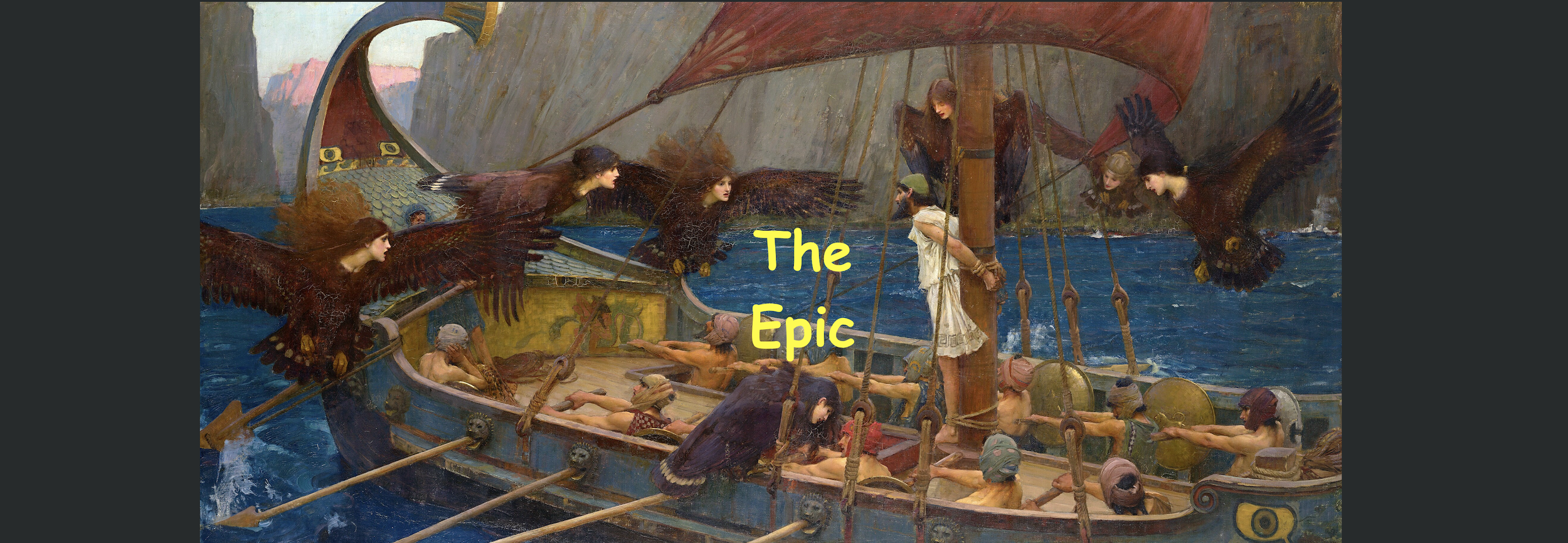
While Gilgamesh highlights the existential notion that there is no afterlife (except for Utnapishtim and his wife), the Greek, Latin, and Italian epics expand the possibilities of the afterlife. In the Greek Odyssey, the epic hero travels to the grim world below to speak to the great warrior Achilles and the seer Tiresias. In the Roman Aeneid, the epic hero travels to the City of the Dead and sees his ruined love, Dido. In the Italian Divine Comedy, Dante mixes the Classic and Christian world into a cosmic panorama of Earth, Hell, Purgatory, and Heaven. Dante’s vision is wide, yet it also reflects the Medieval notion that what really matters is the afterlife.
Prior to Dante’s Comedy, the famous epics integrate the theme of the afterlife more closely into a vision of human life as it’s lived in the here and now. While the direction of travel in Dante is down and then up, leaving us with the splendour of Paradiso, the other epics leave us firmly on terra firma. This is especially true with Gilgamesh, where after being denied an afterlife, the hero comes back to the City of Uruk (where the epic began) to finally accept his responsibilities. The epic begins with King Gilgamesh demanding sex with brides. This prompts the old men of the city to complain to the gods, who decide to disrupt his power by creating a friend (Enkidu) who can stand up to him. After the death of Enkidu, Gilgamesh has a mental breakdown and goes on an epic journey to find his friend in the afterlife. After the alewife and Utnapishtim make it clear that there is no afterlife, he realizes that his true meaning lies in being a decent king.
In all cases, the epic authors try to convey to us the import of our loves, our struggles, and our desire for meaning. This becomes rather tricky for more recent epic authors, however, since the cosmic and ethical worldview has been fragmented by science, empiricism, and global culture. While Byron and Joyce turn the epic on its head (much as existentialism does to religious philosophy), they nevertheless keep the notion of a wider vision, one that includes a journey through life with all its paradoxes and ambiguities. In this sense, epic literature is less like a particular religion than it is like all religions, and then some. By which I mean that 1) it’s global and 2) it encompasses the profane as well as the sacred — from the journeys of Gilgamesh a thousand years before Odysseus, to the rambling 1904 pub-crawl of Leopold Bloom in Ulysses.
🍷
Next: 🍷 Doubt + Belief