The Double Refuge 🍷 Bubbles Winking at the Brim
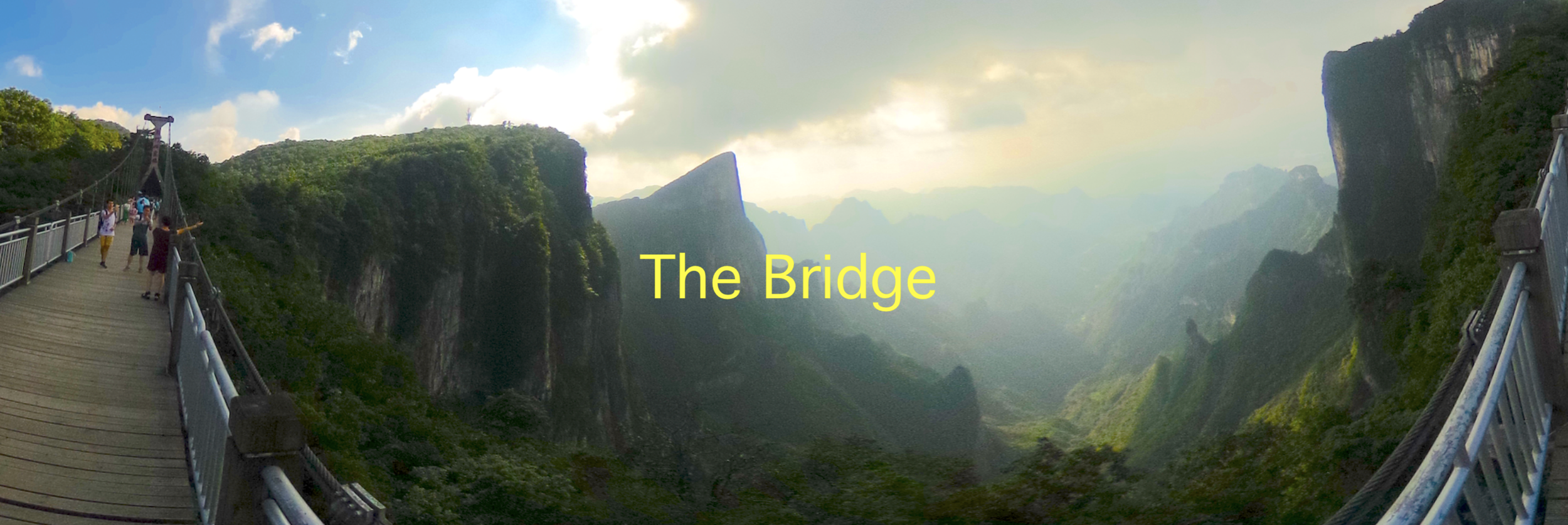
The Bridge
🍷
In approaching religion and metaphysics, I assume that they’re inseparable from science and the practical physical world in which we live. And yet they aren’t quite the same. Khayyam highlights the relation between spirit and sense throughout his Rubaiyat, especially in the physicality of the wine that turns into metaphor.
The most obvious aspect of Khayyam’s poetry is its sensuality, which urges us to drink wine and seize the moment while we can:
Ah, make the most of what we yet may spend,
Before we too into the Dust Descend;
Dust into Dust, and under Dust, to lie,
Sans Wine, sans Song, sans Singer and — sans End!
Yet here’s where Khayyam gets tricky: some chemical (or some other mysterious quality in the wine) makes his head spin — perhaps like a dervish whirling with the atoms, or like an angel dancing on the head of a pin. His “rapt heart” then attains unconsciousness, which sounds suspiciously like the annihilation of the egocentric self that Sufi poets write about. The world as he knew it gets blurry, and “Songs flow as water,” as if by miracle, from his “burning brain.”
What time, my cup in hand, its draughts I drain,
And with rapt heart unconsciousness attain,
Behold what wondrous miracles are wrought,
Songs flow as water from my burning brain.
Khayyam strays closer and closer to the symbolic world of Rumi’s mystic, seeing himself less as “the spoil” of this world than as “the spoil of wine” — that is, of the mysterious quality within wine that makes his heart rapt and makes his head burn:
To-day is but a breathing space, quaff wine!
Thou wilt not see again this life of thine;
So, as the world becomes the spoil of time,
Offer thyself to be the spoil of wine!
There’s an old debate about whether Khayyam is a hedonist who merely drinks to get drunk, or a mystic who drinks to get divinely drunk — as in Mahfouz’ short story “Zaabalawi,” where drunkenness merges with self-annihilation, the Sufi pre-requisite for mystical union. Personally, I think Khayyam is a prime example of a double refugee, that is, a person who finds refuge in wine 🔺 from the rigours of math and logic, and also 🔺 from the rigidity of religious dogma.
Khayyam also implies several questions. What if reason and religion aren’t mutually exclusive? What if one can live in this physical world of wine and crispy baguettes, and also in the metaphysical world of divine intoxication and the bread of angels?
From doubt to clear assurance is a breath,
A breath from infidelity to faith;
Oh, precious breath, enjoy it while you may,
'Tis all that life can give, and then comes death.
Khayyam’s vision of sense & spirit makes even more sense when we remember that he was a famous mathematician and a renowned astronomer, and yet also a brilliant poet and a subtle mystic. One might say that he was sometimes a mathematician and sometimes a poet.
We can see these two sides of Khayyam in the way Edward Fitzgerald translates his Rubaiyyat as hedonistic poetry, while others, like Robert Graves and Omar Ali-Shah, translate the Rubaiyyat as mystical poetry. In his preface to their translation, Omar Ali-Shah criticizes Fitzgerald and his famous translations, arguing that the Persian poet was more “Sufic” than hedonist, and that “whatever Omar Khayaam was, he was no atheist”:
Edward Fitzgerald is not the only Westerner for whom the meaning of the Rubaiyyat has seemed too obscure for accurate translation into English; yet E. H. Whinfield, as a Khayaam expert, dismisses the possibility that it contains any secret Sufic doctrine. He states, though unhistorically, that ‘this symbolism was not formulated in Omar's time'. On a previous page, however, he has conceded that 'most of the verses probably bear a mystic meaning'. He refrains from suggesting what sort of mysticism this was, but leaves himself room for tactical retreat; and has at least been generous enough to admit that whatever Omar Khayaam was, he was no atheist.
The question of whether Khayyam was a hedonist or a mystic seems to me an odd, dichotomous one. Why couldn’t he be both? Why insist Khayyam is always a believer or always a doubter when it seems just as likely that he was sometimes one and sometimes the other? He himself says that “From doubt to clear assurance is a breath, / A breath from infidelity to faith.”
Hard-core atheists and hard-core agnostics are convinced that we must doubt everything all the time. Hard-core theists on the other hand are convinced that the spiritual world is the ultimate reality, and that we must stress this in every aspect of our lives. They often go so far as to suggest that God abhors doubt.
Yet for double refugees it’s not necessary to either doubt or believe. It’s not either one or the other. It’s alot of both.
In Either/Or, Søren Kierkegaard suggests 🔺 we can live either an aesthetic life or a moral life, and 🔺 we should make a leap of faith from hedonistic materialism to moralistic spirituality. In The Double Refuge I argue that we can either doubt or believe — AND we can do both. I argue for either/and rather than either/or.
The double refugee leaps back and forth all the time, away from the chaotic world to the unified realm that religion promises, and then back to the material world, where we see real sky, without the images of gods and angels hovering in the air.
Double refugees straddle the gap between the physical and the metaphysical. They fasten their ropes from one side to the other. They lay down planks in the air, to make it easier to walk (few of us are tightrope walkers). They line the walkway with glass plates, and gaze dumbfounded at the yawning gulf below. As if they were in China, in Hunan Province, on the Zhangjiajie Glass Bridge:
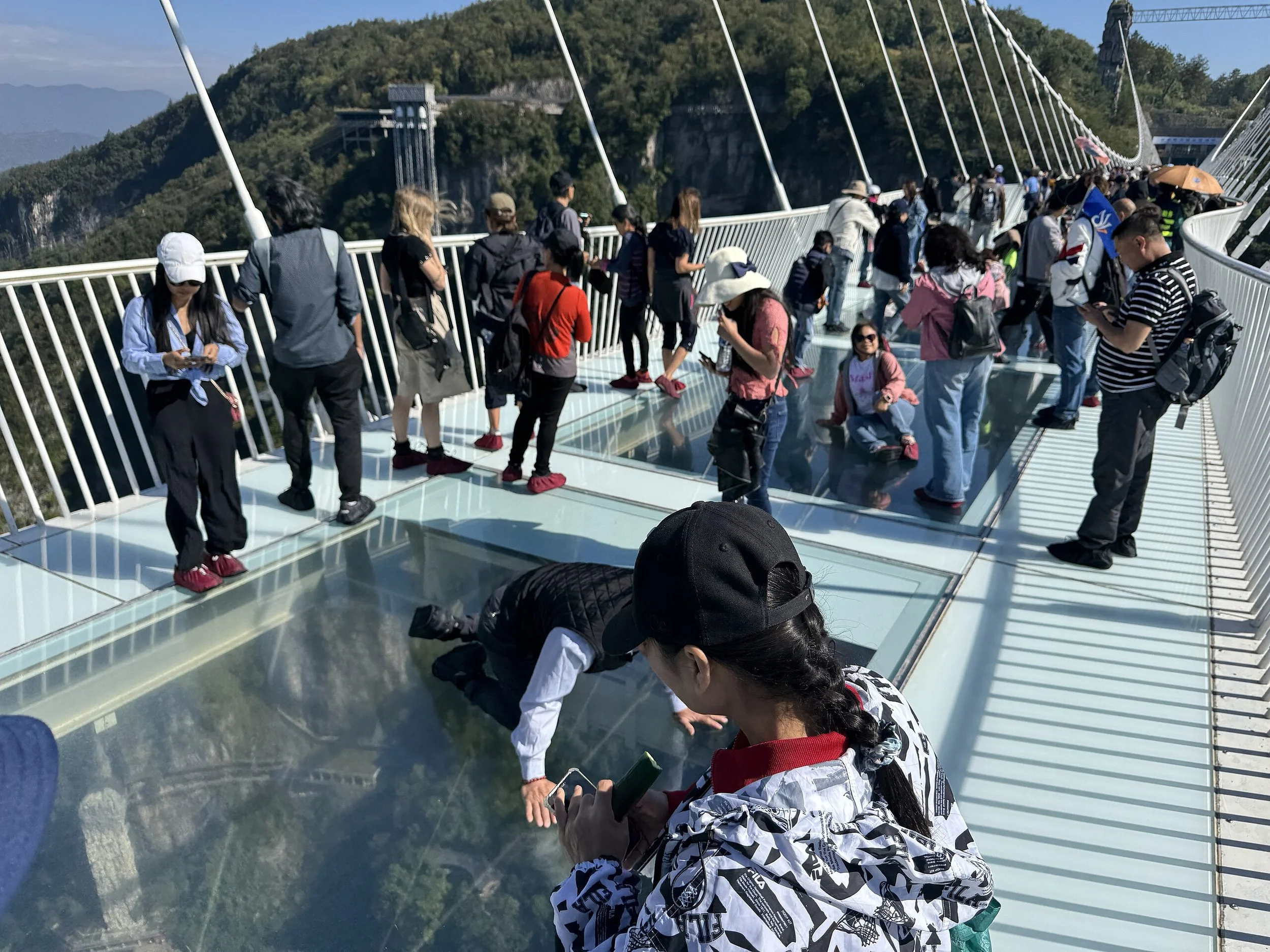
Zhangjiajie Glass Bridge, 25 October 2024. Author: Codas. (From Wikimedia Commons)
We look down at the yawning gulf, the one that Pascal says is an infinity that only God can fill. We see the stone and trees, the jagged rocks leading up to the horizon, where the bright clouds magnify the blinding sun, which is now lost behind the blue sky, floating out there, somewhere beyond our perception, in outer space.
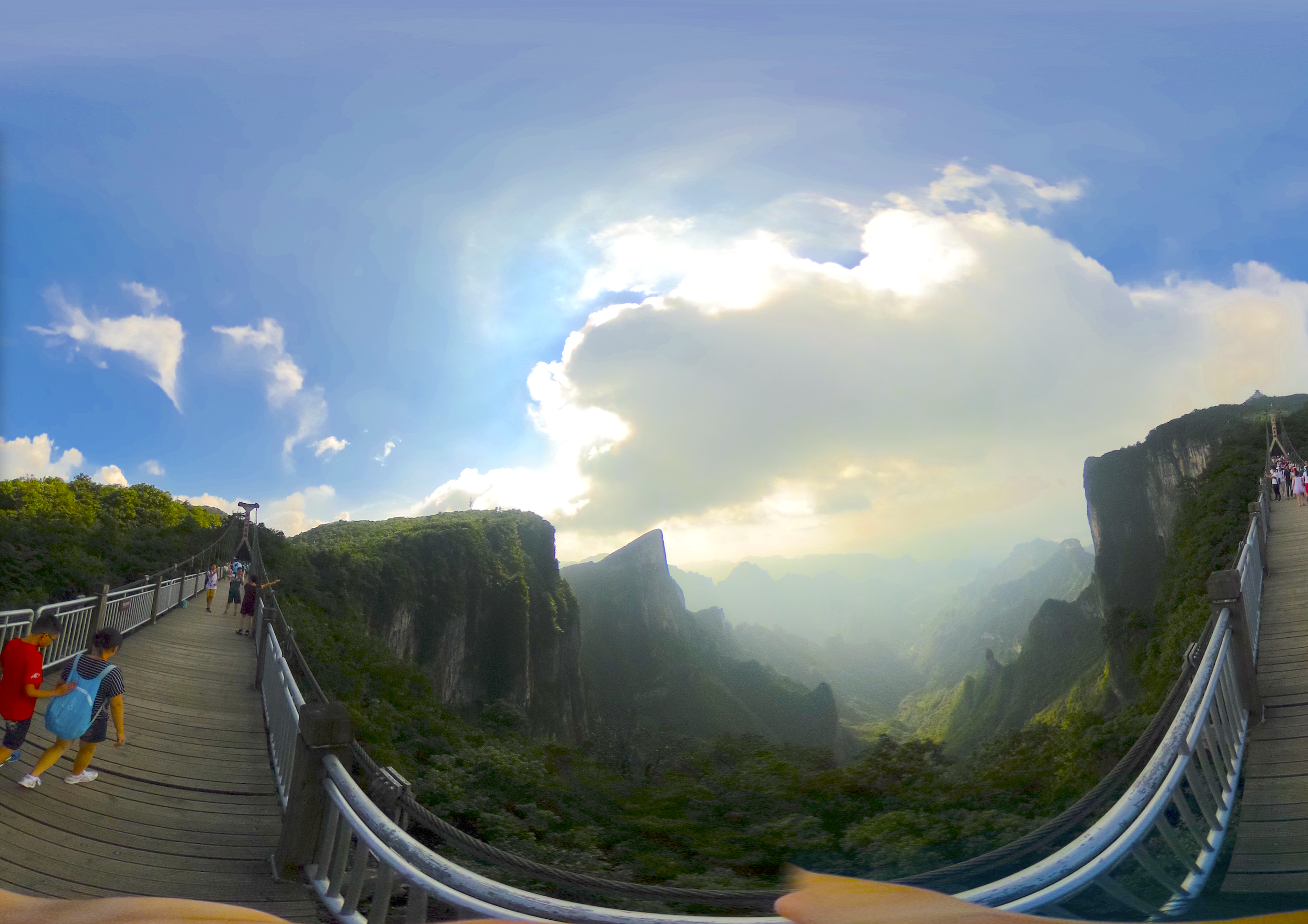
良い眺め, 12 August 2016. Source: R0010272.jpg. Author: Kuruman, from Tokyo, Japan. (from Wikimedia Commons, cropped and colour-adjusted by RYC)
Rather than an eternal dichotomy or a desperate leap from reason & doubt to emotion & faith, I suggest a balance (as in Montaigne), or a pivot (as in Zhuangzi), or a negative capability (as in Keats), or any other concept that allows us to pass freely to and from the realms of doubt and belief.
I doubt that God is worried about 🔺 the exact way we define doubt and belief, 🔺 the exact way we go from one to the next, or 🔺 the exact percentage on either side. I suspect He cares far more about LOVE, TRUTH, PEACE, JUSTICE, COMPASSION, and REDEMPTION.
🍷
Next: 🍷 Prufrock