The Double Refuge 🍷 Bubbles Winking at the Brim
Nishapur Wine
🍷
However enticing the other world of spirituality may be, it can’t trump or eclipse this world we live in, this heaven, hell, and purgatory of sense and idea that we call the human condition.
At it’s best, this world is Heaven on Earth:
A Book of Verses underneath the Bough,
A Jug of Wine, a Loaf of Bread — and Thou
Beside me singing in the Wilderness —
Oh, Wilderness were Paradise enow!* *enough
Of course, this world is also full of suffering and angst. Yet tears of angst and joy are part of the same mechanism and the same dynamic: our human body and the way it fits into the world as we live it. Any spirituality that separates us from that, and that makes the physical seem low or unreal, is bound to fail. Any religion that doesn’t allow the concept of love to take every form it will, will be found wanting.
In the following poem I suggest that the wine Khayyam writes about isn’t just the wine shared by lovers on a grassy bed. It’s also the wine of experience, of living 🔺 without filtering or codifying the impact of the world around us, 🔺 without hiding from the urges and desires deep within us, and 🔺 without distorting the memories that are sad or beautiful yet always inseparable from who we are:
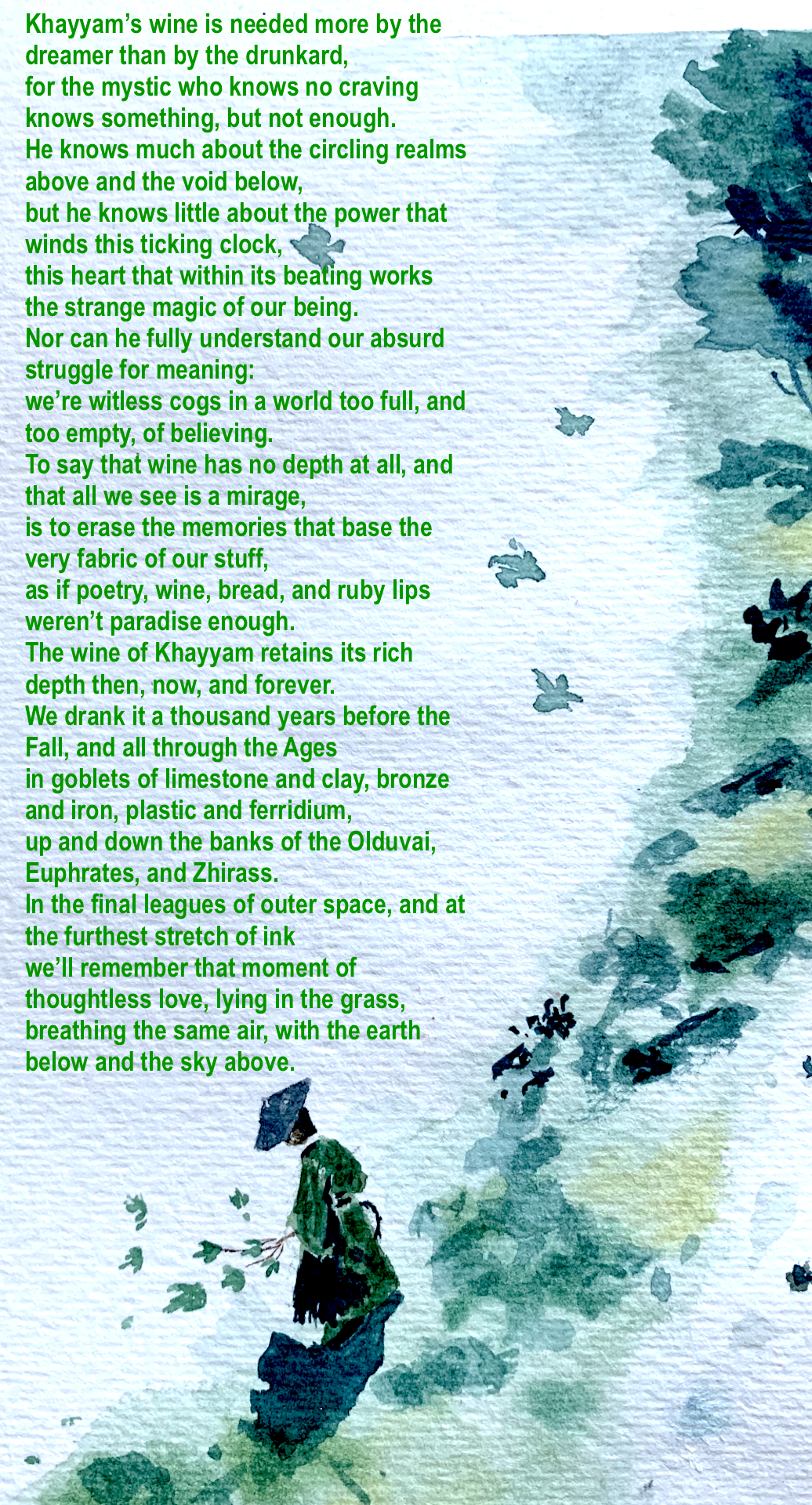
~ background image by my wife Ruby, based on a Chinese print ~
(I ought to confess that there’s a fair amount of poetical theft going on in my poem: Shakespeare writes of “ruby lips” in “Sonnet 116”; he also writes about the “baseless fabric of this vision” and says that “We are such stuff / As dreams are made on” in The Tempest; in “To His Coy Mistress” Marvell tells his lover, “I would / Love you ten years before the flood”; and in “Bright Star” Keats yearns to be “Pillow'd upon [his] fair love's ripening breast, / To feel for ever its soft fall and swell.” Ferridium and Zhirass, on the other hand, are my own fabrications, intended to suggest a metal of the future and a river in some far-off world.)
I sent this poem, that I called “Nishapur Wine,” to my friend Kent Lewis. He returned the favour with a poem of his own, one that had a different aesthetic yet a similar point. Kent’s poem makes a case for the value of sensual experience and spiritual flight, and it also recognizes the damage, and the need for escape, created by the world around us — in this case the fascist drift of early 2026, with its headlines about Putin, Trump, ICE, etc.
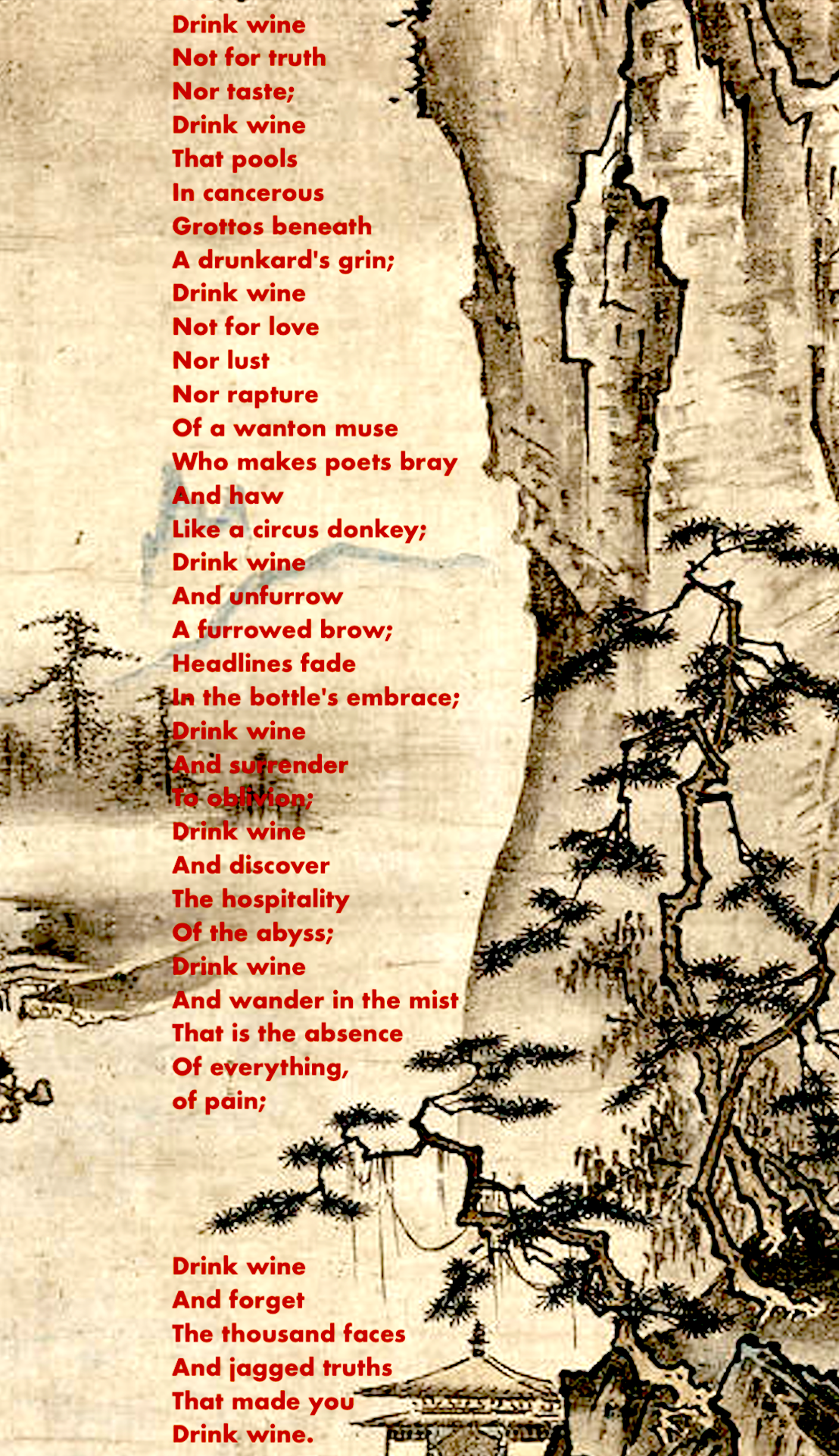
In Kent’s poem, wine serves multiple aims: it’s 🔺 a ground vehicle to the world we normally shun — the grottos beneath a drunkard’s grin, and it’s 🔺 an air vehicle to the world we desire — the wanton muse, the hospitality of the abyss, and wandering in the mist. (Because of this wandering in the mist, I set the poem on a naturalistic Chinese background, a decision that my favourite drunken Daoist poet Li Po might appreciate!) In the poem, wine is also 🔺 a vehicle of escape from the present political nightmare — the thousand faces and jagged truths.
The reason I underscore this political aspect of Kent’s poem is that political freedom is often a prerequisite to a varied exploration of doubt and belief. We’re most free to explore different ways of thinking and living if the culture and society we live in allows us to read, think, and do what we want. The same freedom that mysticism and ecumenicalism offer in religion, liberal democracy and secularism offer in society. Just as we’re more likely to choose our own direction if we’re not forced (or manipulated) to vote for a single party, so we’re more likely to explore different religions and to choose what we really want from religion if we’re not threatened or otherwise manipulated by a single, strict, severe doctrine.
This doesn’t mean that double refugees don’t appreciate doctrines or specific beliefs within a doctrine. Rather, it means the opposite: everyone is free to believe and explore whatever they want, however specific or ‘special’ that might be. Walt Whitman calls this, “Not objecting to special revelations,” and putting ourselves “here and now to the ambush'd womb of the shadows.” Whitman’s point isn’t fully idealistic here, since he acknowledges that in the realms of religion everything isn’t all angels and light. There are also devils and shadows.
The main caveat I see in allowing for all “special revelations” is the same as the caveat that excludes intolerance: it’s a paradox, not a contradiction to be intolerant of intolerance. Inclusiveness can’t remain waht it is if it allows exclusion. In a liberal democracy no one is “free” 🔺 to impose their religion on others; 🔺to promote hatred and intolerance; and 🔺 to restrict the freedom of others. There’s an inherent tension in tolerance and liberalism, yet there are also two golden rules that help to ease this tension: 🔹 1, do unto others as you would have them do unto you; and 🔹 2, don’t do unto others what you would not have them do unto you.
We can also try to turn bigotry into tolerance, and to turn tolerance into appreciation. We can be open to beliefs that are strange to us. If possible, we can find out about these beliefs, and we can find out why people believe them. We can immerse ourselves in them, and try to feel what other believers feel, down to the specifics of image and chant. But throughout all this exploration we can’t let go of openness and inclusiveness. If necessary, we must insist that everyone has the right to believe what they want. And if they don’t want to believe, they have the right to do that too.
In terms of the dominant metaphor I use in this introduction to The Double Refuge, I’d say that we’re free to drink Nishapur wine, with capitalized divine Love spilling over the brim. We’re also free to drink Eucharist wine, with its resurrection spilling into our blood. We’re also free to drink Syrah or Vin Santo without any thought of hidden symbol or sacred chalice. We can sit rapt and transported, looking into a pair of starry eyes, thinking about ruby lips.
We can remember, with Khayyam, to be a spoil of wine rather than a spoil of time. And we can remember, with Shakespeare, that love “is an ever-fixed mark, / That looks on tempests and is never shaken;”
It is the star to every wandering bark,*. ship
Whose worth’s unknown, although his* height be taken. its
Love’s not Time’s fool, though rosy lips and cheeks
Within his bending sickle’s compass come;
Love alters not with his brief hours and weeks,
But bears it out even to the edge of doom.
🍷
Next: 🍷 The Bridge