

The Double Refuge 🔬 Science & Mystery
Dante’s Journey
The Creation of Structure - The Dissolution of Structure - From Woods to Open Seas
🔬
To one who has faith, no explanation is necessary. To one without faith, no explanation is possible.
This aphorism from Aquinas’ Summa Theologica (1274) crystallizes a perception of reality shared by many of the great thinkers of the Medieval period. It comes from a world in which a scientific explanation for our existence wasn’t possible.
Before geology and astronomy showed us where we are, and before evolution and DNA showed us how we got to be what we are, it’s not surprising that people discarded objective explanation. It was then inferior to revelation because 1. it didn’t explain much (far, far less than science does today), 2. it had no overall framework (such as evolution) and 3. it gave no coherent mode of operating for individual lives (such as liberalism or existentialism).
In such a world Aquinas felt it possible to write a Summa Theologica, that is, a work that sums up the design and meaning of a universe designed by God. Science didn’t have much to counter this explanation because it simply hadn’t yet come up with an explanation of how the physical world was designed.
🔬
The Creation of Structure
In the Middle Ages Dante presented a poetic and spiritual vision of the universe, one which complemented Aquinas’ more logical framework. This isn’t to say that Dante didn’t think of his vision as a logical one; indeed he made it seem both durable and at times terrifyingly realistic: he gave his Medieval reader extensive historical reference points, and he painted colourful portraits of all sorts of historical figures. All of this allowed the Medieval reader to see his fictional creation as a very solid vision of the world and the universe.
Dante’s universe comes complete with the precise meanings of an intricately layered Heaven, Purgatory, and Hell. In Domenico di Michelino’s 1465 fresco (below), we see Dante opening the text of his long poem, The Divine Comedy (1320). The text he’s reading explores the subterranean, terrestrial, and etherial realms we see in the fresco.

Michelino’s painting shows us the integrated yet vast realms of Inferno, Purgatory, and Paradise. Dante gives us an intimate, emotional sense of these realms by placing his protagonist, himself, in a dark forest. Here he is terrified by three beasts, meets his guide (the Roman poet Virgil), then the two of them enter the Gates of Hell. This is a terrifying journey, yet it isn’t meaningless: he provides a moving, poetic description of the realms, and both he and his guide explain how they fit into the bigger scheme of things.
Dante is guided first by the Roman poet Virgil (down to the bottom of Hell and partway up the Island of Purgatory) and then by the Florentine woman who Dante loved platonically all his life, Beatrice Portinari (whose poetic and spiritual sensibility allows her to describe the etherial realms of Heaven). En route, the Medieval reader learns the meaning of everything, from the depths of the earth where Satan is jammed in his icy lake, to the farthest reaches of the sky, where a Blessed Rose of angelic spirits circles the ineffable presence of God.
Thus Dante integrates the world of scripture and spirit into the contours of geography, astronomy, and human experience. Moreover, he supplies a religious vision of human existence in all its theological and psychological complexity.
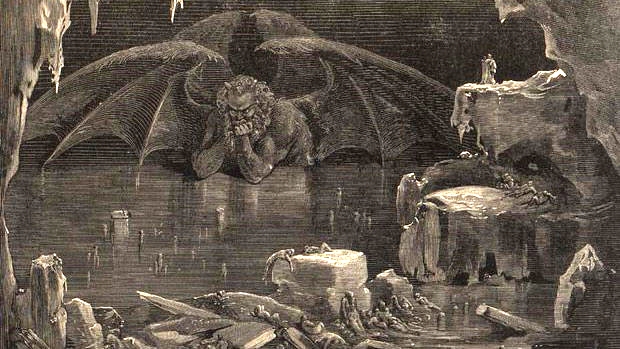

✯ Wood engravings by Gustave Doré, 1866-7 ✯


Yet from a double refugee point of view, Dante supplies his reader with a complete and specific explanation that can’t be supplied. He also answers a question that can’t be answered: What happens after we die? Save for the initial part where Dante is in the forest, the whole grand epic describes this afterlife realm, and supplies a detailed commentary on what people did in their lives that resulted in them spending eternity on this or that level of Hell, Purgatory, or Heaven.
Double refugees may be deeply moved by Dante’s journey, and may see deep pockets of Truth along the way, yet they aren’t convinced that this is how the universe works. There are too many specific cultural and epistemological assumptions, and too many debatable points asserted as theological fact. The world is wider than it was then. Catholicism is no longer the main branch of Western Christianity: Protestantism and ecumenicalism have since developed. So has the understanding of the rest of the world: native religions, Hinduism, Buddhism, and Daoism have all been added to the mix.
Obviously, everyone in Dante’s day didn’t think in the same way. Yet the roads to alternative understanding were fewer, and, apart from the Classical Greek and Roman tradition, much of the Classical world’s philosophical and cultural diversity had been whittled down by ‘Christian’ councils, inquisitions, and heresy seekers. Whatever alternative paths there were, were not well trodden in 1300. Most important in terms of religion, 1. other philosophies and religions were little understood, and 2. the sciences of astronomy, geology, genetics, archaeology and philology were yet to make their mark. Back in 1300 that mark might well have been seen as the Mark of the Beast, yet the Beast was gradually tamed by use, reason, and practicality.
🔬
The Dissolution of Structure
While Dante supplies us with perhaps the finest and most powerful vision of the Medieval afterlife, the particulars of his vision — as opposed to its poetic and mystical dimensions — don’t stand the test of time. In particular, the fields of astronomy, geology, and philology turn his vision from one of believable doctrine into one of poetic myth.
Atheists would say that this structure vanishes completely, and becomes mere myth.
Open agnostics would say that the structure is still important, but that it now has an indeterminate status. It may be there, but it’s invisible or exists on a different plane or dimension. Or it may be there in our minds as a dissolved, translucent outline of cosmic locations or dimensions that still have meaning. Or it may have a mythic meaning, by which they don’t mean a fairy tale or an unbelievable meaning, but a poetic, possible, intangible meaning, an outline in our minds which may yet guide us along la diritta via, the straight path.
Open theists would agree with the agnostics in this, yet they would be inclined to stress the transcendental nature of the image. Others may see it as poetry and myth, but they see it as an invisible guide, as a series of places that leads them onward and upward to a transcendent, ineffable, dissolving yet magically reappearing Heaven.
Thus while atheists see Dante’s cosmos as mere myth-making, double refugees see it as a structure worth keeping. For them, it’s an image that responds to our psychological and spiritual need, one that gives an invisible or essential shape to our inmost dreams. They acknowledge that over time science has dissolved this structure, yet its invisibility is symbolic or transcendent rather than meaningless.
🔬
From Woods to Open Seas
Dante’s Inferno starts with the famous lines, In the middle of our life’s road / I found myself in a dark wood, / the straight path being lost to me. (Nel mezzo del cammin di nostra vita / mi ritrovai per una selva oscura, / ché la diritta via era smarrita). He then takes a dangerous journey into Hell and up the Mountain of Purgatory. From the top of the Mountain he ascends to Heaven, with a warning to any who would follow him:
O you in a small boat who desire to hear and follow closely my singing ship, turn back to look again upon the shore; don’t put out to sea, because if you lose me you’ll be lost. The water that I sail on has never been sailed before …
O voi che siete in piccioletta barca, desiderosi d'ascoltar, seguiti dietro al mio legno che cantando varca, tornate a riveder li vostri liti: non vi mettete in pelago, ché forse, perdendo me, rimarreste smarriti. L’acqua ch’io prendo già mai non si corse … (Paradiso, 2.1-7)
Dante’s use of nautical imagery is striking in that it describes his flight to Heaven as if he were sailing in a boat. To me, this detail not only indicates the debt Dante pays to the Classical writers Homer and Virgil, but also the debt that the entire Judaeo-Christian tradition doesn’t pay to the Ancient world — to Sumer, Akkad, Babylon, and Assyria.
This debt may not seem like a problem on the surface, given that later cultures always borrow from earlier ones. Yet this debt is one that has wide-ranging implications for the ability of the Medieval view of the universe to effectively explain both where we are and who we are. This unacknowledged debt to Sumer and Akkad will crop up again and again in the following pages and sections. It involves us in the archaeology of intellectual and religious history, and it lies beneath what we thought we invented, what we thought we knew. It might be seen as the cultural companion piece to the harder, more biological theory of evolution: just as Darwin’s theory upended all sorts of fantastic scenarios describing how we got to be who we are, so the philological knowledge of Gilgamesh and of Mesopotamian writing and laws upended the notion that the Bible is an original and culturally independent record of God’s relation with the world.
🔬
Dante’s use of nautical imagery to describe a flight toward Paradise seems odd on the surface. Yet it makes poetic sense in that it echoes the ocean journeys described in Homer’s Odyssey and Virgil’s Aeneid. In Homer’s epic, Odysseus is directed by the sorceress Circe to sail to a western river, where he communes with the sunken dead (Achilles, Tiresias, his mother, etc.) and then sails back to his wife Penelope on the island of Ithaca. In Virgil’s epic, Aeneas sails from the ruins of Troy to Carthage, where he falls in love with Dido. Then, fated to found Rome, he sails to Sicily, leaving Dido on her suicidal pyre, marriage bed and all. Aeneas is then guided by the famous prophetess of Cumae to an Underworld, which is a more developed version of the one in the Odyssey.

Charon Crossing the Styx (main portion), by Joachim Patinir, c 1515-24, Prado Museum, Madrid (Wikimedia Commons)
The idea of a journey to the afterlife, especially when combined with the Graeco-Roman figure of the boatman Charon (above), reverberates in a distant, uncanny way with the earliest work of world literature, Gilgamesh. Originating in the Sumerian and Akkadian civilizations of the third and second millennia BC, Gilgamesh recounts the exploits of a king who probably existed in the early 3rd millennium BC. In this story, Gilgamesh sails to Dilmun, guided by the boatman Urshanabi. When they get to Dilmun, Gilgamesh interviews Utnapishtim, the only human who has been granted immortality.
The reason Utnapishtim gets to live eternally (unlike Gilgamesh or anyone else) is perhaps the most surprising bit of literary archaeology to confront the Judeo-Christian world: Utnapishtim built an ark and saved all life on earth. This occurred after the earth was flooded because a god was angry.
If Utnapishtim is the pagan original for Noah (and the details of the two stories strongly suggest this, as I discuss in The Currents of Sumer), and if Dante’s journey to the afterlife is prefigured numerous times and in numerous ways in pagan literature, it becomes more difficult to believe the Italian poet when he says that his journey is original:
The watery path I take has never been taken; / Minerva breathes [into the sails], Apollo guides me, and the nine Muses show me [the constellation of] the Bear.
L’acqua ch’io prendo già mai non si corse; / Minerva spira, e conducemi Appollo, / e nove Muse mi dimostran l’Orse. (Paradiso, 2.7-9)
One could argue that Dante’s journey is original in the sense that the pagans of the Ancient and Classical world never imagined sailing to a Heaven full of Grace (by contrast, the pagan afterlife was a downward, dark, and pessimistic one, like that of the early Hebrews). One could also argue that Dante simply does to literature what Augustine did to Christianity: he blends Classical and Christian, always asserting that the latter is superior to the former. Like Milton after him, he uses and refers to Classical pagan models, but he turns them into Christian ones.
Yet there’s at least one enormous problem with this: key aspects of Dante’s story go back 4000 years to civilizations whose overall view of the universe had nothing to do with monotheism or Jesus, and even less to do with the certainties of Medieval Italy. Those who believe in the sanctity of the Bible believe it to be an inspired and true version of events both cosmic and human. Yet if the very framework of a key story is borrowed, then its supposed novelty is likely to be a fiction, and clearly not an original account of the past. The result of all of this is that Dante’s Medieval view of the afterlife and the Flood become a monotheistic certainty that’s undermined by the very components of its construction.
I’ll return to this narrative archaeology in ♒️ The Currents of Sumer. Here I want to continue fleshing out the Medieval view of the universe, by contrasting Aquinas and Dante to Boccaccio and Chaucer (Don’t Forget the Miller) and by suggesting a way that Dante’s vision might be seen in terms of the double refuge (Primum Mobile).
If we see the medieval world and its doctrinal Christianity only in terms of thinkers like Dante and Aquinas, we’re likely to get the impression that it was a solid thing that brooked no diversity. Yet if we include 14th Century writers like Boccaccio and Chaucer, we see that many people back then didn’t think in dogmatic terms. The path toward a more inclusive and wide-ranging Christianity was perhaps there, at least in outline. While the doctrinal views appear to have held sway, perhaps everyone wasn’t as dogmatic as we often assume. Was there already a sort of double refuge that we don’t see because our own historical framework has been determined by milestones that stress religious dogmatism versus scientific advances? In terms of intellectual history, we often think about Galileo’s forced recanting of astronomical facts before the Inquisition, or Darwin’s portrayal as a monkey, yet we don’t think so much about Chaucer’s host in The Canterbury Tales: confronted with a drunk miller who tires to jam his story between those of the Knight and Monk, the host says, Go ahead, tell your dirty story. Everyone has the right to be heard.
🔬
Next: 🔬Don't Forget the Miller