The Double Refuge 🍷 Bubbles Winking at the Brim

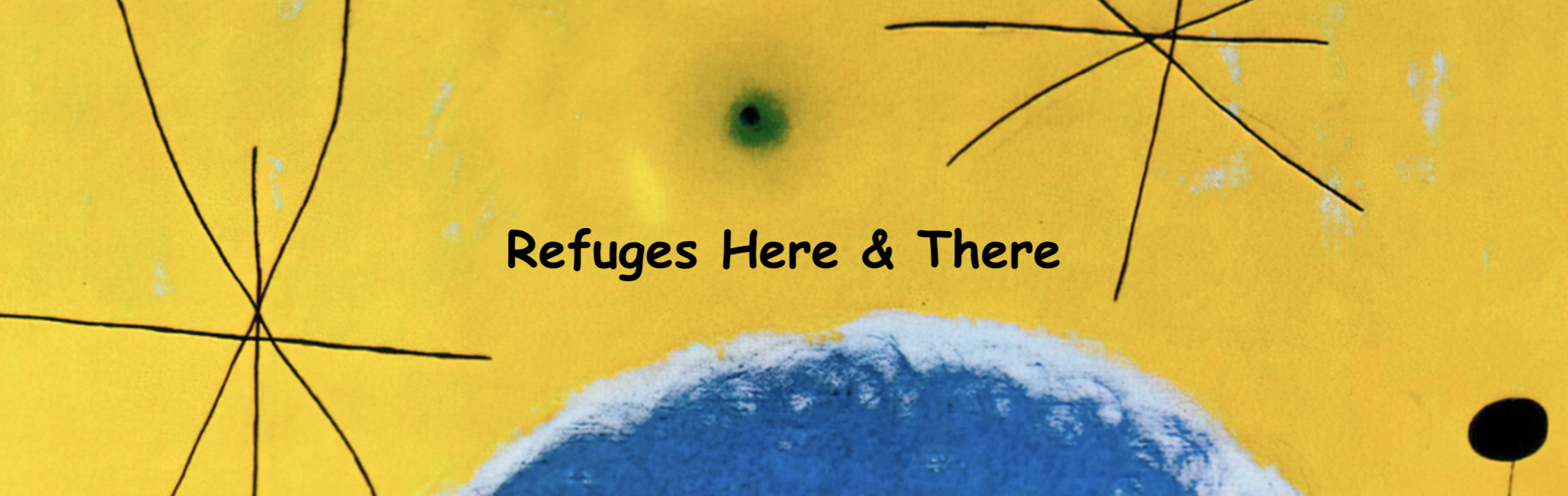
Refuges Here & There

Two Refuges - Overview - Tangents

🍷

Two Refuges

In The Double Refuge I explore the relation between doubt and belief. I suggest that each can help in understanding the other, and that each can be a refuge for the other. Belief can be a refuge from fear, alienation, angst, and meaninglessness, and doubt can be a refuge from pride, dogma, religious conflict, and the feeling of being boxed in.

Conventionally, doubt and belief are seen as distinct, and are quite often seen as opposites. Even irreconcilable opposites. I, on the other hand, see them as complementary. Moreover, I think they can strengthen and temper one another. Belief can soften the hard edges of doubt, and doubt can soften the hard edges of belief. This complementary relation relies on one thing: openness. For my double refuge system to work, doubt must remain open to doubting its own doubt (which creates room for belief), and belief must remain open to different beliefs and ways of thinking (which creates room for doubt).

The conventional scenario is that we leap from doubt to faith, or we fall from faith to doubt. Yet that scenario often involves a great deal of psychological angst, and leaves us divided between what we were and what we are. This invites internal fracture, a chasm in the psyche. I suggest instead that we get used to sliding back and forth between doubt and belief, until the mix of the two isn’t just a part of our thinking, but is instinctual, living inside the nerves that move our muscles and bones. I suggest going back and forth so often that the invisible ligaments between doubt and belief become strong enough to support running at full speed or darting like a hummingbird. In this way, we can leap from place to place without leaving our past behind.

🍷

More specifically, in The Double Refuge I aim to explore 1. the many-sided beast of agnosticism, 2. the ways that agnosticism is compatible, though distinct from, atheism and theism, and 3. the way that open agnosticism and open theism can work hand in hand.

1 and 2 are crucial to this study, yet my goal is to sound the depths of 3, that is, the way that open agnosticism and open theism relate, differ, connect, and strengthen each other. I’ll explore how the double refuge — the open space that embraces both doubt and belief — connects the material to the spiritual, and opens us up to ideas, experiences, imagery, and symbolism which help us understand our relation to the physical world and to that elusive Something Greater, which remains beyond our ability to grasp, define, or control.

🍷

Throughout The Double Refuge I range widely in focus and approach. I go from Khayyam to Shakespeare, from Zhuangzi to Camus, from prose to poetry, from critical analysis to fiction & autobiography, from serious debate to comic diversion.

Philosophically, I’m agnostic in the tradition of Henry Huxley. Theologically, I’m non-dualist, more or less in the traditions of Neoplatonism, Daoism, Vedanta, Walt Whitman, and Richard Rohr. Thinking along these lines puts me in awe of the mysteries that science and religion try to understand. I believe that science without positivism sees eye-to-eye with religion without dogma. Perhaps the laws of Nature emanate from a Unified Theory just as versions of religion emanate from a transcendent One.

The sight-line that goes back and forth between science and religion might be called the double vision. And yet it’s one line, just as the vision of poets and mystics is of one Greater Reality, which for want of a better term we might call the One or the Whole.

People often talk about matter and spirit as if they were separate, as if a Great Wall and innumerable traps are set along the border. They often talk as if there was in fact a solid border, impenetrable on the scientific side because of the demonstrable facts of space and the invisible facts of gravity and magnetism 🔭🔬, and impenetrable on the religious side because of the solid weight of doctrine and the invisible spiritual powers of gravity and magnetism ✝️🕉️.

Both sides appear to have different types of gravity and magnetism, attracting us in different ways and pulling us apart so that we see the two as completely separate. Yet what if the same gravity and magnetism operated in both? What if gravity and magnetism operate in the visible realm, and also in the realm of thought and feeling, psychology and spirit, intuition and belief? What if the border doesn’t really exist, but is just a way of dividing up the same Whole? How many ways can we divvy up what we can’t see?

In The Double Refuge I focus on the unifying notion of refuge, which refers to an escape or refuge from the trap of isolation, alienation, & exclusivity that we can fall into if we divide science from the invisible beauties of emotion, art, intoxication, mysticism, etc. In this sense the double refuge is a safe haven from the alienation of existentialism and the dogma of religion.

Notwithstanding this notion of refuge, I’m still agnostic enough to admit that I don’t really know if I’m right or not. So I look as widely and as deeply as I can, putting much of my little spotlight on the fringes and borders. I look as deeply as I can into the question of how the most open versions of realism and agnosticism might connect with the most open versions of mysticism and religion.

In all cases, I suspect that humility is the key. In the double refuge of open agnosticism and non-doctrinal mysticism we see that we’re only a tiny part of the universe and that we can’t claim to speak for the Great Whole, whatever that may be. Scientifically and rationally we may think of the Cosmos; poetically and mystically we may think of the One and the Good. Yet however we approach the topic, the Great Whole may well be infinite and therefore beyond definition, conception, or conclusion. And yet, while we may not be able to define or lay down borders, we can still imagine a Unified Field, a Universal Mind, a Wholeness, a Goodness, a Mystical Union, a Yoga of body and spirit, a Holy Spirit connecting to everything. It may not make perfect sense, but there it is.

In Adonais, his 1821 elegy on the death of Keats, Shelley gets as close as he can to the poetic mysticism of ineffability: “Rome’s azure sky, / Flowers, ruins, statues, music, words, are weak / The glory they transfuse with fitting truth to speak.”

🍷

Overview

Introductions

The Double Refuge begins with three introductions. In the first, 🍷 Bubbles Winking at the Brim, I illustrate my philosophical point and my literary approach, and I use the metaphor of wine to discuss an intoxication that may be both physical and spiritual. 🍏 Agnosticism highlights the role of agnosticism as an intercessor between atheism and theism, and also defines some of the terminology I use throughout. 🧩 Butterflies Landing delves into more involved terms and concepts — such as zero-sum philosophy, paradoxes of doubt, the philosophical implications of infinity, T.S. Eliot’s unified sensibility, Keats’ negative capability, etc.

🍷

Sections

The main body of The Double Refuge is comprised of two sections. The eight chapters of PATHWAYS TO DOUBT emphasize the effect of science on religion, especially how astronomy and natural science eroded Medieval certainties, and led to the formulation of agnosticism in the late 19th century. The nine chapters of CURRENTS OF RELIGION emphasize the diverse history of religion, as well as aspects of mysticism that survive the collapse of certainty. I’ll argue that this mysticism, with its open borders and lack of doctrine, can act as a conduit between agnosticism and theism — as well as a refuge from the ravages of both.

Throughout this exploration I use historical timelines, yet my arguments are more about the nature of doubt and belief than about historical development. My range is quite wide and varied — from early expressions of doubt and belief in Mesopotamia, India, China, and Classical Europe to the empiricism and agnosticism of the 18th and 19th centuries, to the liberalism and existentialism of the 20th century. I highlight literature that’s especially relevant to the relation of agnosticism to belief. For instance, I look at proto-agnosticism and Christianity in Dickens’ Bleak House, and at Modern agnosticism and mysticism in Forster’s A Passage to India in 🦖 At the Wild & Fog (starting with A Misty Maze, But Not Without a Plan).

🍷

Chapters

The first large section, PATHWAYS TO DOUBT, follows a rough chronological order. I start by looking at the revolutionary impact of astronomy in 🔭 The Sum of All Space (starting with Third Spinning Rock from the Sun), and at the parallel rise of science and skepticism from the 16th to 20th centuries in 🔬 Science & Mystery (starting with Overview) and in ♒️ A River Journey (starting with Mountain Springs). I then look at the skeptical and empirical strains in agnosticism, from the Greeks to the 19th century (❤️ Three Little Words, starting with Critical Distance), after which I look at 17th and 18th century empiricism in light of my personal experience while visiting Guanajuato in the year 2000 (🇲🇽 Señor Locke, starting with The Gringo Takes Stock).

I then look at the shift from pre- to post- Darwinian thinking in Dickens’ England (🦖 At the Wild & Fog, starting with A Misty Maze, But Not Without a Plan), at the relation between agnosticism and theism in the 20th century French existentialists Sartre and Camus (🎲 Almost Existential, starting with Poor, Bare, Forked), and at a mystical version of the contemporary existential heroine in the song, “A Lighter Shade of Pale” (🧜🏽‍♀️ The Mermaid: Existential & Then Some, starting with The Heroine).

The second section, CURRENTS OF RELIGION, also follows a rough chronological order, beginning with an overview of religious history (🌎 Many Tribes, starting with Overview and Six Versions of Infinity). I then look at the influence of Mesopotamian civilization on Judaism & Christianity (♒️ The Currents of Sumer, starting with Introduction & Overview), at changing religious paradigms (⏯ Systems, starting with Mere Religion? and ✝︎ St. Francis, starting with Rapt Angel), at a fictional Biblical & Mesopotamian scenario (🍎 The Apple-Merchant of Babylon, starting with The Genealogy of Mortals), at religion vs. science in contemporary France (🇫🇷 The Priest’s Dilemma, starting with Rivers of God), at mysticism in Classical China & Whitman’s 19th Century Transcendentalism (💫 Believing in the Mystery, starting with Introduction: Daoism & Whitman’s Transcendentalism), at the battle against dogma in the Indian subcontinent in the 20th century (🇮🇳 The Fiction of Doubt, starting with Rise of the Simurg), and at the age-old puzzle of death (☠️ Ars Moriendi, starting with Teeing Off).

For a list of contents for each page of each chapter, see Detailed Contents.

🍷

Tangents

The bulk of The Double Refuge is written in essay form, although I sometimes shift into fiction and autobiography. Two chapters are entirely fictional: in 🇫🇷 The Priest’s Dilemma a Parisian priest struggles with evolution and philology; in 🍎 The Apple-Merchant of Babylon the business troubles of Moses lead him to a novel form of monotheism. Two other chapters are autobiographical: ☠️ Ars Moriendi reflects on the death of my father and brother; 🇲🇽 Señor Locke applies Locke’s theory about sense impressions to traumatic experiences I had — being robbed at knifepoint in Mexico City, and being held by criminals in Istanbul. This fictional and autobiographical veering away from exposition & argument is in keeping with my notion that while agnosticism and theism have abstract philosophical dimensions, they are based in personal experience.

This is especially true for agnosticism: at its heart it isn’t as much a system or doctrine as it is an open mode of operating and being. It urges us to think and feel critically, openly, and eclectically. Of course, religion can work in this open, critical way too, which is why I think of open agnosticism and open theism as the double refuge. Christian ecumenicalism goes some way in this, yet it often remains within the sphere of Christianity rather than becoming part of a global religious sensibility. Notable exceptions to this can be found in the writings of Walt Whitman, Ralph Waldo Emerson, Thomas Merton, Raimundo Panikkar, Bede Griffiths, or, more recently, Richard Rohr.

The following poem I wrote exemplifies what I mean by a global religious sensibility. In it I try to combine this sensibility with the desire to burn away the chaff, that is, to remove whatever stops us from connecting more broadly, from exploring and empathizing, from loving and forgiving, from reaching the grain or valuable substance which is protected yet also hidden by the chaff. In my poem the names of God are many. God thus becomes Shiva, the God of destruction and creation, as well as Christ, the God who is killed and resurrected. In both agnostic and mystical thought, it doesn’t matter what the name is; it’s the principle of improvement and the experience of reconstruction that counts:

By and large religion is dominated by those who tend to think in exclusive terms, often promulgating the notion that their religion is the best. They set Christ against Krishna, Mary against Mahakali. Personal experience too often gets subsumed by the doctrine of a particular church, sect, or school — just as it does by the atheist doctrine of positivism, which argues that the only verification we can rely on comes from the scientific method. Agnostics, by the very nature of their philosophy, are loathe to make such claims to exclusivity and superiority. It’s why agnostics aren’t bothered in the least if an agnostic embraces faith or leaves it altogether — that is, if they stop being an agnostic and become a theist or an atheist. It’s the sincerity of the search and the honesty of the appraisal that counts.

🍷

While The Double Refuge has themes and threads, I have a laissez-faire attitude in the pages themselves, taking tangents wherever I think they might yield some insight. A certain amount of latitude seems appropriate in exploring the relation between poetic agnosticism and mystical theism, since both are rather sliding, floating endeavours. It may be that if you’re willing to explore everything, you’re likely to keep shifting your bearings, and at times quite abruptly. Even to include humour, as when I have Moses in 🍎 The Apple-Merchant of Babylon get so frustrated by the Indian apple-merchants that he invents a new religion. Or by seeing God as the Scarlet Pimpernel, having fun rather than making fun of what’s so often seen as exclusively serious:

Gold of the Azure, 1967, by Joan Miró (clipped by RYC, from Wiki of Infinite Art).

In my exploration of doubt & belief I follow timelines and threads, but beyond these there are other trajectories and fabrics. Much as beyond Miró’s blue blob there’s a galaxy of gold and black lines with hints of stars and justice, of upside-down smiles and beings on faraway planets.

The lines we type onto the page or Internet stretch so far from us that eventually they become other, our scheme intersecting with other schemes, until we suspect that the universe is full of patterns and schemes. To impose a pattern or gospel on the universe says more about us than it does about the cosmos.

“In this image taken on Oct. 30, 2021, an aurora dimly intersected with Earth's airglow as the International Space Station flew into an orbital sunrise 264 miles above the Pacific Ocean before crossing over Canada. Image Credit: NASA” (link here).