The Double Refuge 🍷 Bubbles Winking at the Brim
Doubt + Belief
The Need for Doubt - The Need for Belief
🍷
The main reason I suggest embracing both 🔹 doubt and 🔸 belief is that neither, on their own, can do what we need them to. Put briefly, 🔹 doubt allows us to explore all philosophical and theological possibilities, and it goes a long way in explaining the physical here and now; 🔸 belief on the other hand, gives us a deep sense of meaning, focuses our attention on forgiveness and love, and gives us hope about things we can’t know for sure. Belief can give us the feeling that we’re worthwhile in the greater scheme of things: we have a soul despite our imperfections, and this soul lends us a place in the cosmos while we’re alive and an even better place when we die.
🍷
🔹 The Need for Doubt
The most solid religious belief can’t explain the physical world, nor can it explain other religious beliefs. As a result, there’s good cause to doubt solid religious beliefs, and to make room for other explanations. We can still believe in love, forgiveness, redemption, and meaning, and we can still believe in specific incarnations like Jesus or Krishna. Yet if we’re after universal truth, we can’t assume that religion explains science or that all the other beliefs in the world are fantastic or wrong.
While belief can be liberating, and can supply a meaning that’s impossible to find in this world, it can also take a form that’s too elevated or too solid. It can elevate our goals so high that all we see is the distance between the heavenly Ideal and the woe-begotten Earth. This creates a gap or chasm between 🔺 our emotional lives on a higher plane, in a metaphysical dimension, or within an astrophysical paradox such as Heaven on Earth, and 🔻 our rational and practical lives here on the surface of planet Earth. Too often we tell ourselves that we want this Higher Realm, but what we really want is fresh air, tasty food, a smooth merlot, a cedar cottage on a lake, a car that doesn’t break down, a sexy mate, and commercial-free streaming. Dante writes elegantly about “the bread of angels,” but most of us want beer and a slice of pizza.
Belief can also reduce our diverse and ambiguous experience to overly solid doctrines and catechisms. It can dilute free thought, and can fix within us ideas like predestination, original sin, caste, the Chosen People, the Elect, the End of Days, the Whore of Babylon — or, in the worst of cases, War in the Name of God.
🔸 The Need for Belief. Conversely, doubt needs belief. The most impeccable reason can’t explain why we’re here or where we’re going after it all ends. Evolution may tell us how we got here (at least since the ‘creation’ of the biosphere), but exactly why evolution did this remains a mystery. We appear to have come from stardust, but why would this dust cohere to make this life possible? As the saying goes, Heaven only knows! Science can’t explain the reason, so it throws the question over to the arationality of religion. Heaven only knows.
Yet whether or not Heaven actually knows is debatable. Khayyam writes that there’s little use asking Heaven, because “the Powers that Be are themselves in a spin.” In Rg Veda (the first Hindu text, written around 1450 BC) the poet says that only the God in the highest Heaven knows where this universe came from … “or perhaps He does not.” If we ask religion to answer everything, we ask the impossible. If, on the other hand, we maintain some healthy skepticism and ask religion to open us up to the old trinity of Peace, Love, and Understanding, then any religion worth its name will be up to the task.
Perhaps we need religion most because it responds to our deepest needs, fears, and hopes. If we’re going to dream beyond our knowledge and beyond science itself, we may as well dream big. And who knows, according to the doubts that reason casts on itself, we may in fact have an eternal soul, and we may in fact soar from this world to some better place, or shift into some other dimension after we die. As the Spanish say, Ojala! — a phrase borrowed from Islam meaning If God wills it!
Doubt can be liberating, but it can also create chaos, angst, and alienation. Above all, it can bring meaninglessness. For many people religion is essential because no matter how expansive knowledge may seem, and not matter how wonderful existence may be, sooner or later we realize that our conceptions are just too tiny to make sense of our existence. No amount of reasoning or romanticization can make Blind Chance sound reassuring. Sartre expressed the paradox of our liberated plight succinctly: “We’re condemned to freedom”; « Nous sommes condamnés à la liberté. »
I see this situation in terms of cause and effect: the cause is the combination of reason and science, which are like the sturdy ramparts of a castle; the effect is the alienation of existentialism, which is like a wobbly watchtower above.
Cause — Because reason and science work hand in hand, they can be a formidable pair. It’s useless to argue against the facts of space and time, geography and history, evolution, DNA, and biological structure. And there’s no debating the two simple, basic facts: we live and we die. Even taxes are less certain.
While it’s true that the facts of our neurology allow us 🔺to think for ourselves, 🔺to change the world around us, and 🔺to imagine metaphysical worlds, our thoughts can’t dissolve or supersede these facts. We may feel like we transcend this world in moments of meditation or prayer, yet we always come back down to earth. It’s also debatable if we ever left.
No matter what our philosophy, we remain circumscribed by physiology, from our earliest days in a crib to our final moments in a wooden box. The only exceptions to this are 🔺 when we were born someone put us onto a bed rather than into a crib, and 🔺 when we die someone cremates our body on a pile of burning sticks rather than buries it in the ground.
Effect — Because the logic of reason and the physics of science are so relentless, they force us into acceptance of the scientific method, which is a wonderfully solid thing, yet it also entails a never-ending (and sometimes frustrating) search for truth. This search is conducted within the parameters of its own rational understanding of the physical universe. In terms of Sartre’s existentialism, we might say that this type of existence is only comprehensible on its own terms, and these terms don’t include essence or spirit.
It can be a great freedom to think freely, especially if we’ve been brought up to believe in a rigid and exclusive religious doctrine. Yet it can also be uncomfortable, even terrifying, to live with the sense that there’s no meaning in the world or in our lives. Khayyam puts this powerfully when he depicts a waster on the ground who doesn’t believe in anything. Khayyam asks, “Who in this world has the courage of this man?”
We may think we’re strong and can go it alone, yet it’s very likely that sooner or later we’ll need help. And humans aren’t always willing to help. In such a case, it’s a great relief to find refuge in belief, in the notion that however miserable or misguided we are, and however messed up the world is, there is still Something Better. Something Else. God. However far we fall, there’s always redemption. As Rumi points out, desperation is a powerful conduit to belief:
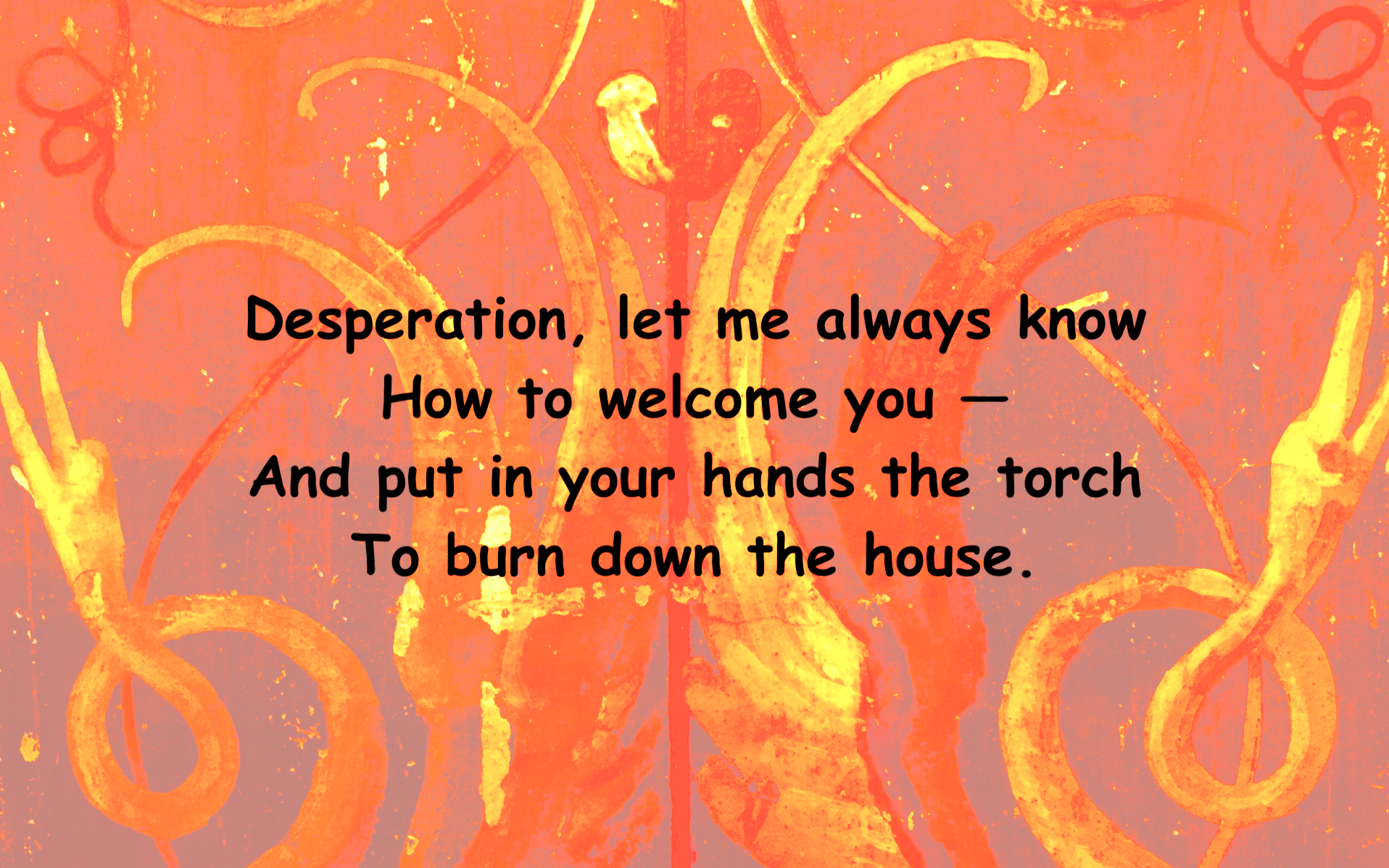
This translation, as well as the one below, are by Andrew Harvey (from Love’s Fire, 1988).
The desire for belief isn’t always a reaction to alienation or despair. It can also come from an understanding of the limits of human knowledge, or from an appreciation of the beauty and staggering natural order that surrounds us and that’s inside us (our brains contain over 100 trillion synaptic connections). This appreciation can be like a spark, setting alight a mystical sense that beauty and order is everywhere. Rumi mixes the scent of red wine with the sight of red flame to suggest that the general contagion of beauty is not just in our senses but is at the very core of our being:
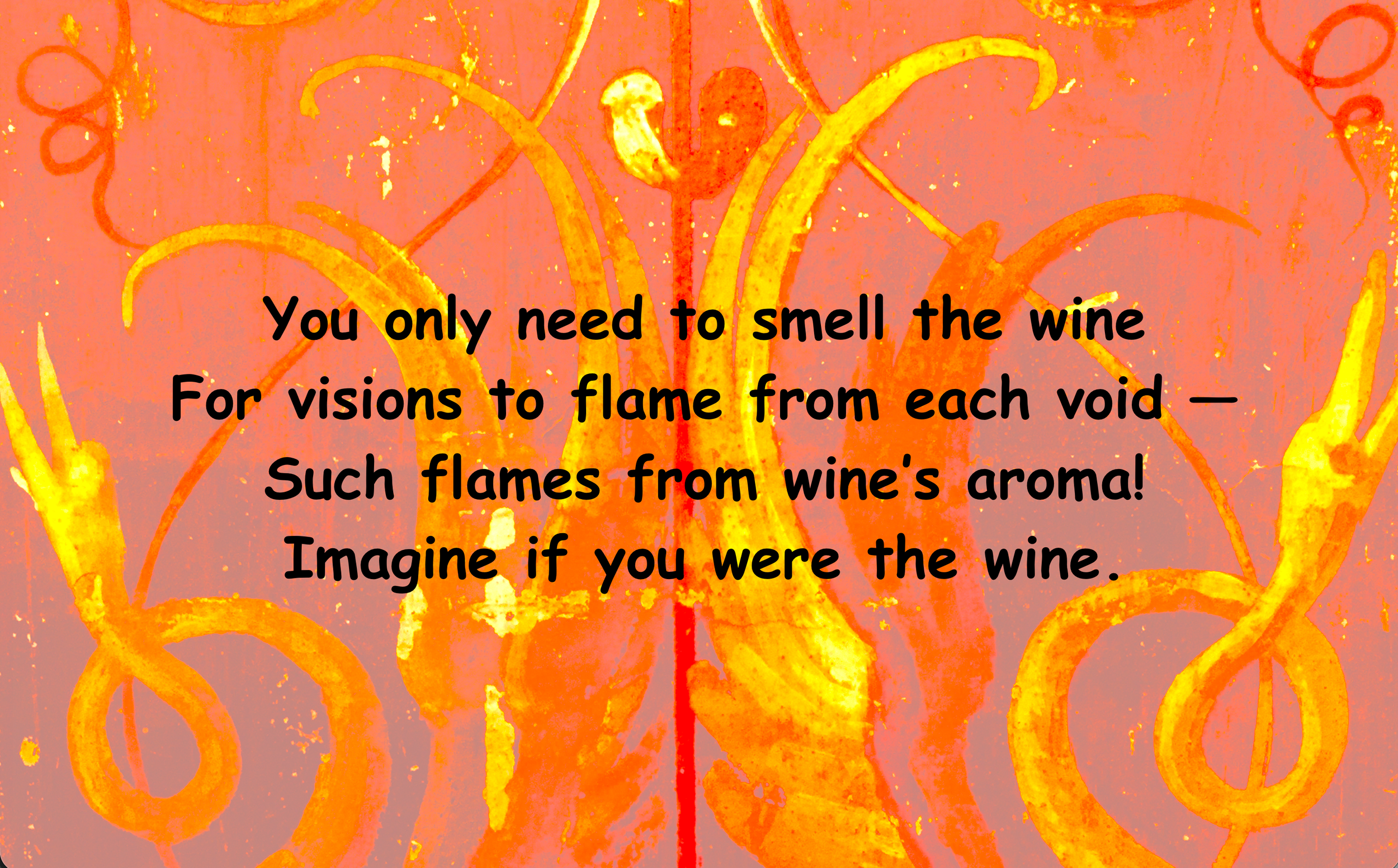
One of the reasons that Rumi is such a popular, universal poet is that he takes the hell or heaven of our lives and turns them into transcendent Meaning. No matter how dark or bright our lives are, all roads lead to God, who is at the same time Being, Infinity, and Meaning. Whether the world is burned down in a torrent of violence and death or in the fires of mystical vision, it all leads to the Infinite. Pascal also puts this eloquently when he says this world is an inifnite abyss that only the infinity of God can fill.
Belief also helps us cope with suffering and fear. I suspect that many avowed atheists would quickly swap their disbelief for belief when hurtling toward death in a crashing plane, or when facing a torturer’s blade. Psalm 23 may well have come to mind: Yea, though I walk through the valley of the shadow of death, I will fear no evil: for thou art with me; thy rod and thy staff they comfort me … In this case, atheists instinctively (and miraculously) transformed into theists, despite themselves.
Belief is equally helpful in confronting the unknown realms of dream and the afterlife. Psychologically, belief can help us come to terms with what Jung calls the shadow, that is, a darker part of us that lingers beneath our practicality, logic, and good intentions. With a belief in a universal Good, be it in the form of Krishna or Saint Mary, we may go to sleep more easily, knowing that we may soon be thrown into the chaos of our dreams. Dreams are perhaps the best analogy we have for the afterlife, since we don’t know what may happen: we may end up on a feather bed of angelic delight or we may end up face to face with a demonic beast. In such situations, all we can do is pray, Thy rod and thy staff they comfort me / Thou preparest a table before me in the presence of mine enemies… If we can’t think outside our own box of doubt, we have no backup, no refuge from the dangerous currents that flow inside our own minds and in the ether of space.
Belief is perhaps most needed when we contemplate death. As Hamlet notes, dreams are a foretaste of the afterlife, which may or may not exist. Hamlet says “perchance to dream”; that is, we sometimes dream and sometimes don’t. The only certainty here is that we don’t know if we’ll exist in an afterlife.
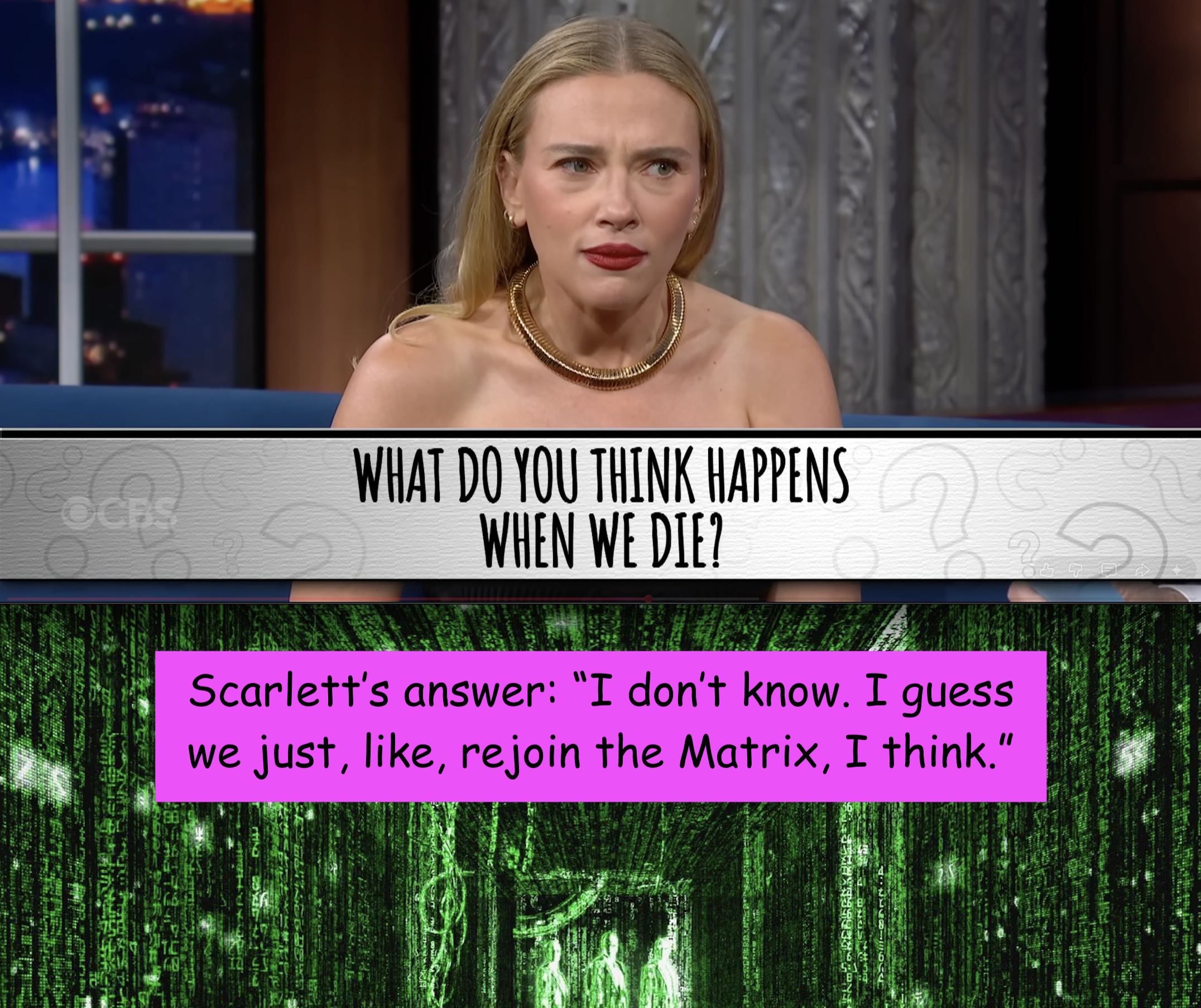
In thinking about the afterlife, it helps to entertain a positive sense about the universe. Who knows what sort of Purgatory or Hell awaits? Why not hope for the best? The mind reels. This is where it helps to entertain the notion of a benevolent God, or any form of Grace so powerful that whatever our past actions, we might still find peace and meaning.
Why, given our limited powers, resist the idea of God and Grace, when we can’t be sure they don’t exist, and when they might be so helpful in moments of danger and death? Why not keep our reasonable doubt, yet keep our minds open to belief? This, to me, is the valuable part of Pascal’s Wager, where the 17th century philosopher and mathematician argues that you have noting to lose and everything to gain by believing in God.
Yet none of this requires exclusivity. Just because we believe in one religious system doesn’t mean that there’s only one type of religious system, only one type of spiritual journey, or only one type of greater meaning. Doubting the superiority of our own particular belief system opens us to all the others. By giving ourselves the freedom to doubt, we can more confidently explore both science and religion. And if we give ourselves the freedom to explore spirituality, we’re more likely to go beyond tolerance and ecumenicalism to an understanding, through experience, of other religions. This is a type of lived Comparative Religion. It’s not just understood from afar — from either the academic’s chair or the throne of one who already knows the One and Only Truth. If we’re going to believe in a God that has no limits and can’t be circumscribed by reason, why ascribe to Him specific limits?
🍷
Next: 🍷 The Battered Caravanserai