
The Great Game 🎲 Fallar Discordia
Into the Battered Cliffs
🎲
The sun glittered above him and the water sparkled beneath him. Cagnazzo had the world at his fingertips. He breathed in deeply, confident that his every move would be executed with agility and precision.
He was about to dive from the springboard of Dun Aengus into the gorgeous blue playfulness of the North Atlantic. He was about to dive into the beautiful blue-green Mediterranean, with Messina on one side and Villa San Giovanni on the other.
Actually, he didn’t believe that he was anywhere near those places. Which just goes to show that he had no idea where he ought to have been.
🎲
Looking more carefully at the cryptogram Dactalla sent, Cagnazzo saw that her liaison with Qayam had born orchards of fruit. At long last. It had taken decades, yet finally she had established herself as an innocuous travel agent, and seduced Qayam. She had lowered his guard to the point where she found herself unsupervised for three hours in his apartment, opening the files on his personal computer.
Dactalla included in her cryptogram detailed notes on how she got Qayam to let down his guard. She listed the sexual enticements she offered — the minzin coat that she opened like the petals of a blood rose, the shimmering skirt that fell down her slim legs, and the black satin shift that was so thin and so short that Qayam could see her nipples beneath, and her pubic hair in the bright sun of his bedroom lamp. She described, somewhat ambiguously, the way she used her mouth and hands, to the point that Qayam couldn’t tell which was which. She also listed the drugs she used to put Aatari Lok’s top security agent firmly in Fairly Land for four straight hours.
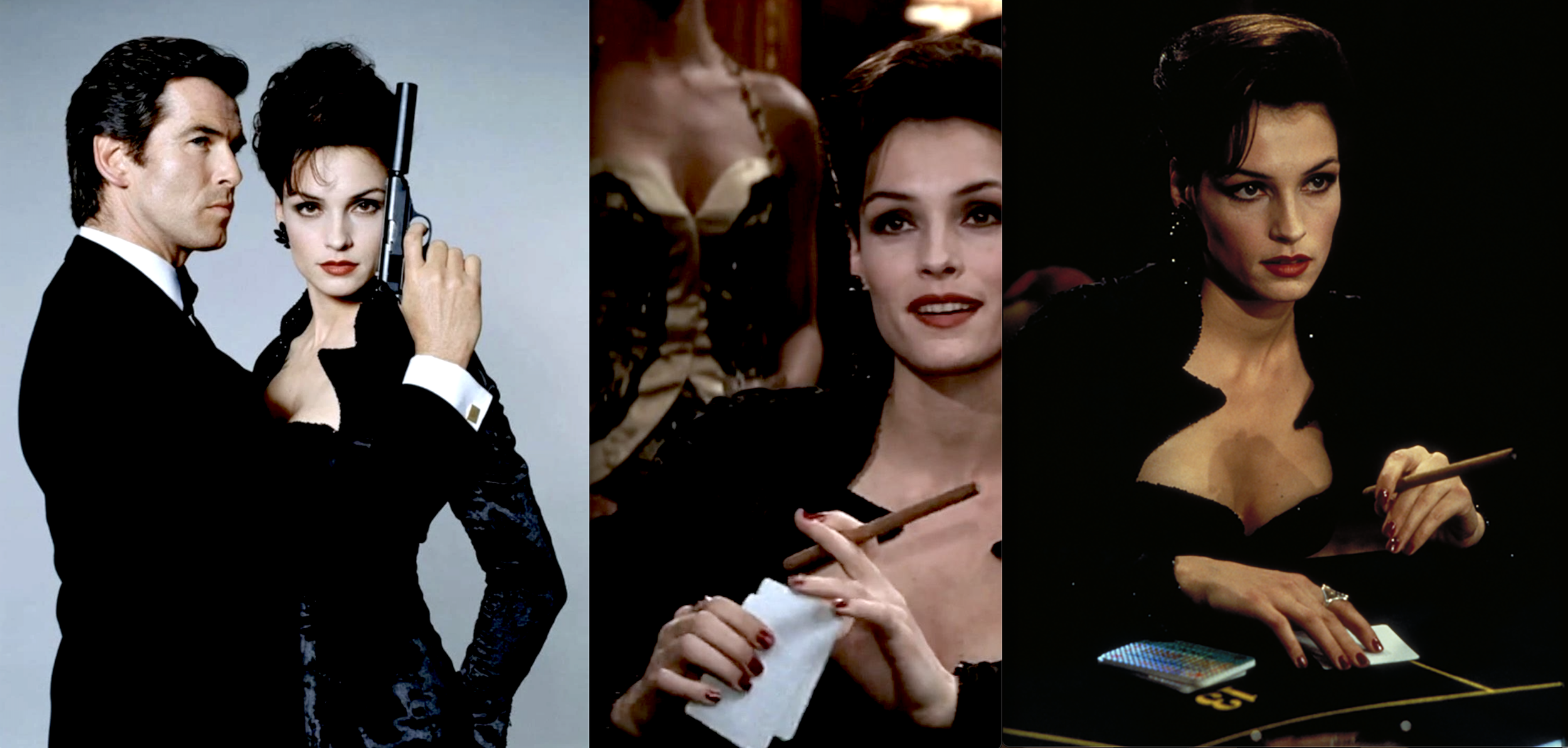
Cagnazzo imagined her in action, as if she were at a card table in a Bond film. She was the icy-hearted Kseniya Onatopp. She was on a deep-cover mission to bring down that goodie two-shoes, that fluffed-up dandy James Bond, together with that almighty gang of toffee-nosed snots, MI6.
But why did Dactalla have to send him so much unnecessary information about what she did in the bedroom? He didn’t give a damn about that! Why didn’t she just file it in a separate report, in an appendix, or in the end notes? Instead, she put the infernal details in point form in the footnotes, in the same font size, directly below the information copied from Qayam’s computer.
- drugs took effect - threw him on bed - jerked his cock a dozen times - got his attention - placed cuffs on hands and ankles - scraped my nails along —
Cagnazzo couldn’t bear reading the footnotes, and forced his eyes to the top of the screen.
🎲
The files were invaluable. They contained detailed information about criminals, and also about the methods Qayam used to track them. The files laid bare how Aatari Prime surveilled the trillion galaxies of the Aatari Lok universe. Much of their surveillance occurred on the Ataari planet of Kollarum, the most famous of all planets when it came to summits, international diplomacy, conference centres, and holiday resorts. For it was in Kollarum that the thirteen universes of the cosmos met to decide policy and resolve disputes. While Vicino Prossimo and Fallar Prime were the two most powerful planets in the cosmos, Kollarum was where they met.
Dactalla’s files also laid bare the manner in which Aatari agents communicated with their lawyers, judges, and politicians, and, even more astonishingly, how they communicated with their counterparts in the Blue Dream Alliance.
Cagnazzo was beside himself with glee. This was the information he needed to get around the Dolcezza universe cluster, which was the main extensions of Vicinese power.
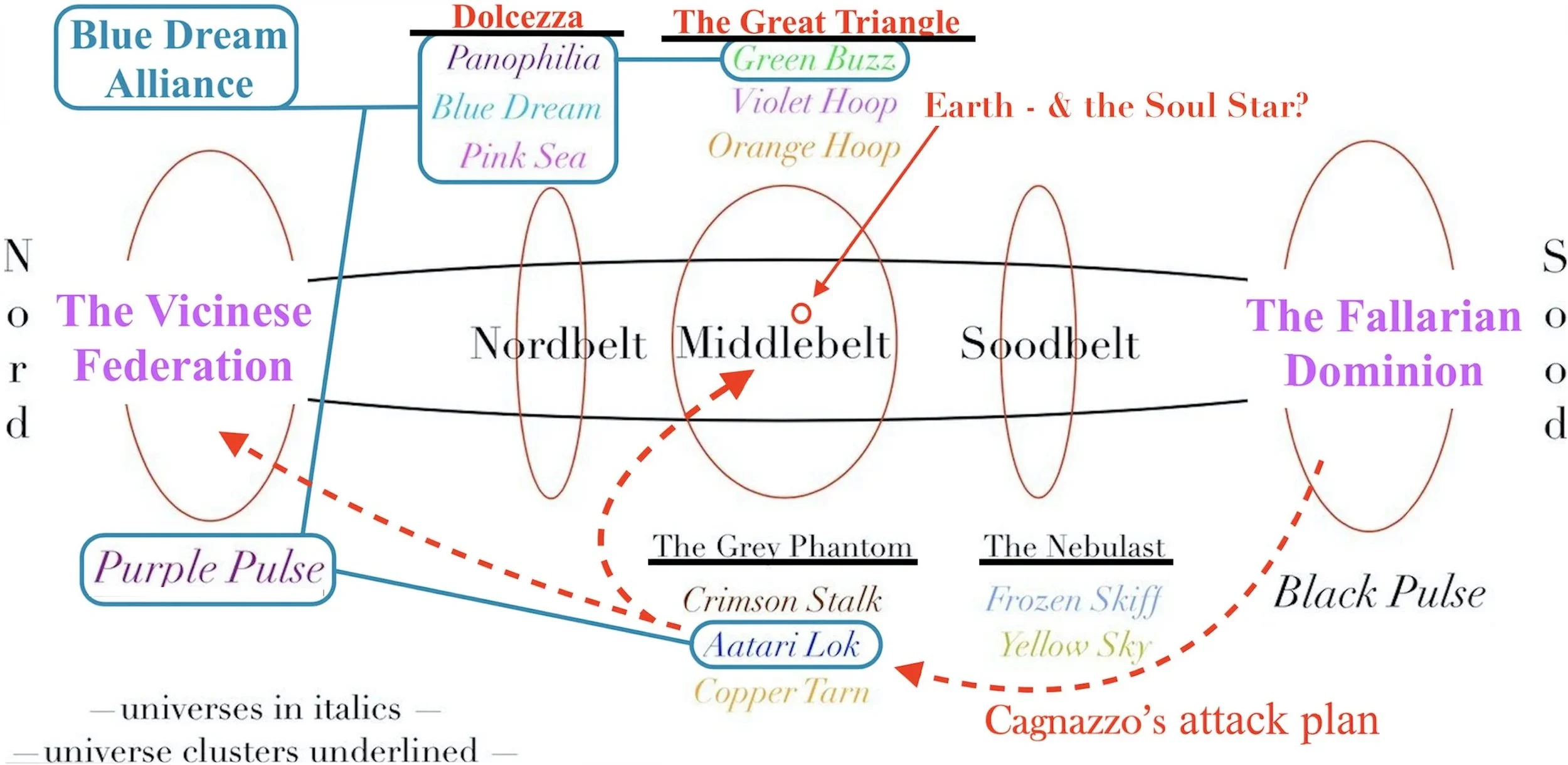
It was in the Dolcezza that the Blue Dream universe first began the initiative that was eventually to become the Blue Dream Alliance, the most powerful alliance in the cosmos. It was a military, trade, and intelligence alliance of six universes: The Purple Pulse (seat of the Vicinese Federation), Panophilia, Blue Dream, and Pink Sea (the three universes in Dolcezza), and the Green Buzz and Aatari Lok (in the Great Triangle and the Grey Phantom respectively).
The Blue Dream Alliance was what held the Nordern half of the cosmos together, and it was the Vicinese Federation that was the heavyweight power in the Alliance. While Aatari Lok was of great great interest to Cagnazzo, his real aim was the planet of Vicino Prossimo, the capital of the Vicinese Federation.
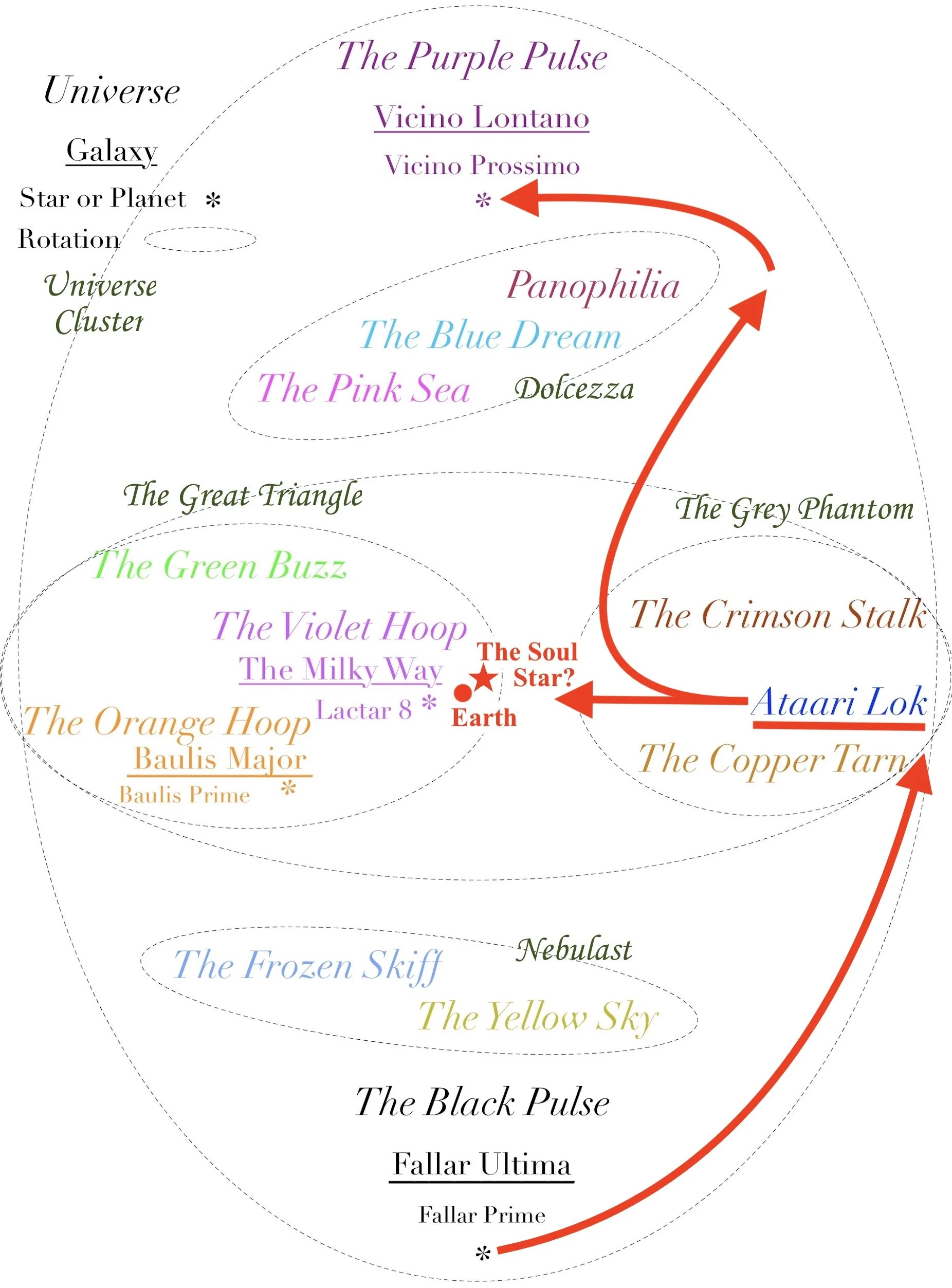
By worming his way into Aatari Lok, Cagnazzo planned to infiltrate the Vicinese intelligence network. He could also get his hooks into the Violet Hoop, which was home to Earth and the elusive Soul Star.
The Soul Star
According to legend, the Soul Star lay somewhere in the Local Void of the Virgo Supercluster. Rumoured to lie at the centre of everything, it was supposedly the heavenly place to which souls travelled after their bodies died. Yet figuring out the exact “centre of everything” was difficult, given that galaxy walls and universes shifted constantly. It was even more difficult to calculate the trajectory of souls at the moment of their death, given that their trajectory was only measurable for a second or two.
Cagnazzo had spent centuries trying to measure this trajectory. 200 years ago he built a laboratory on the planet of Tarry Doom (later called Tarry Dot). His hope was that by triggering a series of mass extinctions, he might detect a stronger and more accurate trajectory signal. From there, he hoped to locate the Soul Star and either destroy it or bring it under his control. He also wanted to capture the energy of the soul’s initial trajectory, and direct it to the Black Star in the Black Pulse.
Yet his lab on Tarry Doom was blown up by what he called the enemies of science. These were the same idiots who were obsessed with Earth and its potential to be a Gateway to Heaven. These Idiots pointed out that Earth was, as primitive Earthlings once said, at the centre of the universe. Yet these idiots were as clueless as the primitives who once insisted that the Earth was flat.
Of course Earth was at the spatial centre of the universe. Yet for how long? The Vicinese planted their Soul Star in the centre, yet the Fallarians created their own Black Star, the densest black hole in the cosmos. For centuries Cagnazzo had been working on a technology that could magnify the Black Star’s density. In Time, he hoped to see the Star become so dense that the other twelve universes of the Kraslika would revolve around the Black Pulse.
He saw the Kraslika twirling like a fiery comet with the Black Star at its centre, rocketing through outer space to who knows where. At the dusty tail of this whipping fireball was the Vicinese Federation, flailing and flying apart into the dark embers of the cosmos. Or, better yet, the Vicinese and all their poetic nonsense would be flung off the Congo-line of burning universes and crash into some dense field of intergalactic tar. Reduced to the scattered nothings of a comet’s tail, the Vicinese would land in an inky Cloud of Unknowing. They would spend decades, perhaps centuries in this backwater of science and superstition, where the gentlemen wore black stockings and looked up into the sky to see if there could possibly be life beyond their tiny planet.

About a terrible and marvelous comet as appeared the Tuesday after St. Martin's Day (1577-11-12) on heaven. A depiction of the Great Comet of 1577 over Prague. In addition to the comet, five zodiac symbols appear in the sky: (L-R) Aries, Pisces, Aquarius, Capricorn, and Sagittarius. Below the comet's tail are the crescent moon and Saturn, depicted as a star with the astronomical symbol ♄. At the bottom center, a man draws the comet by the light of a lantern. 1577. woodcut print, Zentralbibliothek Zürich, Source/ Photographer: Zentralbibliothek Zürich. From Wikimedia Commons.
The idiots would no doubt respond with the same old song about the mystic connection between Earth and the cosmos, about the mystic crystal revelation that would one day bring all races together as One. Cagnazzo couldn’t think of anything worse.
So what if human poets wrote about a heavenly star whose worth’s unknown although its height be taken? So what if their planet mirrored the cosmos in strange ways? He didn’t care that the Vicinese and Fallarian word manipulare was the same in Italian, or that the German word Hölle was the same word that the Vicinese and Fallarians used for Hell. Humans were pre-fractal idiots. Its height be taken — what a laugh! Humans couldn’t even measure the size of their own universe! Cagnazzo couldn’t care less about what the humans thought. And he couldn’t care even less about poetry.
But one thing he did care about was getting control of the Soul Star. In his black notebook, where the letters only scintillated under a compressed ferridian light, he wrote the following goals:
✦ First, control the Soul Star and point its dense energy at the enemies. These enemies include, but aren’t limited to: Ferridian Priests who don’t follow orders (backstabbers like Graffiacane and Draghignazzo). Then suck the Soul Star into the Ferridian Black Star in order to ignite the engine to propel the entire Kraslika across the black heavens like a burning comet.
✦ Second, deactivate that part of the Soul Star which allows the enemies to find a place to hide. Why should they be granted an eternal refuge, forever beyond my grasp? What’s all this nonsense about Grace and Reconciliation?
✦ The second goal brings up a third, which sprang from the worst of my fears, from what I want most to avoid: succumbing to the pull of the Soul Star myself. What if I too, at the moment of my death, am overpowered and sucked into its angelic vortex? What if I too am left forever sitting on some cloud, harp in hand, talking about my feelings to a stupid cherub? I can see it already: the brainless child yanks me by the throat, while his fellow idiots teach everyone to bounce on clouds as if they were trampolines.
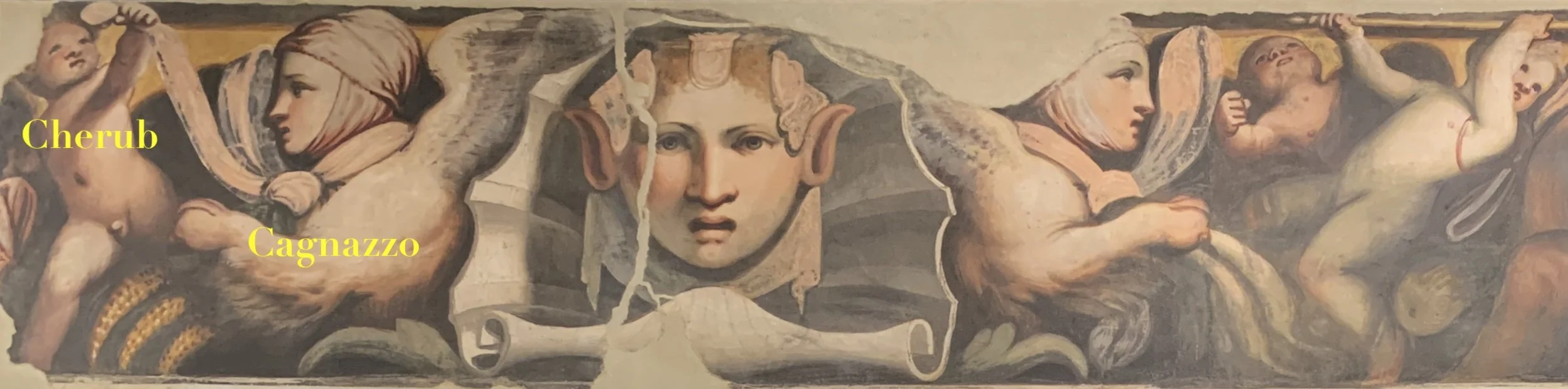
From the Pinacoteca Tosio Martinengo, Brescia, Italy (photo by RYC)
If I take control of the Soul Star I’ll teach the little numbskulls how to behave in the presence of their betters. I might even teach them how to ride one of my four white stallions with the black eyes. Better to whip them with my riding crop than to allow them to stick their noisome violins in my finely-tuned ear. Better to seize the Soul Star now, while I still had Time in my hands. Better that than languish forever in Time’s slow-chapped power.
✦ An alternative plan: refit the Star for a different purpose. If the Star can be used to store souls for eternity, it can be used to make those souls do my bidding for eternity. Why fling all of existence across the heavens if you could make the heavens your slave? Better to reign in heaven than fly endlessly through eternal darkness.
While Cagnazzo liked the scenario of flinging the Vicinese into a field of intergalactic tar, he knew it would be more satisfying to control them forever. He would never tire of watching them dance to his merry tune.
He could see it all: Time’s wingèd chariot hurried near, and yonder all before them lay deserts of vast eternity. There, on those arid plains, the old gods Shamash and Helios worked 12 hours a day doing his bidding in dark back alleys, digging canals and uncovering secrets, constructing ziggurats and threatening the justices of the peace. No longer would they get to hold the reins of their precious sun-chariots.
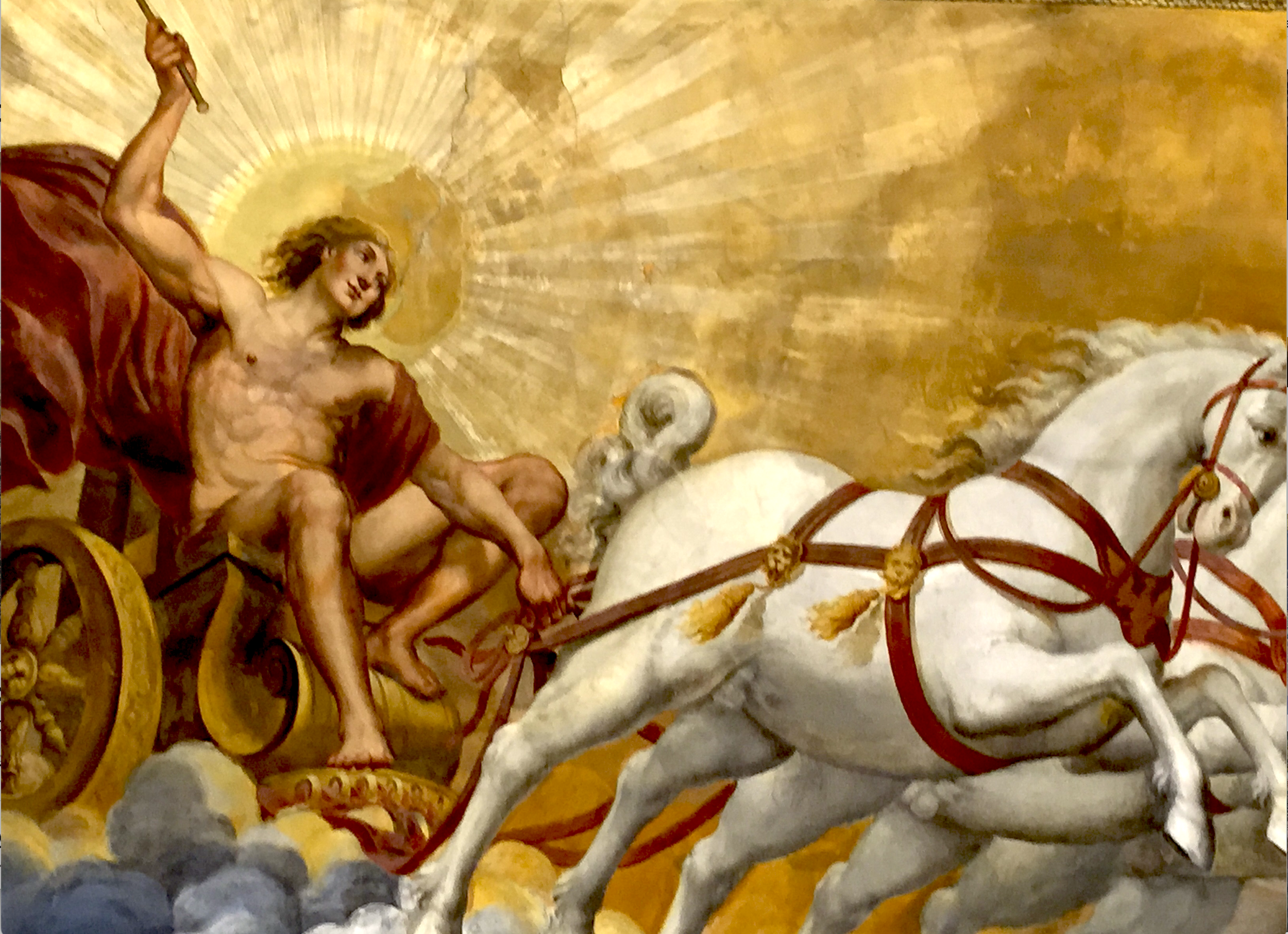
From the ceiling of the Palazzo Ducale in Mantua (photo by RYC)
Instead, they would be demoted from charioteer to steed. They would spend their days weeping hot tears onto the trampled clouds.
Like a king in a soliloquy, Cagnazzo concluded his feverish dream:
Thus, though we cannot make our sun
stand still, yet we will make him run.
The only drawback he could see in all this was that it rhymed.
🎲
Next: 🎲 Degrees of Darkness
Contents - Characters - Glossary: A-F∙G-Z - Maps - Storylines