
The Double Refuge ⏯ Systems
Lord of the Meeting Rivers
2: Syncretism
Starting in Haridwar - A River By Any Other Name - The Western Sadhu - A Fluid Definition of God - Unified Sensibility
⏯
Starting in Haridwar
The photo in the banner above was taken by Dirk Hartung at the Kumbh Mela festival in Haridwar, a city of about 230,000 which lies in the foothills of the Himalayas. Haridwar is one the four cities which host Kumbh Mela pilgrims from all over the world, the largest meeting taking place on the Ganges at Prayagraj, which is about 500 miles downstream.
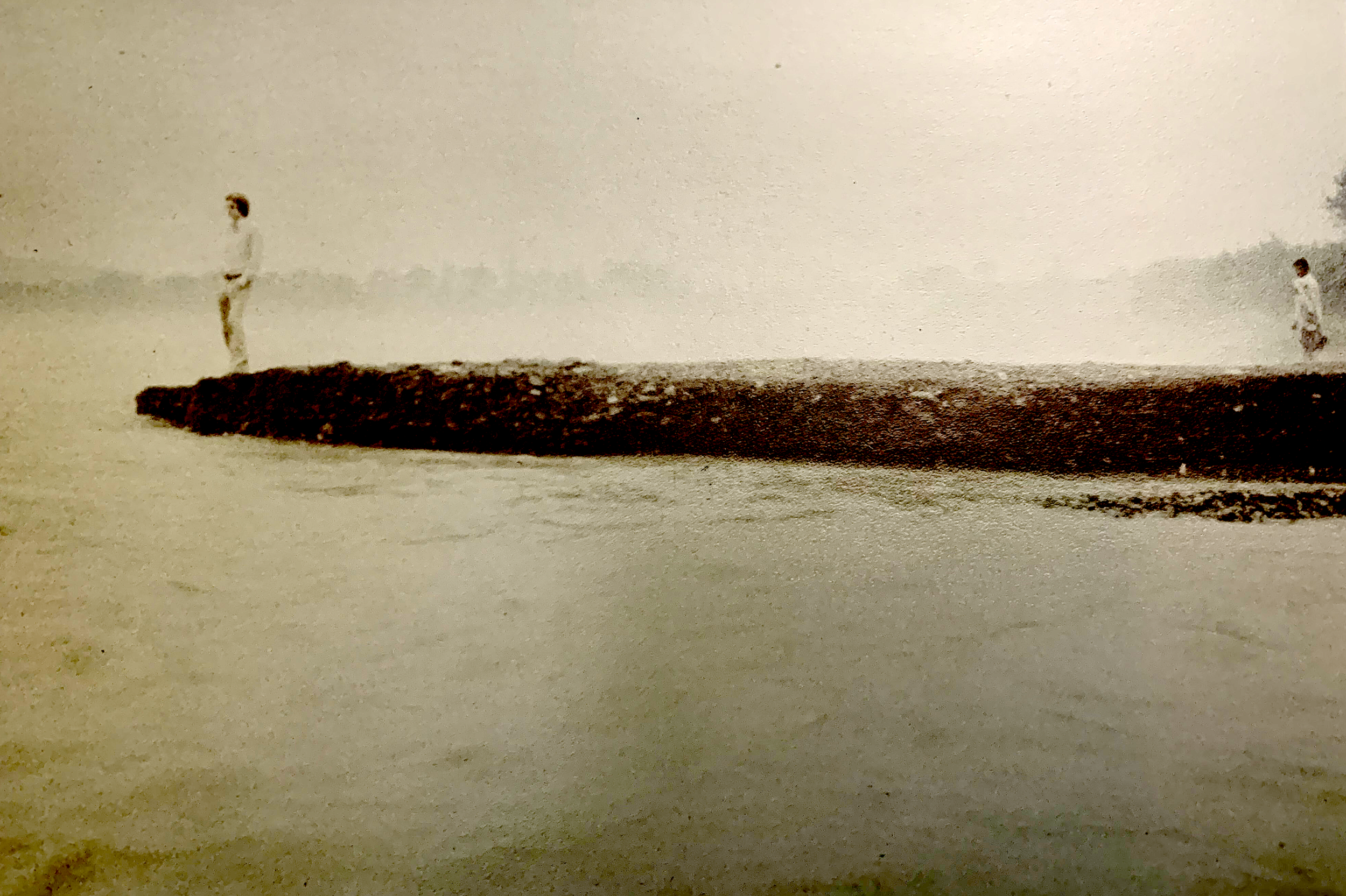
It’s hard to imagine how large the river is, even in the foothills. Here’s a shot of me in Rishikesh, upriver from Haridwar, followed by a shot of Haridwar from the air:
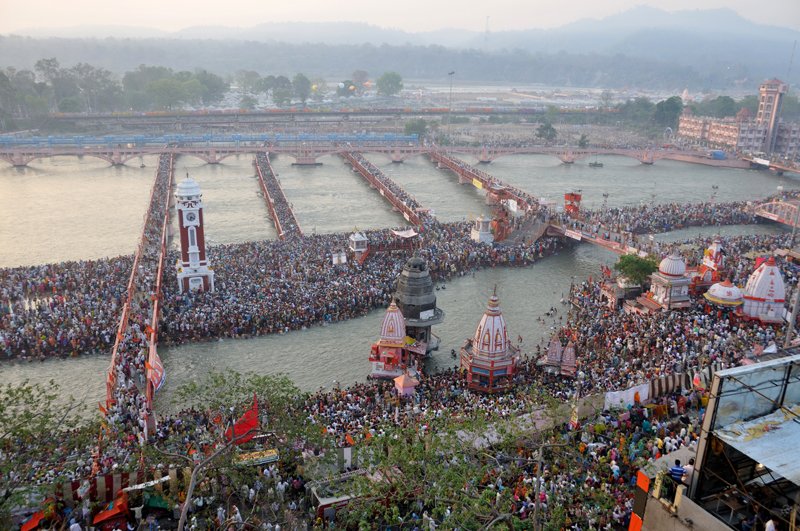
Haridwar April 14th 2010: Pilgrims gather at the third Shahi Snan in Har ki Pauri to take the Royal Bath in the Ganges. Video still from the documentary "Amrit Nectar of Immortality" April 2010. Author: Coupdoeil / Philipp Eyer. (From Wikimedia Commons)
From Haridwar the Ganges flows one and a half thousand miles to the Bay of Bengal. Hindus believe that the river flows down through the hair of Shiva, who is often referred to as the Lord of the Meeting Rivers.
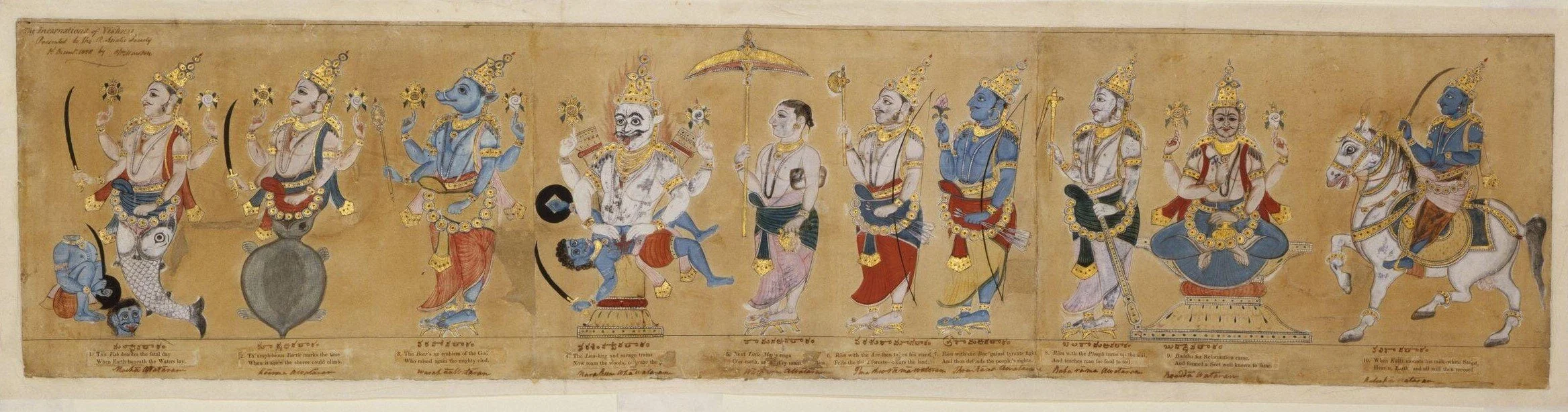
Shiva is one of the two greatest Hindu gods. He’s often thought of as the Destroyer, while Vishnu is seen as the Preserver, yet these names don’t adequately describe their complexity. To start with, Shiva dances his cosmic dance of both destruction and creation, and Vishnu has ten avatars (or divine incarnations), which together express a personality that defies simple definition.
From Wikimedia Commons:
Dasavatar, Andhra Pradesh, 19th century. India. (Combined version of two pieces of a scroll painting. Enhanced, corrected and joined using Photoshop 7)
Watercolour and gold on paper.
From left: Matsya, Kurma, Varaha, Narasimha, Vamana, Parashurama, Rama, Balarama, Buddha, Kalki.
"Marks and inscriptions
1. The Fish denotes the fatal day / When Earth beneath the Waters lay. / Macha Awataram' The fish incarnation of Vishnu (Matsya avatara)
2. Th'amphibious Turtle marks the time / When it again the shores could climb. / Koorma Awataram.' The turtle incarnation of Vishnu (Kurma avatara)
3. The Boar's an emblem of the God / Who raised again the mighty clod. / Waraha Awataram' The boar incarnation of Vishnu (Varaha avatara)
4. The Lion-king and savage trains / Now roam the woods, o[r] graze the [plains]. / Narasheem Awataram' The man-lion incarnation of Vishnu (Narasimha avatara)
5. Next [came the] Little Man's reign / Oe'r earth an[d wa]try' main / Wamana Awataram' The dward incarnation of Vishnu (Vamana avatara)
6. Ram with the Axe then takes his stand, / Fells the thick forests - clears the land. / Parasurama Awataram' Rama with the Axe (Parasurama avatara)
7. Ram with the Bow 'gainst tyrants fight[s] / And thus defends the people's rights. / Shreerama Awataram' Rama with the bow (Rama avatara)
8. Ram with the Plough turns up the soil, / And teaches man for food to toil. / Balarama Awataram' Rama with the Plough (Balarama avatara)
9. Buddha for Reformation came, / And formed a Sect well known to fame. / Boodha Awataram' Vishnu as the Buddha (Buddha avatara).
10. When Kalki mounts his milk white Steed, / Heav'n, Earth, and all will then recede! / Kalkeekawataram' Vishnu as a warrior on a white horse (Kalki avatara)"
Date: 19th century. Source: V & A Museum. Author: Anonymous
The two gods are also a mirror of Hinduism itself: a spiritual force may take a particular form, yet each form merges back into the Whole, the infinite Godhead, which for want of a better term is often called Brahman.
It’s a tricky concept for Western religious sensibilities, which tend to see One God as a doctrinal foundation, and tend to see any splintering of this One God as a deviation rather than as an expansion. Yet to Hindus there isn’t a contradiction between a God like Shiva, Vishnu, or Mahadevi (literally Great Goddess) who represent a totality of spiritual aims, and the even greater essence of Brahman into which all concepts of deity merge. Westerners often think of this as polytheism, as a diversity of deities, while Hindus see this as a syncretism or merging, as a Oneness in Diversity, or a Diversity in Oneness.
This syncretism has deep roots in Hindu theology. Indeed, the two main streams of Hinduism are based on this oneness or non-duality: 🔺 the stream which sees all gods and all souls as the same infinite Brahman is called Advaita Vedanta or Non-dual Completion of the Vedas; 🔺 the stream which sees all gods and souls as distinct yet also part of Brahman is called Visist Advaita Vedanta or Qualified Non-dual Completion of the Vedas. The important thing to note here is that both streams have as their main modifier Advaita, non-dualism. I should note here that there are also dualistic streams of Hinduism, yet the non-dual streams predominate.
While Hindu philosophizing on these points is diverse and complex, in general Hindus accept 🔺 pure non-dualism, where everything is unified in Brahman, and 🔺 qualified non-dualism, where there are temporary spaces between Brahman and Deities, as well as temporary spaces between a specific Deity and His or Her worshipper. Non-dualism remains even when it’s qualified, that is, even when complete unity is momentarily altered by intense focus on a specific Deity, or by the worshipper’s distance from (and yearning) for that Deity.
⏯
A River By Any Other Name
Nor does it seem strange to Hindus that spiritual forces can take on worldly forms and yet still be part of an ineffable greater spiritual Unity. This allows for all sorts of scenarios which diverge and merge, weaving together spiritual powers with what we normally consider worldly things like geography and sex. For instance, high on Mount Kailasa Shiva makes love with his consort Parvati, and shakes the cosmos. Yet he also saves the world when he uses his body to stop the impact of the goddess Ganga as she falls to Earth, laying down his long hair to break her fall.
For Hindus, the Ganges is not only a life-source for much of Northern India. It’s also a goddess who brings purity, forgiveness, and deliverance from the heavens. It’s considered the greatest fortune to be cremated in Benares (Varanasi) and to have your ashes scattered onto the Ganges. Along the ghats of the great river, homeless long-haired sadhus smear their foreheads with ash, and chant mantras to their god Shiva.
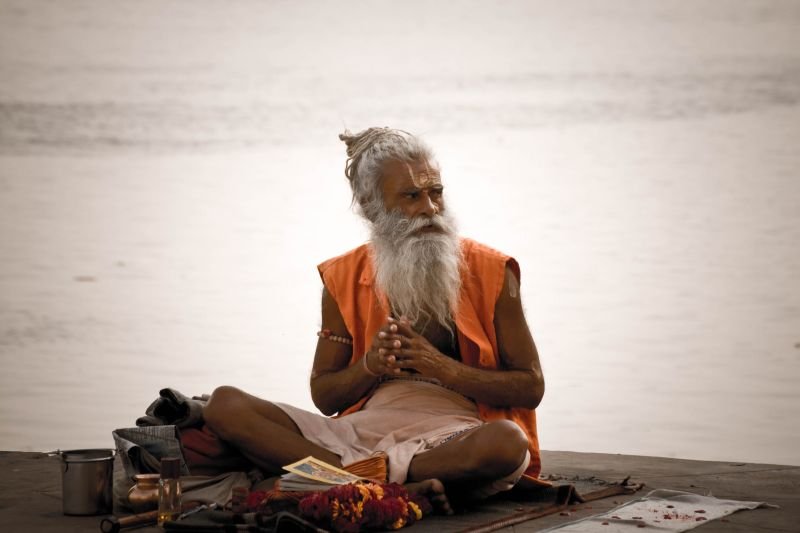
A sadhu by the Ghats on the Ganges, Varanasi (Benares). 22 de març de 2008. Autor. (From Wikimedia Commons).
En route to the Bay of Bengal, the Ganges passes by Prayagraj, once called Allahabad. Here the holiest of Hindu rivers meets the Yamuna River, which is also a goddess of love and nurturing. At Prayagraj the two goddesses meet a third goddess, Saraswati.
Hindus believe that the Saraswati River once flowed in the West, most probably in the Punjab, which means the Five Rivers (from the Persian panj five and āb water). Hindus also believe that it was on the banks of the Saraswati that the great poets wrote the Rg Veda, the deep symbolism of which constitutes the most ancient roots of Hinduism. (Philologists believe the Rg Veda was composed around 1500 BC, although most Hindus believe it to be much older). Hindus also believe that the Saraswati River later went underground, and that it now resurfaces at Prayagraj, the meeting point of the three rivers.
Symbolically, Prayagraj is an enormously consequential site. Its name comes from Prayāga, which means place of a sacrifice (from the Sanskrit pra fore and yāj to sacrifice), and Hindus believe that the creator God, Brahma, performed the first ritual sacrifice at this location. Because of all this (and much more), Prayagraj is the site of the largest religious gathering on Earth. According to Wikipedia, “The 2025 Maha Kumbh Mela in Prayagraj concluded with a record-breaking, cumulative attendance of over 660 million pilgrims over its 45-day duration.”
To me, Prayagraj is a Hindu name and has a Hindu meaning, yet it also retains its old Muslim name, Allahabad, “God’s abode.” While Hindu nationalism has recently risen in India, I suspect that the syncretic logic of Hinduism still allows for this, just as it 🔺 allows a river to be a goddess, as it 🔺 allows each person to choose their own god or goddess, and as it 🔺 allows a river to disappear and reappear; to change places and keep its original identity, as if deity itself was fluid, transcending time and space.
In Prayagraj the most metamorphic of river deities is Saraswati, goddess of language, art, and music. She’s especially famous for her patronage of poetry, which might be defined as the metamorphosis of words into new meanings, symbols, and extended metaphors. Like Persia, India is especially rich in this type of language, from the first Vedic utterances to the 12th century poetry of Basavanna:
Make of my body the beam of a lute
of my head the sounding gourd
of my nerves the strings
of my fingers the plucking rods.
Clutch me close
and play your thirty-two songs
O lord of the meeting rivers!
— From Speaking of Shiva, trans. A.K. Ramanujan
The logic of Hinduism doesn’t stop there. Or anywhere. Hindu rivers aren’t historically defined in the manner of Jordan or Tiber, and because of this they can merge with all rivers of symbolic intent.
⏯
The Western Sadhu
In the following poem I take advantage of this fluidity, imagining a Western sadhu among the crowds on the banks of the Ganges at Haridwar. He communes with the mystical feelings around him, and immerses himself in the baptismal waters of their beliefs. Yet in the end he returns to a Greek construction — Charon and the River Styx — not in a denial of his surroundings, but in their expansion:
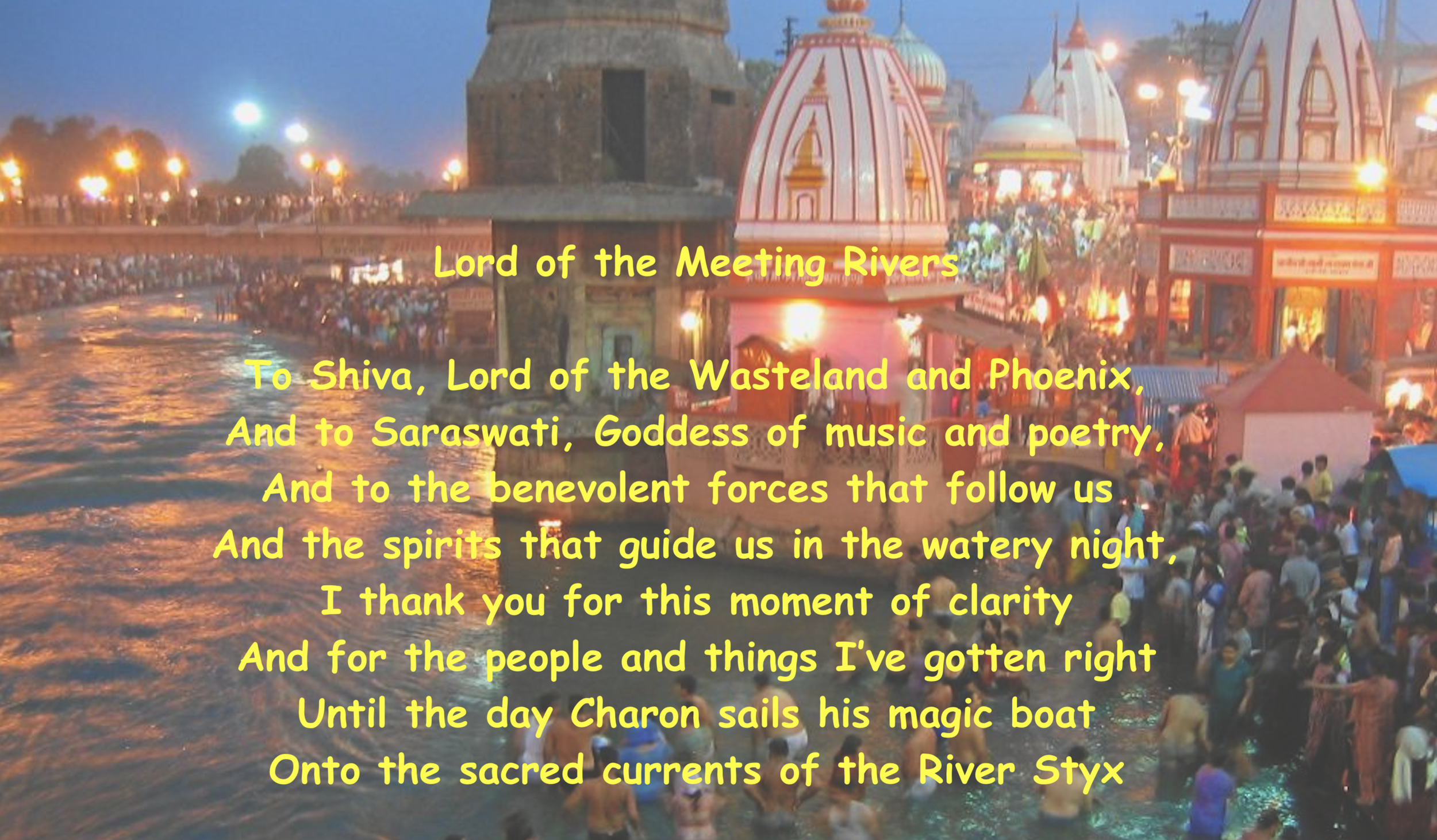
On the way back from a weekend of river rafting in Rhishikesh we stopped in Haridwar, because the Aarti ceremony was soon about to start. It was an amazing experience with this huge number of people and all the lights. Some of my Indian colleagues took a dip in the water. Few of them even did the 100 dips. May 2004, 19:17. Source: Evening prayers at Har-Ki-Pairi Ghat in Haridwar. Author: Dirk Hartung from Bonn, Germany. (From Wikimedia Commons)
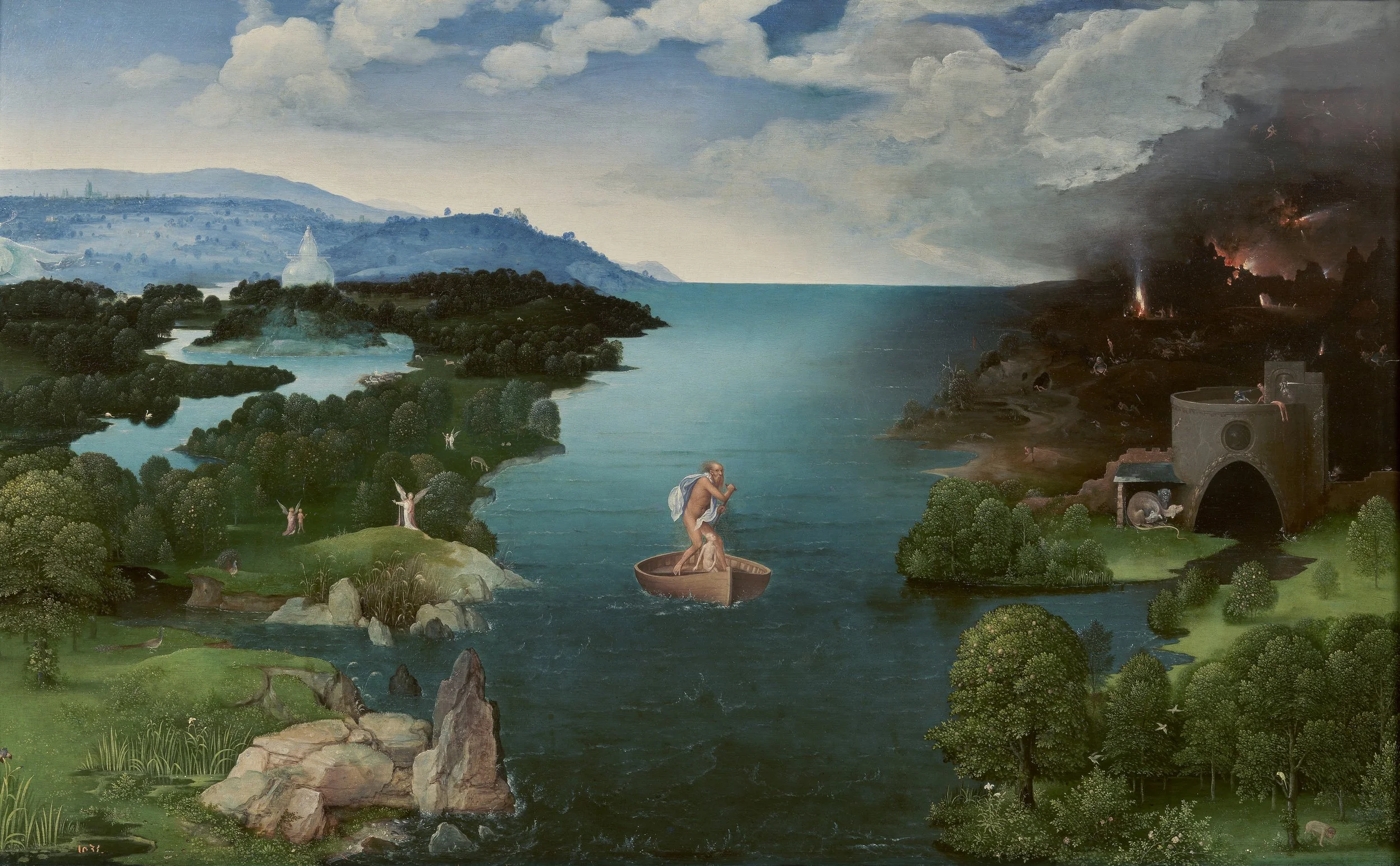
Landscape with the crossing of the Styx, between 1520 and 1524, by Joachim Patinir (circa 1480–1524), Museo del Prado. (From Wikimedia Commons)
Our Western sadhu, having wandered so far from home, nevertheless returns to it. His fusion of allusions can be seen all along: 🔺he thinks of Shiva’s dance of destruction & creation in terms of the Phoenix, (which is Greek but has parallels in Egypt and Persia); 🔺 his reference to Saraswati brings to mind the Greek Muses, and 🔺 his forces and spirits can be applied both East and West. Such a traveller has much in common with the travelling afterlife soul: deep down they may come from somewhere else, but their aim is to open themselves to new forms.
⏯
A Fluid Definition of God
For open theists, all the great religions are true. And even many are true that aren’t considered great. In each of them, the only thing the open theist is wary of is the claim of exclusivity. The claim of only this and the highest that. It’s paradoxical, not contradictory, to state, All truths are acceptable, except those who would tell you, “Ours is the only truth, and all the others are vanity.” If non-dualists didn’t object to exclusivity, they wouldn’t be non-dualists.
I realize this isn’t the standard definition of religion, but it seems to me that the word religion and the concepts of spirituality have been controlled too long by those 🔺who not only believe their religion to be the most true (which they have every right to believe) but also by those 🔺 who slander, downgrade, and misrepresent other religions, so as to maintain in public discourse that those others are false.
We can believe in our heart of hearts that our God is the only God, but at some point we must surely allow God to work in a different way in order to touch people who are different from us. Even if our hearts can't do this, our minds can. This is perhaps the reason why the most intolerant believers downgrade the value of reason, logic, scholarship, comparative analysis, and anything else that approaches ecumenicalism, or tries to expand ecumenicalism into global religion and syncretism.
Imagine you’re sitting in a room full of theists. One of them says that only he understands the room, the people in it, the world outside, the world below, and the invisible truths that float uncounted in the ether above. Would you believe him? Or would you listen to the counsel of each theist, assuming that each religion is a component of all religion? Emerson gets at this interconnectivity and interdependence in the final lines of his 1834 poem “Each and All”:
Then I said, "I covet truth;
Beauty is unripe childhood's cheat;
I leave it behind with the games of youth:"
—As I spoke, beneath my feet
The ground-pine curled its pretty wreath,
Running over the club-moss burrs;
I inhaled the violet’s breath;
Around me stood the oaks and firs;
Pine-cones and acorns lay on the ground;
Over me soared the eternal sky,
Full of light and of deity;
Again I saw, again I heard,
The rolling river, the morning bird.
Beauty through my senses stole;
I yielded myself to the perfect whole.
Only the all can welcome the diverse eaches, and bring them into conference and unity. The use of only here is a paradox, not a contradiction, because a totality cannot be confused with a part. The Medieval Sufi poet Attar knew this, despite the many exclusive claims of Islam. His Conference of the Birds is premised on this idea.
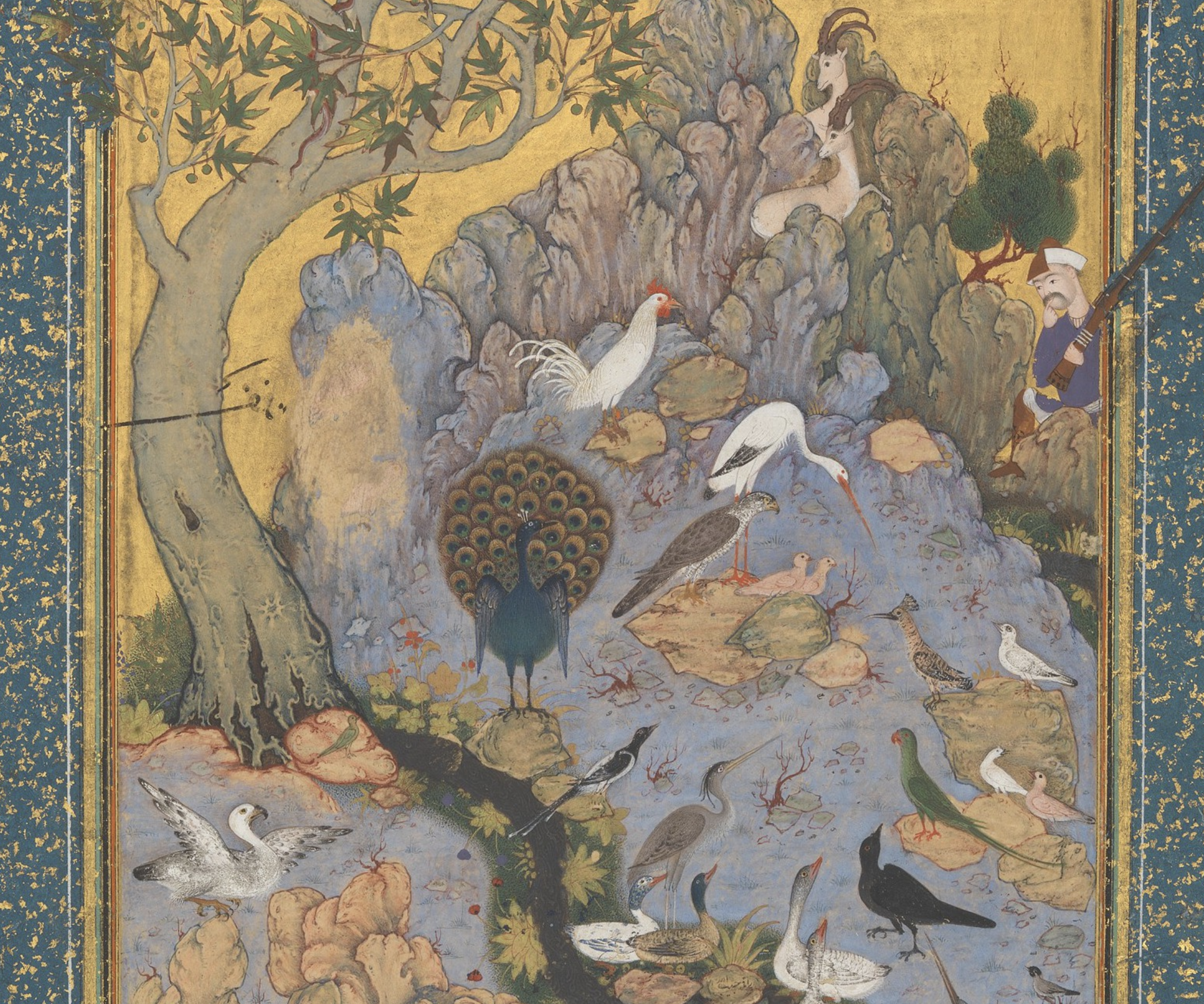
Page from a manuscript of Conference of the Birds, by Habiballah of Sava ca. 1610. (Wikimedia Commons, cropped by RYC)
Attar’s 30 birds represent the infinite voices, peoples, and realities of life. His Conference is the acknowledgment that each is important to all, and that no each can speak for all, silencing others who disagree. This deeply political point is embedded in a religious context, just as the 30 birds, si murgh in Persian, merge into the king of birds, the Simurg, at the end of his long poem. Once the 30 birds have winnowed away their self-centredness, they realize that the Simurg isn’t a physical bird, but rather it’s the union and annihilation of the 30 souls who reach the peak of Mount Qaf. This mountain lies all around us, suggesting the furthest reach of human existence, its magic green jade encircling the Earth, and its mythic stone rising to the heavens.
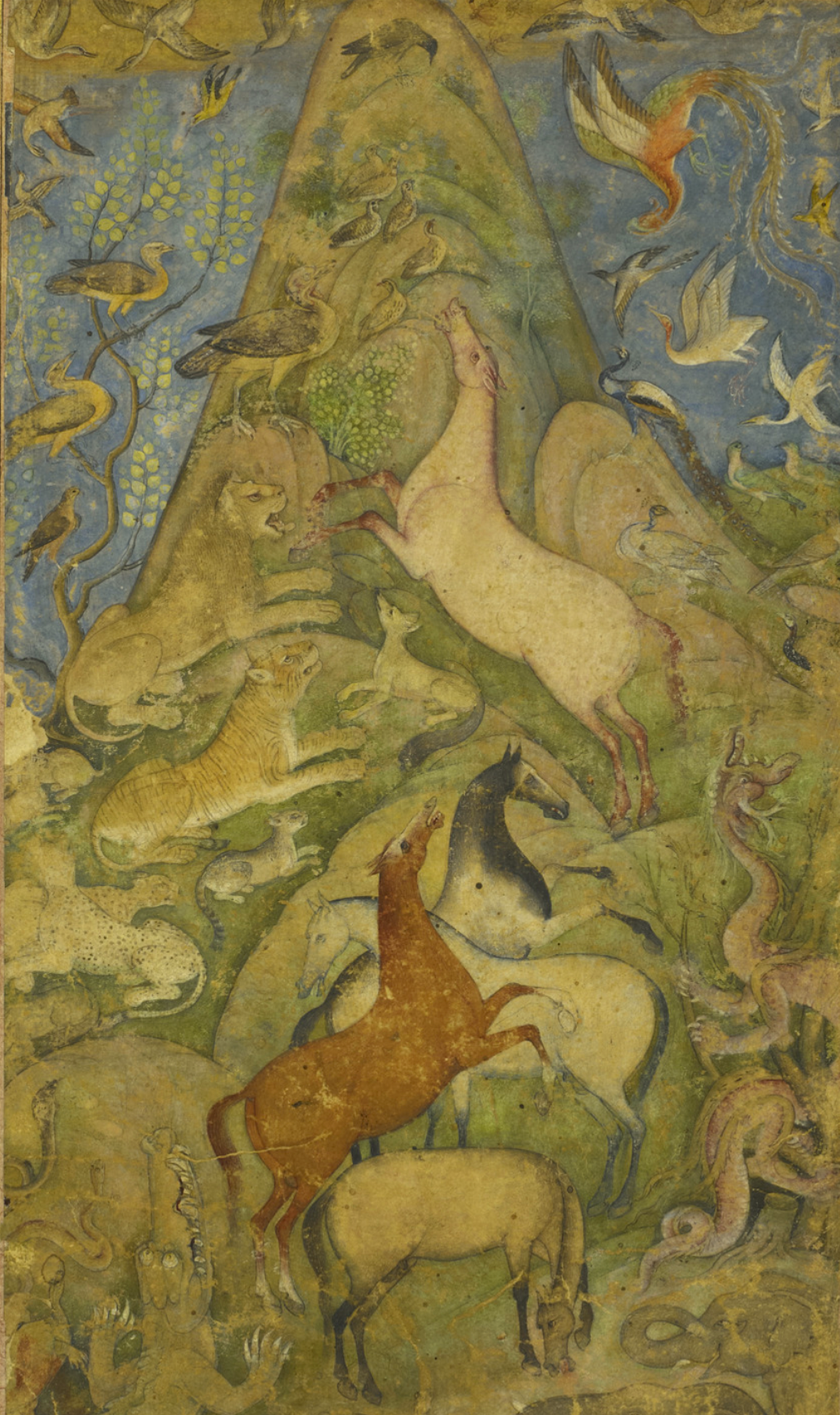
Unknown author, circa 1610. Collection, British Library. Image taken from [Johnson Collection]. Held and digitised by the British Library. (Wikimedia Commons)
Salman Rushdie makes this political point about Each and All again and again in his early fiction. I look at this in detail in 🇮🇳 The Fiction of Doubt — see Rise of the Simurg, When Religions Collide, Coming Together, Eruptions of the Sacred, and Return of the Simurg.
⏯
Unified Sensibility
To be fully in touch with religion doesn’t mean rejecting the physical things in the world – the planet, the soil, its insects and animals, the nutrients that build our bodies, the currents of air and water, the brain with it swirling neurons and overlapping waves, and the heart with its currents of blood pulsing through our veins — even when they stump us or seem to get in our way. All of them, together with everything else, constitute the Whole, the One, the meeting place of the many rivers.
We come to the gods and the spirit world with needs of our own. Are we always angry? Are we every moment of every day bitter at the world? Well, hopefully not. Then why pray each moment to a god or force that specifically calms anger? The Whole doesn't mind if you're only a part. Within that part are other parts — fear, loneliness, joy, rapture, etc. God doesn’t mind if within that multiplicity of your self you find the corresponding deity you need.
God — the highest One and Whole — isn't stingy, and doesn't resent you picking and choosing, as if you were a North American University student picking a chemistry course here and a poetry course there. The courses course through the world of knowledge, some going straight into a desert where you thirst for a drink, others meandering this way and that, making you wonder what on Earth will be on the final exam. All eventually meet in the vision of God which is the ocean. One may think that the watery course that leads into the desert and dries up is vanity. But the water evaporates into the air, and joins the misty community of mysticism nevertheless.
Either God is wise, and wise leaders know how to delegate, or God is infinite in a way that beggars belief to such a degree that He listens to each and every one of us, following us in our every thought and action, guiding us to the light of fullness. The open theist takes this either/or and turns it into either/and. We can’t know for sure, but maybe, just maybe, it’s both.
⏯
Next: Systems of Operation