The Double Refuge 🇲🇽 Señor Locke
Fault Lines
🇲🇽
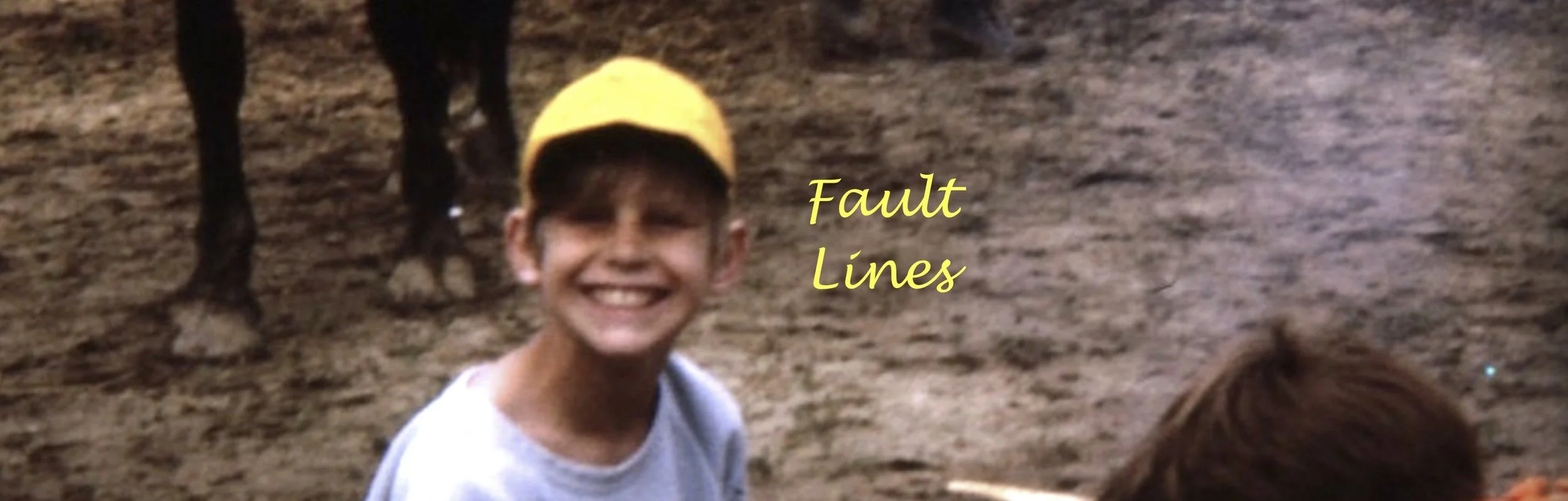
Until about 1970, our family attended the United Church of Canada, one of the most liberal versions of institutional Christianity on planet Earth. At this point my older brother began his lifelong atheist campaign, demanding that our parents justify what he called “brainwashing.” This rebellion was quickly followed by my experience at a Christian summer camp. At the age of eleven, just when I was looking into the pros & cons of Christianity, I was abused by an evangelical counsellor.
My camp experience made me rebellious and distrustful of authority (I explore this in Campfires). Listening to Demons & Wizards, Black Sabbath’s “Paranoid,” and Queen’s “Great King Rat,” “Jesus,” and “Liar,” it became increasingly difficult for me to open my heart up to Jesus. As they say, the first cut is the deepest…
Nevertheless, when I got older and my sister became religious, I felt I should alter my negative view of Christianity. My sister went from experimentation and a giant butterfly on her jean jacket to what I think of as God Consciousness, which has nothing to do with abusive camp counsellors. To me, whether she’s Christian or not, she’s still the same person, and she’s still the same influence in my life. Even after fifty years, she’s still playing with me in the yard, or looking up from her desk:


Perhaps there really is a mystical force or figure called Jesus, and perhaps this incarnation of God might set me free. Yet whenever I think about this possibility, I realize how indelibly I’ve been imprinted by my past, just as John Locke argued over 300 years ago. In thinking about Christian belief I find myself thinking more about my sister than about the Jesus she tells me about.

My difficulty to connect to the male figure of Christ had to do with my camp disaster and also with my vague and abstract religious sensibility. Perhaps my camp experience fashioned my sensibility into something vague, I’m not sure. And perhaps all my philosophizing just boils down to verbal psychotherapy, with concepts like love representing my sister and science representing my older brother, while my mom sits in the background talking to leprechauns and my dad rolls his eyes as if to say, Really?
Whatever the causes, the foundations of my philosophy are like the geographies of nations: cracked and varied; imperfect and aspirational; built up over time, and ultimately prey to time. I empathize with Tom Petty when he sings, “Down below / the man I know / might not be me / and I got a few of my own fault lines / runnin’ under my life.” As a result of these fault lines, that continue to fragment the solid belief of my prairie grandparents, I took a very different path from that of my sister.
In grade 12, the most difficult year of my life, I found a book lying around the house, The Texts of Taoism. I immediately gravitated to this vague and least doctrinaire of religions. Its mix of humble belief in some mystic Force, and doubt about everything else, made me see religion in a new light. It opened the door to religion in general, since it combined doubt with a vague inkling of some sort of cosmic order or meaning. Perhaps Daoism had such an impact on me because it was Chinese, and therefore almost entirely foreign. It wasn’t tainted or obstructed with previous conceptions about religion or previous experiences of abuse & hypocrisy. It was something which I was entirely free to take or leave.
Daoism worked for me because it was doubt, inkling, and specificity combined into one construct, one formulated yet ever-unformulating form of thinking. Translated Chinese in a Calgary suburb was just what the cosmic doctor ordered for my alienated 16-year-old self.
Daoism has been a great help to me ever since, for while I’ve had experiences that might be called cosmic or mystic, these never crystallize into a religious system, let alone into a religious figure like Krishna or Jesus. And once Daoism opened the realm of religious doubt, I couldn’t help applying this doubt to Daoism too.
From there it wasn’t a stretch to the most diverse and metamorphic of religions, Hinduism, with its endless points of view and its endless stories and sacred texts — Bhagavad-Gita, Upanishads, Vedas, Ramayana, Mahabharata, Puranas, Yoga Vasistha, Brahma Sutras, etc. My interest in Hinduism was also spurred by practicing Transcendental Meditation since I was 13. My mother and sister had started meditating a year earlier, and they figured that it might calm me down (I was a hyperactive borderline anarchist). Meditating did calm me down (although badminton and karate helped!). Meditating often gave me, and still gives me, a blissful sense of awareness. Perhaps because of this very practical experience I’ve always respected the Hindu tradition from where this meditation came. Again, the foreignness of it was probably part of its initial success. I mean, if I had to follow Hindu caste rules and Hindu vegetarianism (and swear off Big Macs) I might have been less keen…
From Daoism and Hinduism, it was even less of a stretch back to philosophies that were more culturally familiar to me. Taking up literature in university, I dived into the subtle explorations of Dickens, the idealistic poetry of Shelly, the subtle agnosticism of Keats and Byron, and the cosmic visions of Whitman. From there my readings multiplied like rabbits. Poets like Khayyam, Kabir, and Attar began to fascinate me, especially when they crumbled the foundations of their stricter religion to the ground of love. The vaguer the religious claim, the more likely I was — and am — to entertain it. The more the claim can be accommodated within the realms of history and science, the better.
Now even the most nebulous religious systems intrigue me, yet also make me want to look out the window. Now even the most abstract notions of God make me want to look into their origins and then open the door and join Walt Whitman as he tramps his perpetual journey around town, wandering through the streets to the fields and forests, where he looks up at the stars. It's therefore not surprising that I wrote my Master's thesis on Walt Whitman, Laozi, & Zhuangzi (see my thesis here), and that I later wrote my Ph.D. on the mix of religion and politics in the early novels of Salman Rushdie (see my book Stranger Gods here).
Other people have had cosmic or mystic experiences that fit comfortably into a specific philosophy or religion. For me, these experiences seldom crystallize that way. So I have a hard time understanding people who understand their religious experience in a certain way and then expect other people to understand their experience in exactly the same way. I can’t imagine a belief where other beliefs are forbidden or excluded. But I recognize that this too is a particular belief: I believe in considering all philosophies, especially those that end in infinity, ineffability, never-ending points of view, and openness to all spatial and temporal possibilities.
I’m tempted to call myself a mystic or a poet, yet these words seem too grand. Perhaps my obsession with Infinity merely comes from my interest in geography and astronomy, and perhaps they merely point to my insignificance, my own vanishing point of view. Perhaps mystical annihilation is just plain old realism that leads to obliteration. Perhaps what Pascal calls an infinite abyss is in fact a finite fault. Perhaps at the bottom of the fault lies solid ground, just as the glittering spike of lightning doesn't come from a god, but from the facts of meteorology. For this reason I don’t call myself a mystic or a poet, but a doubter who believes and believer who doubts.
🇲🇽
Next: 🇲🇽 The Floating World