

The Double Refuge 🍷 Bubbles Winking at the Brim
Literature
7 X 7 Types of Ambiguity - Models of Mind
🍷
7 X 7 Types of Ambiguity
For me, neither science nor religion successfully explains, or allows us to fully cope with, the mystery of our existence. Together, however, they might.
On one hand, science is so logical and rational that it has difficulty fathoming our deeper feelings of love and wonder, let alone our stranger dreams, affinities, intuitions, and feelings of connection. It’s hard for facts about survival to give us hope for an afterlife, let alone salvation and Grace. Two thousand years ago Marcus Aurelius came close to fusing the rational and the mystical in his term “the universal mind.” Yet however much we see kindness and gentleness in nature, it’s still rife with violence, selfishness, chaos, and alienation.
And however much computers act like humans, wires aren’t neurons. Using the most sophisticated program we might mirror the complexity of the biomass of the human brain, yet two questions would still remain: 1) Can engineered complexity ever create feeling? 2) Even if we understand the workings of the universe, why has it developed in the first place? Who or what wrote the programming to create existence and to promote survival? Or, as a writer of the Kena Upanishad put it, what matters isn’t what we think and feel, but that we think and feel. “Know that to be Brahman.”
On the other hand, religions are often too specific in their formulations, often too internally coherent or self-referential to be externally applicable to the wider range of humanity. Distant from Modern science in time and history, each major religion struggles to integrate its ancient truths to the ever-changing fields of astronomy, physics, chemistry, biology, physiology, neurology, and psychology. And distant from other peoples in space, geography, language, and culture, each single religion has difficulty reconciling itself with other religions,
Yet there is one field of study which reaches back to cuneiform and forward to html, which is contemporary with the development of philosophies and belief systems, and which doesn’t need to contort itself into relevance: literature.
I’d argue that literature is a reliable guide to meaning because it’s as old as civilization and because it reflects multiple aspects of reality. Even when these reflections are oppositional or contradictory, literature manages to present us with meaningful insights and perspectives. Looking from different points of view, we find different insights. Between different insights we find more perspectives, which lead to more insights. Perspectives and insights multiply to create a weaving web of interdependent meanings stretching as far as the eye can see. These meanings change each moment, depending on our point of view, the angle of the sunlight, the mists, and the clouds of our knowing or unknowing.
Literature is realistic, moral, amoral, immoral, fantastic, and idealistic. Its scenarios lean in the direction of questions & answers, tangents & truths, ambiguities & clarifications, doubts & beliefs. It runs the gamut of rational, emotional, interpersonal, sociological, philosophical, and religious scenarios, leaving readers to decide which ones are meaningful to them.
In this sense, literature resembles the double refuge: both use an open interpretive method and both lack a specific aim. Both hold definitive interpretation at bay, so as to appreciate a diverse, wide range of possibilities, mysteries, dichotomies, and ambiguities.
A helpful study in this regard is William Empson’s 7 Types of Ambiguity (1930). Empson argues that language, especially poetic language, is enriched (rather than obscured) by ambiguity, that is, by the multiple ways language can be interpreted. I’d note that the deconstruction method in academia is based on this continual ambiguity in language. I’d also note that deconstruction begs reconstruction, which is what poets usually do with their scattered meanings, bringing them together in the art of a poem. Even when poets push coherence into incoherence, chaos, or alienation, they’re still making a point about incoherence, chaos, or alienation.
I’ll return often to this notion of scattering and cohering, especially in relation to Keats’ negative capability and Eliot’s unified sensibility. Here I’d like to restrict my argument to two points. 1) Because language is fundamental to our conceptions of reality, and because language is full of ambiguity, our conceptions are necessarily full of ambiguity. 2) The same ambiguity that’s basic to our articulation in languge is basic to our articulation in philosophy and religion.
While Empson’s points are about ambiguity in language, they fit nicely with my points about ambiguity in philosophy, religion and the double refuge. In the following quote I cross out Empson’s terms and add (in bold) the transference or application I want to make: when Empson writes word I replace it with philosophy or religion, and when he writes ambiguity I replace it with the double refuge:
… a word philosophy or religion may have several distinct meanings; several meanings connected with one another; several meanings which need one another to complete their meaning; or several meanings which unite together so that the word philosophy or religion means one relation or one process. This is a scale which might be followed continuously. ' Ambiguity' The double refuge itself can mean an indecision as to what you mean, an intention to mean several things, a probability that one or other or both of two things has been meant, and the fact that a statement has several meanings. It is useful to be able to separate these if you wish, but it is not obvious that in separating them at any particular point you will not be raising more problems than you solve. […]
The following passage gets more specifically at a larger and more nebulous nexus of meanings, and hence closer to the mix of material philosophies and essentialist religions which characterize the double refuge:
And behind this notion of the word philosophy or religion itself, as a solid tool rather than as a collection of meanings, must be placed a notion of the way such a word philosophy or religion is regarded as a member of the language double refuge; this seems still darker and less communicable in any terms but its own. For one may know what has been put into the pot, and recognise the objects in the stew, but the juice in which they are sustained must be regarded with a peculiar respect because they are all in there too, somehow, and one does not know how they are combined or held in suspension. One must feel the respect due to a profound lack of understanding for the notion of a potential, and for the poet’s sense of the nature of a language the double refuge.
Double refugees appreciate philosophies and religions which interpret reality in different ways, but they don’t make claims about the nature of the “juice” which reconciles the differences. For instance, they don’t know what allows science and religion, Shiva and Christ to live together in the same realm of human ideas. And yet this juice is what I mean when I talk about the double refuge, a liquid realm where meanings of a word, points of view, interpretations, philosophies, religions, and all seemingly irreconcilable realities don’t cancel each other out as much as they enrich each other.
Ideas like good and evil, Grace and Justice, the Apollonian and the Dionysian, are “held in suspension” in the double refuge, where they act as mysteriously as any holy ghost might. Yet what is this juice that holds everything together in this realm, and which I think we should regard with “a peculiar respect”? Is it the same merging Principle/Force that brings together the Father, the Son, and the Holy Ghost in the Trinity, and which also, simultaneously, brings together Brahma, Shiva, and Vishnu, in the Trimurti? Is this unifying juice soma, the intoxicant of the Vedic poets? Is it the akasha (or ether) referred to in the Upanishads? Is it Leibniz’s notion of the ubiquitous soul unit, the monad? Or is it a unified field or force in nature, one that unites gravity, electromagnetism, the strong nuclear force, and the weak nuclear force? Is it what binds the high to the low, the outcaste to the caste, the sinner to the saint?
Maybe some holy man, yogi, or mad physicist knows the answer to this question. But if he does, he hasn’t proved it yet. Lacking an explanation, we might, in Empson’s words, “feel the respect due to a profound lack of understanding for the notion of a potential, and for the poet’s sense of the nature of a language.” I’d suggest that this mystery, or “lack of understanding” operates in language, that most crucial of human developments, yet also in the creation of meaning from the scientific and philosophic to the religious and mystical.
I imagine that it’s in this liquid refuge, or in some similarly amorphic realm, that pluralities merge into non-duality. In his Four Quartets (1943), Eliot describes such a place beyond strict logic, a place that unites myth and experience, matter and soul. In the final lines of his long poem, he takes his reader from religion and myth (the river and the apple) to the integration of opposites (stillness and waves) to a symbolic fusion of purifying movement (fire) and the sanctified beauty of stillness (the rose):
the source of the longest river
The voice of the hidden waterfall
And the children in the apple-tree
Not known, because not looked for
But heard, half-heard, in the stillness
Between two waves of the sea.
Quick now, here, now, always--
A condition of complete simplicity
(Costing not less than everything)
And all shall be well and
All manner of thing shall be well
When the tongues of flames are in-folded
Into the crowned knot of fire
And the fire and the rose are one.
2,000 years before Eliot, Zhuangzi suggests something similar, yet without the Western imagery of fire or rose. Zhuangzi picks up the old question of where we can find someone who can truly transcend the differences and conflicts of this world. He says that instead of trying to find such an enlightened being who knows how this realm of unification works, we ought to simply submit to this realm, allowing our egos and all our questions about virtue, vice, right, wrong, etc, to empty into the unknown. He suggests that we enter and live in this realm, taking “our position there”:
I and you and those others would all not be able to come to a mutual understanding; and shall we then wait for that great sage? We need not do so. To wait on others to learn how conflicting opinions are changed is simply like not so waiting at all. [Palmer translates this last sentience, “To wait for one voice to bring it all together is as pointless as waiting for no one”.] The harmonising of them is to be found in the invisible operation of Heaven, and by following this on into the unlimited past. It is by this method that we can complete our years without our minds being disturbed. […]. Let us forget the lapse of time; let us forget the conflict of opinions. Let us make our appeal to the Infinite, and take up our position there. (James Legge trans.)
While religions the world over revere sages, gurus, and saints, and are always on the lookout for someone who can articulate the hidden secret of their faith, Zhuangzi suggests that everyone can find this secret by giving up the search for any one particular form of secret. He refers us to the “invisible operation of Heaven” and suggests that we “make our appeal to the Infinite.” In doing this, poets can be of great help, given that they mine the meanings between words and urge the reader to find the meanings for themselves. Note that at the end of Empson’s quote he refers to “the poet’s sense of the nature of a language,” which is important contextually because he mostly uses English poetry (and some drama) throughout his book. It’s also important because it singles poetry out as the most ambiguous, obscure, and potentially meaningful type of language. I’d suggest that as a result, poetry is the language most likely to succeed in getting at the ambiguities, obscurities, and potential meanings of philosophy and religion. Poetry also contains a creative spark, a magical verbal spell if you like, that lights up the world and brings it together in one vision.
An important point about my hypothetical double refuge realm is that it isn’t just about the higher and more etherial poetic, philosophic, and religious aspects of experience. It’s a realm in which high and low merge, so that the earthy roots of our ideas are as important as the ideas themselves. The molecular and biological functions, the mechanics of body and tongue, are all parts of this realm. What’s the point of including the study of biology if we shy away from the properties and functions that allow us to think about biology?
In articulating my idea about the double refuge I’m not attempting to replace the heights of philosophy and religion with a different lofty realm. It may be Augustine’s City of God, but it’s also a common city of integration, transformation, and potential. It’s where sexuality, the insect kingdom, and all the things that are left out of rarified philosophy come back to face the philosopher.
I remember yesterday seeing a fairly large and dynamic spider suddenly ascend the edge of my desk and walk along it. A powerful spider walking past my Timex clock tward the base of my iMac!
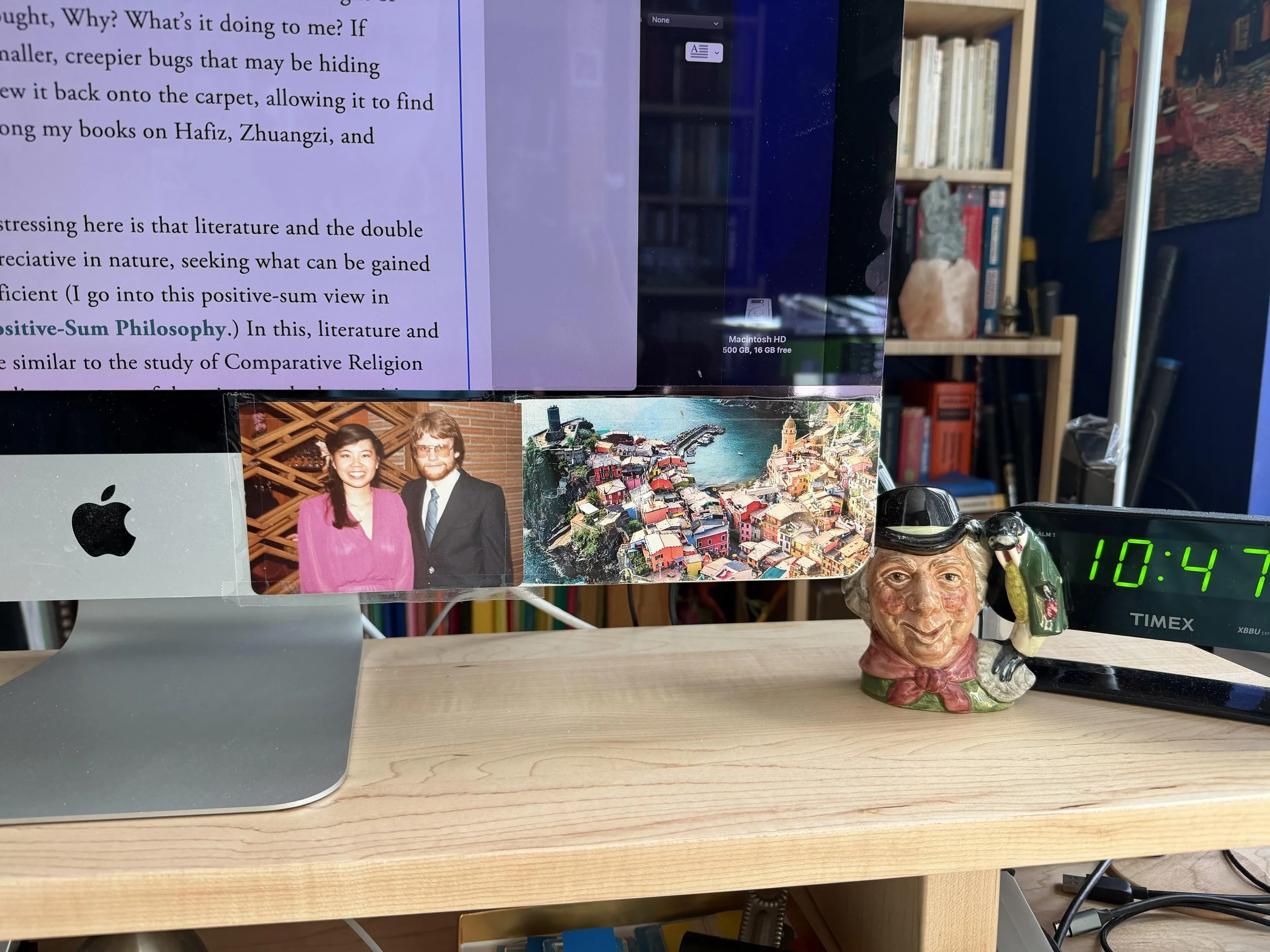
In between the clock and my iMac, however, stand my dad’s old pen-holder cup in the form of Lewis Carroll’s “The Walrus and the Carpenter.” These two characters present children with a valuable yet harsh lesson, a cautionary tale about our dog-eat-dog world, the brutal nature of Nature. The walrus is dressed ever so finely and talks ever so politely to the little oysters, even to the point of weeping so compassionately as he wolfs them down:
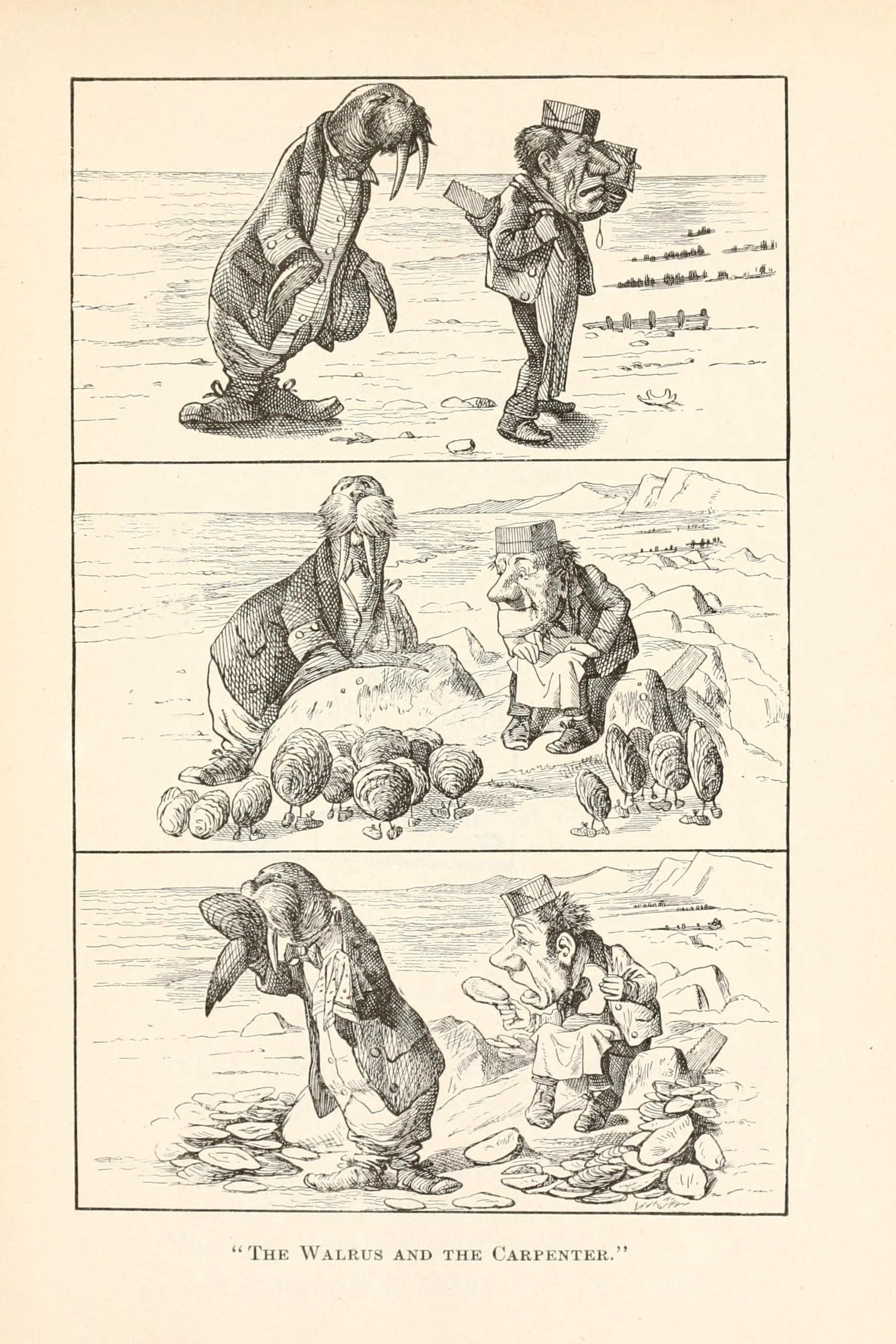
From Wikimedia Commons (Identifier: heartofoakbooks03nort (find matches). Title: The heart of oak books. Year: 1906 (1900s). Authors: Norton, Charles Eliot, 1827-1908. Subjects: Nursery rhymes Fairy tales. Publisher: Boston, Mass. : D.C. Heath & Co.)
'I weep for you,' the Walrus said.
'I deeply sympathize!
With sobs and tears he sorted out
Those of the largest size,
Holding his pocket-handkerchief
Before his streaming eyes.
I saw the spider and was shocked (I’d never seen a spider in my study before). I immediately thought about how I’d kill it. But then I thought, Why? What’s it doing to me? If anything, it’ll kill the smaller, creepier bugs that may be hiding somewhere else. It’s like the connecting wires below my computer, without which I’d have neither word nor screen.
As it crawled along my desk I thought of Whitman’s patient spider,
A noiseless patient spider,
I mark'd where on a little promontory it stood isolated,
Mark'd how to explore the vacant vast surrounding,
It launch'd forth filament, filament, filament, out of itself,
Ever unreeling them, ever tirelessly speeding them.
And you O my soul where you stand,
Surrounded, detached, in measureless oceans of space,
Ceaselessly musing, venturing, throwing, seeking the spheres to connect them,
Till the bridge you will need be form'd, till the ductile anchor hold,
Till the gossamer thread you fling catch somewhere, O my soul.
So I filled my lungs and blew the spider back onto the carpet, allowing it to find a home somewhere among my books on Hafiz, Zhuangzi, and Shelley.
🍷
Next: Constantly & Sometimes