The Double Refuge 🍷 Bubbles Winking at the Brim
Hinge, Pivot, & Jamb
Each and All - Pivot & Antenna - Sunset
🍷
Unscrew the locks from the doors! Unscrew the doors themselves from their jambs!
— Walt Whitman, Song of Myself
Each and All
In Song of Myself, Whitman professes “the greatest of faiths and the least of faiths.” His phrase helps gets at what I call the Double Refuge, that is, a philosophy that’s open to all religious beliefs and to any particular religious belief, and that’s also open to science, questions, and critical thinking. In this sense it’s a religious philosophy that tries to keep every door to truth open, and allows for the freedom of going through any particular door. It imagines a way of keeping the doors perpetually open — by unscrewing the locks from the doors, and unscrewing the doors themselves from their jambs.
The Open Refuge aims to combine belief & doubt, faith & science in a way that allows a free flow from one to the other. Key to my argument is the word open: the Double Refuge combine Open Theism with Open Agnosticism.
Open Theism involves a belief in any religious or mythic idea while remaining open to other theistic beliefs. This form of theism is ecumenical and eclectic. It can also be highly syncretic: it can go so far as maintaining that all forms of positive spirituality — all forms of love, compassion, forgiveness, redemption, enlightenment, etc. — come together in the notion of a positive God or Great Spirit.
This Spirit may be general, with no particular affiliation, or it may be seen in a more particular light. For instance, It may be seen in naturalistic terms (Mother Nature or the Dao), in transcendental terms (Brahman or the Neoplatonic One), or in terms of a moral or intelligent design (Plato’s Good or Aurelia’s Universal Mind). Open Theology celebrates all types of positive belief (i.e. not types that encourage coercion, hierarchy, wealth, power, etc.) and doesn’t operate in terms of zero-sum. Instead of operating within a closed arena, it operates in a wide-open country in which people can go from one city to the next, one region to the next, finding different values, customs, languages, and beliefs along the way. Yet always finding welcome.
I aim to combine this Open Theism with Open Agnosticism, which uses doubt not as a way to negate or deny, but as a way to explore all ideas and experiences. In this open form of agnosticism — not to be confused with hard or closed agnosticism (see 🍏 Types of Agnosticism) — doubt also doubts itself. It leaves us free to doubt and question, and to integrate science and history into a spiritual view of reality. Shelley gets close to this tension or paradox in his poem, “Mont Blanc” (1816):
The wilderness has a mysterious tongue
Which teaches awful doubt, or faith so mild,
So solemn, so serene, that man may be,
But for such faith, with Nature reconciled
Shelley suggests a subtle interplay between belief and doubt: one slips into the other, and yet the two can’t be reconciled completely. They remain distinct: doubt and experience tell us that this world is a beautiful and nasty place; faith tells us that everything reflects a deeper truth, one that’s forever beyond reach. Shelley imagines that this faith and Nature come together, and realizes that they also remain separate.
Combining Open Doubt with Open Belief can free us from rigid reasoning on the skeptical side, and from exclusive dogma on the religious side. In this sense it’s a refuge from the ravages of skepticism and from the zealotry of doctrine.
Ralph Waldo Emerson gets at the spirit of this idea in his poem “Each and All” (1839). He starts off by observing that we generally aren’t aware of how one event affects the next. He observes that we also think we can separate a specific good thing from the things around it. He then sees that a bird and a shell lose much of their beauty when they’re not surrounded by the forest and the beach. He concludes by applying his observations to truth:
Then I said, “I covet truth;
Beauty is unripe childhood's cheat;
I leave it behind with the games of youth.”
As I spoke, beneath my feet
The ground-pine curled its pretty wreath,
Running over the club-moss burrs;
I inhaled the violet’s breath;
Around me stood the oaks and firs;
Pine-cones and acorns lay on the ground;
Over me soared the eternal sky,
Full of light and of deity;
Again I saw, again I heard,
The rolling river, the morning bird.
Beauty through my senses stole;
I yielded myself to the perfect whole.
Keats put this more succinctly and emphatically: Beauty is truth, truth beauty, — That is all ye know on earth, and all ye need to know.
🍷
In a famous passage of his Pensées (1670), Blaise Pascal suggests that belief and disbelief are like two sides of a coin. He argues that we should choose belief because we have nothing to lose and everything to gain. Double Refugees would rather not flip such a coin. Instead, they’d set it on a table and spin it, so that the physical and metaphysical worlds whirl around each other so fast that it becomes impossible to say which is which.
We might also see belief and disbelief as winning or losing in a game of dice. Double Refugees prefer not to take their chances: they opt not to throw the dice. Instead of betting on materialism or spirituality — a choice they believe to be based on such limited knowledge that it might as well be based on chance — they keep themselves open to both:
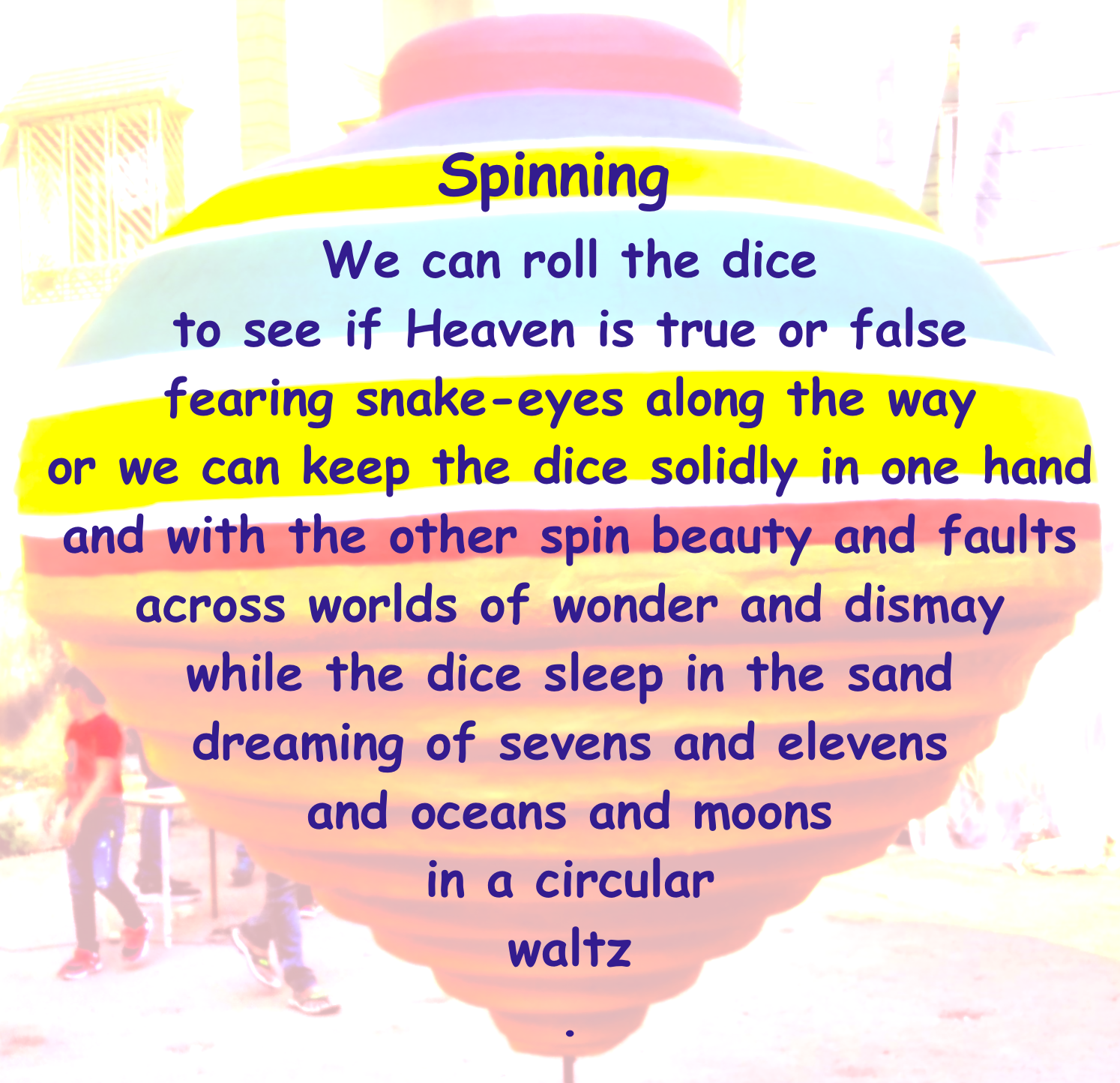
The metaphors of the spinning coin and the spinning top make more sense to double refugees than deciding on either doubt or belief. To them, both seems more reasonable than either / or.
🍷
Pivot & Antenna
Over two thousand years ago the Daoist writer Zhuangzi saw this eternal spinning in terms of a pivot. (Note: Daoist, Zhuangzi, and Laozi are the recent transliterations for the previous Taoist, Chuang Tzu, and Lao Tzu). Zhuangzi sees this spinning in terms of what he calls the pivot of the Dao — the Dao being the Chinese notion of a God that’s transcendent yet also operates mysteriously in Nature, humanity, and all things. Zhuangzi suggests that we position ourselves at this pivot, so that we can exist both existentially and spiritually at a single, unified point. From this point, we can open ourselves up to an infinity in which all perspectives connect to their corresponding opposites:
[…] that view involves both a right and a wrong; and this view involves also a right and a wrong:—are there indeed, or are there not the two views, that and this? They have not found their point of correspondency which is called the pivot of the Tao. As soon as one finds this pivot, he stands in the centre of the ring (of thought), where he can respond without end to the changing views;—without end to those affirming, and without end to those denying. — Chuang Tzu 2.1.2, trans. James Legge
We can put this in negative terms as well, in order to focus on the perspective we leave behind in order to appreciate a new perspective. In this case neither / nor fits the same bill. This negative take is similar to Keats’ negative capability, which is more an invitation to explore than to stay at home. Because this negative way opens up to the same diversity and infinity, it’s more a See you later than a Good-bye.
Prior to his reinterpretations of Zhuangzi, the Trappist monk Thomas Merton makes the point that leaving our old ways behind doesn’t lead to a fixed place. Such a departure doesn’t lead to some otherworldly version of our normal lives. Instead, this new way is a way that has no particular direction, a path that has no particular signpost:
Chuang Tzu would have agreed with Saint John of the Cross that you enter upon this kind of way when you leave all ways and, in some sense, get lost.
In Daoism God is referred to as the Dao or the Way, and in the first major Daoist writing, the Daodejing, the author (the legendary Laozi) makes it clear again and again that the Way that can be spoken of is not the Way. God cannot be defined, pinned down to a human definition or understanding. I hasten to add that neither can reality or the meaning of the universe. In Daoism there’s no clear division between the spiritual Way and Nature. Both open up into a vast unknown. Any loudly proclaimed rupture between reason and revelation, science and faith, is, from this pivotal point of view, premature.
In making our way into the unknown we’re still our little selves, and we’re increasingly aware of this fact. Indeed, this is one of the finest points made by Sufi poets such as Attar and Rumi: by annihilating our limited selves we become one with Infinity; by getting drunk on the wine of Infinity we see — blurrily! — how ridiculous our pretentious are. Mystics the world over conclude that while we’re more and more aware of our disorientation, the trick lies in embracing this disorientation. The scientist uses wonder to keep himself going further into the unknown. The mystic scientist combines this wonder with the belief — and sometimes only the hope — that behind this wonder lies a benevolent power. Aurelius called it the Universal Mind, although it goes by many names: God, Allah, Brahman, Dao, Creative Intelligence, Creative Design, Mother Nature, etc.
Open doubt and open belief allow us to move seamlessly from geography and history into larger stretches of time and space. We become more and more aware of the fact that our cardinal points are only cardinal from a human perspective, and only from Earth. The Pope to this cardinal remains elusive.
The word cardinal comes from the Latin cardo, which means hinge or pivot. The spatial term, as in cardinal direction, comes from cardo maximus, which refers to a Roman main street and to a directional line that extends in the same manner as such a street. This concept of a straight directional line has given us helpful direction for two thousand years. After Columbus sailed to the West Indies we realized that such a line, stretched far enough, comes back to itself — if, that is, we follow it along the curving contour of the earth. If on the other hand we follow it straight, and see it lift up into the atmosphere, maintaining the straight line of cosmic space, the cardo maximus comes back to itself only if we can imagine a universe which curves back into itself — which in astronomy remains an unproven theory. I suspect that it’s more likely that the cardo maximus just keeps travelling, infinitely, eternally, far enough in our imagination to give us an inkling of where we truly are.
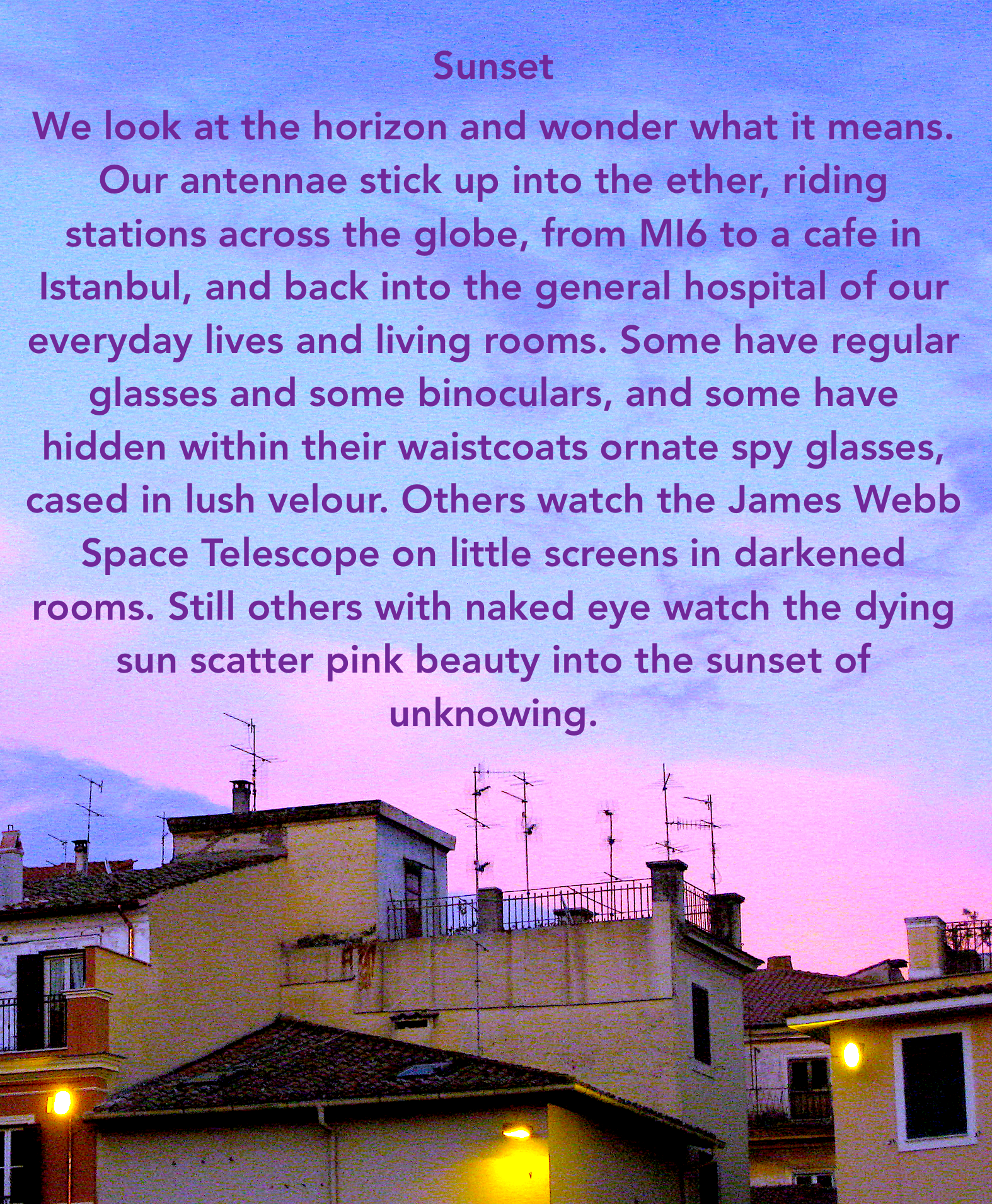
The universe is vast, and we can’t, even in moments of mystical ecstasy, say how it’s shaped, who controls it, or what it means. We’re less like the analysts at Mission Control and more like disparate antennae. We pick up a TV show (an old Bond film or a re-run of General Hospital) or we listen to the song waves of a nightingale as it drifts into the forest. Or we stare gobsmacked into a computer screen that shows us the size of the Local Void: about 175 million light-years in width. The Void shrinks when we zoom out toward the edges of the Laniakea supercluster of stars within both Void and Earth are located.
Laniakea is about a half of a percent of the size of the known universe. Yet sitting somewhere near the original cardo maximus, on the little planet of Earth, we pick up a faint but powerful wave. It lands softly on our ears, like a small wave on our little beach, as we look up into the infinite sea of space.
🍷