The Double Refuge 🍷 Bubbles Winking at the Brim
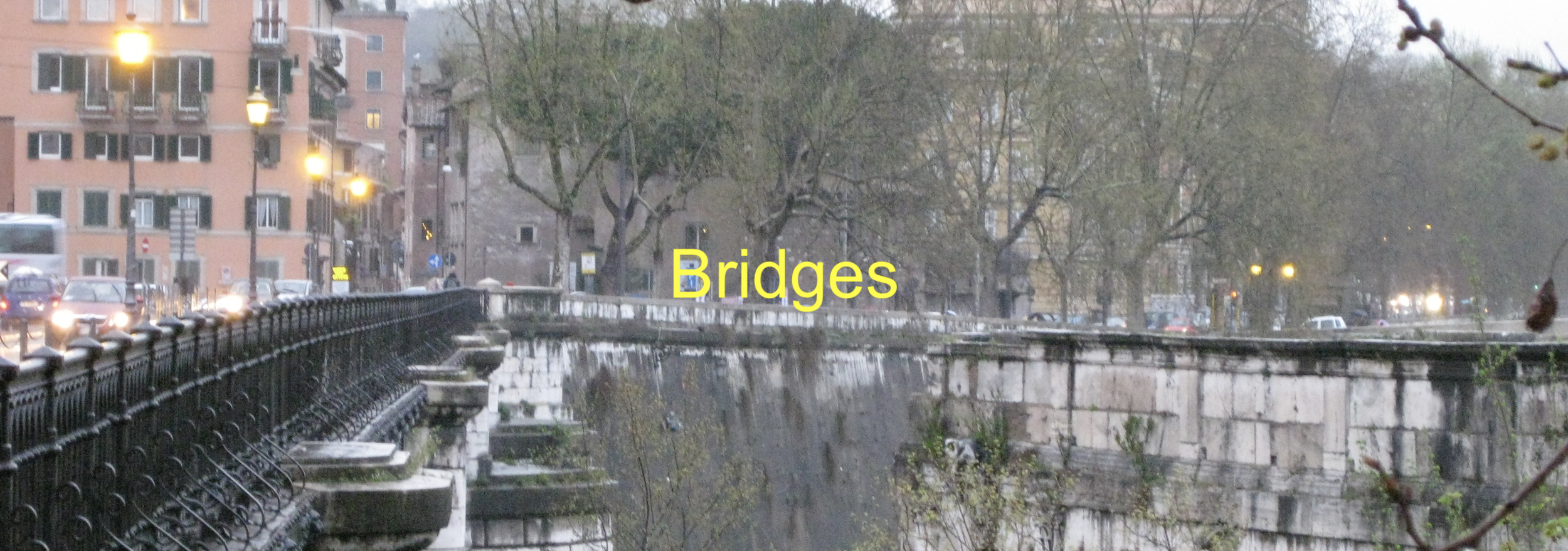
Bridges
🍷
The conventional scenario is that we leap from doubt to faith, or we fall from faith to doubt. Yet these scenarios often involve a great deal of psychological angst, and leaves us divided between what we were and what we are. This invites internal fracture, a chasm in the psyche. I suggest instead that we get used to sliding back and forth between doubt and belief, until the mix of the two isn’t just a part of our thinking, but is instinctual, living inside the nerves that move our muscles and bones. I suggest going back and forth so often that the invisible ligaments between doubt and belief become strong enough to support running at full speed or darting like a hummingbird. In this way, we can leap from place to place without leaving our past behind.
In The Double Refuge I go into the nature of agnosticism in depth, given that it’s a reliable, time-honoured bridge between logical and scientific perspectives on one hand, and mystical and religious perspectives on the other. I should note here that while there are two basic types of agnosticism — hard or open (see Types of Agnosticism) — I focus on open agnosticism. As its name suggests, hard agnosticism is less flexible: it insists on doubt, and doesn’t apply its main principle, doubt, to doubt itself. Hard agnostics would see such an application as a contradiction, whereas open agnostics would see it as a paradox, that is, as something that seems like it can’t be done, but in fact can be done.
In The Double Refuge I emphasize the different ways that the doubt of the open agnostic might interpenetrate open belief. By open theism or open belief I mean a belief that’s open to all philosophies and all faiths, all places and all times. This is the belief of 🔺 the Buddhist who thinks of God ‣ as an Absolute beyond definition, ‣ as a full void into which all minor voids evaporate, and ‣ as a destination beyond this ocean, and beyond the ocean that lies beyond this one, and the ocean beyond that, ad infinitum. It’s also the belief of 🔺 the Sufi who finds the atoms of our existence finely spun in a mystical dance of Love, or 🔺 the Daoist who can’t say where spirit is, or where God is, but is content with the notion that they’re nowhere and everywhere.
It’s the belief of 🔺 the Hindu who ‣ has his own deity, ‣ is happy that others have their own deities, and ‣ imagines that all deities merge somewhere in the ether. Whether this merging occurs in the Holy Ghost of Jehovah or in the akasha of Brahman seems a too delicate point, an overly refined distinction, so fine that it disappears in the merging of fine mists.
This is also the belief of 🔺 the Christian who believes in what I call Christianity 2.0. This new Christian discards dogma and exclusivity, and believes instead that Christ is an open, loving, inclusive spiritual force or being. I was tempted to write that Christ is a higher power, even to capitalize it, Higher Power, yet this Christ wanders among the prostitute and the outcast, sits in the dust like a sadhu among the Untouchables, and leans back in a chair like Strider in a dark corner of The Prancing Pony.
Strider may be the King of Arnor and Gondor, yet he’s content to live like a pauper. The attractive thing about Strider is that he doesn’t seem to see any essential difference between the king and the pauper. The pauper barely understands this, and the elite have no idea what he’s talking about. In taking this lower position, Strider is like the Dao, Laozi’s version of God: like water, they descend to the lowest places to nourish the life-blood of animals and the sap of trees.
🍷
People often talk about matter and spirit as if they were separate, as if a Great Wall has been built, and as if innumerable traps are set on both sides — and in some places gun turrets! They often talk as if there was in fact a solid border, impenetrable on the scientific side because of verifiable facts, and impenetrable on the religious side because of time-honoured doctrine. Both sides appear to have different types of gravity and magnetism, attracting us in different ways and pulling us apart so that we see the two as completely separate. Yet what if the same gravity and magnetism operated in both? What if the border doesn’t really exist, but is just a way of dividing up the same Whole? How many ways can we divvy up what we can’t see?
In The Double Refuge I focus on the unifying notion of refuge, which refers to an escape or refuge from the trap of isolation, alienation, & exclusivity that we can fall into when we divide the physical world from the invisible beauties of emotion, art, mysticism, and religion. In this sense the double refuge is a safe haven from both the alienation of existentialism and the dogma of religion.
Notwithstanding this notion of refuge, I’m still agnostic enough to admit that I don’t really know if I’m right or not. So I look as widely and as deeply as I can into the question of how the most open versions of agnostic realism might connect with the most open versions of religious mysticism.
Perhaps the most obvious way they connect is through humility. In the double refuge of open agnosticism and non-doctrinal mysticism we see that we’re only a tiny part of the universe and that we know only a tiny part of what there is to know. We can’t claim to speak for the Great Whole, whatever that may be. Scientifically and rationally we may think of the Cosmos; poetically and mystically we may think of the One and the Good. Yet however we approach the topic, the Great Whole may well be infinite and therefore beyond our conception. And yet, while we may not be able to reach conclusions or clear definitions, we can still imagine a God who is infinite and omnipresent and eternal, a Unified Field, a Universal Mind, an Absolute, a Full Void, a Goodness, a Mystical Union, a Yoga of body and spirit, a Holy Spirit connecting everything. It may not make perfect sense, but there it is.
In Adonais, his 1821 elegy on the death of Keats, Shelley does a great job of defining the undefinable: “Rome’s azure sky, / Flowers, ruins, statues, music, words, are weak / The glory they transfuse with fitting truth to speak.”
🍷
Next: 🍷 Refuges Here & There