
The Double Refuge 🍷 Bubbles Winking at the Brim
Constantly & Sometimes
🍷
Religions and philosophies change over time, yet they almost always aim for truth, which is a thing that double refugees italicize. Unlike skeptics, refugees don’t italicize truth to suggest it’s a sort of illusion, but rather to suggest that whatever truth we find, and however intrigued we are about this truth, it’s almost certainly tentative and conditional. It’s one among many. It’s a version of reality, even if it’s a version that runs away from strict definitions. In this sense truth is like literature: it morphs from age to age, presenting different points of view within each age, and also within each group and individual.
In terms of its ability to change points of view, poetry is paramount, as it thrives on ambiguity. Poets can put different points of view in a historical or a chronological line, but also in a single line, or a single word. When a word means one, two, three, four, five things, the poet opens our perspectives in a variety of directions. For example, the Eagles’ 2008 song “Long Road Out of Eden,” concludes in the following way: “Behold the bitten apple, the power of the tools / But all the knowledge in the world is of no use to fools / And it's a long road out of Eden.” Here the word apple means 1. a fruit one can bite into, 2. knowledge of good and evil (from the Biblical account of the Garden of Eden), 3. knowledge which leads to bombs and military hardware that kill others, and 4. succumbing to a temptation that results in expulsion from a perfect existence (the Garden of Eden and in this context, a pristine America). In the context of the song — where gluttony is explicit and the Iraq War is implicit — the “bitten apple” also means 5. Americans have driven themselves from their own paradise, and are creating its opposite: a violent hell on earth.
Quite often a poetic shift in perspective leads to, or is accompanied by, an altered state of consciousness. In the Eagles’ lyric, the shift might have come as a blinding light, suggested by “the road to Damascus,” although the Eagles also suggest that Americans aren’t looking for the kind of redemptive light Paul found on his road to Damascus. They’re too busy stuffing themselves on bar-b-qed brisket and driving drunk on the highway in a great big SUV. (I also discuss “Long Road Out of Eden in relation to American and Russian wars in Crisis 22: Ukraine: 🚥 Symbolic Landscape and 🍎 The Road to Damascus).
This drunken gluttony and violence contrasts with the drunkenness we find in Persian and Chinese poetry, where it’s two things: 1. the expansive, open feeling we get from drinking alcohol, and 2. a symbol of divine intoxication we get from connecting to God. Getting drunk signifies not drunken brawls and indulgence, arguments with your spouse, or bombing Iraqi infrastructure, but rather getting out of your usual perceptions and entering a more fluid and rarified state of awareness. Perhaps the most famous among the Chinese poets for his drunken illuminations is the 8th century Li Po, who dances with his shadow in the moonlight, and was last seen falling into the water because he tried to grasp the moon’s reflection (or so the legends goes).
In the following poem by Yuan Hongdao (1568–1610), he describes a drunken state leading to the rejection of religious divisions and to an embrace of Nature — in this case “the green mountain.” The poem illustrates the way alcohol is used to shift perspectives, and also the way literature is linked to philosophy, religion, and personalized epistemology:
In my cup, thick wine; I get crazy-drunk,
eat my fill, then stagger up the green mountain.
The southern sect, the northern sect, I've tried them all:
this hermit has his own school of Zen philosophy.
— from “On Receiving My Letter of Resignation,”
16th Century, by Yuan Hongdao (trans. J. Chaves)
Like Hongdao’s Buddhism, literature tends to relativize our understanding and to personalize larger doctrines. It doesn’t aim to show that beneath relative truth lies a doctrinal version of God, but rather a personal experience. It aims to reflect, like Hamlet’s mirror, and to explore, without insisting on either an existential view of relativity or a religious vision of the Absolute. In this, literature can be very slippery, like the double refuge: some writers aim to take apart religion and others to promote a specific religious view. A poet like Yuan Hongdao might relativize our understanding of Zen Buddhism (which derives from two schools of Chan Buddhism during the Tang Dynasty), while another poet might praise the “Northern sect” above all else, and claim that the “Southern sect” is nothing but a school of drunks.
In the following scroll, we see Yuan Hongdao on the far left, next to the tree, not taking a prominent place among the gathered literati:
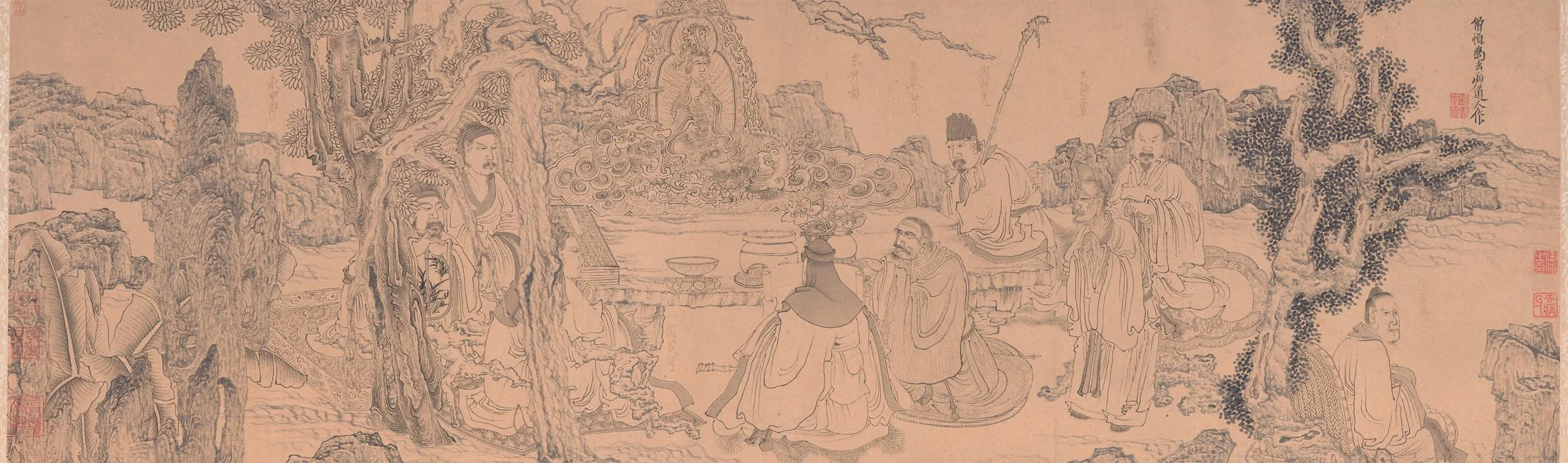
An Elegant Gathering, by Chen Hongshou (1598 or 1599 – 1652). Source/Photographer: Elegant Gathering. Telling Images of China (2010 exhibit). Dublin: Chester Beatty Library. (direct link to image) (web archive link for work) (Wikimedia Commons)

🍷
Literature sometimes aims to break apart, and sometimes to bring together. It sometimes aims to arrive at and sometimes to avoid, sometimes to hold in balance and sometimes to upset. Like a teeter-totter, it goes up and down. Like a prism, it reflects the colours on a spectrum, from red to violet, magenta to purple. In this sense it’s like the mind itself, arriving at ideas, avoiding others, always going up and down, left and right, back and forth, with whatever we encounter.
In the following poem, Yuan Hongdao stops the teeter-totter half-way between meaning and the continual search for meaning. By never saying exactly what he means, but by speaking through places, symbols, and sounds, he places his readers in a situation and then lets them understand the situation in their own way:
Writing Down What I See
The setting sun brings a pallor to the face of autumn;
floating clouds gather quickly into clusters.
They slant down, veiling the trees,
only two or three mountains still visible in the haze.
My horse glances back at the bridge-spanned river;
a group of monks returns along a path of pine trees.
The cliff is too high-I can see no temple;
suddenly, through the mist, I hear
a temple bell. — (trans. J. Chaves)
The poem may seem to some like a sort of itinerary or nature scene, yet it’s far more than this: Hongdao sets up a connected series of eight visual images and then brings them together in one image which is then counter-balanced by one sound. At the beginning of the poem, the poet is depressed — perhaps by the obscurity of meaning, that is, by his inability to see the connectedness or unity of all things and the Absolute. The poet’s depression is symbolized by 1. the setting sun, 2. the face of autumn, 3. the downward slant, 4. his inability to see a range of mountains, and 5. his horse glancing back. The things that normally connect or console him are in the past (6. the bridge is behind him) and apart from him (7. the monks travel in the opposite direction to him). His way forward is blocked: 8. the cliff is so high that he can’t see the object of his journey, the temple. Despite these 8 problems — brought together by 9. the mist — he shifts his senses, using his ears rather than his eyes, and connects with everything through 10. the invisible sound of the temple bell.
Some readers may find this poem too obscure, yet in East Asian poetry (as well as Persian poetry) it’s common to use symbolism in order to make the reader connect ideas. In this way, the reader becomes an active participant in the production of meaning. A great example of this can be found in Ezra Pound’s short poem “In a Station of the Metro,” written in 1915. In this poem Pound marries art & philosophy, nature & technology, disparate meanings & artistic unity. These come together in a poetic form that marries English words & a French setting (a newly built metro station in Paris) with haiku-style brevity & imagery:
In a Station of the Metro
The apparition of these faces in the crowd:
Petals on a wet, black bough.
🍷
Having studied literature for half a century, I’ve come to believe that all writing is, like all people, a product of specific places and times. Whether people consider writings to be sacred or profane, they’re products of particular locations and sense impressions, and of the flow of particular human experiences over the eighty-odd years of human life. Hindus, Christians, & Muslims may believe that their scriptures came down to them from the Highest Heaven, yet I doubt it. Or, at the very least, I’d say that Heaven came down here, just as It came down there; that Heaven doesn’t play favourites, and that It, like the Scarlet Pimpernel, goes everywhere. Yet I also suspect that my doubt and my eclectic theology are both products of my own experience, my own time & space, and they therefore don't constitute any sort of absolute truth.
Another thing worth stressing here is that the study of literature and the double refuge are largely appreciative in nature, seeking what can be gained rather than what’s deficient. (I go into this positive-sum view in greater detail in A Positive-Sum Philosophy.) In this sense, the study of literature and the double refuge are similar to the study of Comparative Religion and to the interdisciplinary nature of the sciences, the humanities, and a liberal educational system in general. Comparative Religion aims to appreciate the richness of different religions rather than to evaluate which ones are the best. Disciplines cooperate and enrich each other — as in math & physics, biology & chemistry, history & geography, music & dance, etc. The goal of a liberal education is to give people a deeper understanding of a particular field, and also to give them a deeper appreciation of the way that diverse fields work together to be useful to humanity and to enrich our lives.
🍷
Next: 🍷 The Epic