
The Double Refuge ☯️ Herr Jung
On the Couch
Dreams & Literature - Poets & Psychiatrists - Mad Gambits - Heal Thyself - Free Rein
☯️
Dreams & Literature
On two previous pages I explored dream scenarios involving a vampire and a knight. The vampire scenario (Animal Dreams) was based on the fragment of a real dream I had, while the knight scenario (Knight Errors) was an entirely fictional fabrication based on the surreal, dream-like 14th century text, Sir Gawain and the Green Knight. On both pages I saw dreams as free-form literary endeavours aimed at personal freedom, not as expressions of archetypes or personifications that have mythic patterns and mystical meanings. On the next several pages I’ll take a further look at why it’s helpful to use literature — rather than mythic or archetypal pattern — to explore our dreams and to connect with our unconscious or dreaming self.
There are at least three reasons why I think it’s helpful to see dreams in the way that literary critics see literature — that is, with a high level of detachment:
1. We don’t have control over our own dreams. It’s as if a director were controlling the action and dialogue, and we’re both players acting out the script and spectators watching the show.
2. The events in dreams are sometimes so disturbing that we don’t want to identity too closely with the actions or characters. In such cases, it’s better to take a more distanced view, like that of a spectator or critic.
3. At a remove from the scenarios, spectators and critics can appreciate and interpret them; they can see how they fit together, and how they might apply to their lives.
I’ll also suggest that open refugees are well-suited to seeing dreams in this light. In explaining this, I’ll use a modified version of Jungian analysis, a version in which we see dreams as dramatic scenarios with a limited number of positive characters (Knight, Friend, Fairy, and Gatekeeper) and with the clear positive outcomes that we find in traditional theology (based on the basic concepts of prayer and grace). I’m hoping that my pared-down version of Jung — with four characters and positive theology, rather than multiple archetypes and slippery occultism — may be useful in approaching dreams that are particularly disturbing or harrowing.
☯️
Poets & Psychiatrists
Literary critics analyze the workings of a text and often highlight its subtleties, complexities, ambiguities, contradictions, and paradoxes. Likewise, psychologists analyze the workings of the mind and often highlight the same things. Poets and psychiatrists are especially close: both aim to bring diverse and fragmented elements together into a unity or wholeness. Both aim to illuminate our awareness, to give us moments of clarity and insight, so that we can see ourselves and the world in a meaningful way.
Just as the poet aims to create a unified text full of creativity and insight (even if the insight is about chaos), so the psychiatrist aims to unify the fractured psyche of the patient. The connection to the double refuge here is that both literature and psychology operate best when we let go of pre-programmed explanations and methodologies. Instead, we proceed with openness and creativity, keeping our theories in our back pockets, using them only when they actually clarify the situation. We’re ready to discard our theories if they don’t work, and to expand on them if they do.
When confronted with the inexplicable, poets explore new combinations of words, images, settings, characters, and symbols. When confronted with inexplicable scenarios of the unconscious dreaming mind, Jung urges his patients to think in their own terms. The psychiatrist isn’t to overload his patients with ideas and frameworks they that they have to integrate into their own structures of understanding. Jung cautions his colleagues: “Patients aren’t here to prove your theory, or even to fit into it. You’re here to help them fix themselves, to find a perspective or theory that works for them.” The psychiatrist doesn’t force his system of symbols and meanings on patients. Rather, he encourages them to create their own structures of meaning — much as poets do in creating their poems.
While my schema is deeply indebted to Jung, I put more stress on the avoidance of hierarchies and labels, and I put less stress on the importance of archetypes. I want my approach to apply to any epistemological register, that is, to any type of meaning we might believe or entertain. I want an approach which openly explores the difficulty of the dreaming mind, no matter if one thinks in terms of a traditional religious system, skepticism, agnosticism, or atheism.
☯️
Mad Gambits
In our daily lives we rarely need to examine our minds in extensive detail. Which is a good thing, since the archaeology of the mind involves endless excavations, which can feel like a series of root canals in a dental chair. Also, the complexity of the mind involves endless causes and distortions, which can be baffling and disturbing, unless we’re lucky enough to find the perfect couch in a psychiatrist’s office. And even if we find ourselves on such a couch (at $200 an hour), the real work is done on our own time.
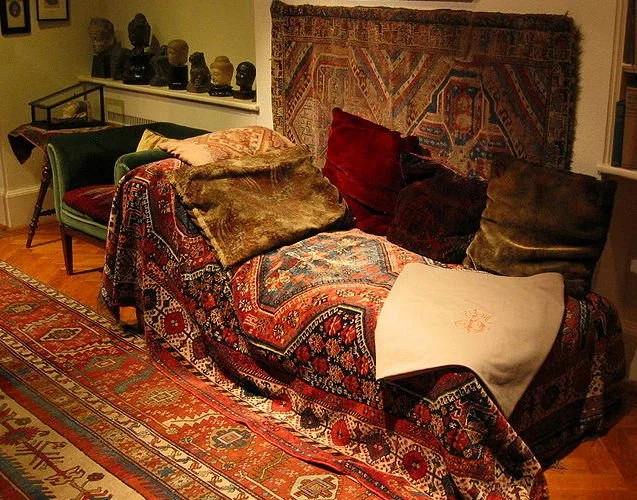
Sigmund Freud's Sofa, 2004. Source (From Wikimedia Commons)
During most of our lives deep introspection is unnecessary and perhaps even counter-productive. When we’re studying, working, or doing some task, we need concentration, not introspection. And when we have leisure time, we want to relax and enjoy ourselves. Why dig laboriously into our unconscious minds when we can do a million other enjoyable things? Or, if psychology interests us, why dig laboriously when we could sit back on our couch and watch others do it with flair — like Don in Mad Men or Beth in The Queen’s Gambit?
These two characters do this difficult mental work under the auspicious know-how of Hollywood. Writers, directors, musicians, producers, and actors knit together a drama which reaches into the corners of human thought and feeling. From start to finish, these TV shows entertain us yet also give us an intimate view of the ecstasies, frustrations, and conundrums of the modern mind.
Such high-quality viewing has a way of enticing us into the realm of psychological drama — starting with their finely-crafted opening credits, which disrupt and intrigue:
At the start of each Mad Men episode we see a cartoon version of Don fall down the side of a skyscraper, past beautiful women, and past the image of his own perfect nuclear family. The sequence of images makes us wonder, Why does Don fall further and further from the ideal of a faithful family man? How does he save himself from hitting the rock-hard pavement of Madison Avenue? How exactly can he land, cat-like, onto a couch, tie still in place, cooly smoking a cigarette?
At the start of the opening credits to The Queen’s Gambit we see a wine glass crash onto a chess board. The spilled wine then takes the chess pieces down with it, starting with the most powerful piece, the queen, down through a red-tinted sea. What does this symbolize, this bloody collapse of a game known for its precision and forethought? Is Beth — so skillful in making chess moves (like the opening sequence of moves called the queen’s gambit) — the fallen queen?
Over multiple episodes, these dramas stir us with music, engage us with conflict, and urge us toward a suspenseful series of climaxes. We need a cigarette afterwards, not a session with a psychiatrist.
☯️
Heal Thyself
Yet when our own unconscious mind acts up, giving us strange and disturbing dreams, we ask ourselves What’s going on? And when what’s going on is far more complicated and obscure than we imagined, we start to worry about falling like Don or drowning like Beth’s queen. We wonder if we might need to spend some time on the psychiatrist’s couch. We look around for a way to understand what’s going on.
While TV shows explore the unconscious, it’s one thing to examine a fictional character’s experience, and quite another to try to figure out our own experience. Here, for example, is a brief Google AI take on Don’s relation with Rachel, a woman who challenges Don in almost every way, and who refuses to be a pawn in his game of endless seduction:
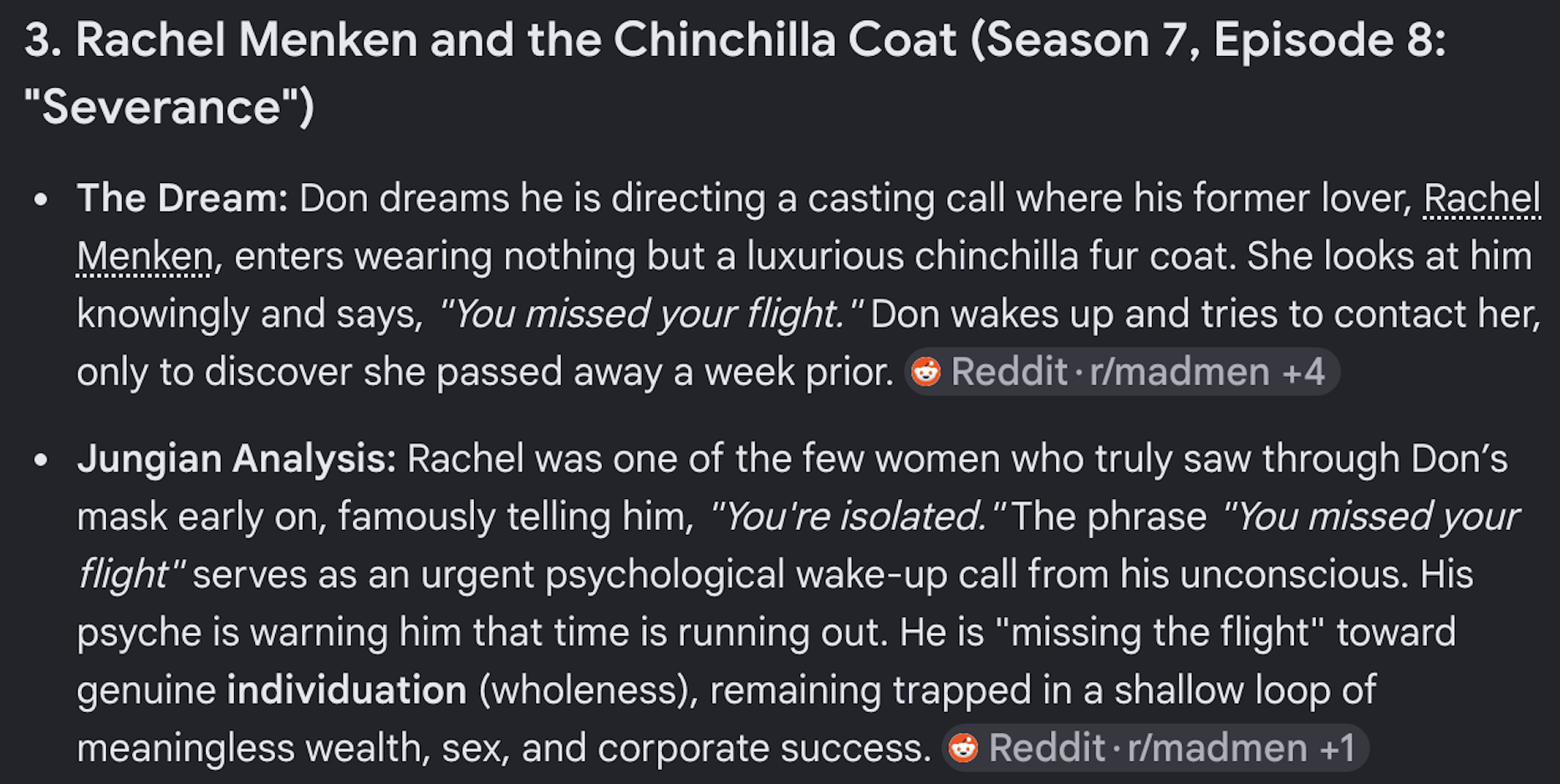
Such an analysis helps us to see how we might look inside our own minds, although it’s a far cry from coping with disturbing dreams in real life. The TV scenario is relatively easy to piece together. For instance, both the symbolism and the meaning of Rachel’s suitcase are easy enough to guess. In dreams, on the other hand, ◆ there’s no group of writers crafting a coherent whole, ◆ there are few recurring or consistent characters, and ◆ there’s no clear structure or plot to give meaning to individual symbols, figures, and events.
In order to cope with the chaos of the unconscious, we can look into specific psychological and religious approaches, hoping that a specific method can be applied to our particular situation. If we’re Catholic, we might confess and get advice from a priest. The Church has 2000 years of helping people with their problems, so for many people this is a good option. Others might go to a guidance counsellor, a psychologist, or a psychiatrist. They’ve studied the mind in great detail (and often from many angles), and can supply explanations and practical solutions. I’m sure that they’ve saved many Beths from drowning, and talked many Dons off the ledge.
I don’t mean for my approach to replace these in any way, and I don’t profess to be a trained psychologist or psychiatrist. What I suggest isn’t a replacement for the methods of priest or psychiatrist, but rather a way of looking at the unconscious mind, a way that brings together different methods into a non-denominational schema of sorts. This schema doesn’t require that we believe in the specific causes, concepts, or remedies of a priest or psychiatrist. For instance, we don’t need to believe in original sin and divine forgiveness to accept that we’ve got things wrong in our lives and to forgive ourselves, in a secular echo of God’s forgiveness.
The same applies to the psychiatrist. If we don’t have the money for a psychiatrist, or if we doubt that psychiatrists can understand our minds, we can still use a simplified version of dream analysis and individuation — that is, the unification of the diverse parts of our psyche. With Jung this is very appropriate, given the warning he gives to his colleagues against theories: “Patients aren’t here to prove your theory, or even to fit into it. You’re here to help them fix themselves, to find a perspective or theory that works for them.”
From the double refugee perspective, we can look for a way of understanding our minds without relying or discarding any single theory. We don’t have to accept or reject any given framework or belief. We just need to look honestly at ourselves and to think deeply about the relation of our conscious self to our unconscious (or dreaming) self. We do this with the aim of reconciling the two, of finding a psychological wholeness that will allow us to move through the murk and confusion and come back to our regular lives with a deeper understanding of ourselves.
☯️
Free Rein
I wonder how many people, disturbed by their inner dreamworld, lose themselves in trying to sound its depths. I also wonder how many people Jung saves from the distinct impression that they’re going insane? I’m guessing that Jung saves quite a few, especially those who feel that a part of them is detached from their identity. Yet for those who aren’t already detached in this way, is it really a good idea to imagine separate figures roaming about in our unconscious?
How many, attempting to make sense of disturbing dreams, found in those dreams a monstrous reflection of themselves? And how many mistook this reflection for a Dantean lawyer-demon who found a loophole in an obscure 13th century criminal code, and made his way by hook and by crook into their fantasies of barley and light? How many, wanting to dive deeper into the complex landscape of their inner faults, found themselves hounded by the angels of their own judgment, which pierced them like the pitchforks that slipped in their delicate hands?
Is it possible to transform inner nightmare into adventure? Instead of being driven by searing distortions of fear, can we imagine taking hold of the reins? We would of course do this without imagining we control the direction of the horse. Such is the logic of dreams that it will canter or trot wherever it wants — across the uneven foothills, into the burning heartland, or up the narrow headwaters of the soul.
This inner realm, once so full of dark corners and empty wastelands, is now an open field. The horse is flying beneath the swaying wheat. The rider can’t say where he’s going, so light are the reins in his hands. At last, he gives himself permission to go with the flow, to allow his dreaming mind to alter sense, time, and space. One moment he’s riding a horse and the next he’s Odysseus looking out from the salty deck. He listens to the music, shrill and piercing like a bohemian opera, and gallops on through.
☯️
Next: ☯️ Lust For Life