The Double Refuge ☯️ Herr Jung
Knight Errors
Stuck in the Middle Again - Jung’s Open Model - Sir Gawain, 2026
☯️
Stuck in the Middle Again
Jung argues that psychiatrists should steer clear of specific theories when treating their patients. And yet he also does the opposite: he suggests that we engage with quasi-occult figures and quasi-theological scenarios in order to make sense of our dreams — instead of letting the dreams speak for themselves and letting their meanings shift and change. He puts us in a vulnerable middle position: on one side he gives us the freedom to devise whatever scenario we want (without encouraging an empirical way of detaching ourselves from our own created scenario); on the other side he doesn’t provide a positive theological framework which can control, or provide an escape from, our quasi-mythic personifications.
Like Felipe, we find ourselves somewhere between the powers of empirical reason and mystical faith. In this position, we can easily be seduced into a magical spell, completely oblivious of Locke and neurology. Yet at the same time, the resources of theology are unclear: there’s little mention of any metaphysical force that might come to our rescue — be it the Jesus who’s blasphemed by Consuelo, the Holy Ghost that’s no where to be felt, or some other symbol or even fantastic allusion — to the wand of a Blue Fairy that might break the spell, the spectre of a Holy Ghost that might also haunt the mansion, or the chord of Saraswati’s veena that might float like the beauty of Aura from room to room.
It’s for this reason that I present on this page a poem (“Knight Errors”) in which I allude to mystical archetypes yet discard them in favour of literary empiricism. And it’s for this reason that I follow up this page with ♦️ an argument for literature over psychotherapy (On the Couch & Lust For Life), ♦️ a simplified typology that’s literary and theological rather than occult and archetypal (In the Land of Mordor, The Bread of Angels, The Travelling Friend, The Gatekeeper, & Gandalf’s Ring), and ♦️ an epilogue to Aura in which Felipe manages to break the spell (Time’s Fool, John Locke on the Beach of the Dead, & Hotel de Cervantes).
☯️
Jung’s Open Model
In Modern Man in Search of a Soul (1933), Jung explains his specific approach, as well as the general framework within which he operates. This framework is largely free of theoretical constraints and rules, which makes it very similar to the framework of open agnostics and open theists. I’ll list here several basic points, followed by quotes from Modern Man in Search of a Soul.
🔺 The respected person with a learned explanation doesn’t always know best. The certainty of an analyst, priest, positivist, professor, writer, etc. can hamper our ability to understand things for ourselves:
… nothing is more unbearable for the patient than to be always understood. The latter in any case relies too much upon the mysterious insight of the doctor, and, by appealing to his professional vanity, lays a dangerous trap for him. By taking refuge in the doctor’s self-confidence and “profound” understanding, the patient loses all sense of reality, falls into a stubborn transference, and retards the cure.
🔺 It’s better for us to align ourselves with others, be open to their state of mind and point of view, than to force on them some pre-programmed truth:
We appeal only to the patient’s brain if we try to inculcate a truth; but if we help him to grow up to this truth in the course of his own development, we have reached his heart, and this appeal goes deeper and acts with greater force.
🔺 We can see the wide application of Jung’s framework by replacing doctor with believer, patient with other person, and dream with experience:
The doctor believer should regard every dream experience as a new departure—as a source of information about unknown conditions concerning which he has as much to learn as the patient other person. It goes without saying that he should hold no preconceived opinions based upon a particular theory, but stand ready in every single case to construct a totally new theory of dreams experience.
🔺 Even in the particulars of understanding — say, of a symbol by a poet or analyst — we should avoid dogma:
Instead of taking a dogmatic stand that rests upon the illusion that we know something because we have a familiar word for it, I prefer to regard the symbol as the announcement of something unknown, hard to recognize and not to be fully determined.
Jung doesn’t aim to impose his system on his patients as much as to focus on what each patient is experiencing, and to use patterns and concepts (the shadow, the anima, the unified self, archetypes, etc.) to help the patient bring together the disparate parts of his psyche (which contains mental and emotional activity, both conscious and unconscious). In this way the work of a psychoanalyst is similar to that of a poet, who uses any and all concepts (images, symbols, metaphors, etc.) to bring diversity together into an artistic unity.
About the diverse content of dreams, Jung says,
Dreams may give expression to ineluctable truths, to philosophical pronouncements, illusions, wild fantasies, memories, plans, anticipations, irrational experiences, even telepathic visions, and heaven knows what besides.
Like the open agnostic and the open theist, Jung leaves the ontological door wide open. That is, he sees our being, and the flow of our being, within an empirical framework, but also within uncertain, surreal, and unworldly frameworks. To boil complex psychological states — especially the dreaming psyche — down to one narrow doctrine is like boiling the metaphysical world of religion and myth down to one narrow dogma:
It is certain that consciousness consists not only of wishes and fears, but of vastly more than these, and it is highly probable that the unconscious psyche contains a wealth of contents and living forms equal to or even greater than does consciousness, which is characterized by concentration, limitation and exclusion. This being the state of affairs, it is imperative that we should not pare down the meaning of a dream to fit some narrow doctrine.
I find this quite fascinating, yet what I can’t understand is how Jung then advocates a system in which he urges us to fit diverse dreaming scenarios into categories, and in which he urges us to connect dreaming images, symbols, figures, and scenarios into archetypal patterns. Don’t these patterns work against the very open method he requires of the psychoanalyst?
It seems to me a better idea to work in a literary manner, following T.S. Eliot:
There is, it seems to us,
At best, only a limited value
In the knowledge derived from experience.
The knowledge imposes a pattern, and falsifies,
For the pattern is new in every moment
And every moment is a new and shocking
Valuation of all we have been. We are only undeceived
Of that which, deceiving, could no longer harm.
In the middle, not only in the middle of the way
but all the way, in a dark wood, in a bramble,
On the edge of a grimpen, where is no secure foothold,
And menaced by monsters, fancy lights,
Risking enchantment. Do not let me hear
Of the wisdom of old men, but rather of their folly,
Their fear of fear and frenzy, their fear of possession,
Of belonging to another, or to others, or to God.
The only wisdom we can hope to acquire
Is the wisdom of humility: humility is endless.
— Four Quartets; East Coker II
☯️
Sir Gawain, 2026
I’ll use my poem “Knight Errors” (below) to illustrate how poetry can work like a form of psychoanalysis, yet without enchanting or luring us into a final pattern that contains archetypes or dramatic personifications. In depicting a journey from disorder to unity, from nightmare to peace of mind, from the chaos of dreams to the calm of the waking mind, I use a literary method, one that treats each scenario as fictional — not as fitting into an archetypal structure. In seeing nightmares in this way, we can let go of them once we’re awake, rather than fear their strange figures or brood on their occult meanings.
Poetry is particularly suitable for the shifting scenarios we find in dreams, as it is less connected to linear plots, and is more free when it comes to associations. Of course novels and short stories can work in similar ways, although generally with less density. Poetry is helpful here not only because its compactness brings ideas more closely together (allowing us to see them more distinctly and comparatively), but also because it’s shorter, quicker to read, and easier to deal with on a single web page.
My poem contains a diversity of things: fairy tales and the real world, 14th century chivalry and contemporary American politics, King Arthur’s Round Table and a meeting of U.S. Army generals, personal opinions and surreal shifts from one scene or ‘mental reality’ to the next, anger and temptation, sex and guilt, trial and retribution, terror and peace. This diversity mimics the diverse psychological reality that we experience in our outer lives and especially in the confused, enigmatic world of our dreams. It also suggests the way the real world impinges on the surreal world of our dreams.
I start my poem with an ambiguous title: “Knight Errors.” This suggests both the errors made by knights and, with a doubly articulated t, night terrors. The notion behind this duality is that errors are made in the elite world (of knights and politicians) as well as in our personal lives. Both types of errors end up bothering us, sometimes even creating terrors in our dreams. Because the poltical situation is such a mess at the moment — Trump still in power, Putin still bombing hospitals and apartments — we shouldn’t be surprised that politics is messing up our dreams:
Why, if we stretch our necks onto the world’s stage
to see the best and worst examples of humankind
and all the manic types that tarnish our tinpot Age,
are we surprised to find in our dreams the Fearful Sage
and the Friar Star, and the General Stripe who’s lost his mind?
In the second stanza, I look briefly and satirically at the first of my knights, Pete Hegseth. “Lord Hogsbreath” is a would-be hero who puffed himself up at Quantico in front of the generals on September 30, 2025:
Lord Hogsbreath bows to his Lady, the disgruntled Taylor-Green,
and barks a braggart’s prologue, prepared for the doughty crowd,
yelping a tale of shock and splendour, and every fantasy between
so that Heaven and Earth, soon to be folded into the general shroud,
white and glorious, sail over the heads of the old guard. Cowed
by the incessant barking, they turn their eyes from the Orange Machine.
At Quantico, Hegseth offered to the experienced generals a braggart version of American bravery. Hegseth’s speech was a sad follow-up to the egregious speech J.D. Vance made earlier the same year, on Valentine’s Day at the Munich Security Conference. Knights are meant to have a moral code, a chivalric ideal of service and faithfulness, yet Hegseth and Vance distort these, leaving hundreds of millions of Americans angry or deluded. Trump criticizes the first American Pope in history, yet he ought to listen to him instead.
The second knight in my poem contrasts with Hogsbreath the Valiant because he tries to live with humbler — and one might add more Christian — values. Yet this perplexed knight lives in the present topsy-turvy world of politics initiated by Donald Trump and his table of bootlickers — chief among them Hegseth, Vance, and Rubio. The spectacle of their flattery (seen here around a White House table) is a mockery of the famous Round Table. Trump has turned the world upside down. In normal days he could be ignored, yet the way things are, here in June 2026, he can’t be avoided. His gong show, The Chaos of Vanity, invades our psyches, so that a moral compass is hard to find — and even harder to find amid the surreality of dreams:
Knight Errors, April 2026
The age demanded an image
Of its accelerated grimace,
Something for the modern stage,
Not, at any rate, an Attic grace…
— Ezra Pound
1. The Chopping Block of Dreams
Why, if we stretch our necks onto the world’s stage
to see the best and worst examples of humankind
and all the manic types that tarnish our tinpot Age,
are we surprised to find in our dreams the Fearful Sage
and the Friar Star, and the General Stripe who’s lost his mind?
2. A Dog Wags His Tail in the Public Nose
Lord Hogsbreath bows to his Lady, the disgruntled Taylor-Green,
and barks a braggart’s prologue, prepared for the doughty crowd,
yelping a tale of shock and splendour, and every fantasy between
so that Heaven and Earth, soon to be folded into the general shroud,
white and glorious, sail over the heads of the old guard. Cowed
by the incessant barking, they turn their eyes from the Orange Machine.
3. The Barking Never Stops
These aren’t mere fairy stories or looking-glass tales of old
that open the wardrobe of winter and drag us into the cold.
There’s no way, once we’ve known their dogged imbecility
that we can shake their bite, despite our need for tranquility.
For a year now we’ve seen him bark on the national stage,
even lecturing the Pope on the proper values of our Age.
4. The Plays That Dreams Replay
Afterwards, we try to sleep in peace, but the visions of rank stupidity
enter our dreams and turn them upside down
so that the clown’s a king and the king’s a clown
and the archetypes Jung so carefully catalogued
are sold for worthless stock of rank cupidity
and the vestal virgins are stripped and flogged.
5. The Quest
The curtain reopens when we close our eyes
to the betrayal of King Arthur and to all mortal fear.
Drifting off, we find ourselves lying next to Guinevere
whose dazzling shift reveals a serpentine disguise
though we thought we were swimming through rosy skies.
Lazing in our feather bed for what seems like a year
we tell ourselves that we’re virtuous and have nothing to fear.
6. Mission Accomplished
We see the perilous chapel and go inside
with our reason on the doorstep and our infinite pride
still safe within our hearts. We lance our darts
and slay the dragon, all the while keeping our minds apart
from the terrors of the sorceress, and step back outside.
From the deck of a ship we shout, Mission Accomplished!
And yet it never works out like we really wished.
7. Old Tales New Tails Expose
For we find ourselves scrambling on all fours
and climbing an old wooden step, although we don’t recall
the angry king or the powdered queen or her royal ball
or our sacred quest through a house of mirrored doors
or what happened in 1793, or any other year at all.
8. Merlin Slinks from the Scene
The only thing we can say for sure is that we’re here
and because of some crazy thing that Kafka couldn’t figure out
we’re the ones to blame, as bold shadows walk the plank
of our world’s murky stage, and Merlin hides his staff in fear
of the verdant knight who stalks us with his Beagle snout
like a pirate bent on taking back his piece of shank.
9. On Waking
The dogs of war have marked their favourite spots
and punctured our dreams with yelps and bots.
Opening our BBC app, we see that indeed we’ve been born
In a half savage country where the poet is despised and forlorn,
and where the archetype of the Idiot is much preferred
to the sculpture of rhyme or the falling tree unheard.
10. A Pink Blossom on the River Floats
Disconsolate, yet strangely still amused,
we wander down to the local cafe.
Looking up, we see that it will soon be May.
April’s cruelty no longer makes us feel puzzled and confused
for we know that the world’s currents have always been rough,
and life, despite its barking and its song, won’t remain anyway:
sooner or later the petal on the wet black bough down the river flows.
And yet, despite all that, the moment is everything, and the moment glows.
☯️
My humble knight has laudatory ideals yet he realizes that he’s also a very imperfect being. He has a chivalric code, yet how well does he live up to it? The model for his predicament is in the late Medieval poem, Sir Gawain and the Green Knight. In it, King Arthur’s Round Table is tested by the sorceress Morgan le Fay, who uses her occult magic to create a bizarre scenario. In it, Sir Gawain tries to live by ideals but finds himself all too human. Still, he survives the ordeal, just as the protagonist of my poem survives his nightmare, and eventually moves forward with a greater sense of humility.
The story of Sir Gawain and the Green Knight is a surreal one, almost more dream than reality. In it, a Green Knight comes into King Arthur’s hall and challenges one of the knights to chop his head off. He tells the Round Table that he’ll later return the favour. Sir Gawain offers to chop his head off, thinking no doubt that it’s unlikely for a headless Green Knight to actually return such a favour.
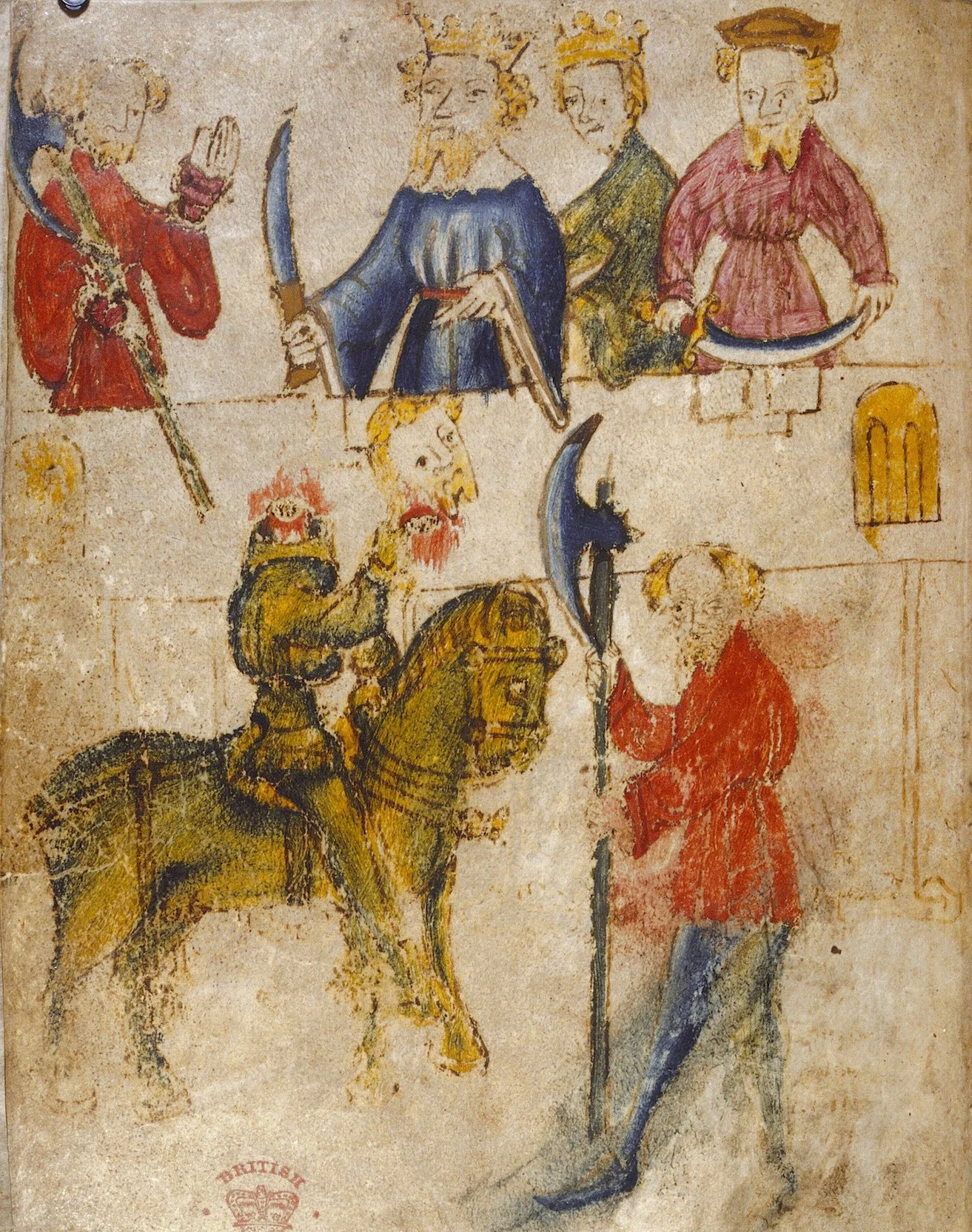
Sir Gawain and the Green Knight, Late 14th century. Source: http://gawain.ucalgary.ca. Author: Unknown. (Wikimedia Commons)
Sir Gawain chops off the head of the Green Knight, who then walks away with his head in his hands, saying that in a year he’ll return the favour. After a year, Gawain goes in search of the Green Knight (to keep his promise to offer his head!) and ends up in the castle of a lord. While the lord is out hunting, the lord’s wife tries to seduce Gawain, but Gawain refuses. After a great deal of lounging around in his bed and flirting with the lord’s wife, he accepts a good-luck ribbon from the lady. This ribbon suggests that he isn’t as brave as one of King Arthur’s knights ought to be. The Green Knight holds this lack of bravery against Gawain. On the last day of Gawain’s stay, the lord is about to chop off Gawain’s head, but then spares his life.
When Gawain leaves the castle, he thinks he’s escaped unharmed. Yet he didn’t pass the test of bravery. He didn’t even realize that this was the test. In this way Gawain reminds me of K., the protagonist in Kafka’s The Trial: both are convicted of a crime of which they remain clueless. Because of this failure, my version of Gawain (the protagonist dreamer in my poem) doesn’t find himself back on an open road after encountering temptation in the castle. Instead, he finds himself crawling on the floor of a forest (the forest is a Medieval symbol of being lost), where he’s stalked by visions of 1. the beheading of knights and nobles during the French Revolution in 1793, and 2. a mad pirate (the Green Knight) still lusting for revenge.
Yet once my knight wakes up (in the 9th stanza), he’s able to shake the confusion and terror of his dream world. In the final stanza he enjoys the simple pleasures of being awake, and being alive to the beauty of the world.
My poem is prefaced by a quote from Ezra Pound’s Hugh Selwyn Mauberley (1920). Pound is relevant to “Knight Errors” in two ways: 1. Pound was for a time a propagandist for Mussolini, who I see as a forerunner of Trump and his MAGA movement; 2. Pound was a brilliant poet who in Hugh Selwyn Mauberley complains that we live in a philistine age. Trump incarnates this type of superficial Age, given his love of gold and his ballroom, and given the general level of tackiness he’s brought to the otherwise dignified office of the President. There is of course a sad irony here: Pound’s type of support for dictators leads to the type of world ushered in by Mussolini and Trump. In Hugh Selwyn Mauberley Pound laments that he lives in a half savage country where philistines ignore the sculpture of rhyme, yet in backing a dictator he plays his own small savage part. Like my dreaming knight, he can’t come out of this dirty world squeaky clean.
☯️
Next: ☯️ On the Couch