
The Double Refuge 🍷 Bubbles Winking at the Brim
Syncretism
🍷
In The Double Refuge I argue that there's nothing wrong with doubt. Even in terms of religion I think doubt is both inevitable and beneficial. Why else would a popular Christian writer like Peter Enns write a book called The Sin of Certainty? While I go further into doubt than Enns does, we both assume that the only God worth worshipping is benevolent and reasonable. Such a God isn’t likely to punish us for exercising rational thought, for exploring alternatives, or for wanting things to be experienced before we believe them.
What could God possibly have against syncretism, against the fusing of religions, against drawing from each what seems true, so that we end up drawing more? Why is belief so often seen in terms of zero-sum?
🍷
Like Khayyam, I suspect that it’s entirely natural to doubt and also to believe:
From doubt to clear assurance is a breath,
A breath from infidelity to faith;
Oh, precious breath, enjoy it while you may,
'Tis all that life can give, and then comes death.
The Franciscan priest Richard Rohr questions the doctrinal primacy of belief from a different angle:
…why have the world religions stopped doing their job of spiritually transfroming people and cultures? Why have we told people they must “believe” in God in order to experience God, when God is clearly at work in ways that many “eyes have not seen, nor ears have heard, nor has it entered into our minds?” (1 Corinthians 2:9)? — from The Naked Now, 2009
Strict adherence to belief, combined with stricture against doubt, have created a false dichotomy between spirituality and knowledge. Yet I can’t imagine a God who wants to strike from human record the knowledge that helps us understand, protect, and appreciate this world and how we fit into it.
Nor can I imagine a God who wants to strike from the record the lessons of astronomy, geology, archaeology, philology, comparative religion, and Assyriology. The latter’s particularly germane to the dynamic between religion and belief, since it’s the study of the Mesopotamian civilizations of Sumer, Akkad, Babylon, and Assyria. These civilizations are often condemned and condescended to in the Bible, and yet they predate and influence the Bible. For instance, Akkadian was the earliest and most widely spoken of Semitic languages. The story of Noah and the Flood, as well as many other narratives and ideas, derive from the Sumerians, Akkadians, and Babylonians. The legal codes of Ur-Nammu in Sumer and Hammurabi in Babylon are at least a thousand years older than any evidence of the law of Moses. (As a child I wondered why Moses received bulky tablets on Mount Sinai. The Mesopotamians wrote on tablets of clay). Letters and numbers themselves were developed over 5000 years ago in Sumer.
I’ll take a detailed look at these Ancient influences, and at Peter Enns’ view of Mesopotamian religion, in ♒️ The Currents of Sumer (starting with Introduction & Overview). Here, I’ll just note that the Bible is a relatively late collection of texts, and that many Christian writers are re-evaluating their long-standing claim of Jewish cultural and spiritual superiority. For instance, Richard Rohr argues that one of the most counter-productive positions taken by Christianity for the last 2000 years is the assumption of superiority — not just superiority to the civilizations out of which Judaism and Christianity arose, but also superiority to all other civilizations on the planet throughout all of human history.
It seems to me that God would want us to understand as many and as much of our religious traditions as possible, even if this challenges our cherished exclusivities. I imagine that God would want us to question all of the historical, cultural, and geographical definitions which limit Him / She / It, even if this questioning leads to 1. radically altering our present views, or 2. syncretism.
Purists see a great danger in syncretism, the fusion of different religious traditions. Yet do those who believe in God really believe that there is a universal omniscient God for one group of people in one place, and then also a different universal omniscient God for a different group of people in another place? In the cloud-banks of Heaven, do the angels and saints refuse to stand next to the gods and bodhisattvas? Would Michael not still fight evil, side by side with Shiva and Rama? Would Christ not combine his love and compassion with that of Krishna and Guanyin? Is God too weak to hold together such an alliance?
St. Thomas Aquinas said in the thirteenth century: If it is true, then it is from the Holy Spirit. In the thirteenth century, when Christians demonized Muslims even more than they do today, St. Francis told us friars that if we found a page of the Koran, we should kiss it and place it on the altar. His Christian truth was not fear-based. He could honor God and holiness anywhere it was found, and not just inside of his own symbol system. — Richard Rohr, The Naked Now
In the following poem I suggest that fusing the figures of Christ and Krishna makes sense from spatial and temporal points of view: the universe is too big and too old to insist on one specific human understanding of God:
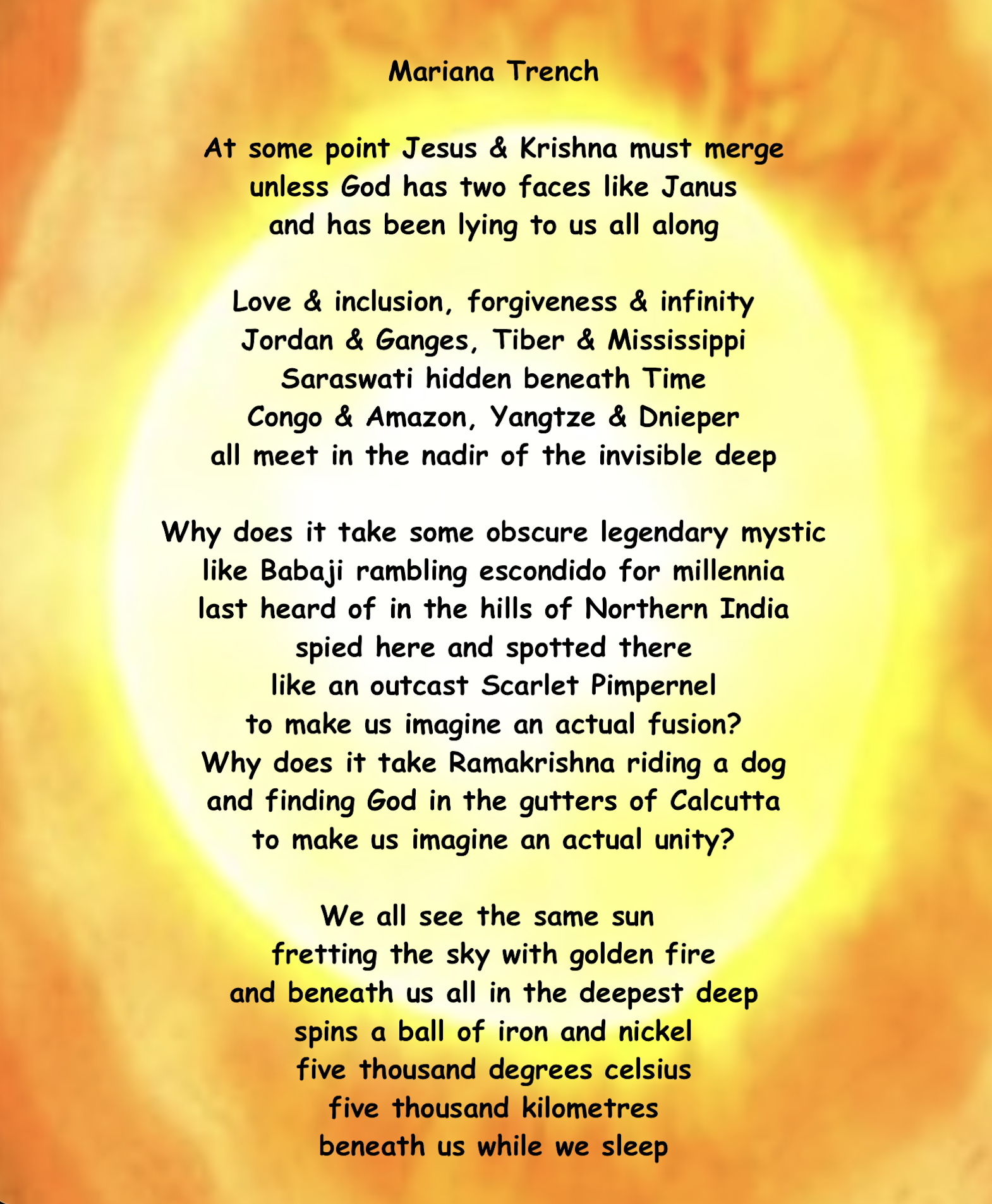
Background: detail from an image on https://news.cornell.edu/stories/2025/02/earths-inner-core-less-solid-previously-thought.
🍷
Purists often condemn syncretism and doubt, yet I suspect that God would take an interest in 🔺 whoever looks for Universal Meaning, 🔺 whoever can’t quite find It, and 🔺 whoever is still willing to consider that God has hidden It well. By the same token of Love & Mercy, God isn’t likely to punish believers who question their faith, and who struggle with things like evolution or comparative religion.
This is where The Double Refuge comes in: it focuses on the close relationship between agnostics who are open to belief (often referred to as open agnostics) and theists who are open to doubt. I call these latter open theists, although they might also be called critically-minded, liberal, universalist, non-denominational, ecumenical, non-dualist, or mystical, depending on the type of doubt they entertain. For instance, many mystics believe in God yet doubt all definitions and doctrines that try to define God.
Personally, I go back and forth between open agnosticism and open theism. I have great respect for all traditions of critical thinking, and I also have great respect for Christianity, Hinduism, Daoism, Judaism, and Islam. For instance, the poets I cite throughout this Prologue — Khayyam and Rumi — reflect the mystical Islamic tradition of Sufism. Also, in 🇮🇳 The Fiction of Doubt (starting with Rise of the Simurg), I foreground the relation between Khayyam’s science and the poetic mysticism shared by Rumi and Farid ud-Din Attar. I explain how Attar’s 12th-century long poem Conference of the Birds provides the dominant extended metaphor (a flight of birds to the king of birds, the Simurg) in Salman Rushdie’s first five novels. I also illustrate how Rushdie uses this metaphor to argue for critical thinking and for a free, open, democratic society.
In terms of syncretism, Rushdie is one of the great writers of the world. In his first novel, Grimus, he fuses Norse, Hindu, Sufi, and Dantean superstructures. In Midnight’s Children he brings together the variety of religions in India in the microcosm of his protagonist’s head, and he champions Attar’s s ideal of unity in the face of the historic antagonism between Hindus and Muslims. Finally, in Haroun and the Sea of Stories Rushdie fuses Attar’s flight of birds with the Hindu ocean of stories, suggesting that Islamic and Hindu notions benefit from admixture. In brief, if syncretism is a sin, Rushdie is a sinner to the very core. And even as the core implodes into a million scintillating parts, each part reflects the light in a different way.
🍷
While Hinduism operates from its beginning (the poetry of the Vedas) along poetic, syncretic, ahistoric, and mystical lines, the three main Western religions follow in the more literal and historical Abrahamic tradition. Here God is understood as favouring a specific people (the Chosen People, who divide off into three camps of True Believers), a specific theology (largely monotheistic, prophetic, and historical), and a specific holy text (Pentateuch, Bible, & Koran).
In The Double Refuge I attempt to loosen some of these religious specificities, starting with the exclusive specifics of my own religious tradition, Christianity. To me, Christianity has too often been dragged down by dogma and compulsion. Too often it’s presented as a doctrine of belief rather than an exploration of love and truth.
Jesus said that he came to fulfill the old Jewish Law (Matthew 5:17), yet in ‘fulfilling’ it he changed it radically — from a focus on judgment and mercy to a focus on forgiveness and Grace. The message of Jesus is complementary to the Law of Moses, but more so in the way that parole and rehabilitation is complimentary to verdicts and incarceration. They’re complementary, but so is yin to yang.
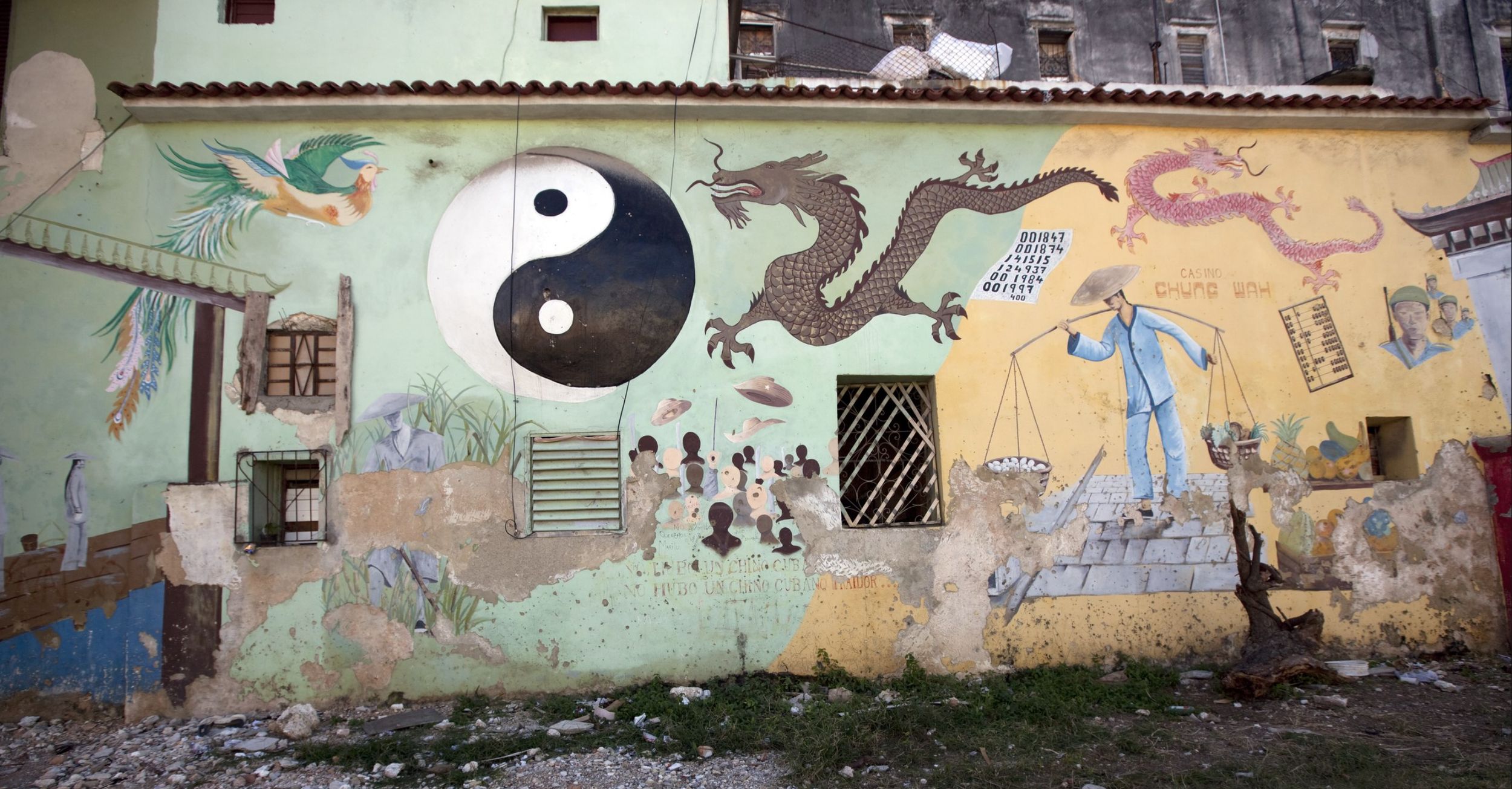
Murals painted on a building on Dragones Street, in the Chinatown section of Havana, Cuba, January 2010. Author: Carol M. Highsmith (1946–) (Wikimedia Commons, cropped by RYC)
The God of Moses displayed mercy on occasion, but He also displayed a great deal of justice and punishment, much of which was based on an exclusive cultural and historical code of rules and customs, as well as an exclusive contract which favoured one particular people. In this context, Jesus steered the Jewish tradition from exclusion to inclusion, and suggested a liberation from compulsion and fear.
While fire-and-brimstone preachers still tell the Old Testament stories about evil-doers and divine vengeance, we see today a movement toward a more forgiving and inclusive Christianity, a global faith that’s willing to engage with all religions, cultures, and philosophies. This is the type of open Christianity urged by Transcendentalists in the 19th century, most notably by Ralph Waldo Emerson and Walt Whitman. It was also current in India and China, as I explain in 💫 Believing in the Mystery (starting with Introduction: Daoism & Whitman’s Transcendentalism). In this chapter I highlight the similarities between the mysticism of Whitman and that of the Daoists Laozi and Zhuangzi.
In the 20th century, open versions of Christianity have been promoted by the likes of Thomas Merton, Raimundo Panikkar, and Richard Rohr. Rohr’s idea of the universal Christ is particularly interesting in the context of inclusive religion. Rohr argues for a cosmic Christ of love, forgiveness, and Grace, one that has existed since at least the Big Bang. This cosmic force of Love flowers in the historical Jesus yet also in any being who acts with charity, compassion, and love. This Jesus operates within a framework of either/and, not either/or. I imagine this Jesus as a sort of bodhisattva on the Jordan.
In 🌎 Many Tribes: (starting with Overview & Six Versions of Infinity) I explore the history of exclusive vs. inclusive Christianity, and in ⏯ Systems (starting with Christianity 2.0) I argue for an inclusive Christianity, even for a Jesus 2.0. This Jesus isn’t burdened with being the only way to God, but is unfettered in the encouragement of love, truth, inclusion, compassion, forgiveness, sacrifice, and redemption. This Jesus honours this religion or that religion, as long as it advocates peace, love, and understanding.
🍷
For a more complete overview of the sections and chapters in The Double Refuge, see the middle section of Refuges Here & There. I’ll restrict my comments here to my overall aim, which is 🔺 to promote critical thinking and 🔺 to explore all religions and philosophies. My hope is that the more agnostics and theists remain open, the more likely they are to understand each other, to get along, perhaps even to merge in the infinity that both see as the dominant feature of reality.
🍷
Next: 🍷 Refuge and Absinthe