
The Double Refuge 🍷 Bubbles Winking at the Brim
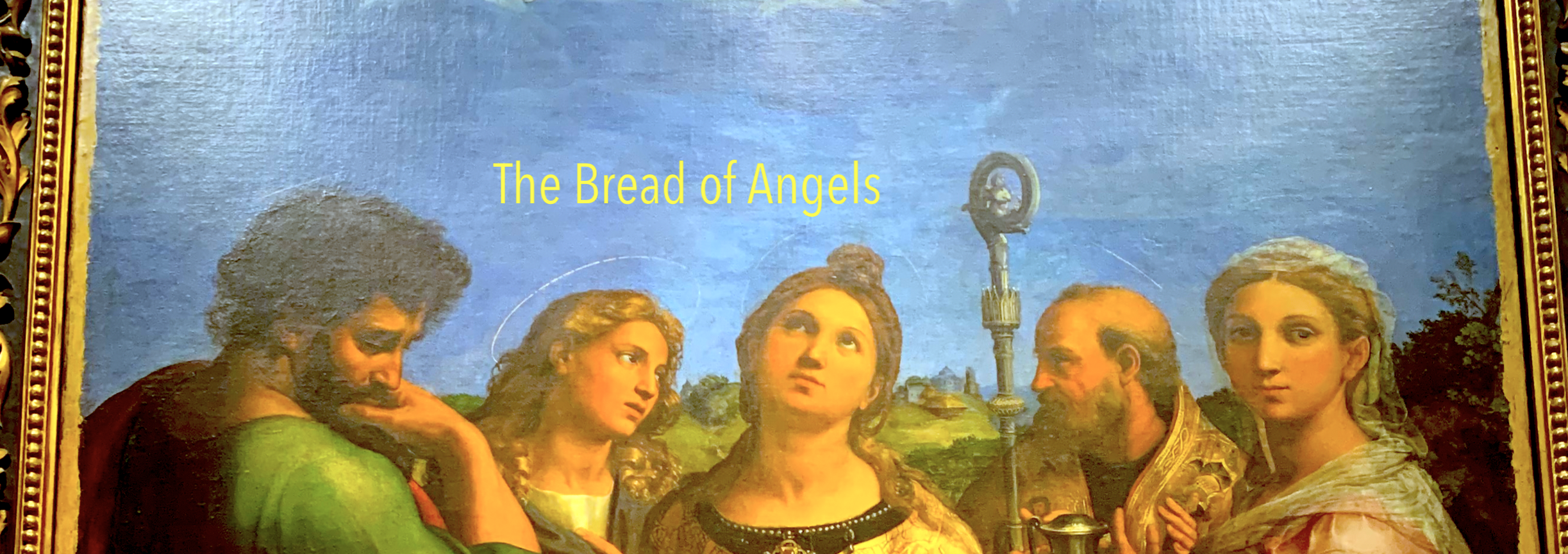
The Bread of Angels
🍷
The angel is free because of his knowledge, the beast because of his ignorance. Between the two remains the son of man to struggle. — Rumi
The body's a mirror of heaven: Its energies make angels jealous. Our purity astounds seraphim. Devils shiver at our nerve. — Rumi
🍷
Rumi often expresses the mystical moment in exaggerated fashion, much as Walt Whitman did when he called himself “a kosmos, of Manhattan the Son.” And like Whitman, Rumi struggles toward unity, toward a coherence of experience in which diverse elements — from angel to devil — come together. Yet this unity, like the chimerical fallen angel in ”One of These Nights,” is hard to come by:
We see the image of this unity, as well as the worldly forces that rip it apart, in Rumi’s poem “We Come Whirling Out of Nothingness.” The poem suggests that we come from nothing, and that our lives mean practically nothing in the grand scheme of things. We’re cogs in what seems like a monstrous machine. And yet for Rumi the machine is the wheel of heaven, a gigantic waterwheel. By immersing himself in this machine, in its spinning atoms and ruthless spokes, he connects with the power that turns the wheel and that makes the atoms and celestial bodies spin, all thanks to the power of love:
We came whirling out of nothingness, scattering stars like dust. The stars made a circle, and in the centre we whirl.
The Wheel of Heaven circles God like a mill. If you grab a spoke it will tear your hand off. Turning and turning, it breaks apart all attachment. Were the wheel not in love, it would cry “Enough! How long can this go on?”
Every atom in its turning is bewildered. Beggars circle tables, dogs circle carrion, the lover circles his own heart, ashamed.
I circle shame, a ruined water wheel. Whatever way I turn is the river.
If the old sky creaks to a stop, still I turn and it is only God circling Himself.
— from Rumi, Fragments-Ecstasies, trans. D. Liebert
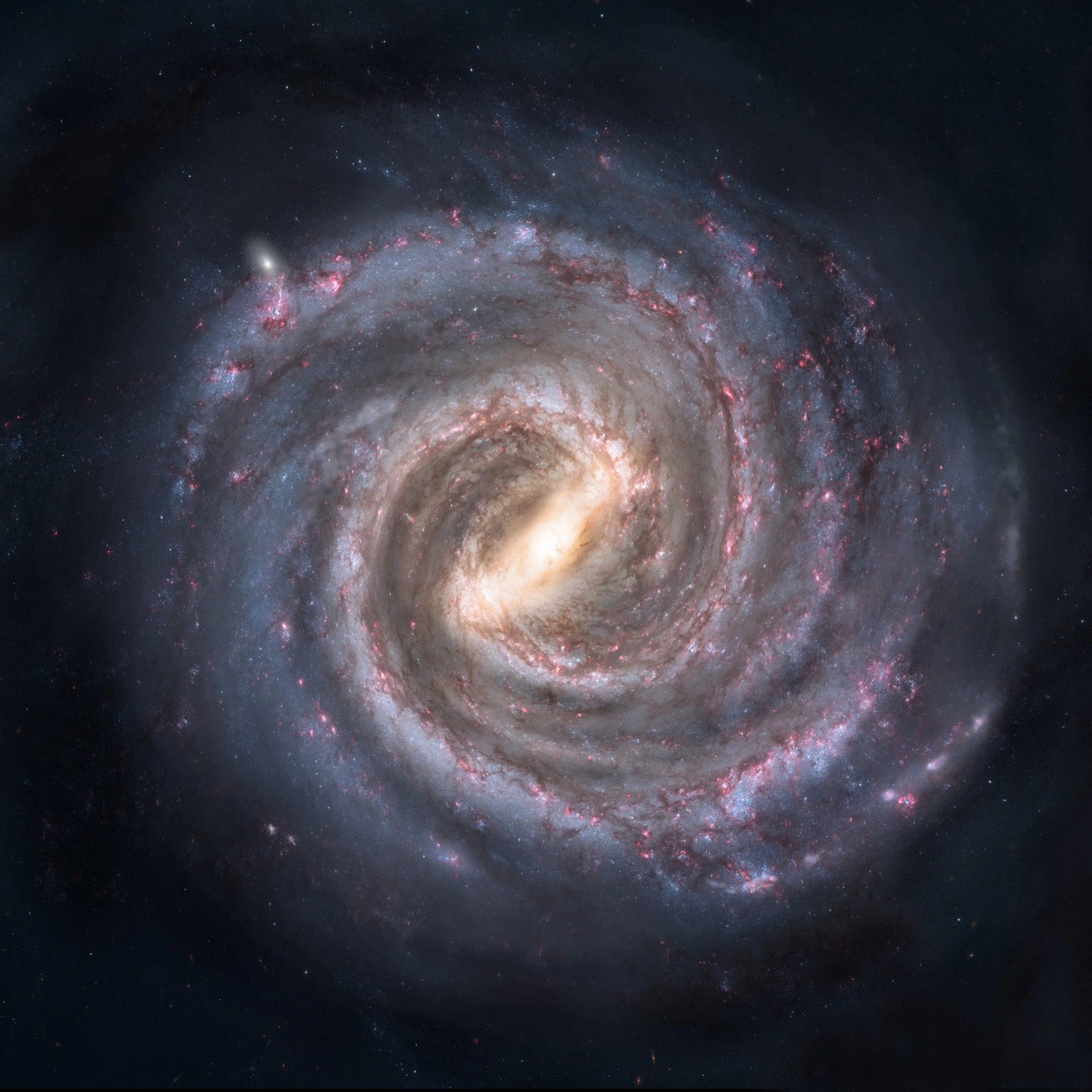
Artist's conception of the Milky Way galaxy, 25 June 2009, Adapted from NASA images - Messier51 sRGB.jpg by Nick Risinger (Wikimedia Commons)
Rumi gives us a vision of mystical union, of God Consciousness, samadhi, wajd, wudd, or whatever we call it when we feel that we’re living here on the plane of this physical world, and yet also here on some other metaphysical plane. When the planes intersect or overlap, we’re intrigued & confused, terrified & fascinated, illuminated & mystified. When the planes fuse, Rumi’s atoms implode, and we taste the bread of angels.
But the bread of angels didn’t get us to this state. This bread may sustain the airy spirits above, and we may taste it on very rare occasions, but it doesn’t constitute our everyday lives. It doesn’t build or sustain our biped legs that walk along the ground. Nor does it fashion the neurons that allow us to think about the sky and look out over the fields of wheat. The actual workings of the wheat field and the leaven that raises our daily bread have more to do with Darwin’s finches than with the feathers of Gabriel.

One might say that the same invisible Power that grew the wheat also fashioned it into a light and airy (yet miraculously crispy) bread — a baguette fallen from the Boulangerie of Heaven. But according to religion the same invisible Force grows and fashions everything, including the thought of the celestial boulangerie on a cold Paris morning, with the baguette crackling and soft in your hands, and further afield the lovers on the grass, and the lamb laying down in the manger, and the tiger hiding deep in the forest of the night? Because this Force is invisible and does everything, we never know for sure exactly what it does, or how it does it. We’re brought back to mysteries, scientific or otherwise. As Khayyam puts it,
That pearl is from a mine unknown to thee,
That ruby bears a stamp thou can'st not see,
The tale of love some other tongue must tell,
All our conjectures are mere phantasy.
The field of wheat and the bread of angels are related, yet they’re different. The practical world may be connected somehow to the world of the mystics, but for the most part they’re different worlds — close, perhaps even integrated on some deep level — but theoretically and practically they’re worlds apart.
Most of the time we walk among the fields of wheat, but on occasion we stray onto the pathway of the sky, flowing in our imagination with the air that sweeps across the earth with its fine-tooth comb. Yet our legs and our thoughts are here on the ground, not up in the sky.
The angels may delight in the finest mille-feuille, layer on layer of crispy pastry and cream, yet down here we have to go to the boulangerie.
🍷
Next: 🍷 The Magic Box