The Double Refuge 🍷 Bubbles Winking at the Brim
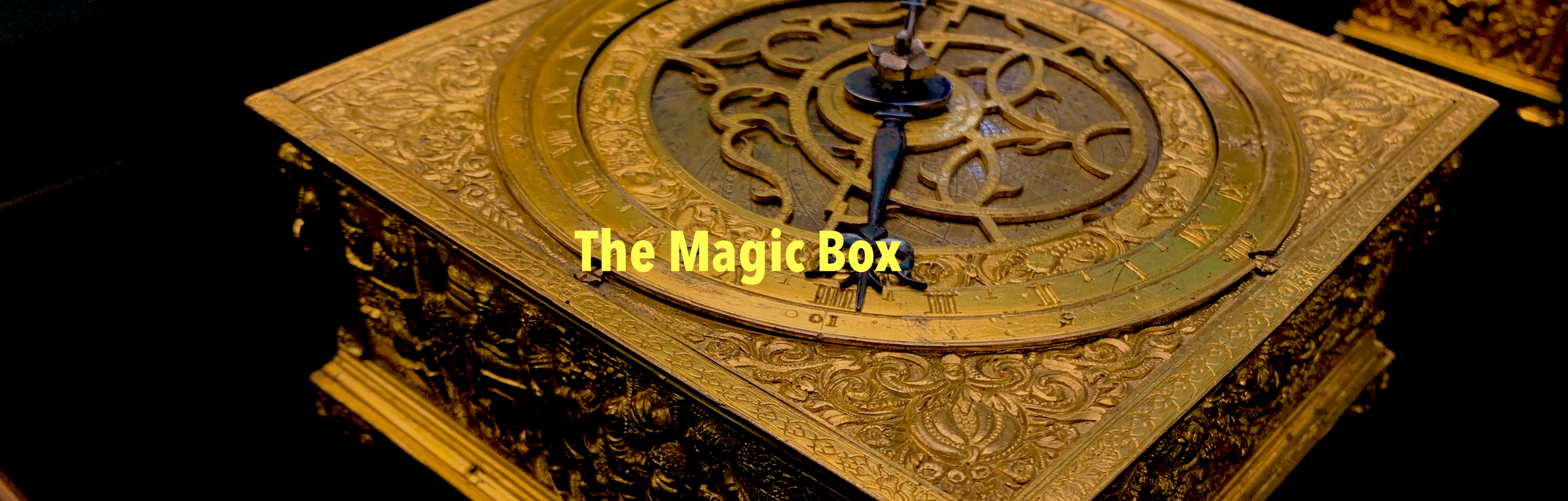
The Magic Box
Boxes - The Pivot - A Magic Show - The Forms of Things Unknown
🍷
Boxes
In isolation, belief or doubt can box us in. Yet together they can allow us to explore the contents of each box, and also to think outside each box.
In the following poem I use the idea of a box to suggest two mutually compatible ways of experiencing life. In the first, it can be liberating to think outside the box, whether it’s the box of doubt or the box of belief. In the second, we get tired of people telling us to think outside the box. Why should we throw away the idea of boxes? Why should we throw away the idea of anything, or anything that might be inside the box? Why not think of boxes differently instead? For instance, why not think of a box that has windows on all sides?
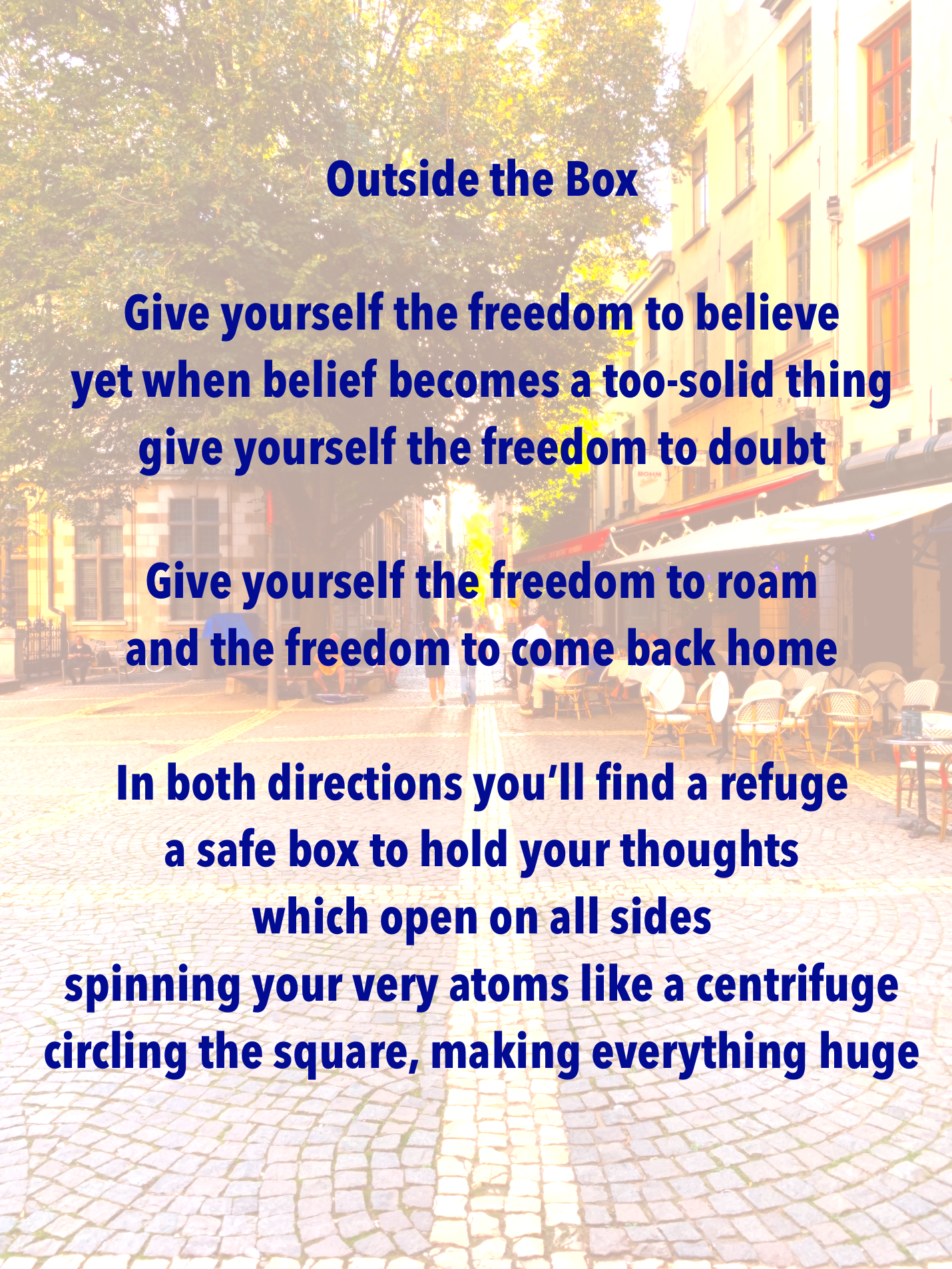
Hendrik Conscienceplein, Antwerp (Photo RYC)
Why not make each side of the box a window with different tints of glass? Or a mirror, like the one Alice found above the fireplace? Or a door we can walk through? Or why not make the box translucent?
🍷
The Pivot
Given that we are destined — by God? by Nature’s Chance? — to live our lives in the magic box of our own conceptions, I suggest that we make it a free and open box, transparent and open on all sides. I suggest that we swivel within it, looking 360 degrees all around us. I suggest putting ourselves at the fulcrum, at what Zhuangzi calls the pivot of the Dao…
[…] that view involves both a right and a wrong; and this view involves also a right and a wrong:—are there indeed, or are there not the two views, that and this? They have not found their point of correspondency which is called the pivot of the Tao [or Dao; in either case, the Chinese notion of a God that is transcendent yet also operates mysteriously in Nature]. As soon as one finds this pivot, he stands in the centre of the ring (of thought), where he can respond without end to the changing views;—without end to those affirming, and without end to those denying. — Chuang Tzu 2.1.2, trans. James Legge
As with many of Zhuangzi’s ideas, this one tends to provoke more questions than answers.
🔺 Is the pivot a function of our reason, or is it the awareness of our deepest self, our consciousness, our soul? Or is that a false dichotomy — that is, a divided way of thinking about two things that are connected, complementary, or unified?
🔺 Is this pivot, that propels us to see differences yet encourages us to connect and erase these differences, the same as what T.S. Eliot called unified sensibility? Is it the simultaneous operation of thinking and feeling? In this case, is feeling the yin (the weaker accommodating force) to thought’s yang?
🔺 Is this pivot of the Dao a personal thing that we operate, or is it a universal thing that operates at the behest of the Dao, the mysterious transcendent God of the early Chinese? Or, again, is this a false dichotomy, one that can be dissolved through the operation of the pivot, the very purpose of which is to reconcile viewpoints?
🍷
A Magic Show
I’d combine Zhuangzi’s notion of a pivot with Shakespeare’s notion of the world as a stage. From the pivot, we see each scenario as a drama, playing out one of the changing views, each view playing out one of the changing themes. For instance, we look out one window of the box and see a man handing a woman a glass of red wine.
We turn horizontally 90 degrees and look through the next window. Here we see the figures of Romeo and Don Giovanni. Ah, he’s a seducer, trying to get the lady drunk. The rascal!
Then we turn another 90 degrees and see a poet sitting at his writing desk, the moon high in the window above. He writes that the wine is dark red, ruby in the late afternoon, crimson in the dusk. Why does the poet care so much about the colour of the wine? And why does he care so little about the rascal’s hand, which is by now sneaking into the lady’s blouse? We notice a glass of water and a crust of dry bread next to the inkstand.
We turn 90 degrees once more and we see the footnotes at the bottom of the poet’s page, which has just been stamped by a monstrous iron press. The notes read: “The cup is the body and the wine is the spirit. The wine is the intoxication of God, and the tavern is the universe.”
We turn once more and we’re back to where we started: the man hands a glass of wine to a woman. The wine is bright red, like a ruby in sunlight.
🍷
Although we might congratulate ourselves at having circled the square, 360 degrees isn’t everything. The pesky geometer inside us insists there are six cardinal directions, not four. So we tilt our neck vertically 90 degrees, and look up into the sky. We see clouds above and we imagine galaxies beyond. We see Andromeda chained to the stars. We can barely make out something that looks like Dante’s Heaven. But then we see another Form, another Platonic Grand Idea, behind that Palace of Angels that dissolves into a metaphoric, interstellar mist.
It all seems so far away, and so very unprovable. So we pivot 180 degrees on the fulcrum of our skulls, and look down toward the earth. Small creatures dance along the forest floor. Squirrels race between the parked cars on the street below our apartment window. Gophers run into holes, and rivers flow into the sea. We swim with the dolphins and float with the jellyfish. We lumber from one subterranean ravine to the next, side by side with the creatures of the deep.
But then we realize that we’re just swaying in our chairs in front of our computers. The stars and rivers were just metaphors. What they really mean, far away in other galaxies or at the bottom of the sea, is their business. What they mean within us, symbolically, remains inside the box. Inside that most curious of boxes.
Having thought about the things that lie beyond the transparent box of our experience, we compare them to what’s inside the box. Looking within, we see the changing nature of our perception. We see the colours of our perspective and the limits of our knowledge. We also realize the undeniable centrality of our feelings. We start to understand 🔺 the oddness of our thoughts (which go on about boxes), 🔺 the continual mystery of our emotions (which plead mutely for our thoughts to give them voice), and 🔺 the astounding fact of our own existence (which is the subject of this series of essays, of Phenomenology, and of most of the world’s poetry).
We marvel at the one unavoidable fact: we exist in the moment. The marvel isn’t so much what we think as it is that we think. It isn’t so much what we are as it is that we are. The ancient thinkers of India marvelled at the same thing. They concluded (in the Upanishads) that everything we see, think, and feel is in fact God, which they called Brahman or That. This flower or ditch, this idea about stars or whales, this feeling of love or hate, are all That. All this is That. Or, as William Blake wrote, “If the doors of perception were cleansed every thing would appear to man as it is, Infinite.”
But what kind of liquid, and what kind of sponge, can be used to cleanse the doors of perception? The Persian poet Rumi says that “essence and its deepest secrets / Are open and manifest to the eyes of the perfect.” But who among us is perfect? How on Earth are we to proceed as if we were in Heaven?
Lofty ideas need to be grounded somehow. It’s fine and dandy to read these things: the box of our brain spins and we create a circle from a square. We guzzle the stars of the Milky Way, and we chug leagues of the watery deep. The Big Dipper dips into the Marianna Trench, and Heaven and Earth are One. Yet our legs are in fact walking beneath us. Where’s the yoga that will unite Heaven and Earth? Our religions hope to do this through meditation, prayer, and charitable works; by knitting the physical world into the ethereal world, and by infusing spirit into matter. Our pivoting soul tells us this is possible, but the soles of our feet give us other information.
We pivot in the air and our feet walk on the ground. Everything else is speculation.
🍷
The Forms of Things Unknown
In The Double Refuge I’ll use literature to explore the pivot within us that allows us to go back and forth between doubt and belief.
Perhaps the first thing to note is that literature resembles the pivot itself. Shakespeare notes in Hamlet that drama is like a mirror up to nature. Literature isn’t tied down to one place or time, but follows us and reflects us, as our shadows follow our bodies, and as our thoughts and feelings reflect our identities. In this sense, literature is very realistic, very connected to the facts of our existence and our interactions with others.
Yet literature is also very open to things that aren’t factual, such as religion, philosophy, and fantasy. In A Midsummer Night’s Dream, Shakespeare notes,
The poet's eye, in fine frenzy rolling,
Doth glance from heaven to earth, from earth to heaven;
And as imagination bodies forth
The forms of things unknown, the poet's pen
Turns them to shapes and gives to airy nothing
A local habitation and a name.
Because literature is so malleable, so open to being used to explore every angle of life, from the realistic to the idealistic, it seems the perfect medium to explore the possibility of being open to both the realistic physical world and to the more speculative world of religion.
🍷
Throughout The Double Refuge I’ll explore the nature of our existence, both from the perspective of doubt (or open agnosticism), and from the perspective of belief (or open theism). I’ll stress a sensibility that allows us to grab onto doubt or belief without the feeling that we have to let go or have to hold tight.
Richard Rohr gets at something similar in “Glimpses of Wonder,” the sixth chapter of his book, The Naked Now (2009):
[Mary] was deeply disturbed [by the words of the angel] and wondered what they might mean. - LUKE 1:29
[The disciples in meeting the risen Jesus] were so in wonder that they could not believe it. - LUKE 24:41
"Wondering" is a word connoting at least three things:
Standing in disbelief
Standing in the question itself
Standing in awe before something
Try letting all three "standings" remain open inside of you. This is a very good way to grow spiritually, as long as the disbelief moves beyond mere skepticism or negativity.
🍷
In a box, or standing and wondering, we can let our stance be an open one. It’s our life, why limit it? Why close the shutters or lock the doors? Or, as Walk Whitman suggests, we can go even further:
Unscrew the locks from the doors!
Unscrew the doors themselves from their jambs!
🍷
Next: 🍷 Nishapur Wine