
The Double Refuge ☯️ Herr Jung
Aura 5: Progressions
Black Magic - London Spooks - Jumping the Life to Come
☯️
Black Magic
Fuentes’ Consuelo uses the old world of forbidden pagan sorcery, mixing it blasphemously with Christianity. We see this in her ambiguous action of shaking her fists at the images on her altar. The reason I say ambiguous is that we can’t be sure what she’s shaking her fists at. Note that the description of her altar focuses more on the demons who are free to explore the violent and sexual aspects of life than on the saints from whom this “freedom” is hidden:
Cristo, María, San Sebastián, Santa Lucía, el Arcángel Miguel, los demonios sonrientes, los únicos sonrientes en esta iconografía del dolor y la cólera: sonrientes porque, en el viejo grabado iluminado por las veladoras, ensartan los tridentes en la piel de los condenados, les vacían calderones de agua hirviente, violan a las mujeres, se embriagan, gozan de la libertad vedada a los santos.
Christ, Mary, Saint Sebastian, Saint Lucy, the Archangel Michael, the smiling demons, the only smiling ones in this iconography of pain and anger: smiling because, in the old picture illuminated by candles, they insert tridents into the skin of the condemned, empty cauldrons of boiling water, rape the women, get drunk, and relish the liberty denied the saints.
Implicit in this pagan/Christian world is that black magic can not only influence the present but can transcend time, bringing back the past — in the form of the general desired by Consuelo.
When Felipe climbs the steps into this world, ever-more seduced by the beauty of Aura, he enters a world that’s ancient, in fact much more ancient than Consuelo and her late 19th century love for the general (a relationship that Felipe is paid by Consuelo to research). The world is one where powers operate outside of yet also onto the physical world of practicality and science. Fuentes is entering here into a second and deeper level of metaphysics, one where spirit operates separately yet with the physical world, and also where the spiritual transcends time and space, when Consuelo brings back the spirit of her dead husband.
The horror that Consuelo enacts may to some seem like an ancient superstition, and indeed it falls strangely into recent history. It’s as if a grotesque swooped down from Notre Dame and threw itself upon a Modern stage.
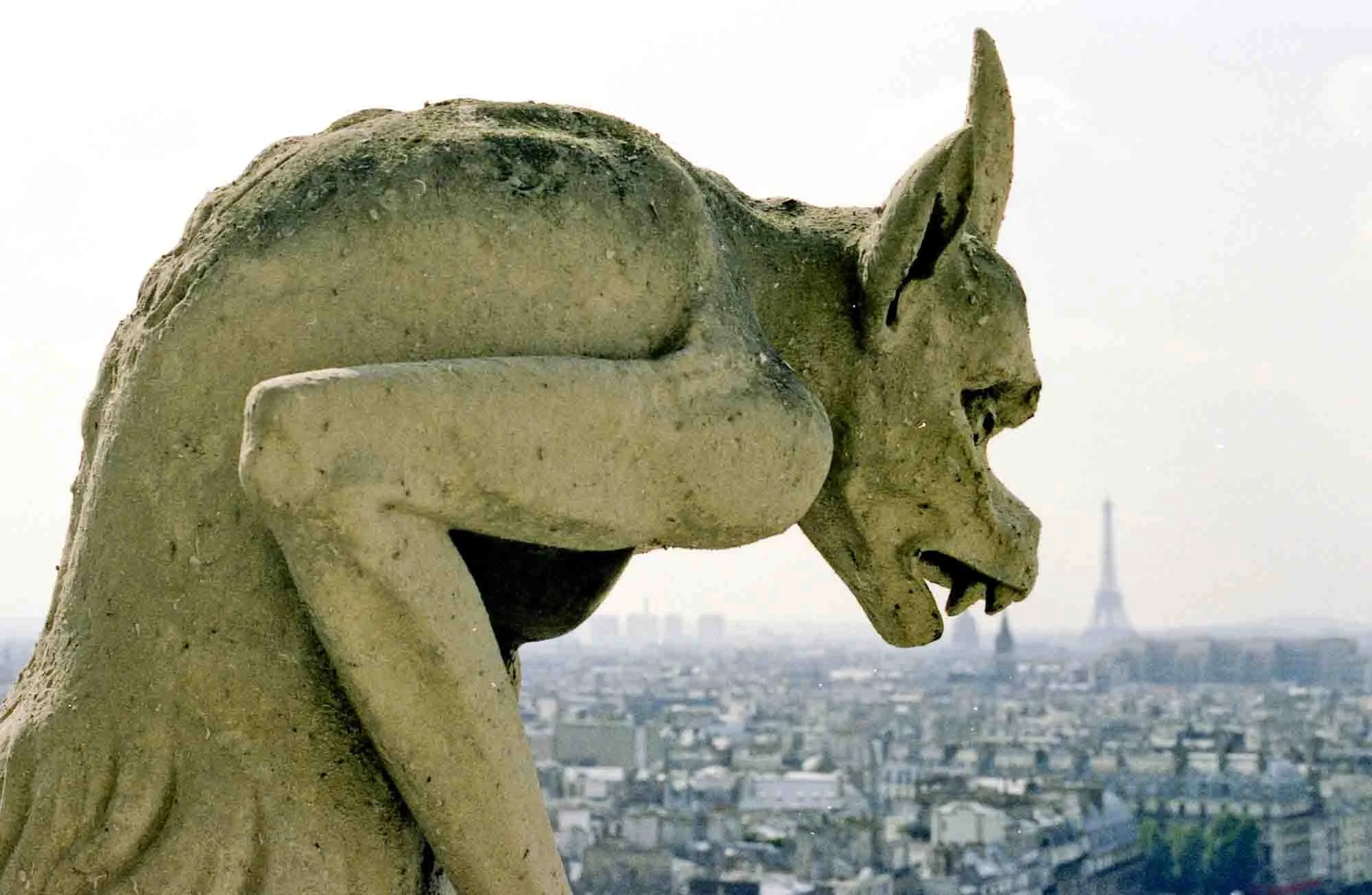
Gargoyle at Notre Dame Cathedral, Paris. August 2012. Author: John Cornellier (Wikimedia Commons)
We can appreciate this more fully by looking at when in history such a notion became obsolete, when it stopped being a fear and started being a performance of horror, leading to the present time, when people routinely watch it and don’t believe it, no matter how gruesome the show might be.
☯️
London Spooks
In Shakespeare’s day the horror of supernatural occurrence could be blood-curdling because people were still surrounded by a religious philosophy which encouraged the belief in the supernatural. Over the course of the next two centuries, the same creepy possibilities survive, yet are approached with an increasing degree of skepticism, and framed in a lexicon that’s increasingly scientific and empirical. In Dickens’ 1852-3 novel Bleak House characters are still frightened of ghosts, yet they were also at a turning point in the power of the scientific explanation. Still, the novel was written prior to Darwin’s Origins in 1859, and to our understanding of neurons, DNA, biblical philology, and galaxies. In other words, the power of rational scientific thinking wasn’t as great as it was to become by the 1920s.
This historical progression suggests that at some point we will erase the occult phantoms of the past. Yet such linear thinking ignores that no amount of time and no amount of proof can affect those who consider faith greater than proof. We will perhaps always have to contend with Aquinas’ logic: “To one who has faith, no explanation is necessary. To one without faith, no explanation is possible.” The second part of Aquinas’ statement may be wrong, given that we do have a scientific explanation, yet this doesn’t nullify the first part.
As a double refugee, I’d argue that science still hasn’t extinguished supernatural belief. Yet what I’m getting at here is the historical rise of rational scientific explanations, especially the use of empirically-based psychology, which we see in Hamlet’s use of “all forms, all pressures past, / That youth and observation copied there,” and which we see in Dickens’ use of “chords of the human mind” — in the conversation between Tony and Mr. Guppy in Chapter 32 of Bleak House. Like Shakespeare in Hamlet and Macbeth, Dickens also focuses on the overwrought sensitivities that make realistic people believe they see ghosts. In regard to Tony and Mr. Guppy, Dickens writes: “So sensitive the two friends happen to be that the air is full of these phantoms”:
“Besides its being calculated to serve that friend in those chords of the human mind which — which need not be called into agonizing vibration on the present occasion — your friend is no fool. What's that?"
"It's eleven o'clock striking by the bell of Saint Paul's. Listen and you'll hear all the bells in the city jangling."
Both sit silent, listening to the metal voices, near and distant, resounding from towers of various heights, in tones more various than their situations. When these at length cease, all seems more mysterious and quiet than before. One disagreeable result of whispering is that it seems to evoke an atmosphere of silence, haunted by the ghosts of sound — strange cracks and tickings, the rustling of garments that have no substance in them, and the tread of dreadful feet that would leave no mark on the sea-sand or the winter snow. So sensitive the two friends happen to be that the air is full of these phantoms, and the two look over their shoulders by one consent to see that the door is shut.
"As to dead men, Tony," proceeds Mr. Guppy, evading this proposal, "there have been dead men in most rooms."
"I know there have, but in most rooms you let them alone, and — and they let you alone," Tony answers.
I’ll enter a more in-depth discussion of naturalism vs. supernaturalism in Bleak House (“If the Walls Could Talk,” in At the Fog & Wild). Here I want to note that Fuentes’ novel isn’t couched in the 19th century pre-agnostic quasi-scientific terms we find in Bleak House. Rather, it brings us back to older religious terms of dread and horror, as if Fuentes is taking the witches and ghosts that even Shakespeare seems to question, and making them come alive in all their distant Medieval power.
☯️
Jumping the Life to Come
Macbeth and Hamlet helps us to see the rising empirical way of looking at the mind and also, simultaneously, the horrific, forbidden, blasphemous, retrogressive nature of Consuelo. In one of the great soliloquies, Macbeth notes that he can’t avoid a punishing afterlife if he assassinates King Duncan. Macbeth notes that the Christian, Stoic, karmic principle of divine law operates once we have shuffled off the mortal coil that nature has supplied us. Shakespeare begins by using a deft pun on the word done to signal his imminent assassination — agonizing about whether or not he should do it:
If it were done when ’tis done, then ’twere well
It were done quickly. If th’assassination
Could trammel up the consequence, and catch
With his surcease success: that but this blow
Might be the be-all and the end-all, here,
But here upon this bank and shoal of time,
We’d jump the life to come. But in these cases
We still have judgement here, that we but teach
Bloody instructions which, being taught, return
To plague th’inventor. This even-handed justice
Commends th’ingredience of our poisoned chalice
To our own lips.
In Hamlet’s Claudius we don’t get to see the type of agonized forethought we see in Macbeth, since the play begins after he commits murder, and since most of the equivocation in the play is reserved for Hamlet himself. Yet in one scene, Claudius kneels at an altar and tries to confess for committing both fratricide and regicide. Kneeling at the altar, he is all too aware that no trick of legal reasoning can save him from the iron-clad law of otherworldy or karmic justice that governs the universe.
Whereto serves mercy
But to confront the visage of offence?
And what's in prayer but this two-fold force,
To be forestalled ere we come to fall,
Or pardon'd being down? Then I'll look up;
My fault is past. But, O, what form of prayer
Can serve my turn? 'Forgive me my foul murder'?
That cannot be; since I am still possess'd
Of those effects for which I did the murder,
My crown, mine own ambition and my queen.
May one be pardon'd and retain the offence?
In the corrupted currents of this world
Offence's gilded hand may shove by justice,
And oft 'tis seen the wicked prize itself
Buys out the law: but 'tis not so above;
There is no shuffling, there the action lies
In his true nature; and we ourselves compell'd,
Even to the teeth and forehead of our faults,
To give in evidence.
In Hamlet, Shakespeare cleverly dramatizes this larger structure of universal even-handed justice, but with a poetic twist. Claudius symbolically drinks the poisoned chalice by murdering Hamlet’s father, but he also literally drinks a poisoned chalice at the end of the play. Prior to the dual between Hamlet and Laertes, Claudius poisons a chalice of wine that he intends to give to Hamlet. Yet Gertrude unexpectedly drinks from the chalice. Claudius thus loses the love of his life, about whom he earlier tells Laertes that
She is so conjunctive to my life and soul That, as the star moves not but in his sphere, / I could not but by her.
At the play’s climax, Hamlet shoves the chalice into Claudius’ mouth. Claudius then drowns in the poisonous mix of blood-red wine and poison that he himself put into the drink. As horrible as this is to Claudius, this is only a prelude to the after-world horrors that await him.
☯️
While Shakespeare gives voice to a deep and abiding view of afterlife justice, Hamlet and Macbeth also have striking degrees of ambiguity in regard to the ultimate question of metaphysics: do we enter a realm of essences after we die? The ghost in Hamlet comes from a sulpherous Purgatory, yet Hamlet says that while we may see the afterlife in terms of dreaming, this is just a conceit, for the afterlife lies beyond “that bourne from where no traveller returns.” Most tellingly, he introduces the afterlife with the phrase, “Perchance to dream.” This implies an alternative: perhaps we enter an afterlife or perhaps we merely sleep, without dreaming.
Macbeth and his witchy wife summon all the powers of Hell, yet this Hell is a realm of blackness and emptiness, more akin to Augustine’s lack of being than to an actual place or dimension. This empty Hell is like the empty promises of the three weird sisters, and like Macbeth’s view of life as “a walking shadow; a poor player, that struts and frets his hour upon the stage, and then is heard no more: it is a tale told by an idiot, full of sound and fury, signifying nothing.” Perhaps ironically, this Modern Renaissance version of Hell resembles the oldest version of Hell, that of the Sumerians and early Greeks: more an empty realm of dusty meaningless than any scenario of fire or light.
Shakespeare may shock some conservatives with his questioning of Christian doctrine, yet by and large he keeps within it. Mostly, he edges toward doubt, and toward questions that by and large resemble the doubts and questions of the Greek world that was being re-discovered or re-born in the Renaissance or rebirth of his Age. Fuentes, on the other hand, shocks his 20th century reader by returning to that old world of Medieval mysticism, as if the Renaissance and Enlightenment had never taken place.
The stairway Felipe climbs takes him into another dimension, starting with the strange coincidences which lead him into the apartment, then continuing with the strange aura of the apartment — the aura that surrounds the young girl and seems to possess her — and climaxing with the possession of his body by the general who transcends both space and time, coming back from the grave to have sex with his old love Consuelo, who herself seems to be more witch than woman.
In this scenario there is no equivocation on Consuelo’s part. Nor does Fuentes provide Felipe with a frame of mind that’s skeptical enough to negate the sorcery, nor religious enough to oppose it. I’d suggest that Jung’s psychology puts the dreamer in a similar situation: Jung doesn’t underscore the empirical enough to make the dreamer see nightmares as the reworking of sense impressions, nor does he supply a clear and positive theological framework which would subordinate nightmarish figures to the force of omnipotent benevolence. As a result, followers of archetypal analysis can be left somewhere in the middle. As a result, they remains vulnerable: they becomes like Macbeth, who fears the images of sin and death, yet who can’t muster the ruthlessness of his wife and see the images as pictures or painted devils in the way that his ruthless wife is able to do — at least for the moment; later she goes insane with guilt and finds that all the perfumes of Arabia can’t remove the blood from her hands. Like Macbeth, the follower of Jung remains unable to dissociate himself, from the painted devils that he has seen and which are carved into his mind. Nor does Fuentes suggest that he will go insane as a result, and that there is some form of cosmic retributive justice at work. The novel is all the more potent because of this, since it underscores just how precarious a situation Felipe is in.
☯️
Next: ☯️ Knight Errors