The Fractal Heart
Preface
Romances & Comedies - Somewhere in the Thirteen Universes - Fractals & Mirrors - The Impossible Heart - Pumpkins - Fractal & Psyche - Pirouette
💕
This Preface contains plot spoilers. My story contains many plots and subplots, so it may be helpful to get a sense of the overall design. If you prefer, jump to Page 1: Times New Roman.
💕
Romances & Comedies
The Fractal Heart is a sci-fi romance. By sci-fi I mean a brave new world filled with aliens & technological wonders. By romance I mean the same old chaos of lust & love, desire & despair, chivalry & misogyny, jealousy & obsession, etc.
As in Medieval romances and linked tales — such as Le Roman de la Rose, The Decameron, and The Canterbury Tales — my story contains affairs of the heart, yet it also contains allegory, satire, parody, and all sorts of virtue & vice: noble vagabonds & sex-starved heroes, drunk millers & randy wives, poets declaring war & politicians professing peace, celibate transexuals and diabolical monks. It’s as if Chaucer’s pilgrims were acting out their personal dramas on the deck of a Federation Starship, or on the steps of a holy temple on the desert planet of Vulcan, or on the deck of a Klingon Cruiser firing on a Romulan Warbird.
My crazy story might be seen as a sci-fi version of Dante’s Divine Comedy: ❧ it peoples the cosmos with a cast of saints & sinners, heroes & rascals, ❧ it contains an afterlife planet with layers of history beneath and circles of ether above, and ❧ it has a dual spatial structure, with idealism and light on one end of the cosmos, and realism and obscurity on the other.
My novel might also be seen as a sci-fi version of Balzac’s Human Comedy: ❧ its diverse stories are linked in ways that don’t at first seem obvious, ❧ the connection of stories has evolved over time, and ❧ it has a wide moral range of characters, from criminal masterminds (as in Balzac’s Vautrin) to etherial beings (as in the angelic pair we find in Balzac’s Seraphina).
I don’t pretend to the skill or depth of Dante or Balzac, yet my Cosmic Comedy is similarly jammed with a wide range of plots and characters. My Comedy might also be seen as a combination of the two in the sense that it deals with religion, myth, philosophy, & fantasy — from my truth-seeking novice Albert to my scheming priest Cagnazzo — yet it also deals with psychology, society, culture, geography, and politics — from the quietism of the aesthete Curtus to the activism of Occasional Cortez (modelled on AOC).
As happened with Balzac, more plots and more characters keep breaking into my mind from who knows where! They jostle in the queue, eager to push the others off the stage and tell their tales. Which is why my story is literally all over the place.
💕
Somewhere in the Thirteen Universes
One of the main locations is a bright auditorium on the planet of Kollarum, located in the Aatari Lok universe. This is where two diplomats — one from the Vicinese Empire, and one from the Fallarian Empire — will soon make speeches about the fate of the cosmos. They’ll do this on the 216th floor of the Matterhorn Conference Centre, before the assembled ministers and diplomats of the thirteen universes.
(I should note that the outer space of my cosmos is based on the following idea: just as Hubble discovered galaxies in the 1920s, so in the future we’ll discover that some of those blurry bright dots way out there are in fact universes. For more on settings, characters, and plot lines, see Maps, Characters, Glossary a-f / g-z, & Storylines.)
We first see the Vicinese diplomat, Talfar, in his hotel room on the 214th floor of the Matterhorn Conference Centre. For the last two hours he’s been staring deep into his fractal orb (a personal computer that’s shaped like the cosmos and can float, shrink, and expand). Talfar’s trying to decide if the Virgo Supercluster and its Milky Way should be annexed by the Baulian Empire. Big, pink, and boxy, the Baulians are a powerful and highly organized alien species, more Borg than Romulan, more deluded than despicable, more comically clueless than malefically cunning. Talfar wonders if they’ll be tough enough to enforce a buffer zone between the Vicinese and Fallarian empires.
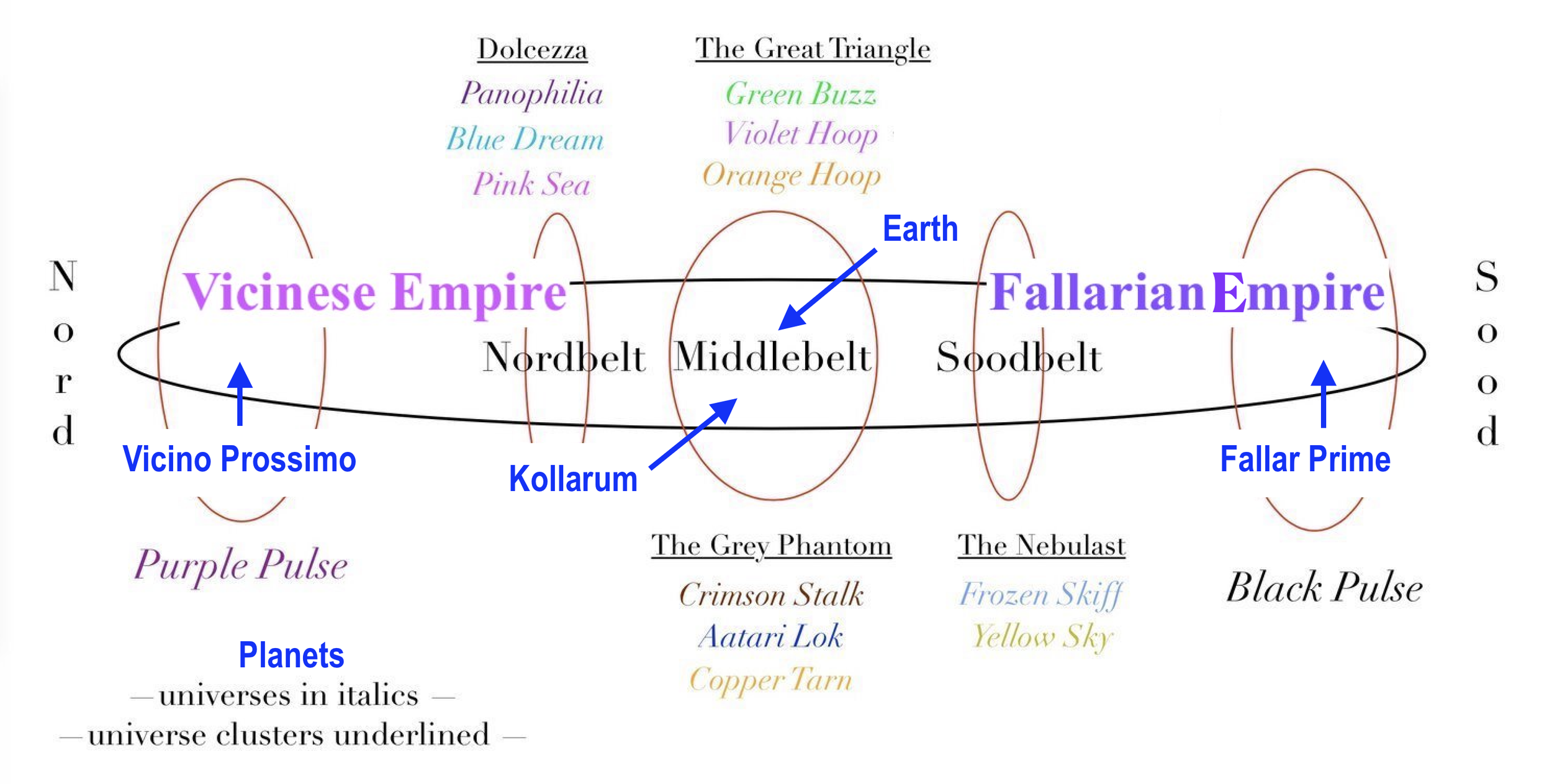
We first see the other diplomat, Farenn, in a cafe on the planet of Vicino Prossimo, 150 years ago (the average lifespan is 500 years). Like Tolkien’s hidden king, the young Farenn strides without trepidation straight into the lion’s den — the capital city of a species who would shoot him on sight, if only they knew that he came from the opposite end of the cosmos, from the enemy planet of Fallar Prime. The reason Farenn steps into the lion’s den is that he wants to find someone in the rarified order of Vicino Concordia (the capital city) who shares his revolutionary ideal: to eliminate the divisive nonsense that threatens to rip the cosmos in two. In other words, he’s looking for someone like Talfar.
My romance is also set on a tiny planet hidden in the Local Void, that vast emptiness that stretches out from the edges of our Milky Way. On this forlorn planet we find Algotodo, the greatest craftsman of algorithms ever known. Algotodo died a million years ago, and he’s now a copy of himself. He’s a fractal replica of the last great sage of the Ancient Vicinese Empire, which ruled The Purple Pulse universe a million years ago.
Algotodo sits at the end of a long dock in the middle of a small green lake, which is in the centre of a large park, which is in the centre of the largest metropolitan area in the cosmos: 8.3 decillion inhabitants. The dock is invisible, so there’s no one to interrupt his obsessive theorizing on the hidden doorways to the past.
Still very much alive in his own afterlife fractal (and on the afterlife fractal planet he created), Algotodo spends his days trying to break through the barrier of Space into the dimension of Time. His aim is to create a fractal, or perhaps a reverse fractal, that will allow him to go back a million years. Only then can he re-create the only woman he ever loved, the incarnation of Love itself, a simple farm girl named Wei. He remembers the moment he first saw her: she was wading through the rushes of a small green lake, smiling up at the nerdy stranger, as if she were the sun itself.
Another main setting is Paris, where Albert the novice struggles to accept Catholic doctrine, and eventually leaves the Church for the university and the study of probability. As he stands at the front of the elite grey-rinse crowd of the Collège de France, he starts to wobble on his feet. His mind also starts to wobble, between the logical improbability and the unlikely possibility of the orange streak he sees beaming from the head of a man in the crowd. Also in the crowd is Martine, a pretty French actress who despite being able to have almost any man on the planet, has chosen Albert. Because of this, she directs the currents of his heart using the ring she gave him. She doesn’t intend to trap him, but rather to set his mind free from logic, so that he can intuit and feel, so that he can find what he really wants, which she knows is her. The ring is a symbol of her heart, yet its current is a magic that has no symbol. Martine knows that this current of strange energy is important in some larger way, yet she doesn’t realize that it’s the key algorithmic step in the formula Algotodo seeks.
💕
These settings are just the tip of the iceberg. Others sway slowly and crackle suddenly in the icy waters beneath: the Pink Well, where a million years ago the Baulians swirled upwards like angry piranhas from the deep; the combs of Meliflorium, where Y accuses X of ignoring her, while X explains that he was just trying to get to know a Crimsect, that is, a floating galaxy that contracts and expands like a swarm of honey bees; the tree-top ledges of the cafes of Vicino Concordia, where Talfar spends his afternoons reading and wondering what happened to his first love Thalphemera, his first love who left him at the tender age of 50 and who dedicated her life to the exploration of the cosmic border, way way out there where the giant Beings roam; Rome, where the visions of three graceful Italian women come together in the Eye of the Pantheon, where the gods hold their council; Mount Voolcan on Fallar Discordia, where burning shards shoot into the dark sky, and where on the edge of a cliff Farenn addresses the Dark Council of Ferridian Priests; the cedar apartment aboard The Luxorium, a spaceship run by gay aliens, onto which Prester John the priest from small-town Alberta is flabbergasted to find a home; the penthouse apartment on 5th avenue where Curtus looks down at the burning streets and wonders how many macarons are left in the fridge; etcetera.
Some might point out snippishly that north of Tuktoyaktuk the icebergs are shrinking and that soon all my crazy stories will slip into the sea. That may be, metaphorically and here on Earth. Yet my iceberg floats in the ocean of a distant planet that’s getting colder year by year. New plots and new sub plots fork outward like icicles from the bulky undercarriage into the vast expanse of water beneath.
I suspect that I’ll suffer the fate of Balzac: the settings and characters will keep multiplying until my freezing body collapses, still clutching at meaning on the slippery deck of my own making. Above me the winter winds continue to blow, fed by the slow rotation of the icy planet and the irrational hope of Spring.
💕
Fractals & Mirrors
Two things that link my diverse settings are mirrors and fractals. The two most important of these are 1. Earth is an uncanny mirror of the animals and species of the cosmos, and 2. Algotodo’s tiny planet in the Local Void contains within it a miniature version — a fractal — of the entire Kraslika. Crucially, mirrors can be found within fractals, and fractals can be found within mirrors. For instance, Algotodo’s holy quest for the key to immortality is mirrored darkly by Cagnazzo, and also by Antonio, a Fallarian rebel in Alberta who masquerades as a magician. Both of these nefarious characters try to find the tiny hidden planet of infinite infractions — not to extend its bright candle of life, but rather to harness its energy, or snuff it out.
Mirroring also occurs in New York, where the aesthete Curtus presumes to incarnate the best, and ignore the worst, of his collapsing nation. Occasional Cortez on the other hand does the opposite: she doesn’t give a damn how beautiful she is (although everybody else does); she aims instead to stop the divisive nonsense of a President who promised no more wars, yet then aligns his nation with a tyrant who bombs children’s hospitals and then bombs them again to kill the paramedics who are trying to pull the children from their early graves.
Watching all of this, as if in an ancient bronze mirror darkly, are two characters who are themselves mirrors of the author, me. At The University of British Columbia (my alma mater), Matthew writes an exam paper about an epic journey which takes him from Greece & the Trojan War to Iceland & Ragnarök. As he writes, he tries to remember everything he learned the night before, sitting in his bathtub like Snorri Sturlesson (the compiler of Norse myth), his feet slipping and sliding in the soapy water beneath and between the smooth legs of his girlfriend Sylvia, a student of environmental science who warns him of the imminent climate catastrophe.
As he gets closer to 8 AM (when his exam starts), he drifts further and further into the dangerous currents of the North Atlantic. Finally, with The Prose Edda wobbling on the tap, his eyes close and his bathtub launches itself from the coast of Iceland. With Loki and Hel working the sails, they make land at l’Anse aux Meadows, attach a drive train and roar across the prairies, over the mountains and through Hell’s Gate, down to the wide stretch of highway that leads into the city of Vancouver. Amid the totem poles and collapsed bodies of fentanyl addicts, he see that the giant snake Jörmungandr and the Devil himself are turning the world into flames. Orange beams streak across the sky, and the machinery of Hell itself thunders in the air.
Yet just as one man and one woman survive Ragnarök in the trunk of a tree, so Matthew afterwords finds himself still alive, now that the Baulians have sliced the planet with their orange beams. The smell of coffee rising beside him, he finds himself in front of a computer screen, visited daily by an alien French maid, ready to write his Gospel of the New Roman Times.
In Southern Alberta we find another version of myself: Ragor, a Blue Dreamer tasked by the Blue Dream Alliance to document the transition into Baulian rule. The great big pink cubes have taken over the Earth, and are putting their finishing touches on what Orwell calls pacification, transfer of population, rectification of frontiers, and elimination of unreliable elements. Ragor has been given a great deal of latitude by the Blue Dream Alliance, so he finds himself ignoring the day’s fatal news and instead slipping into a Keatsean dream of nightingale songs, opium charms, and beakers of the warm South. Yet in writing his routine travel reports to the Blue Dream Alliance he notices that Antonio, the Fallarian across the street, has made headway in locating Algotodo’s hidden realm.
💕
The Impossible Heart
Algotodo’s world — like the infinite energy which allows species to vault from one side of the cosmos to the next — derives from my sci-fi notion of fractals.
Fractals are usually seen as a series of graphics in which a larger thing is represented in miniature and in all its detail. Yet the graphic can be made larger as well, so that the smaller form can be seen in a larger dimension. The cosmos I describe in The Fractal Heart is one in which fractals work both ways — toward the infinitely small and the infinitely large. And they work on external, graphic, technical levels as well as on levels of thought, feeling, interpersonal relations, society, politics, social construction, cultural structure, religious programming, etc.
The fractal notion of infinite compression is at least as old as the paradox of Xeno, who lived in 6th century BC Greece. Modern logic has confirmed it again and again in the mathematical fact of infinite divisibility. Yet in practical life infinite division doesn’t work, since we’re unable to replicate design on a subatomic scale. We’re also unable to replicate infinite expansion on a larger, cosmic scale, given our limited ability to reach into outer space.
But what if we could enter fully into the paradox of infinite replication, both by division and multiplication? What if we could, as Xeno prophesied, never arrive at the core of a single point in space, because within that point we found another level of points within it, and within one of those new points we found even smaller points, ad infinitum?
💕
In my sci-fi romance the Vicinese learned long ago to plumb the depths of subatomic space. A group of scientist sages worked within these depths to create worlds within worlds. Then, a million years ago, the smartest of these sages, Algotodo, found a way to replicate the thirteen universes of the cosmos into a tiny speck, which he placed in the Local Void, not far from Earth.
Algotodo then detonated a fractal bomb, which infused instructions into all DNA at a depth of 10 to the power of minus 60. The instructions go so deep that no species can even detect them. These instructions allow every sentient creature to create a fractal of itself, project this fractal across trillions of parsecs, and find a home on the tiny speck. The speck, one millimetre cubed, is so deeply infracted that it’s able to contain the entire population of the thirteen universes.
The speck is an enormous planet, with the past layered like geological strata below ground, the present on the surface, and the future floating this way and that in the air. Many people erroneously call the planet The Soul Star, which is understandable given that when people die they leave a fractal projection trace. Scientists and theologians alike conclude that the souls of beings must travel to a heavenly home, which they agree to call The Soul Star. The theologians are happy to include the notion of soul, and the scientists are happy that the proof is really all about mass, force, and vector.
Much like our own Heaven, the Soul Star is no where to be seen. It is however — based on the trajectories of the soul fractals — probably located somewhere near the centre of the cosmos. That is, in the Local Void not far from planet Earth.
One would be forgiven to believe that the Soul Star came about because of a pure love for scientific progress, a pure love for a perfect world of reason and technology, structured forever into the DNA of a rational cosmos. Yet this is far from the case. In fact, the sages tried to find Heaven for centuries, and it was because of the angst they felt at not finding Heaven that they conceived of the daring, desperate, even blasphemous idea of creating one of their own.
Moreover, the work of Algotodo, which brought the work of the sages to its final form, came as a result of his personal grief. What drove him wasn’t the arcane relation between algebra and geometry, but rather that fact that the woman of his dreams, Wei, his soul mate, died in the climate catastrophe of his home planet. Unable to face living without her, Algotodo built the Soul Star in the desperate hope that someday she might be reincarnated, or refractalized, and sit beside him once again.
The Soul Star and everything within it was created simply because he loved her so desperately that all the worlds in the cosmos couldn’t make up for the loss of her. And all of this was because of two simple facts: 1. he could infract the present but not the past, and 2. she died before he found the algorithm he needed to infract the present.
What Algotodo desired more than anything was to invent an algorithm which would allow him to move the core of the fractal of the Soul Star back in time so as to recreate the exact setting in which Wei once lived. From that setting he might reconstruct Wei herself. Or at least this was his hope. This was why he spent his days staring at long sequences of scrambled numbers, letters, and symbols, and also why he journeyed deep into the centre of the planet. Every week or two he would go deep into the past, ever closer to the core. He aimed to reach a hypothetical boundary, an event horizon of the infinitely small infraction along the curvatures of space, a line between infinite infracted space and infinite infracted time. It was a desperate hope, but it was all he cared about.
But he knew it to be impossible, at least in terms of the dimensions that we know. So he wondered if he might instead plumb the depth of his own fractal heart, in a desperate attempt to unlock the door of time itself. Could the neurons and waves of his being connect with that fourth dimension of time, that dimension that doesn’t really exist? And could that French woman, that Martine, with her strange ring, and her strange mix of playful lust and mytical charm, help him to do it?
💕
Pumpkins
In his Divine Comedy Dante wanted to expose the mytical superstructure of the cosmos, and remind us that it’s all controlled by God. In his Human Comedy, Balzac wanted to show that the same superstructure held within it a worldly structure of the widest moral dimensions. This dichotomy between the two writers isn’t absolute, for in Dante there are moment of crushing physical reality, and in Balzac moments of etherial flight — as in Seraphita (1834) when Minna says to Wilfrid:
“We have seen the worlds on their march to God; we know the Path. Our diadem of stars is There.”
Floating downward through the abysses, they re-entered the dust of the lesser worlds, and saw the Earth, like a subterranean cavern, suddenly illuminated to their eyes by the light which their souls brought with them, and which still environed them in a cloud of the paling harmonies of heaven.
What, between the idealisms and realisms of Dante and Balzac, do I aim for in my outlandish cosmic comedy, The Fractal Heart?
Generally, I want to do what both Dante and Balzac did: explore mythic, fantastic, and real worlds, showing how they interpenetrate and depend on each other. The ideals and dreams we have couldn’t exist wihtout our physical bodies; although the reverse is speculative. It would be nice if Dante was right that Matter couldn’t exist without Spirit, yet the jury is out on this one.
Specifically, I want to suggest something that’s at once philosophical and psychological.
Philosophically, I want to suggest that all religions and myths are imaginative extensions of our minds into infinity, whether this infinity resembles Dante’s stretches from Satan’s icy lake to Heaven’s ineffable circles, or whether it resembles the distance from Star Trek’s home planet Earth to the far-off corners of the comos, which can only be reached by entering that convenient sci-fi space-gobbler, the worm hole.
Psychologically, I want to suggest that this extension toward infinity is already within us, in the fractal of our understanding, which creates a personalized map of the world and the universe. This map is both mental and emotional; in includes the feeling of he blood in our flesh as well as the thought of that blood. It includes the nerves and muscles in our groin and forearm; the stretch of bodies around us, the world on which those bodies spin, and all the worlds that spin and drift in the infinite beyond.
💕
To get at what I mean here I’ll start with a more precise illustration of what a fractal is. Then I can suggest the larger philosophical and psychological dimensions that my romance implies and explores.
When people think about fractals they think about a graphic design that is a miniature of an original graphic design. A humorous illustration of this can be seen in the TV show Single Parents, when a nerdy daughter carves a pumpkin. Her father explains what the graphic means:
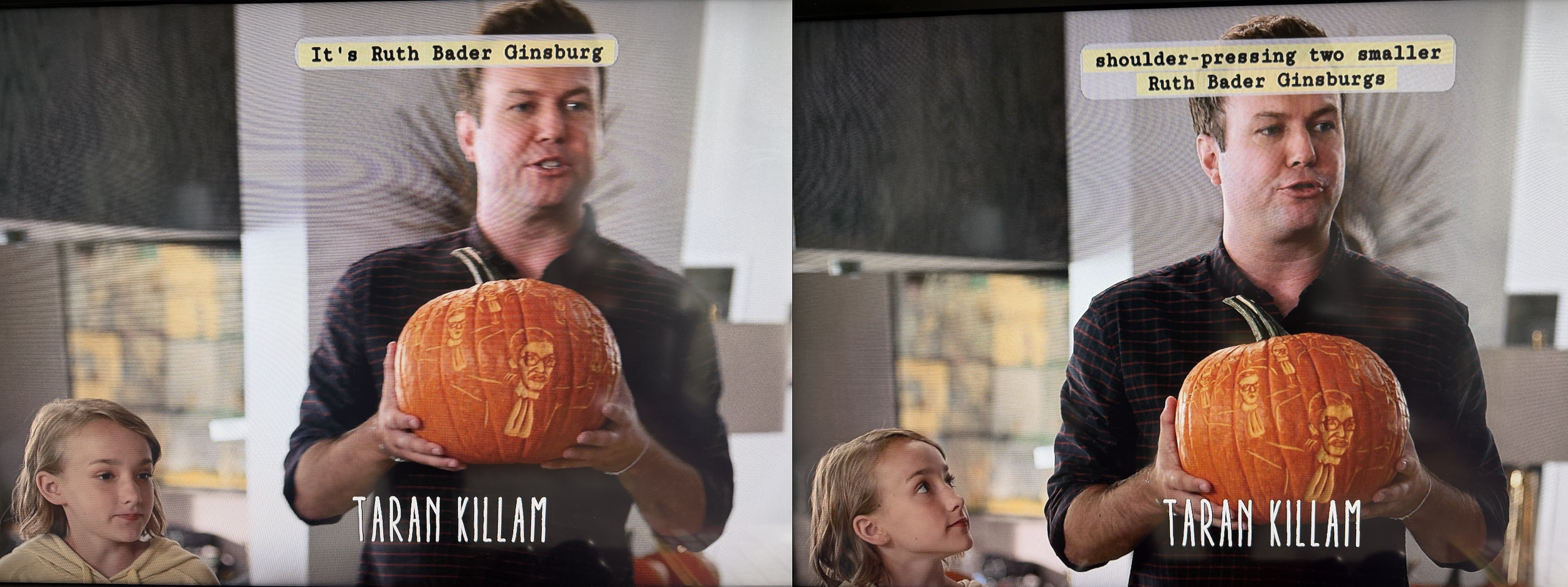
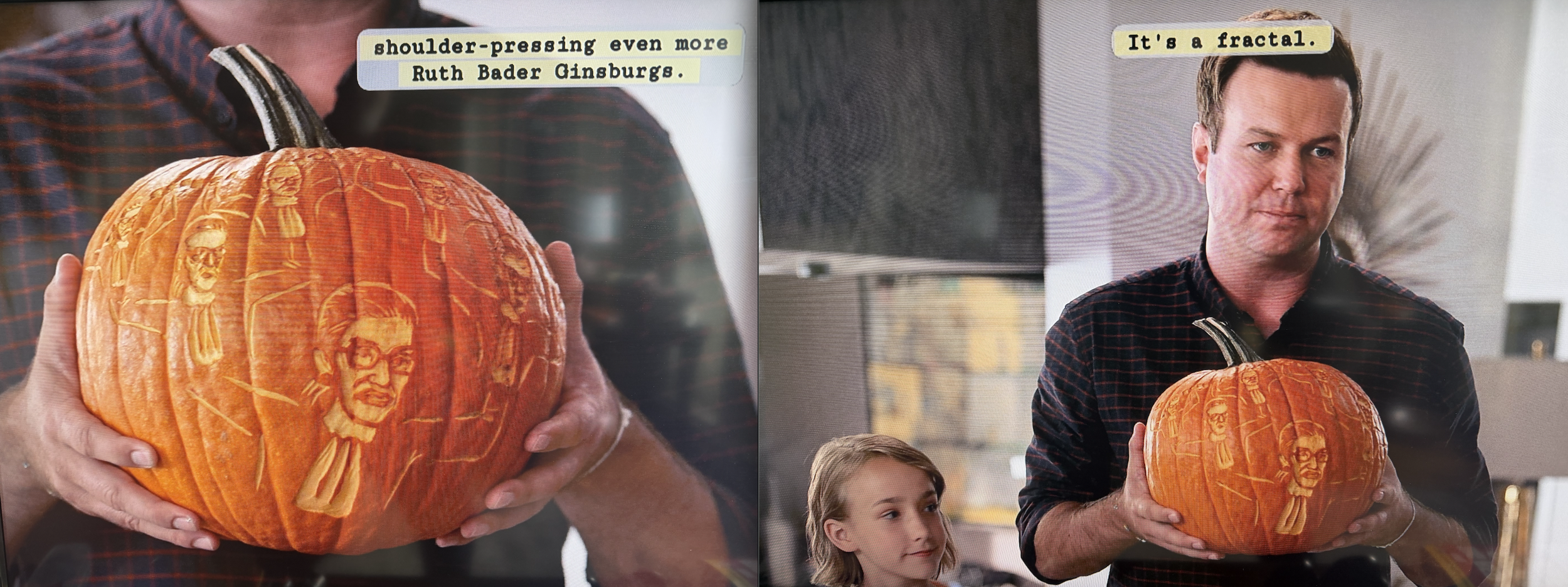
The situation is humorous because we assume a young girl would be interested in dolls or little tea parties, and yet she carves a fractal series of the famous Supreme Court judge Ruth Bader Ginsburg. This is just several seconds in a TV show, yet to me it suggests at least two things.
First, we already live in a very technical age, one which would be science-fiction to Victorians living in the 19th Century. We seldom think about the fact, the nearly miraculous fact that we're watching a television. We don't have to go into the complexities of physics or neurology to appreciate that we're sitting on a couch, watching a luminescence screen, projecting images, or fractals, of our world. What we’re watching are scenic realities, that is, dramatic possibilities of things we could easily have lived. We didn't see that particular pumpkin or go to that particular Halloween party, yet we understand it: somewhere in our memory we've logged images of pumpkins, and most of us (in North America at least) have danced along the sidewalk in a strange suit in order to accumulate a great bag of candies. That these scenarios are played out before our eyes, and we can rewind them to take pictures of the pumpkin, stopping, and starting the realities, streaming this way, or that way at will, would make Victorians sit up in their graves. That we can then put the captured images of this TV show on a system where someone in Timbuktu can watch them the very moment we post them, would make their hair rise, make electricity flow through their skeletons, and make their eye sockets glow.
Second, that a young girl would be interested in the Supreme Court judge, may seem a funny thing, but it also suggests that at our core we may not be beings that become smarter and more creative as we age. We may be, deep down inside, more intelligent than we are when we're older, more focussed on the things that really matter. Where this intelligence comes from? Is it a chance of evolution or a design of some Universal Mind, as Aurelius said 2000 years ago?
However it came, we know it's there. Or at least I think it is. Anecdotal proof of this is the following poem written by my childhood girlfriend, Claudia. In the 8th grade, she understood the state of the world better than most people understand it now.
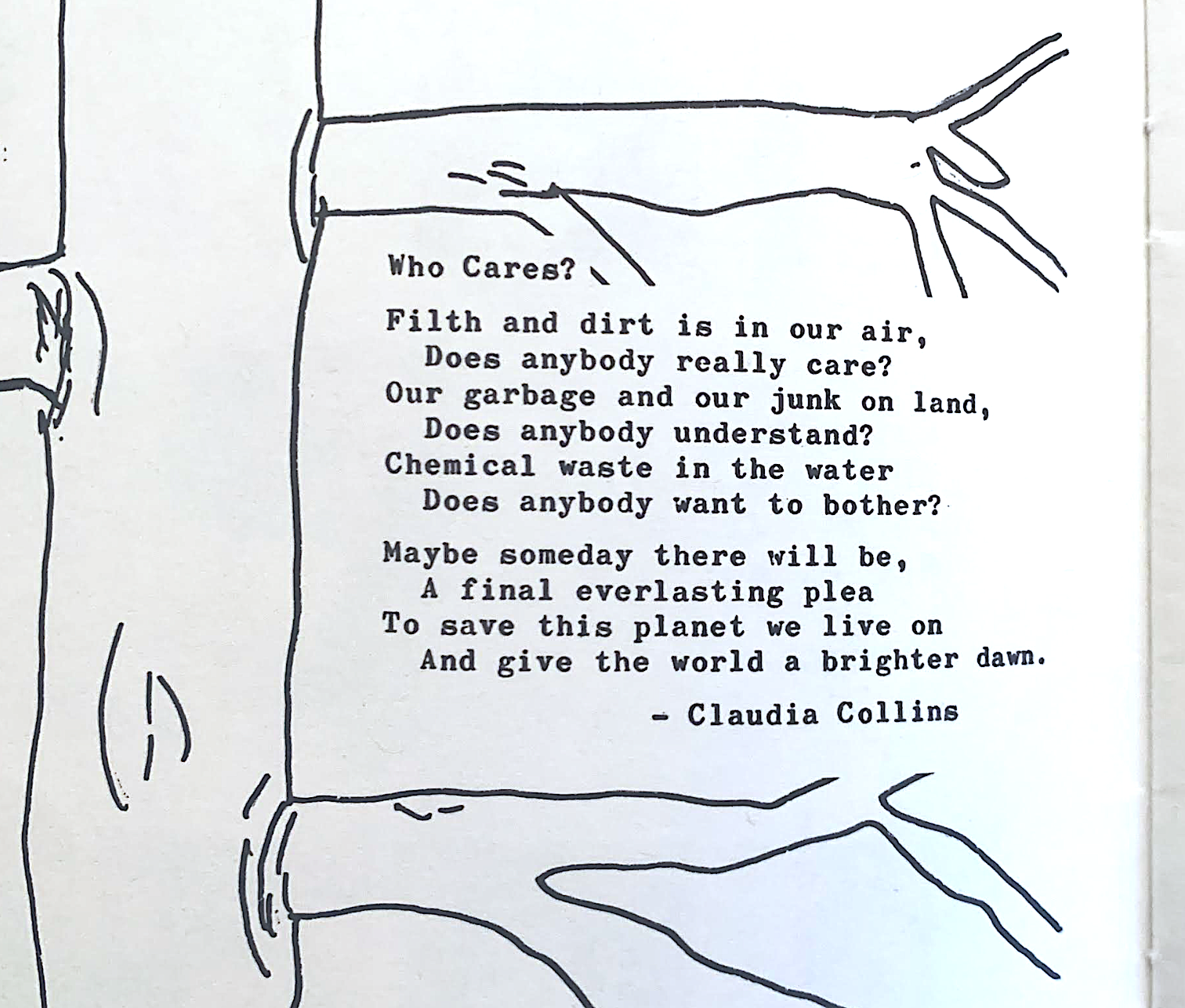
Although Claudia had MS and has passed away, I nevertheless dedicate my sci-fi romance to her. I also dedicate to her my depiction of the following female characters: Francesca the little girl who orders an ice-cream in Rome; Claudia the Sicilian beauty who wonders about the meaning of life; Lucia the Parmigiana who stumbles into her own cosmic visions; Sylvia the ecological activist who accompanies Matthew in his exam preparation and his ride to Ragnarök; Francine the diplomat outsider in New York; Occasional Cortez the sharp-teethed political revolutionary; Martine the actress who seduces the world; and Thalphemera the explorer who dares to step out of our cosmos and into the widest expanse we can imagine.
💕
Fractal & Psyche
My main psychological point is that we all have within us a fractal of sorts, mirroring in miniature the world we live in. This fractal is, in its most essential state, a 3-D map. On this map we find our heart & brain, our bones & flesh, our home & neighbourhood, our city & country, our planet & solar system — and beyond these, the stars & the Great Unknown.
We add to this map a trick of the third dimension we call time. In practical human terms, the fourth dimension doesn’t exist in any distinct, separate, or tangible way. Rather, it’s a concept we create by juxtaposing 3-D scenarios, all the while remaining — absolutely and completely — in 3-D space. While time may be an artificial construction, it’s fundamental to our sense of who we are, and hence it’s as real to us as anything else. Indeed, time is the great connector of disparate moments, of the settings, scenes, characters, conflicts, and resolutions that constitute the drama of our lives. The pumpkin is a moment, but the revelation that a girl created fractals of Ruth Bader Ginsburg within it, is a function of time.
The fact that we all have this 4-D fractal inside us doesn’t mean that one fractal is the same as the next or that we use our fractals in the same way. We’re all distinct in space and therefore we all construct and use our fractal according to different outside vectors and sensory inputs, as well as different internal flows of blood, movements of flesh, and currents of neurons. Some of us are raised in a Calgary of cement driveways and baseball bats, and others are raised in a Lagos of waterways and push poles:
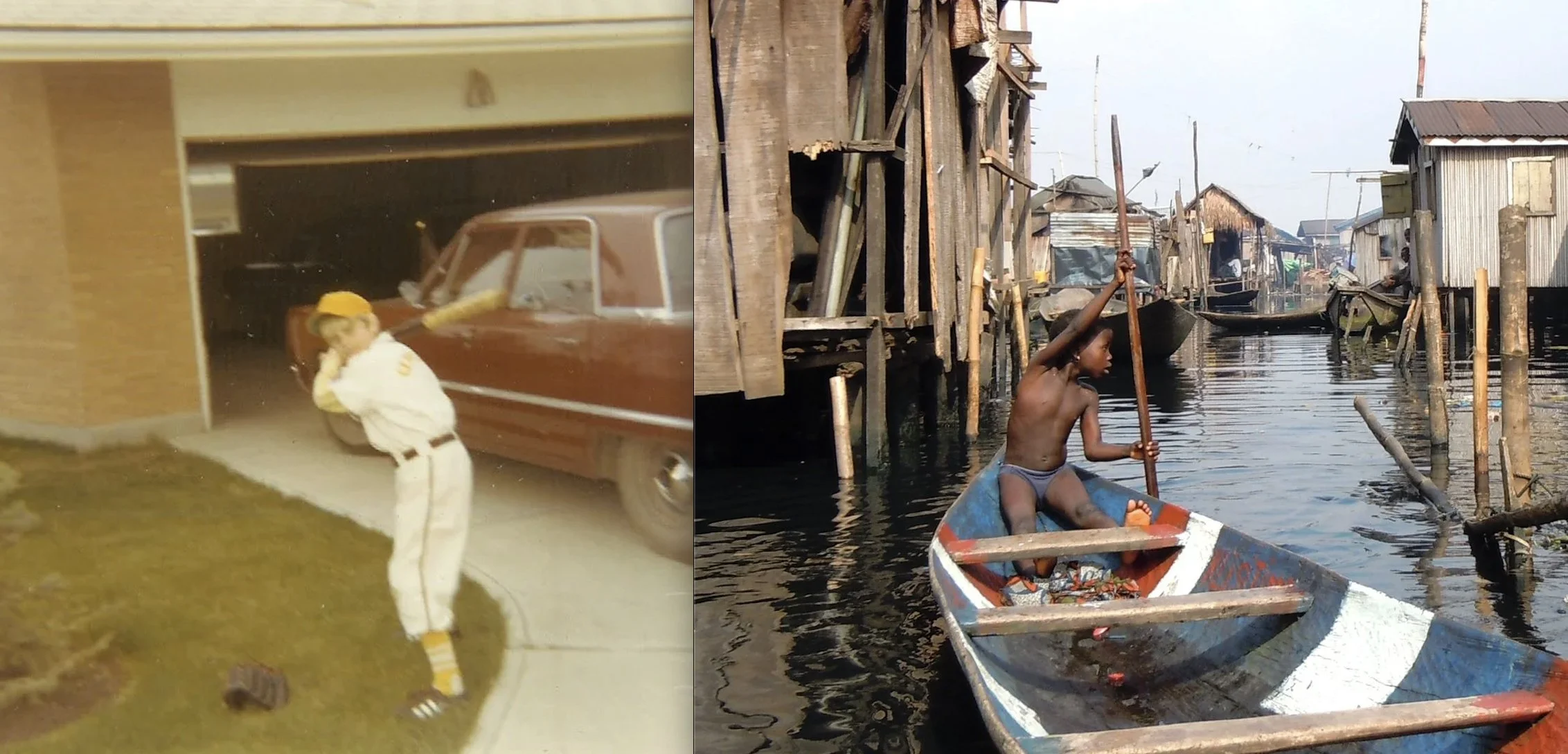
Makoko auf dem Wasser. Uploaded by Elitre, November 2010 (from Wikimedia Commons).
We may see the same moon, but we see it from different angles. We may have a piece of wood in our hands, but we do different things with it.
This is the empirical point that the university student Claudia writes her essay about in the English Garden in Palermo. And this is the point that her professor, Tarnar, seizes upon, extends in the direction of cultural diversity, and then creates a vector stretching from Palermo to his native Copper Tarn universe.
Nor does the fact that we all have this 4-D fractal inside us mean that our fractals are remotely accurate. David Hume’s empiricism saw to that. Almost 300 years ago, he showed us that our brains are far from the precise mechanisms we sometimes imagine them to be. They record and compute, but in very unreliable ways. Hume argued this long before Modern neurology and astronomy, which at once eviscerated and exacerbated our cluelessness: the more our insights into the brain and the stars destroyed our old models, the more we were thrown into the infinite abyss of unknowing.
Now on both ends of the spatial spectrum, from neuron to Local Void, we find more and more guesswork. Mystery stretches out in every direction. If we’re of a scientific frame of mind, we populate this mystery with data and theories. If we’re poets, sci-fi fans, or mystics, we populate it with our imagination — from the dancing of atoms to the greenest of aliens, and from intimations of a human soul to invasions of a cosmic Holy Ghost.
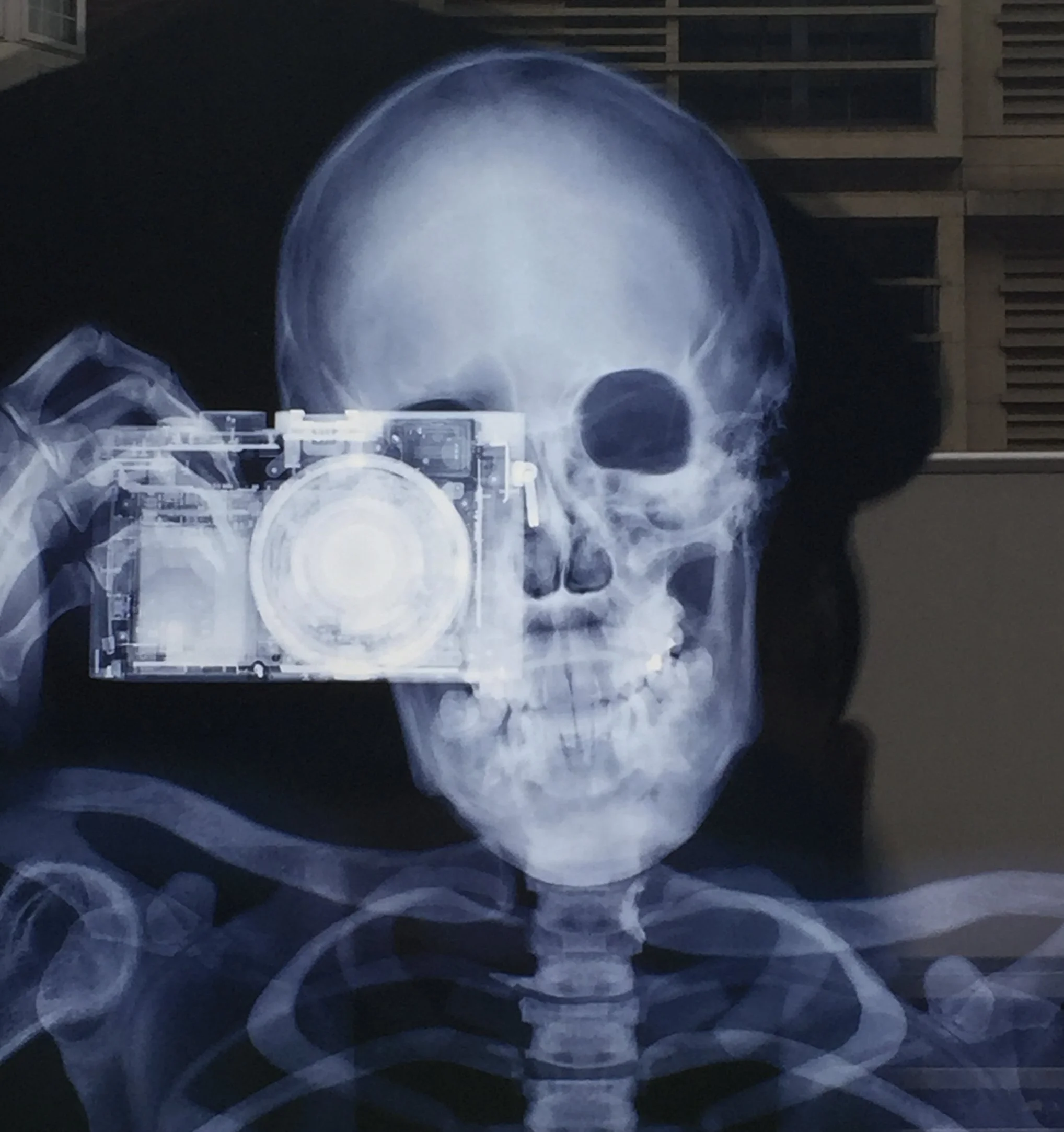
We don’t know why the neurons in our brains fire into currents that create waves, nor how these waves might interact with the tiniest vibrations of the subatomic matter that lies deep within us and also remains a mystery. And we don’t know why waves from outer space go through us like gamma rays, or why the light of the sun warms our skin. We may know how, but we may never know why.
Reaching for the how and the why, we create models in our minds. We construct fractals that reflect in miniature the correlations between the outer world of rock, papyrus, and hieroglyph, and the inner world of sense, feeling, and thought. Then we add to these fractals the fourth dimension, time, which allows us to see the transformations occurring within the fractal along a line that we imagine to be as straight as if a ruler had drafted it onto a piece of paper.
Yet one thought haunts us: this line could go on forever. What if there is no end?
Expanse — subatomic and cosmic — is the starting point of The Fractal Heart. The novel explores a number of questions related to the never-ending line that exists in space each moment and exists in time from one moment to the next. How do we get to the heart of things when things are hidden deep inside us, at the point where the line disappears in the waves of neurons and the energy of subatomic particles? And how do we get to the heart of things when everything we understand dissolves into the mist somewhere beyond our horizon?
And how, if we can barely connect to those near us, will we ever connect to beings from other dimensions or galaxies? This may seem a fantastical question, as if it came from outer space. Yet the contention of unreality conflicts with the deeper and more enduring reality that we’re in fact a tiny part of the universe, both in space and in time. Someday we may connect with other life forms from other planets. Yet even if we never make such a connection, even if humans go on their merry way alone — as a beacon of light in the limitless dark, or as a short blast of radiation — the fundamental, contextual, inevitable fact of our existence is this larger context of space. It remains, like the Heaven of believers, long after you and I are gone.
So, to me at least, it seems crucial to think about 1. how we interiorize, or make fractals of, the reality that surrounds us, and 2. how we deal with the extremes of space and time. The neuron pathways of our brains create pathways to understanding, yet always with the proviso that Hume hammered home to us centuries ago: we ought not to confuse our fractals with reality itself. This proviso is even more insistent when we consider the difference between our understanding of this world and our understanding of the cosmos. While we can see, touch, and smell a flower, we can only draw a colourful paint-by-number outline, only extrapolate the most general shape of a faraway supercluster of galaxies.
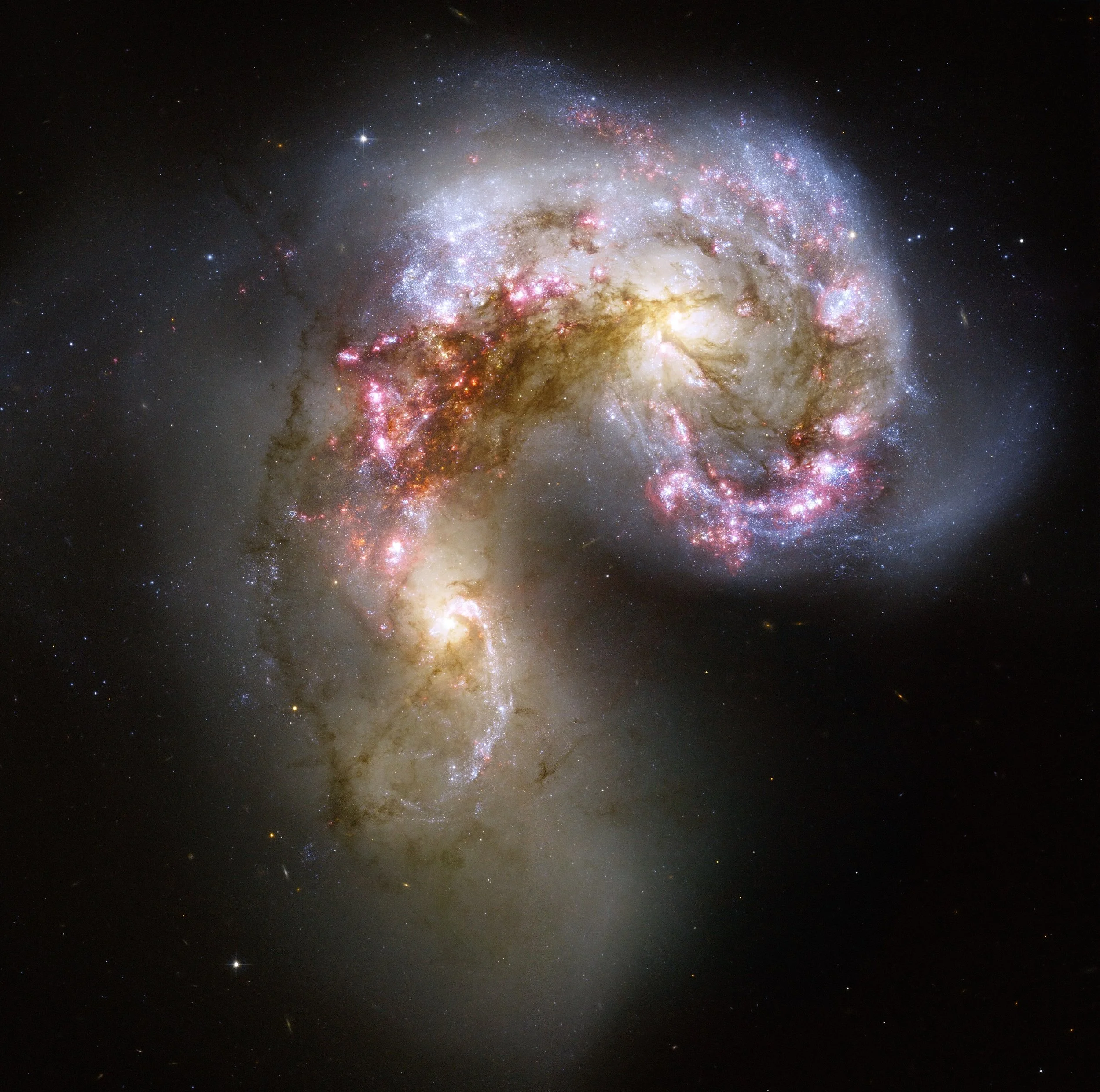
“This NASA Hubble Space Telescope image of the Antennae galaxies (NGC 4038 & 4039) is the sharpest yet of this merging pair of galaxies.” Source: http://hubblesite.org/newscenter/archive/releases/2006/46/image/a/ (direct link) (From Wikimedia Commons)

💕
Pirouette
The question remains: how can we align the fractals of our thought and feeling with those of other beings, be they from Earth or Alpha Centauri? If Ukrainians and Russians, if Azerbaijanis and Armenians can’t see eye to eye, how are we to gaze into the five eyes of a being who measures time in gradients of colour, and time in shades of emotion? If our imaginations can’t get us safely to a table in Geneva, how are we to navigate the gulfs and spiky corners of outer space?
This may sound like a rhetorical question, begging the conclusion that we discard the question itself. But it isn’t merely rhetorical. I have an answer. Maybe not the right answer, but an answer nevertheless: we exercise our imaginations more routinely, more widely, and more radically.
I suggest that we get used to getting out of ourselves. We can start this by imagining a critical distance from the fractal within us. In doing this, we create a sort of uber-fractal, one that allows us to see our own fractal from different angles. Some might call this critical distance, others might call it self-awareness. This doesn’t mean self-centredness, but rather an understanding that we are all self-oriented by the omnipotent parameters of space and time.
This isn’t news. Rather, it’s an idea that goes back to at least the 3rd century BC philosophers Pyrrho in Greece and Zhuangzi in China. Both suggest that we lever ourselves psychologically from our own fixed points of view: Pyrrho aims at a suspension of judgment (epoché), while Zhuangzi aims at a still point within ourselves, from where we can pivot from one point of view to the next (he calls this the pivot of the Dao). For Pyrrho this results in tranquility (ataraxia), and for Zhuangzi this results in a natural flow with the infinite cosmos.
Or we can borrow Keats’ negative capability, which allows us to ‘enter into mysteries, doubts and uncertainties without irritably searching after fact and reason.’ In other words, the quest for deep knowledge and valuable experience needn’t imply the quest for a certain answer or truth. We can combine this with Keats’ notion of the chameleon poet, that is, a state of mind where one can entertain everything — from the purity of Desdemona to the cruelty of Iago — with an interest that goes beyond the morality of good and evil.
Although we all create 4-D fractals of the world inside our brains, we can also see ourselves as more than what these fractals show us. We are the beings that make these fractals. And if we can make them, we can make them connect with other fractals. We can find an uber-mode of fractology that connects and fuses fractals that were once upon a time constructed along completely different lines.
This leads me back to the title of my sci-fi romance, The Fractal Heart, where I imagine ways that humans and aliens tear each other apart and glue each other back again, better than the Humpty-Dumpty that Matthew fears may be the idol of his literary theology. Matthew is broken by his past experiences of abuse and violence, yet he finds a way to become whole again, and also to engage with the Baulians, the nerdy cubic pink aliens who take over the Earth. As on his computer screen, which blows the Net into a network from galaxy to galaxy, his understanding of the meaning of life dissolves and extends, dissolves and extends, dissolves and extends…
💕
Next: ✏️ Times New Roman
Contents - Characters - Glossary: A-F∙G-Z - Maps - Storylines