The Double Refuge 🍷 Bubbles Winking at the Brim
Wine & the Ocean of Love
🍷
In this first introductory chapter, 🍷 Bubbles Winking at the Brim, I suggest that the Open Refuge is like wine. Whether it’s the wine of the tavern, the wine of the Eucharist, or the wine of Persian poetry, this wine takes us away from our normal sober state, where we aim to square our personal designs with the curves, loops, and arabesques of the world around us. Sip by sip, we slip into a less certain framework. The edges get blurry and we start to let loose of our definitions and guardrails. Whether some idea is true or untrue becomes less an argument than an invitation.
We stop worrying about what we used to think, and let ourselves flow, perhaps even merge with other ideas, people, realities. It’s like a dream, but more solid and less fleeting. The wine may not take us as far as the mystic poets of Persia, and we may not clutch at the moon like Li Po, yet we each in our own way explore further, dipping our toes or diving head first, into the currents of existence.
🍷
While in the first chapter I use wine to suggest the intoxication of Open Agnosticism and Open Theism, in the second chapter I try to explain the many-sided beast of 🍏 Agnosticism. I argue that Open Agnosticism, with its hold on tradition on one hand, and its reach for new ideas and experiences on the other, is complementary to Open Theism. Both are willing to grab onto new things without tightening the grasp so much that it becomes impossible to change. Neither counsels an aimless drift, for neither insists on drifting for the sake of drifting. Or on mooring for the sake of mooring.
Open Refugees see many rivers leading to the Sea. Their iconoclasm makes them similar in some ways to the Virashaivite poet Basavanna, who sees the body, the soul, and the Lord (in this case Shiva) as one entity:
My legs are pillars, / the body the shrine, / the head a cupola of gold. // Listen, O lord of the meeting rivers, / things standing shall fall, / but the moving ever shall stay.
(trans. A.K. Ramanujan)
Basavanna combines the static nature of a temple with the mobile nature of the wandering saint. He includes in a reference to Shiva, who he calls lord of the meeting rivers, which seems to me a wonderful way of fusing the flux Heraclitus talked about in Ancient Greece with the ever-present sense of infinity evoked in the concept of God. (I return to this topic in Lord of the Meeting Rivers 2: Syncretism, in the chapter ⏯ Systems.)
🍷
Double Refugees don’t imagine that any one trajectory could be a sufficient metaphor for our journey through life. For instance, they may find inspiration in Dante’s trajectory — into Hell, across the sea to the Mountain of Purgatory, and up to Heaven — yet they see this paradigm as one among many.
At the start of Paradiso Dante imagines his journey to Purgatory and Heaven as a ship crossing the sea. He tells the readers in his wake that if they lose sight of him they may never find their way:
O voi che siete in piccioletta barca,
O you, eager to hear more,
desiderosi d'ascoltar, seguiti
who have followed in your little bark [boat]
dietro al mio legno che cantando varca,
my ship that singing makes its way,
tornate a riveder li vostri liti:
turn back if you would see your shores again.
non vi mettete in pelago, ché forse,
Do not set forth upon the deep,
perdendo me, rimarreste smarriti.
for, losing sight of me, you would be lost.
Dante may be correct to warn his reader about embarking on the high seas, yet open theists question whether we need to be so fearful. If God is in control of the universe, and if He (She or It) is everywhere, omnipresent and omnipotent, where can we go that He isn’t with us, even in the Valley of the Shadow of Death? Double Refugees are more likely to heed the warning of Byron, who cautions that if we float “in a Sea of Speculation” we may capsize our little boat. Byron doesn’t tell his readers that they must follow him or they’ll be lost.
Open Refugees see the danger. Indeed, what I mean by refugee is that existential and metaphysical winds can blow very rough. Sometimes we need a safe port, a refuge from the storm. Yet, the steady star to our wandering boat is the pole star, not a specific philosophy or religion. In “Sonnet 116,” Shakespeare makes it clear that the star is love in general:
it is an ever-fixèd mark
That looks on tempests and is never shaken;
It is the star to every wand’ring bark
Whose worth’s unknown, although his [its] height be taken.
Shakespeare’s Love isn’t a particular form of love. It could be 1. the love of a mother, father, sister, brother, or friend, 2. the connections and affections that Nature builds in each of us for survival and meaning (in this sense it could be the love of a cat for its kitten), 3. a Neoplatonic love which urges us toward a transcendent Good, 4. the redemptive love of Christ, 5. the love of Krishna, Shiva, Mahadevi, Guanyin, etc., 6. the Sufi love that annihilates the self and opens the tavern door to the intoxication of God, and 7. any other type of love on Earth or any other world. It’s certainly not restricted to Dante’s Medieval version of Christianity. To borrow from Dante’s mentor, the pagan Virgil, it’s the love that conquers all. Before Christ was born, Virgil writes, Omnia vincit amor, et nos cedamus amori; "Love conquers all things; let us yield to this love."
A key aspect of the Double Refuge is that it brings doubt and belief into direct contact. For instance, we can doubt the literal meaning of Dante’s words, yet at the same time we can work through them to reach a greater flexibility. To start with, we can recognize why people generally want to follow in the wake of a larger ship; Blake may tell us to create our own system “or be enslaved to another man’s,” yet that’s easier said than done. It doesn’t have to be, but it can be Dante’s wake, as long as we’re willing to contend with a great deal of Medieval politics and theology. But even here, we don’t have to take everything Dante writes literally. So why not follow in Dante’s wake? And why not also follow in the wake of other ships that criss-cross the dangerous seas? The ships and the seas are just analogies; one hypothetical galleon doesn’t cancel out the other.
There are many ships on the oceans of science and religion, just as there are many mansions in the house of God. His Lordship is reputed to contain multiple dimensions and infinite space, so there’s bound to be room in His house for whatever good thing we might believe, or whatever good news we might hear.
We can follow in the wake of a mighty ship or we can take to the open sea and take our chances. In doing this we may find smooth seas and coconut isles of honey and light, or we may struggle like Melville’s Ahab against the Leviathan of Blind Chance in the Ocean of Doubt. Even if we go down with the ship, we may still find ourselves in amber light. The country beyond whose bourn no traveller returns is a mystery, and no one knows what we’ll find. We may find ourselves sailing back into a port, with a sign on a shop door that says “Wine Tavern.”
We stand on the door sill, one moment looking out at the turbulent winds blowing up from the Strait of Hormuz, and the next moment looking in at the bartender pouring a sparkling shiraz into the glass of a beautiful woman, her ruby lips touching the lip of the glass as the wine flows over her tongue.
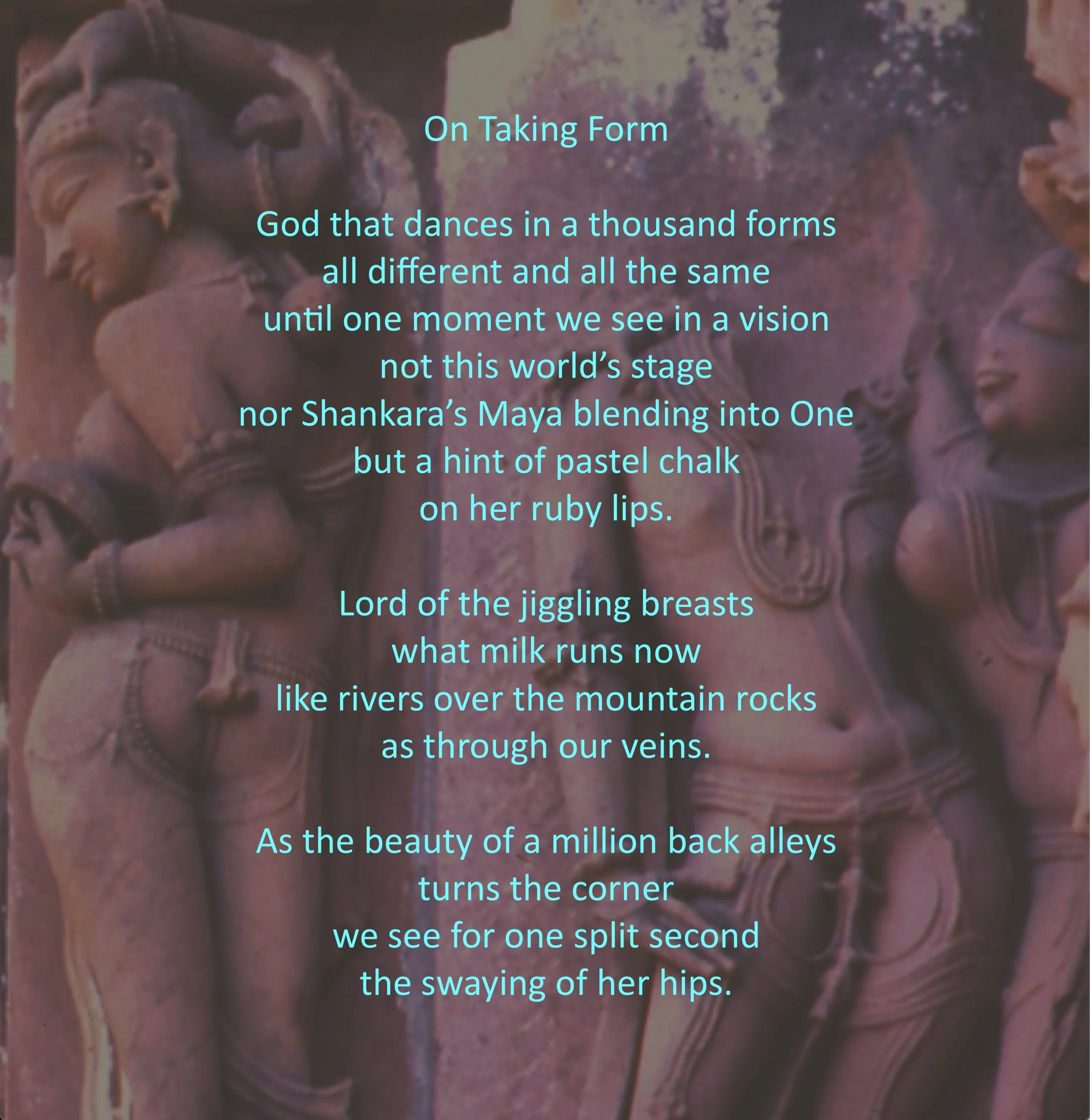
We go in and out of the tavern, always stopping for a second at the door, examining its hinges and the strange fact that it exists between two worlds. The door divides the worlds at times, and connects them at others. We wonder about Plato and his world of Ideal Forms. What is this door, this gate between two worlds? And who is the Gatekeeper?
🍷