
Introduction III
The Impossible Heart - Pumpkins - Fractal & Psyche - Pirouettes
❧
The Impossible Heart
Algotodo’s Soul Star is the ultimate refuge from the type of danger Ragor steadies his mind to confront. Yet the Star is also a mirror of the cosmos, and it therefore can’t escape the very stuff it’s made of: hard matter, invisible energy, fallible brains, overloaded emotions.... As such, and in its sci-fi aspects, the Soul Star is key to my cosmic comedy.
Both infinitely small and infinitely large, the Soul Star encapsulates what I’m trying to get at in terms of meaning: the infinite expanses that lead to angst; the clash of paradigms within a greater whole; the possibility of a greater fractal of meaning that subsumes the smaller meanings, etc. Its status as a subatomic fractal also accounts for many other practical things, such as the infinite subatomic energy that allows my characters to vault from one side of the cosmos to the next. Because of all this, it’s worth taking a closer look at that I mean by fractals and at how I use them in my sci-fi romance.
Fractals are usually seen as a series of graphics in which a larger thing is represented in miniature and in all its detail. Yet the graphic can be made larger as well, so that the smaller form can be seen in a larger dimension. The cosmos I describe in The Fractal Heart is one in which fractals work both ways — toward the infinitely small and the infinitely large. And they work on graphic levels as well as on levels of DNA, neurons, interpersonal relations, society, politics, social construction, religious programming, etc.
My notion of infinite fractal compression and expansion owes much to the paradox of Zeno, who lived in 5th century BC Greece. Modern logic has confirmed it in the mathematical fact of infinite divisibility. Yet in practical life infinite division doesn’t work, since we’re unable to replicate design on a subatomic scale. We’re also unable to replicate infinite expansion on a larger, cosmic scale, given our limited ability to reach into outer space.
But what if we could enter fully into the paradox of infinite replication, both by division and multiplication? What if we could, as Zeno prophesied, never arrive at the core of a single point in space, because within that point we found another level of points within it, and within one of those new points we found even smaller points, ad infinitum?
❧
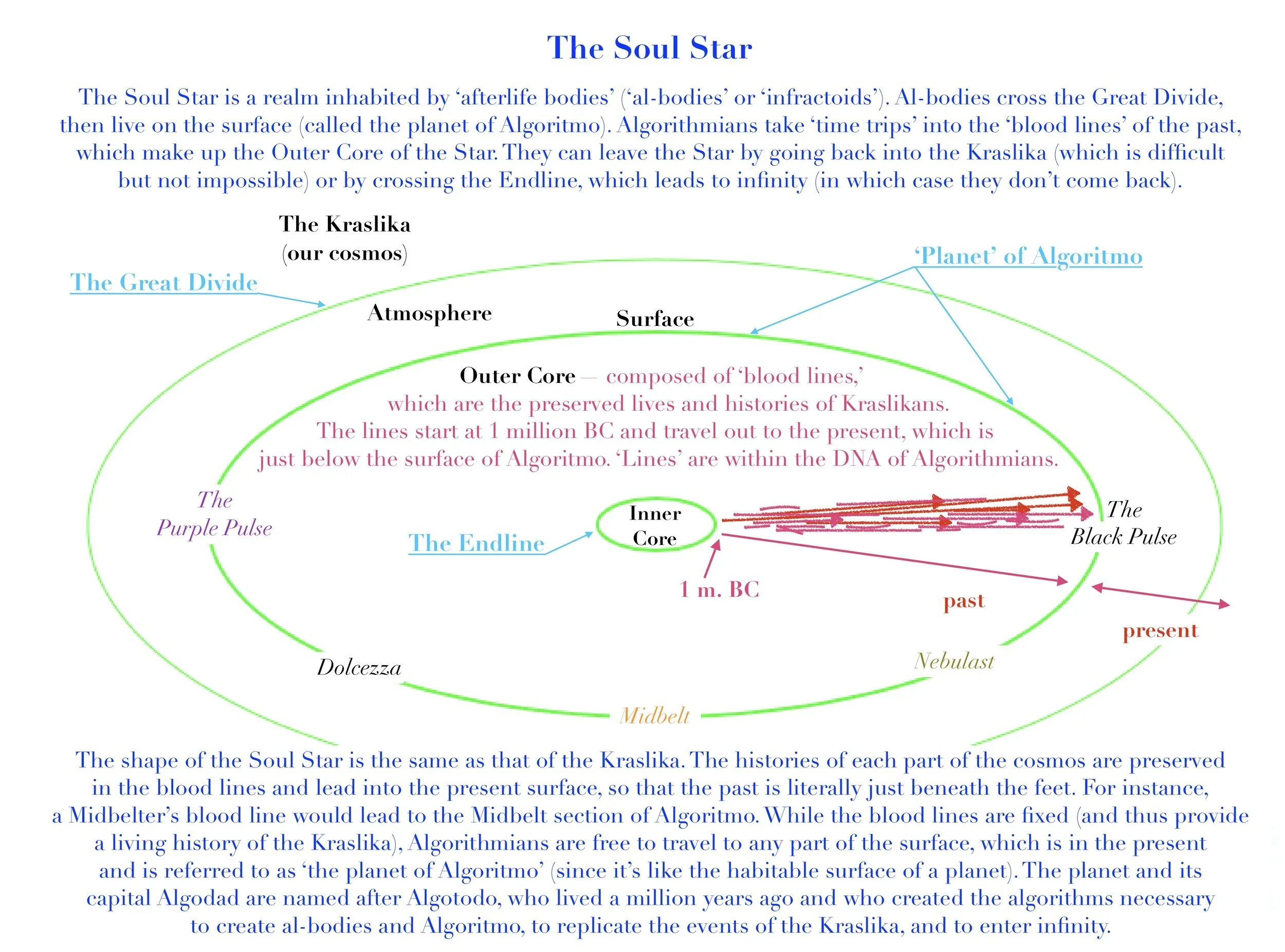
In my sci-fi romance the Vicinese learned long ago to plumb the depths of subatomic space. The Seven Sages worked within these depths to create worlds within worlds. Then, a million years ago, the smartest of these sages, Algotodo, found a way to replicate the thirteen universes of the cosmos into a tiny speck, which he placed in the Local Void, not far from Earth.
Algotodo then detonated a fractal bomb, which infused instructions into all DNA at a depth of 10 to the power of minus 60. The instructions go so deep that no species can even detect them. These instructions allow every sentient creature, at the moment of its death, to create a fractal of itself. They allow this being to project this fractal of itself across trillions of parsecs, and find a home on the tiny sphere, the tiny planet of Algoritmo. This sphere, one millimetre in diameter, is so deeply infracted that it contains the entire population of the thirteen universes. Beneath its surface, it also contains a historical, four-dimensional infraction not only of the cosmos but of the cosmos as it has existed for the last million years.
The speck is tiny, yet it’s also an enormous planet. The past is layered like geological strata below ground, the present is on the surface, and the future is floating this way and that in the air. Many people erroneously call the planet The Soul Star, which is understandable given that when people die they leave a fractal projection trace and this trace appears to be heading toward the Local Void. Scientists and theologians alike conclude that the souls of beings must travel to a heavenly home, which they agree to call The Soul Star. The theologians are happy to include the notion of soul, and the scientists are happy that it’s all really a function of mass, force, and vector.
One would be forgiven to believe that the Soul Star came about because of a pure love for scientific progress, a pure love for a perfect world of reason and technology, structured forever into the DNA of a rational cosmos. Or, better yet, that a Heavenly Power had decreed it to be, in order to allow the infinite beings to find a final, eternal, meaningful existence. Yet this doesn’t seem to be the case, at least as long as we know nothing of gods, cosmic saints, Looking-Glass Beings, or The Nexus — all of which are rumours so preposterous that they might as well be fictional. On the other hand, what history actually records is that ❧ the sages tried to find Heaven for centuries, and that ❧ it was because of the angst they felt at not finding Heaven that they conceived of the daring, desperate, even blasphemous idea of creating one of their own. The Looking-Glass sage Fra Sole might quibble, but it isn’t his job to engage in theological debate.
According to the account made in Algotodo’s The Book of Fractals, it was Algotodo who brought the work of the sages to its final form. Algotodo admits that he did this work not out of grandiose charity, but rather because of his personal grief. What drove him wasn’t the good of God’s creatures, or the love of the arcane relation between physics, algebra, and geometry. Rather, it was because he lost the woman of his dreams in the climate catastrophe of his home planet. Unable to face living without her, Algotodo built the Soul Star in the desperate hope that someday she might be reincarnated, or refractalized, and sit beside him on the dock in the middle of Green Lake.
The Soul Star and everything within it was created simply because he loved her so desperately that all the worlds in the cosmos couldn’t make up for the loss of her. And all of this was because of two simple facts: 1. he could infract the present but not the past, and 2. she died before he found the algorithm he needed to infract the present.
What Algotodo desired more than anything was to invent an algorithm which would allow him to move the core of the fractal of the Soul Star back in time so as to recreate the exact setting in which Wei once lived. From that setting he might reconstruct Wei herself. Or at least this was his hope. This was why he spent his days staring at long sequences of scrambled numbers, letters, and symbols, and also why he journeyed deep into the centre of the planet.
Every week or two he would go deep into the past, ever closer to the core. He aimed to reach a hypothetical boundary, an event horizon of the infinitely small infraction along the curvatures of space, a line between infinite infracted space and infinite infracted time. It was a desperate hope, but it was all he cared about.
But he knew it to be impossible, at least in terms of the dimensions that we know. So he wondered if he might instead plumb the depth of his own fractal heart, in a desperate attempt to unlock the door of time itself. Could the neurons and waves of his being connect with that fourth dimension of time, that dimension that doesn’t really exist? And could that French woman, that Martine, with her strange ring, and her strange mix of playful lust and mystical charm, help him do it?
❧
Pumpkins
In The Fractal Heart I want to entertain, yet I also want to suggest something that’s at once philosophical and psychological.
Philosophically, I want to suggest that our fantasies of religion, myth, and science are imaginative extensions of our minds into infinity, whether this infinity resembles Dante’s stretches from Satan’s icy lake to Heaven’s ineffable circles, or whether it resembles the distance from Star Trek’s home planet Earth to the far-off corners of the cosmos.
Psychologically, I want to suggest that this extension toward infinity already lies within us in the fractal of our understanding, that is, within our personalized map of the world and the universe. The map within us is both mental and emotional; it includes the feeling of the blood in our flesh, as well as the thought of that blood. It includes the nerves and muscles in our groin and forearm, the senses that connect us to the world, the mental images and concepts we use to understand everything around us, including the world on which we spin, as well as all the worlds that spin and drift in the infinite beyond. Our map is of course far from complete. Sci-fi, myth and theology help us to imagine what might be in the blank spaces.
Talfar’s fractal orb is a manifestation and extension of this map, since it contains all the neurological and physiological information about his body and brain, and also operates as a live Cosmic Wide Web as well as a live CPS or Cosmic Positioning System.
❧
To further explain what I mean, I’ll begin again, this time with a more precise illustration of what a fractal is.
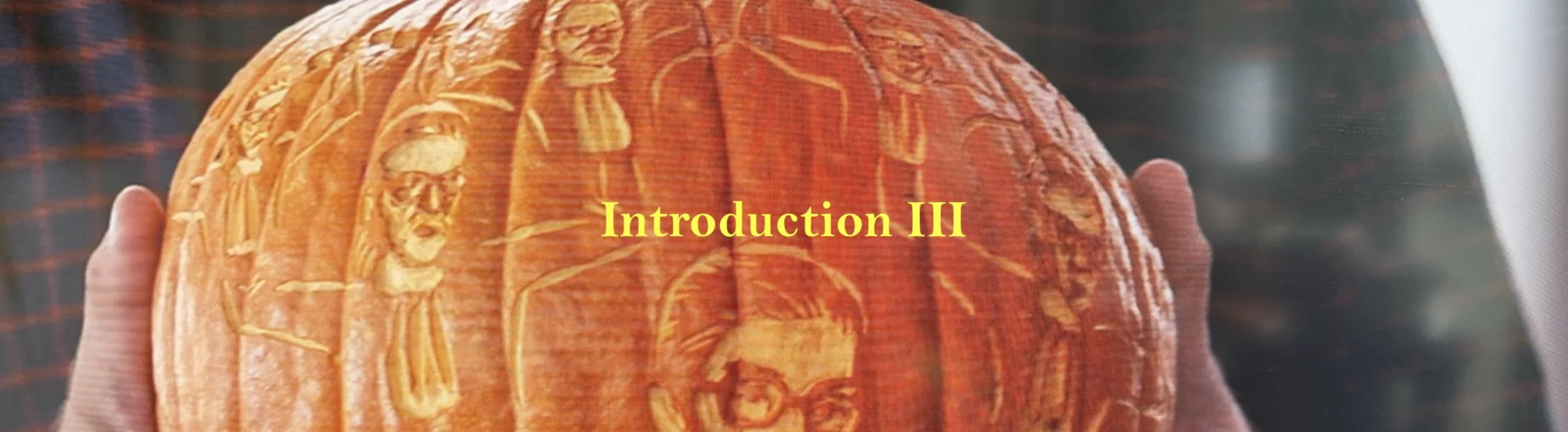
When people think about fractals they think about a graphic design that is a miniature of an original graphic design. A humorous illustration of this can be seen in the TV show Single Parents, when a nerdy daughter carves a pumpkin. Her father explains what the graphic means:
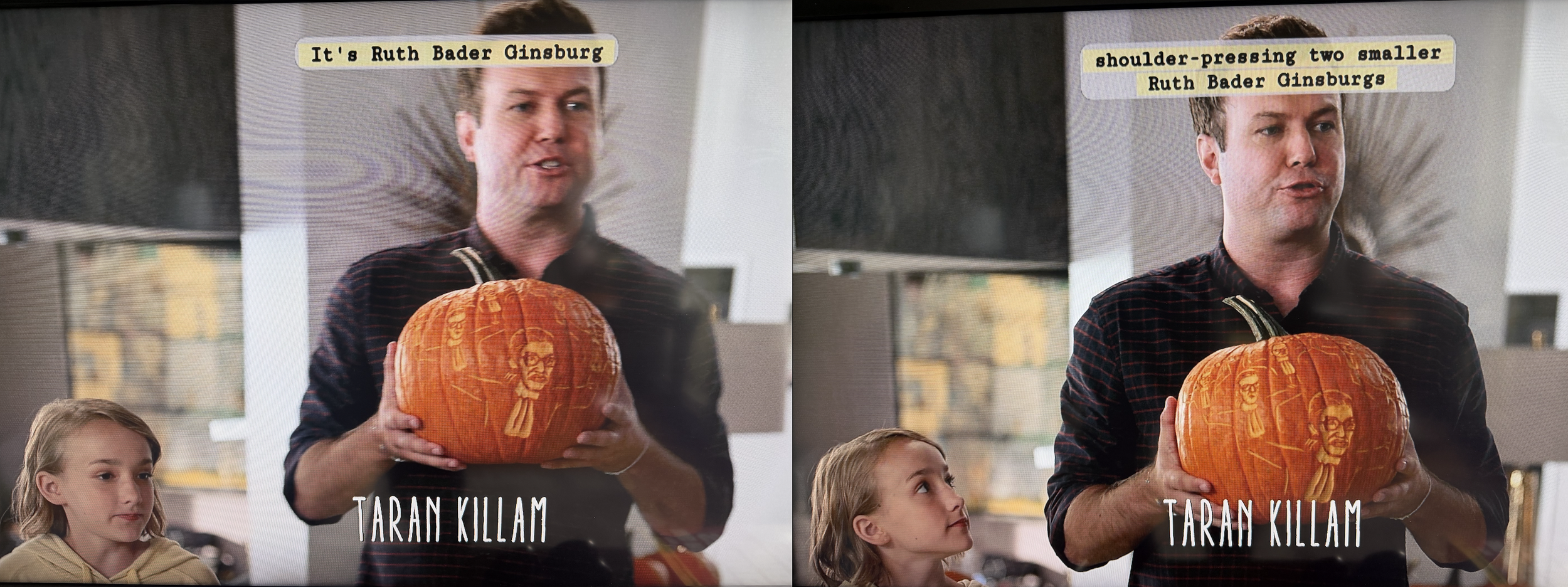
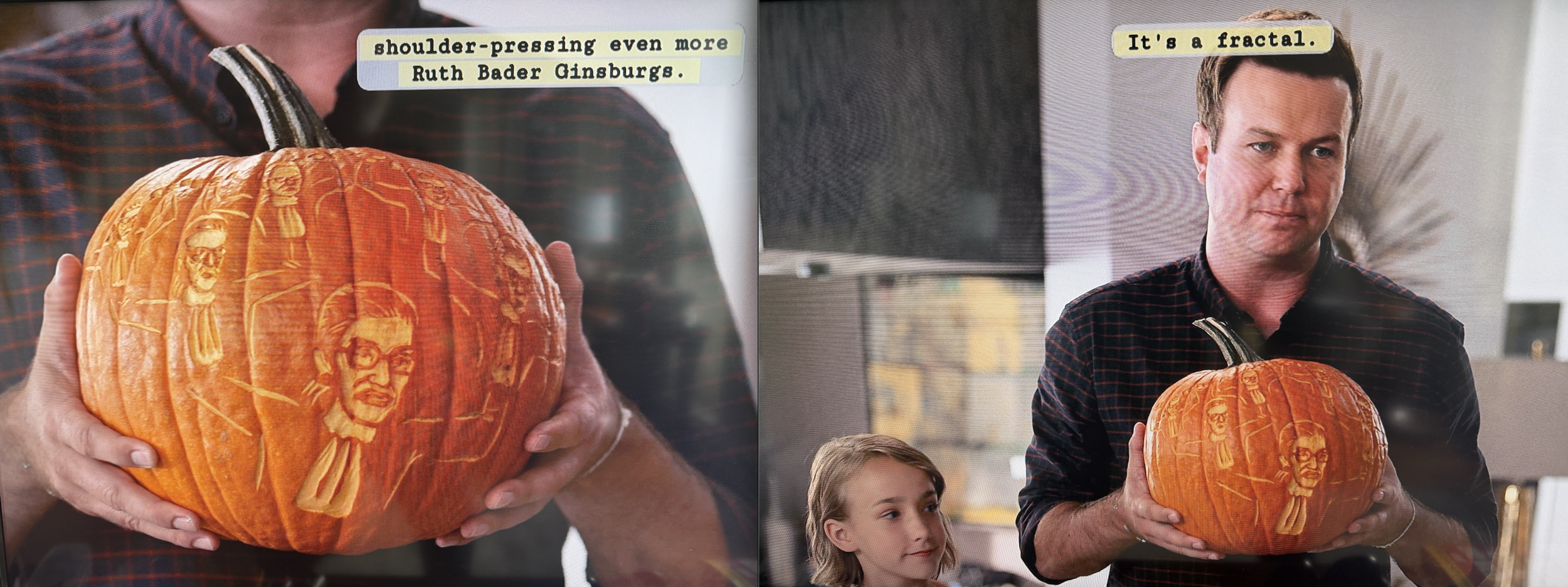
The situation is humorous because we assume a young girl would be interested in dolls or tea parties, and yet she carves fractals of the Supreme Court judge Ruth Bader Ginsburg. This is just several seconds in a TV show, yet to me it suggests at least two important things.
First, we already live in a very technical age, one which would be science-fiction to Balzac in the 19th Century. We seldom think about the nearly miraculous fact that we're watching a luminescent screen that projects images, or fractals, of our world — in this case, a father, a daughter, and four pumpkins engraved with fractals. We’re watching scenic realities, dramatic possibilities of things we may even have lived. We didn't see that particular pumpkin or go to that particular Halloween party, yet we understand it: somewhere in our memory we've logged images of pumpkins, and most of us (in North America at least) have danced along the sidewalk in a strange suit in order to accumulate a great bag of candies.
That these scenarios are played out before our eyes, and we can rewind them to take pictures of the pumpkin, stopping, and starting the realities, streaming this way or that way at will, would make Balzac sit up in his grave. That we can then put the captured images of this TV show on a system where someone in Timbuktu can watch them a fraction of a second after we post them, would make his hair rise, make electricity flow through his skeleton, and make his eye sockets glow.
Second, that a young girl would be interested in a Supreme Court judge, may seem a funny thing. Yet it suggests that at our core we may not be beings that become more caring or more creative as we get older. Twelve year olds like Greta Thunberg can be more focussed than adults on the things that really matter, like the survival of the biosphere. Where does this intelligence comes from? Is it a Chance of Evolution, or a Design of some Universal Mind, as Aurelius said 2000 years ago?
However we got it, I’m glad it's here with us. Which is why I cherish the following poem from my Junior High yearbook, written by Claudia Collins, my girlfriend back then. At twelve years of age she understood the state of the world better than most people understand it now.
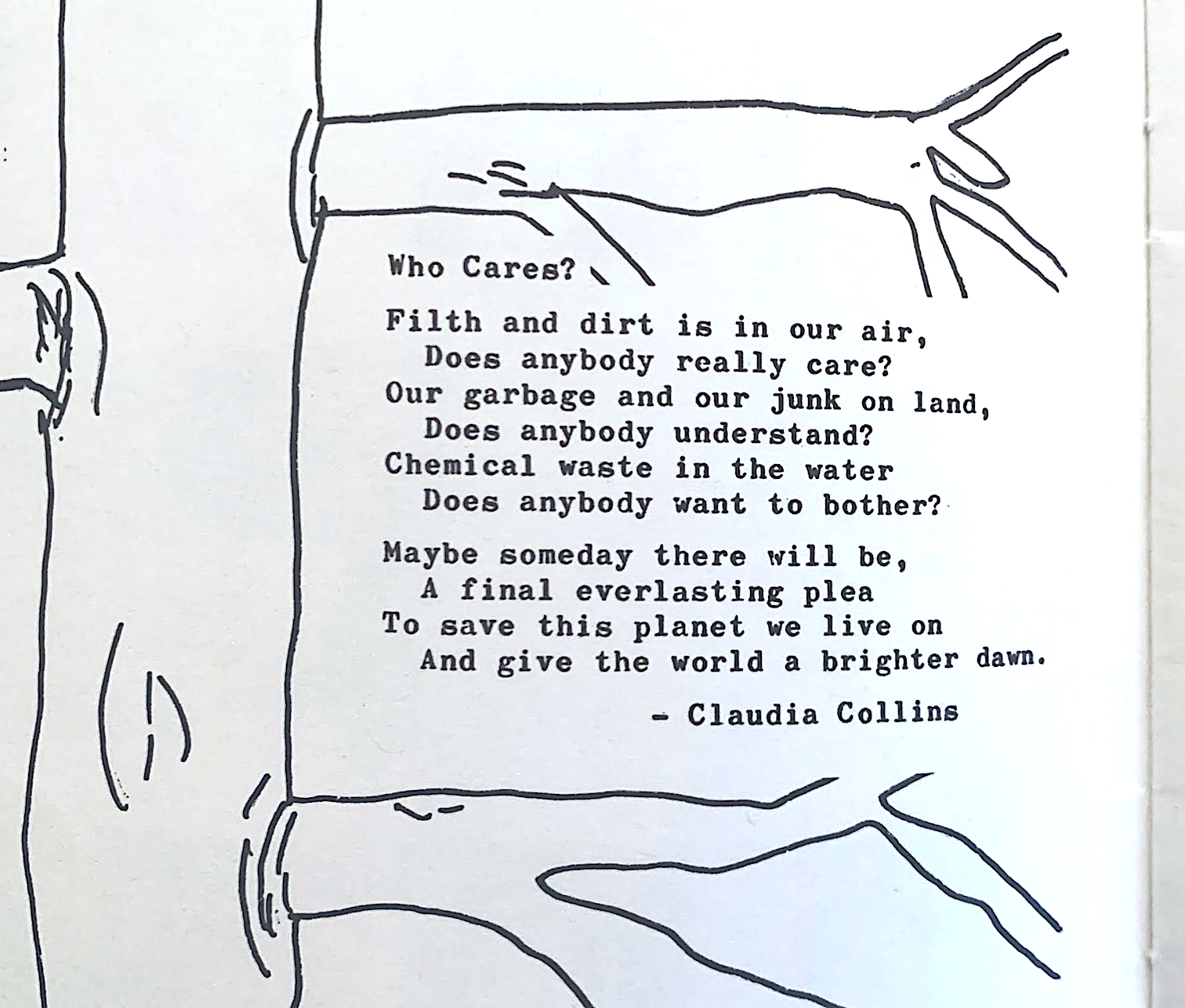
Sadly, Claudia has already passed away. I nevertheless dedicate my sci-fi romance to her. I also dedicate to her my depiction of the all my sensitive and assertive female characters: Francesca the little girl who orders an ice-cream in Rome; Claudia the Sicilian beauty who wonders about the meaning of life; Lucia the Parmigiana who stumbles into her own cosmic visions; Sylvia the ecological activist who accompanies Matthew in his exam preparation and his ride to Ragnarök; Francine the diplomat outsider in New York; Occasional Cortez the sharp-toothed political revolutionary; Martine the actress who seduces the world; and Thalphemera the explorer who dares to step out of our cosmos and into the widest expanse we can imagine.
❧
Fractal & Psyche
My main psychological point is that we all have within us a fractal of sorts, mirroring in miniature the world we live in. This fractal is, in its most essential state, a 3-D map. On this map we find our heart & brain, our bones & flesh, our home & neighbourhood, our city & country, our planet & solar system — and beyond these, the stars & the Great Unknown.
We add to this map a trick of the third dimension we call time. In practical human terms, the fourth dimension doesn’t exist in any distinct, separate, or tangible way. Rather, it’s a concept we create by juxtaposing 3-D scenarios, all the while remaining in 3-D space. While time may be an artificial construction, it’s fundamental to our sense of who we are, and hence it’s as real to us as anything else. Indeed, time is the great connector of disparate moments, of the settings, scenes, characters, conflicts, and resolutions that constitute the drama of our lives. The image of the pumpkin can exist within a moment, but the scenario in which a proud father reveals the design of the pumpkin, simultaneously with his daughter’s creative intelligence, is a function of time.
The fact that we all have this 4-D fractal inside us doesn’t mean that one fractal is the same as the next or that we use our fractals in the same way. We’re all distinct in space and therefore we all construct and use our fractal according to different outside vectors and sensory inputs, as well as different internal flows of blood, movements of flesh, and currents of neurons. Some of us are raised in a Calgary of cement driveways and baseball bats, and others are raised in a Lagos of waterways and push poles:
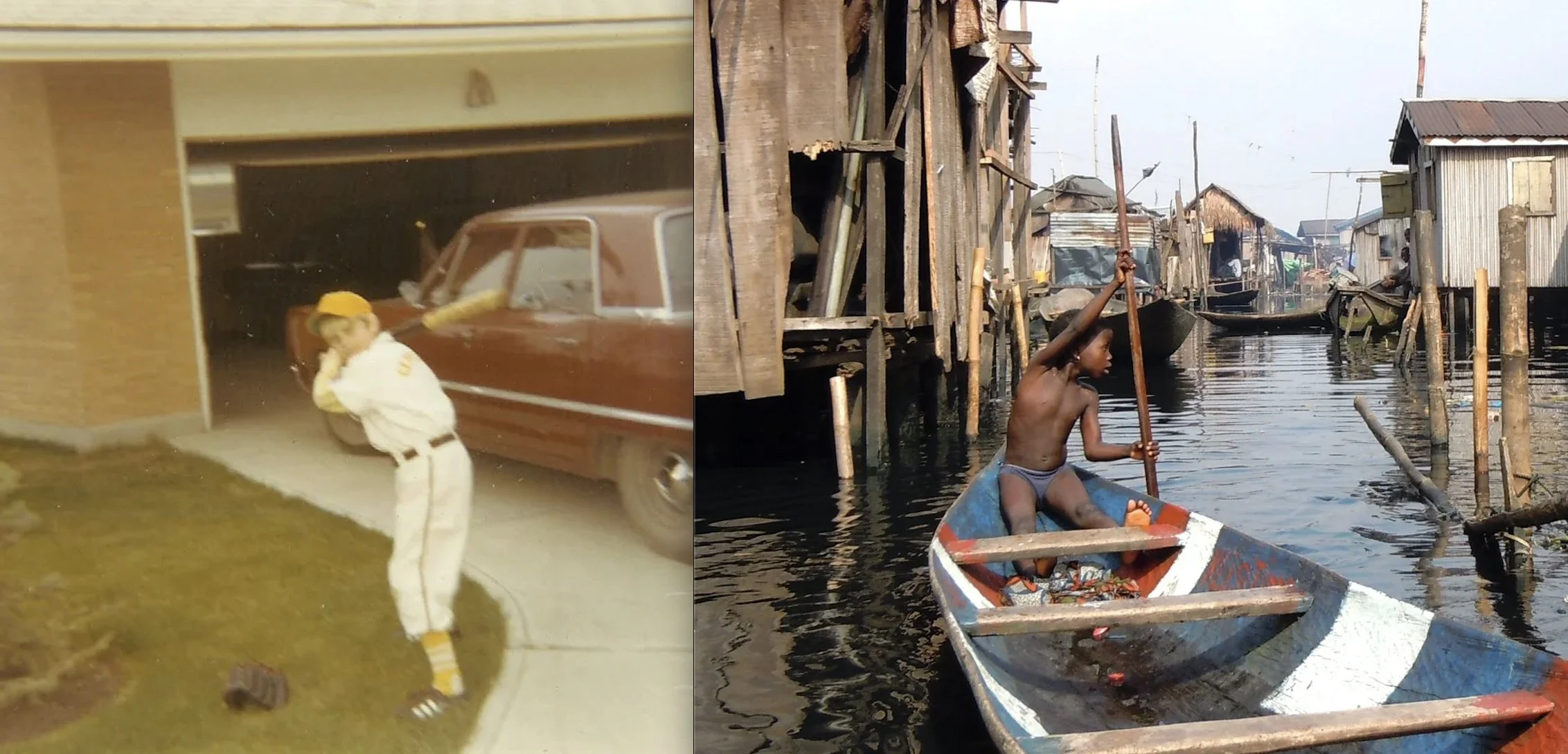
Makoko auf dem Wasser. Uploaded by Elitre, November 2010 (from Wikimedia Commons).
We may both have a piece of wood in our hands, but we do different things with it.
This is the empirical point that the university student Claudia writes about in her essay while sitting in the English Garden in Palermo. And this is the point that her professor, Tarnar, seizes upon, extends in the direction of cultural diversity, and then creates a vector stretching from Palermo to his native Copper Tarn universe.
Nor does the fact that we all have this 4-D fractal inside us mean that our fractals are remotely accurate. David Hume’s empiricism saw to that. Almost 300 years ago, he showed us that our brains are far from the precise mechanisms we sometimes imagine them to be. They record and compute, but in very unreliable ways. Hume argued this long before Modern neurology and astronomy, which at once eviscerated and exacerbated our cluelessness: the more our insights into the brain and the stars destroyed our old models, the more we were thrown into the infinite abyss of unknowing.
Now on both ends of the spatial spectrum, from neuron to Local Void, we find guesswork. Mystery stretches out in every direction. If we’re of a scientific frame of mind, we populate this mystery with data and theories. If we’re poets, sci-fi fans, or mystics, we populate it with our imagination — from the dancing of atoms to the greenest of aliens, and from intimations of a human soul to invasions of a cosmic Holy Ghost.
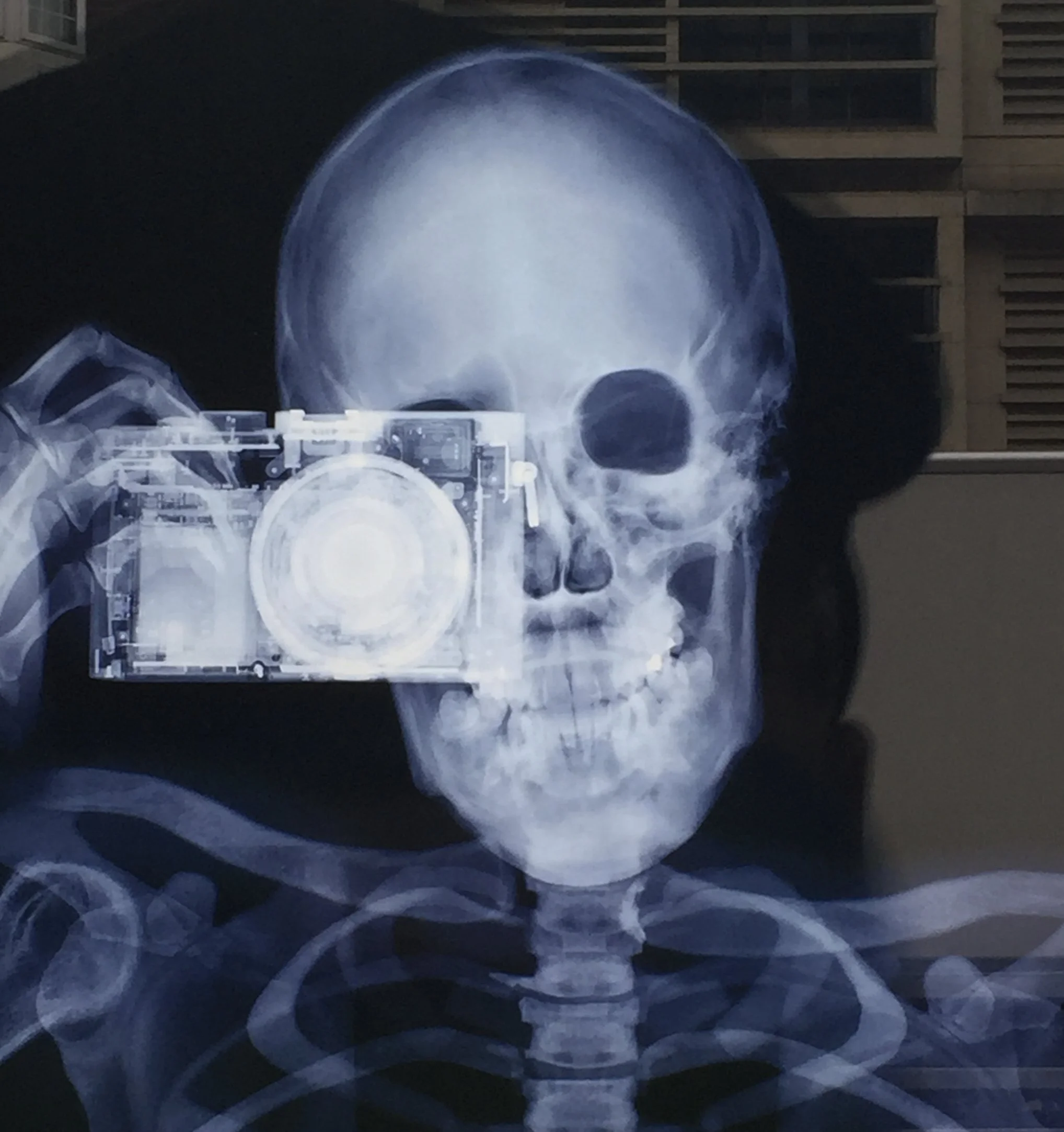
We don’t know why the neurons in our brains fire into currents that create waves, nor how these waves might interact with the tiniest vibrations of the subatomic matter that lies deep within us and also remains a mystery. And we don’t know why waves from outer space go through us like gamma rays, or why the light of the sun warms our skin. We may know how, but we may never know why.
Reaching for the how and the why, we create models in our minds. We construct fractals that reflect in miniature the correlations between the outer world of rock, papyrus, and hieroglyph, and the inner world of sense, feeling, and thought. Then we add to these fractals the fourth dimension, time, which allows us to see the transformations occurring within the fractal along a line that we imagine to be as straight as if a ruler had drafted it onto a piece of paper.
Yet one thought haunts us: this line could go on forever. What if there is no end?
Expanse — subatomic and cosmic — is the starting point of The Fractal Heart. The novel explores a number of questions related to the never-ending line that exists in space each moment and exists in time from one moment to the next. How do we get to the heart of things when things are hidden deep inside us, at the point where the line disappears in the waves of neurons and the energy of subatomic particles? And how do we get to the heart of things when everything we understand dissolves into the mist somewhere beyond our horizon?
And how, if we can barely connect to those near us, will we ever connect to beings from other dimensions or galaxies? This may seem a fantastical question, as if it came from outer space. Yet the contention of unreality conflicts with the deeper and more enduring reality that we’re in fact a tiny part of the universe, both in space and in time. Someday we may connect with other life forms from other planets. Yet even if we never make such a connection, even if humans go on their merry way alone — as a beacon of light in the limitless dark, or as a short blast of radiation — the fundamental, contextual, inevitable fact of our existence is this larger context of space. It remains, like the Heaven of believers, long after you and I are gone.
So, to me at least, it seems crucial to think about 1. how we interiorize, or make fractals of, the reality that surrounds us, and 2. how we accept our ignorance when it comes to the extremes of space and time. The neuron pathways of our brains create pathways to understanding, yet always with the proviso that Hume hammered home to us centuries ago: we ought not to confuse our fractals with reality itself. This proviso is even more insistent when we consider the difference between our understanding of this world and our understanding of the cosmos. While we can see, touch, and smell a flower, we can only draw a colourful paint-by-number outline, only extrapolate the most general shape of faraway galaxies.
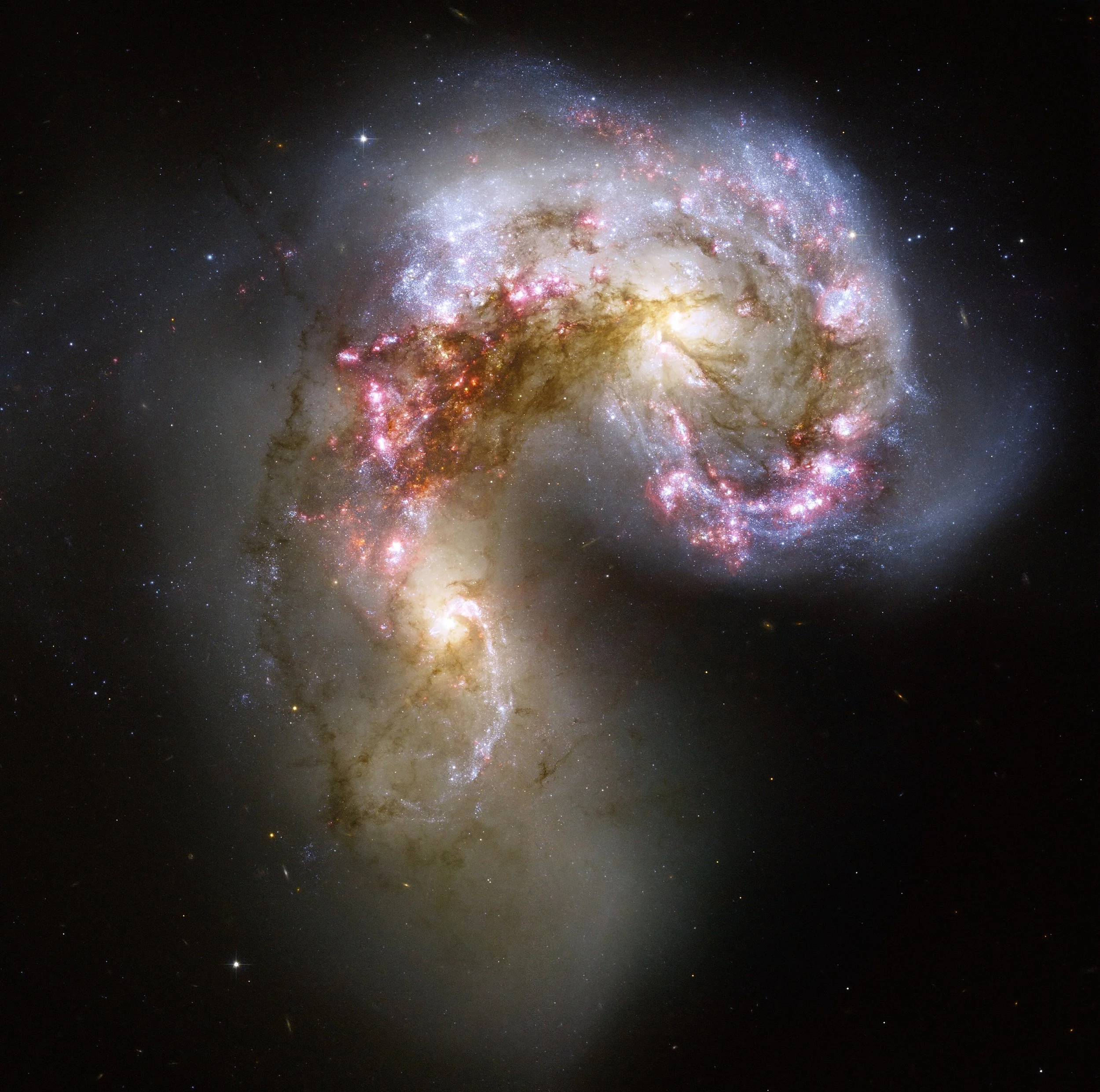
“This NASA Hubble Space Telescope image of the Antennae galaxies (NGC 4038 & 4039) is the sharpest yet of this merging pair of galaxies.” Source: http://hubblesite.org/newscenter/archive/releases/2006/46/image/a/ (direct link) (From Wikimedia Commons)

❧
Pirouettes
The question remains: how can we align the fractals of our thought and feeling with those of other beings, be they from Earth or Alpha Centauri? If Ukrainians and Russians, if Azerbaijanis and Armenians can’t see eye to eye, how are we to gaze into the five eyes of a being who measures space in gradients of colour, and time in shades of emotion? If our imaginations can’t get us safely to a table in Geneva, how are we to navigate the gulfs and spiky corners of outer space?
This may sound like a rhetorical question, begging the conclusion that we discard the question itself. But it isn’t merely rhetorical. I have an answer. Maybe not the right answer, but an answer nevertheless: we exercise our imaginations more routinely, more widely, and more radically.
I suggest that we get used to getting out of ourselves. We can start this by imagining a critical distance from the fractal within us. In doing this, we create a sort of uber-fractal, one that allows us to see our own fractal from different angles (something like Talfar’s fractal orb). Some might call this critical distance, others might call it self-awareness.
This idea goes back to at least the 3rd century BC philosophers Pyrrho in Greece and Zhuangzi in China. Both suggest that we lever ourselves psychologically from our own fixed points of view: Pyrrho aims at a suspension of judgment (epoché), while Zhuangzi aims at a still point within ourselves, from where we can pivot from one point of view to the next (he calls this the pivot of the Dao). For Pyrrho this results in tranquility (ataraxia), and for Zhuangzi this results in a natural flow and an integral connection with the world around us and with the infinite cosmos.
We can also borrow Keats’ negative capability, which allows us to ‘enter into mysteries, doubts and uncertainties without irritably searching after fact and reason.’ In other words, the quest for deep knowledge and valuable experience needn’t imply the quest for a certain answer or truth. We can combine this with Keats’ notion of the chameleon poet, that is, a state of mind where one can entertain everything — from the purity of Desdemona to the cruelty of Iago — with an interest that goes beyond the morality of good and evil.
Although we all create 4-D fractals of the world inside our brains, we can also see ourselves as more than what these fractals show us. We are the beings that make these fractals. And if we can make them, we can make them connect with other fractals. We can find an uber-mode of awareness that connects and fuses fractals that were constructed along different lines.
This leads me back to the title of my sci-fi romance, The Fractal Heart, where I imagine ways that humans and aliens tear each other apart and glue each other back together again, better than the Humpty-Dumpty that Matthew fears may be the avatar of his literary theology. Matthew — the “I” of the novel — is broken by his past experiences of abuse and violence, yet he finds a way to become whole again, and also to engage with the Baulians, the nerdy cubic pink aliens who take over the Earth. As on his computer screen, which blows the Net into a network from galaxy to galaxy, his understanding of the meaning of life dissolves and extends, dissolves and extends, dissolves and extends…
❧
Next: ✏️ Times New Roman
Contents - Characters - Glossary: A-F∙G-Z - Maps - Storylines