
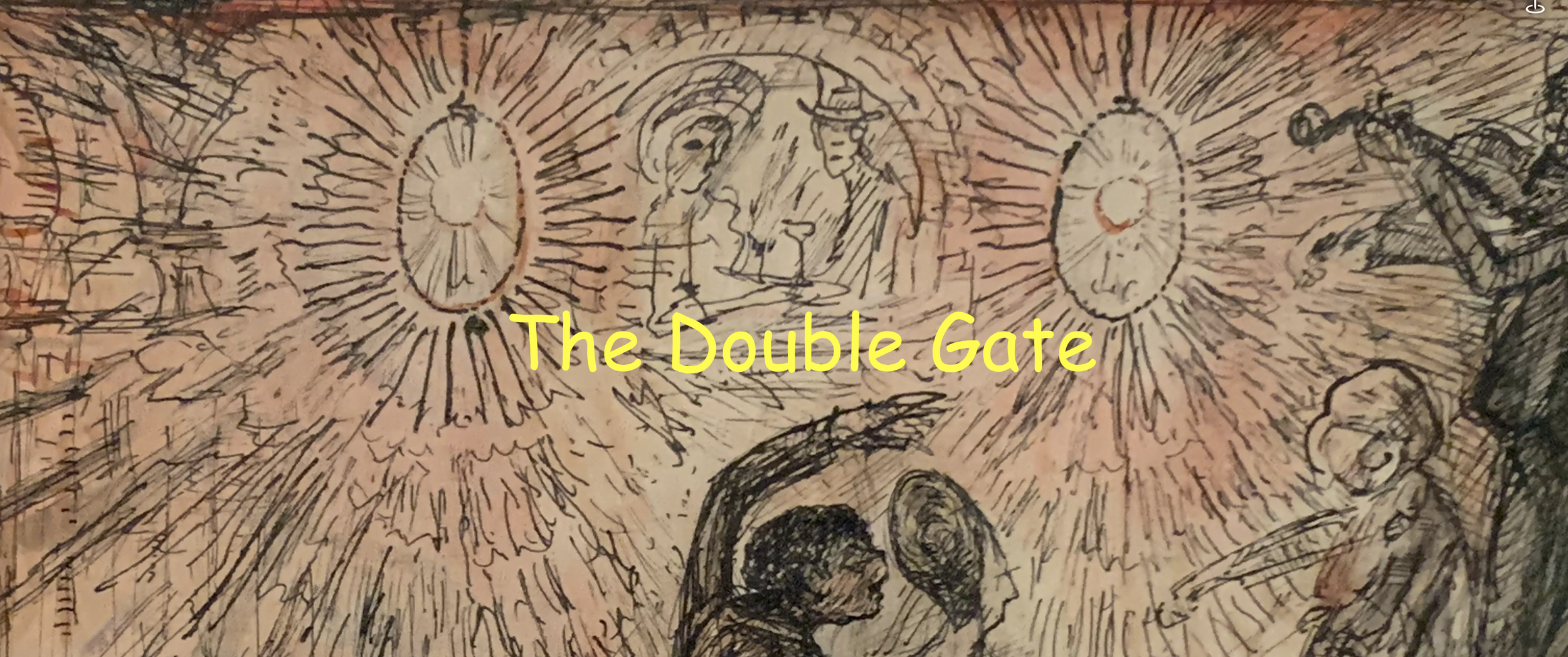
The Double Gate
The Double Gate - Notes
☯️
The Double Gate
Lord, let me pass through the double gate
of sleep and the life to come
fearing no evil
knowing that Thou art by my side
my Travelling Friend and my Blue Fairy
my Strider and my Gandalf
to my shivering Dante and his Ancient guide
Thy rod and Thy staff they comfort me
Thou preparest a table before me
in the presence of mine enemies
Beyond my own brief journey
I pray that Love conquers all — soon!
and that peace contends with freedom — soon!
so that we live to see the day
when the Tyger lies down before the Lamb
from Kiev to Kinshasa
and from Heaven to Jerusalem
🍷
Notes
My poem contains a number of allusions.
First off, the double gate is my own phrase, yet it’s inspired by Hamlet’s notion that “in the sleep of death what dreams may come must give us pause.” My contention is that the Double Refuge helps us to come to terms with the gates which open us to 1. the uncontrollable realm of dreams and 2. the uncontrollable realm of death. Our conception of these realms (and these gates) has root in our empirical neurology and in the guesswork of our brains, yet both realms (and both gates) remain beyond our control. We don’t even have any reliable information about these realms, which is why Hamlet calls the afterlife “that undiscovered country beyond whose realm no traveller returns.” Just as we are helpless to predict or control our dreams, so we are helpless to predict or control the afterlife. Hamlet concludes that such an understanding “must give us pause.”
In this pause, in this reflection on the fact that we are in fact quite clueless, two things can happen. First, we can become more humble in our pronouncements and conclusions, and hence more like an Open Agnostic. Second, we can become more like an Open Theist by opening ourselves to whatever operates these gates and the realms that lie beyond these gates. We can hope, even pray, that the gates of sleep and death will lead to peace & love, order & belonging, culture & beauty, compassion & truth, meaning & happiness. In my conception of the double refuge, we can do both of these things simultaneously.
While Hamlet refers to dreaming and the afterlife, he also applies his thoughts to the world around him (which makes him hesitate to kill his uncle). Likewise, we think about these gates and realms in the present, in the here and now. And just as we think about these realms, so we think about the world around us, aiming at the same goals: peace & love, order & belonging, culture & beauty, compassion & truth, meaning & happiness. In this sense, the way we see the unknowable aligns with, and is made of, the same substance as the way we see the world around us. I imagine this as a type of yoga, a type of unified sensibility (to borrow Eliot’s phrase) where the physical and the mental intertwine. Everything that we feel, think, & are exist in the same time & space of consciousness, whether we’re smelling a rose, slipping into sleep, or whether we’re on our deathbed, with one eye in the world that is perchance to come.
In addition to the obvious borrowings from Psalm 23, I borrow from Blake’s famous short poem “The Tyger.” Blake asks if God made the cruelty of the tiger and also the gentleness of the lamb. We can only hope that the conclusion to our moment in cosmic theodicy (that is, in a world where God and evil coexist) will come soon, and that the Tyger of Chaos & Violence will lie down before the Lamb of Peace & Love.
My notion of Lord and Thou takes many forms, from Yahweh to Brahman. Here Thou is most closely associated with the majestic double-deity of Jesus & Lord. Yet Thou incarnates itself not just in deity, but also in personal forms such as Travelling Friend & Blue Fairy as well as Strider & Gandalf. These doubles are lesser parallels to Jesus & Lord, Krishna & Brahman; they signal ideal human forms as well as a magical Grace that infuses, and is one with, these forms.
One of the most concise articulations of the ideal of omnipotent Grace was made by the pre-Christian poet Virgil, who was Dante’s guide into and out of Hell, and also part-way up the Mountain of Purgatory. Virgil penned the famous phrase, Omnia vincit amor, Love conquers all. Yet here we run into theological trouble, caused largely by closed or exclusive theism. According to Dante, Virgil came before Christ, sand as a result he couldn’t — despite his stellar morality and his vast contribution to culture — be allowed to guide Dante all the way up Purgatory. (Beatrice guided him the rest of the way up the Mountain, and from its peak into Heaven). Therein lies the sad paradox of Medieval and fundamentalist Christianity: a great man like Virgil is left standing on some level of Purgatory because of a graceless rule of Medieval theology. Yet in the thereafter of syncretism and open theism lies the promise of Christianity 2.0. From this open point of view, the Roman Virgil was never left standing, but waited inside the gates to welcome the Italian poet. Realizing the absurdity, the two laughed and talked all the way down a treed boulevard, where marble friezes and cypress trees shaded them, and nightingales sang them into the City of God.
T.S. Eliot gets at this type of redemption or reconciliation in the final lines of his Four Quartets, a long poem in which Christ & the Bible share the stage with Krishna & the Mahabharata. The final three sections of Four Quartets were written during WW II, which makes them applicable to our present world, in which Russia is savaging Ukraine, Israel is savaging Palestine, and America is ripping up the world order.
Through the unknown, unremembered gate
When the last of earth left to discover
Is that which was the beginning;
At the source of the longest river
The voice of the hidden waterfall
And the children in the apple-tree
Not known, because not looked for
But heard, half-heard, in the stillness
Between two waves of the sea.
Quick now, here, now, always--
A condition of complete simplicity
(Costing not less than everything)
And all shall be well and
All manner of thing shall be well
When the tongues of flames are in-folded
Into the crowned knot of fire
And the fire and the rose are one.
☯️
Next: Butterflies Landing: 🦋 A Positive-Sum Philosophy