
The Double Refuge 🍷 Bubbles Winking at the Brim
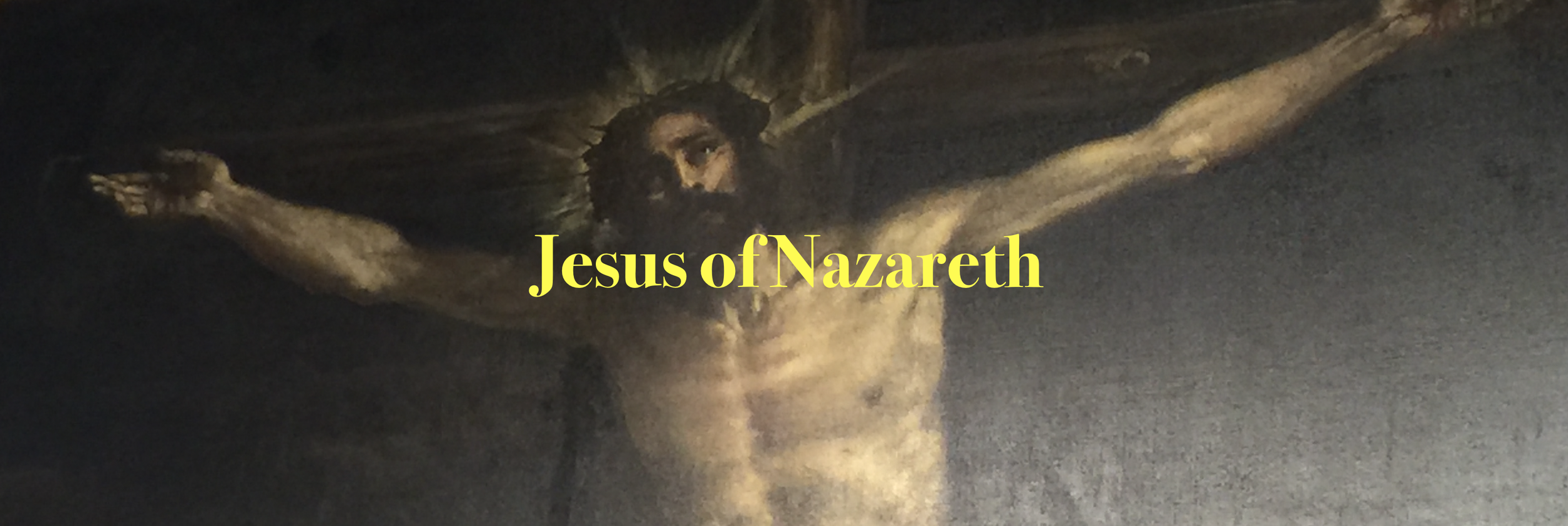
Jesus of Nazareth
Neither Frankincense Nor Myrrh - Four Sources - Biblical Studies - Invisible Grace - The Perennial Equation
🍷
Neither Frankincense Nor Myrrh
He wrote nothing down, left no record
no footprint in the sands of time.
He was a small town nobody
from a northern hamlet of hay and barnyard mud
who stumbled like a stray lamb through the eye of the needle
with all the other vagabonds, camels, and tents
through the gates of Jerusalem.
He wasn’t particularly handsome
so the women paid little attention
until he talked
and they saw something in his eyes
in his hands
in the way he spoke
barely audible amid the loud hawkers
and the lofty syllogisms of the Greek philosophers
who talked about the Good and the Beautiful
as if they were the same thing.
He seemed a lamb among the market goats
content to be ignored
as if to breathe were Heaven enough,
yet when he spoke about the farmer in a drought
or a child lost before it learned to crawl
and the mother’s shattered heart
his very pores wept pity.
And when he talked about the elite
and the indifference of the wealthy
a still anger rose in his voice
so that even his great sympathy
couldn’t erase the wages of their sin
nor could it abate his disdain for the foolish and the blind
who pulled behind them the long blind chain of humankind.
He told his thoughts to a man all men despised
as if he and the jailer had common cause
wandering free about the world
while other men sat wretched and chained to the stony floor
looking up at the window, unable to imagine
a feast, or to even knock at the door.
With a vacant look in his eye
he told the jailer “I am nothing.”
After taking a deep breath he added
“if not my father’s son.
Whatever you might make of me
the fiery planets will change it
and the stars themselves will be undone
in the place you once called Hell
in the cauldron of love
where everything is one.”
He was the spark of all time and space
made manifest in flesh and blood
so that the etherial Father could better see
how humans see, and feel what humans feel:
the broken rose
the thorn upon the brow
the humiliation of the flesh
and the slow pulse dying in the veins.
There was so much pathos behind his words
that everyone felt compelled to ask questions
which he answered in metaphor and parable
as if the truth were too insubstantial
or as if those around him needed to understand
by other means the things no one can understand.
🍷
He told the jailer about his travels beyond the Eastern Hills
where he went to find the Old Master
the original Wise Man of the East
who was older than any man alive
(which is hardly surprising since according to legend he was conceived by a falling star, remained in his mother’s womb for seventy years, and was born an old man!).
Disgusted by the state of the world
the Old Master travelled westward
over the Letter-Box Pass and into the Great Beyond
wandering like the legendary Babaji across the centuries
some would say “hidden,” some would say “lost”
from valley to valley, from peak to peak
where mist meets ether over the House of Frost.
After 600 years of following the inner star of his wandering bark
he descending from the heights of the Himalayas
and followed the Yamuna down to the Ganges Plain
which flows from Mount Kailash to the Bay of Bengal
through Shiva’s matted hair to sweet Calcutta rain.
The Old Master travelled all that distance
from his home town of Chu Jen to the city of Prayaga
to meet his brother.
As soon as they saw each other across the dusty street
they walked immediately to the middle, embraced
and wept with joy
to find that East and West could finally meet
and that their father’s promise was finally kept.
They came on foot, donkey, and ox
without the blare of golden trumpets,
unannounced and unannouncing;
the only palm leaves that waved
waved at them from the river side
that wended its way down to the alluvial plain
where the Ganges met the Yamuna
with sacred Saraswati underground
her vina playing and the Vedic verses rumbling in the clouds
like the Way that’s water, like God’s own eyes
crying into the valleys and rising into the skies.
For 600 years they were only waiting for this moment to arise
like Merton and the Dali Lama in Dharamsala in 1968
yet this was more than that: for eight full years
they laughed and cried, ate and drank, prayed
and lamented that humans see black and white
while the world is grey
and green and blue, and saffron and violet
and deep red like blood,
yet when they try to see more clearly
tiny splinters look large as trees
and tiny rivulets seem a massive flood.
They also talked of fallen gods
and stone tablets
so blank that rhyme and reason disappeared.
What then of yes and no, of platonic love and primal lust,
of good and evil, that old debate that no one can trust
because it connects the best to the worst
like a go-between between love and hate.
🍷
The jailer sat astonished
like a diamond stone, transparent.
Yet neither the Roman nor the Jewish authorities took kindly
to the disturbing promises of the northern stranger
who they dispatched without a French regret to the dungeon
where the other prisoners complained
that he babbled night and day
while the jailer listened.
Forty nights Jesus slept in that rat-infested bed of thorns
until the stars and sun were extinguished in his eyes.
Two drunk centurions dragged him through the town
and up a dirty hill
where the spirit finally left his flesh
not a moment too soon
nor a moment too late.
The jailer followed him across the street and up that fatal hill
saw what no one ever saw
and heard his dying word.
On his way home he told his neighbours
who told their cousins what he had heard.
🍷
Four Sources
If religion is crammed with question marks
and tiny dots in space and time
why not connect the moments with colourful lines
and fill the corners with golden sparks?
There are at least four reasons why we might respond to the biblical stories with stories of our own. These four reasons line up, more or less, with the four main sources of our understanding about Jesus: 1. the gospels themselves read more like edited stories than like history or on-the-spot Good News; 2. Paul’s letters open the door of exegesis so wide that it lets the whole world in, 3. the changes in doctrine from Classical to Medieval to Modern suggest the inevitability of continued change; and 4. the recent development of open theism and Christianity 2.0 invite fluid retellings of the static Word.
1. The first and foremost source of our understanding of Jesus are the Gospels, which were written after he died. These accounts are doubtful in places, yet they establish what we understand to be his essential messages: God is love, not wrath; seek forgiveness and strive to forgive; love thy enemy as well as they neighbour; serve the poor and the downtrodden rather than the wealthy and the powerful; have the courage to stand up for truth and justice.
At times its seems that the greatest historical and theological misfortune is that Jesus wasn’t a writer, that he didn’t leave us with a clear articulation of exactly what he meant. Yet his metaphorical statements and parables give us much to go on, and they also invite a certain freedom. They don’t tie down his word in the same way we find in the Old Testament. As in poetry, the ambiguity and creativity of his metaphors and parables allow ample space for reflection and for ample latitude for interpretation.
Second, there are the writings of Paul, whose perspective colours the ages to come. Writing before Marcion compiled the first New Testament, Paul grounded Christianity in the messages of love and redemption. Paul asserted that Jesus existed before the beginning of Time, that he took on the limited and humble state of a nobody (the opposite of a king with power and wealth), and that his crucifixion and resurrection saved all of humanity by overturning Law and replacing it with Grace.
While Paul expanded the new faith to everyone, he retained some of the old exclusive Chosen People rhetoric: the Spirit of Grace existed before all time yet still needed to be seen as Jesus of Nazareth. It could not easily find expression in a multiplicity of forms, actions, feelings, or deities. This, at least, is the standard reading of the last two thousand years, which I would call Christianity 1.0. Personally I believe in what I call Christianity 2.0, in which Paul isn’t insisting on such a limited or exclusive view of theology. Richard Rohr argues that Paul seldom writes about Jesus, but rather about Christ. Rohr sees Christ as the eternal Power of Love, incarnated in Jesus yet also capable of being incarnated in a trillion ways. I’ll return to Christianity 2.0 in more detail below.
Third, there are the ages that came — Classical, Medieval, and Modern, each of which saw the nature of Christ in different lights. There is of course a wide variety within each age, and one can imagine the timeline as widening at each end — the the diverse philosophies and polytheisms of the Classical age on one end, and the diversity of the Modern Age (starting around 1500) on the other. The Modern Age contains, but isn’t limited to, the following: the Neoplatonism of the Renaissance, the sects and the requisite secularisms of the Reformation, the Deism of the Enlightenment, and the more recent varieties of Christian existentialism, Intelligent Design, negative theology, ecumenicalism, eclecticism, and syncretism. Taken all together, the diversity between and within each age suggest that there’s no such thing as one way to believe or interpret the teachings of Jesus of Nazareth.
Fourth, there is our present sense of 🔹 what Jesus stood for, 🔹 what he meant, 🔹 what he was, and 🔹 how we might interpret his metaphors and parables in order to incorporate them into our lives. It remains something of a puzzle, how we are to implement what he said about love, redemption, compassion, justice, and the courage of our convictions.
Given the obscurity and mutability of the sources we use to understand Jesus, I’d argue that we’re free to read the Bible as an anthology and we’re also free to fictionalize both his life and the history which the Bible presents. The diverse nature of the book, and the obscure nature of Jesus’ biography combine to invite speculation, imagination, and discovery. We can respect the old narratives and yet also craft new narratives of our own.
Perhaps this approach works best if we think in the terms of theologians like Richard Rohr, Matthew Fox, and Tim Harpur. All of these men argue for an open theism in which Christianity merges with all spiritual currents of love. They do this by making a distinction between the historical person of Jesus and the eternal cosmic force of Christ. The two interconnect, yet remain separate, thereby opening a space for other expressions of Deity, other Neoplatonic forms, other localized expressions of love. Richard Rohr argues that we can see this in the Gospels, where Matthew, Luke, and Mark focus on the Jesus of history, while John focuses on the Christ of cosmology. In this reading, when Jesus says in John 14:6, “I am the way and the truth and the life. No one comes to the Father except through me,” he is saying that the cosmic force of love and redemption is the way. In this sense the way takes on a rather Daoist meaning in that it incorporates all mystical and spiritual perspectives, whether in this world or any other.
From this perspective, Jesus is a 2000 year-old incarnation of the cosmic, eternal Love of Christ. Any story we can tell about this particular love, as long as it aims at humility, compassion, truth and justice, is fair game.
I think it makes sense to devise our own illustrations of what history refuses to illustrate. Which makes me wonder: if God didn’t make Himself clear (being omnipotent, He could easily have made himself clear), was it to allow us ample room for art and creativity, for the endless forms that our brains might conceive?
This, in any case, is my justification for what many might consider a crazed and irreverent page — 🔹 for having Jesus meet Laozi in India (“Neither Frankincense Nor Myrrh”), 🔹 for reading the Bible as if it were The Norton Anthology (“Biblical Studies”), 🔹 for mixing angry politics with pacifism and love (“Neither Frankincense Nor Myrrh” and “Invisible Grace”), and 🔹 for my shamelessly Whitmanesque take on Deity (“The Perennial Equation”).
🍷
Biblical Studies
When we open our Norton Anthology of English Literature, do we turn to all pages at once? Or do we find some authors more engaging than others?
Do we curse the House of England and all its writers because its kings were jealous and angry? Or do cheer Beowulf into battle, and afterwards drink wine and laugh with Byron on the slopes of Vesuvius and Carmel?
Do we refuse to read Swift because he blasted his tribe to Hell? Or do we observe how he passes the gunpowder to Orwell?
Do we swear off Shakespeare because his Jew loved money? Or do we debate with Portia the qualities of mercy?
Do we expect Marlowe to have the ethics of Mill? Or do we watch with bated breath as Empire slips into the heart of its own darkness?
Do we think Modern sensibility so fine that it eclipses the humanity of Chaucer? Inversely, do we think the Middle Ages so spiritual that we find in Chaucer nothing but contradiction? Or, do we see the play of paradox and contradiction — morality and immorality, respect and disdain, beauty and squalor, anger and love — run dappled through the pages and along the spine?
🍷
Invisible Grace
If in the cosmic scheme of things
invisible Grace can tilt all worlds
and blot out all imperfections,
each global stain from Genghis Khan to Hitler,
why should I worry about Putin and Trump,
or the tiny thing that burrows under my skin,
erupts on my lip, and calls itself sin?
And yet these monsters pound the continents
and stretch their web of lies ever further,
ever deeper into the hinterland.
I will pronounce each sin upon my lip,
blood-shod, and plead for Grace
this rank, unholy ground to tilt or flip.
🍷
The Perennial Equation
The one God of Western religion is beyond gender or people. Beyond planet or solar system. Beyond galaxy or galaxy wall. Beyond space and time itself. It’s the one unified Reality, Great Spirit, Brahman, Dao. A rose by any other name would smell as sweet. A God by any other name I’m pleased to meet.
In the realms of open theism, this God is a Being, a living Being, an Existence large as the cosmos across all Time. Forget about existence versus essence. It’s both.
It can take specific forms. Why not? It can talk to each and every one of us, and to dogs in its own way. It can take any form It allows us to conceive, perceive, or understand.
It may take the name of Brahman, or more specifically Vishnu, or more specifically yet Krishna. Or it may be called the Jewish God that has no name and cannot be pronounced, or it may be called Yahweh or Elohim or the Holy Ghost. Ot it may be called God’s Son, the Son’s Mother, Mother Nature, or whatever name we give to whatever it is that gives order, peace, love, and hope to the cosmos. These are but four signs of It's presence.
Perhaps its most specific form is the moment of mystical connection, the moment we’re pierced by Love, or the moment we feel Soma coursing through our veins and into our eyes. Into our very sight. Not just into our seeing, but into sight itself. Or, as the Upanishad puts it, “Not what you see, but that you see, know that to be Brahman.”
In all cases, the fundamental assertion seems to be the same: God is everywhere, omnipotent, omniscient, at all times.
Acknowledgment of this is a step toward living it. Islam’s Submission (the literal meaning of Islam) is a key term, signifying liberation rather than enslavement. Another meaning of Islam is surrender. A battle we're dying to lose.
Across the burning sand, we are all marching, backwards or in the air, to the Promised Land.
🍷
Next: 🍷 Bridges