
Preface
Romance & Comedy - Somewhere in the Thirteen Universes - Icebergs
❧
Romance & Comedy
The Fractal Heart is a sci-fi romance. By sci-fi I mean a brave new world filled with aliens & technological wonders. By romance I mean the same old chaos of lust & love, chivalry & obsession, hope & despair. As in Medieval romances and linked tales — such as Le Roman de la Rose, The Decameron, and The Canterbury Tales — my story contains affairs of the heart as well as the affairs of society: politics, religion, culture, art, etc. Like Chaucer’s Tales, The Fractal Heart contains allegory & satire, heroic vagabonds & diabolical monks, drunk millers & randy wives. It’s as if Chaucer’s pilgrims were acting out their personal dramas on the deck of a Federation Starship, on the steps of a holy temple on the desert planet of Vulcan, or on the deck of a Klingon Cruiser firing on a Romulan Warbird.
My romance might also be seen as a sci-fi version of Dante’s Divine Comedy: ❧ it peoples the cosmos with a cast of saints & sinners, heroes & rascals, ❧ it contains an afterlife planet with layers of history beneath it and layers of possible futures above, and ❧ it has idealism and light on one end of the cosmos, and realism and darkness on the other.
Finally, my romance might be seen as a sci-fi version of Balzac’s Human Comedy: ❧ its diverse stories are linked in ways that don’t at first seem obvious, ❧ its stories evolved, and were woven together, over time, and ❧ it has a wide moral range of characters, from criminal masterminds (such as Balzac’s Vautrin) to etherial beings (such as Balzac’s androgynous Séraphîtus/Séraphîta).
I don’t pretend to the art of Dante or Balzac, yet my cosmic comedy is similarly jammed with a wide range of interconnected plots and diverse characters. And, as happened with Balzac, more plots and characters keep crowding into my mind, most of them from The Democratic Republic of Who-Knows-Where! Even the most docile of its citizens jostle in the queue, eager to push others off the stage and tell their tales. Which is why my story is always expanding, and why it expands all over the place.
❧
Somewhere in the Thirteen Universes
One of my story’s key locations is a bright auditorium on the planet of Kollarum, located in the Aatari Lok universe. This is where two diplomats — 🎲 Talfar from the Vicinese Empire, and 🎲 Farenn from the Fallarian Empire — try to sort out ❧ who’s playing dice with the universe, ❧ what they need to do to make the game fair, and ❧ what they’re going to say once they take the podium.
Talfar and Farenn will give their speeches on the 216th floor of the Matterhorn Conference Centre, before the assembled ministers and diplomats of the thirteen universes. I should note here that the size of my sci-fi cosmos beggars belief. And yet I don’t consider its size to be a fantasy in the least. It may be fiction, yet it may also be fact. This is because it’s based on the following rational speculation: just as Hubble discovered galaxies in the 1920s, so in the future we may discover that some of those blurry bright dots way out there are in fact universes.
We first see the Vicinese diplomat, Talfar, in his hotel room on the 214th floor of the Matterhorn Conference Centre. For the last two hours he’s been staring deep into his fractal orb, which is a personal computer that’s shaped like the cosmos. It can float, shrink, expand, and even disappear. The orb is an extension of Talfar’s mind & body, yet it also contains a meticulously detailed map of space & time. One might say that his fractal orb is a personalized Cosmic Wide Web, a replica of his body & mind if they were connected in infinite detail, and at all moments, to the cosmos around him. I’ll return to this concept of an infinitely connected self in my Introduction (which follows this Preface) and throughout my romance. Suffice it to say here that the concept of an infinitely connected self gives new meaning to the famous lines, “Walt Whitman, a kosmos, of Manhattan the son, […] Unscrew the locks from the doors! Unscrew the doors themselves from their jambs!”
Talfar consults his orb in order to decide if the Virgo Supercluster and its Milky Way should be annexed by the Baulian Empire. Big, pink, boxy — and bossy! — the Baulians are a powerful and highly organized species from the Orange Hoop universe. Yet they’re more Borg than Romulan, more clueless than cunning. Which makes Talfar wonder if they’ll be tough enough — and canny enough — to enforce a buffer zone between the Vicinese and Fallarian empires.
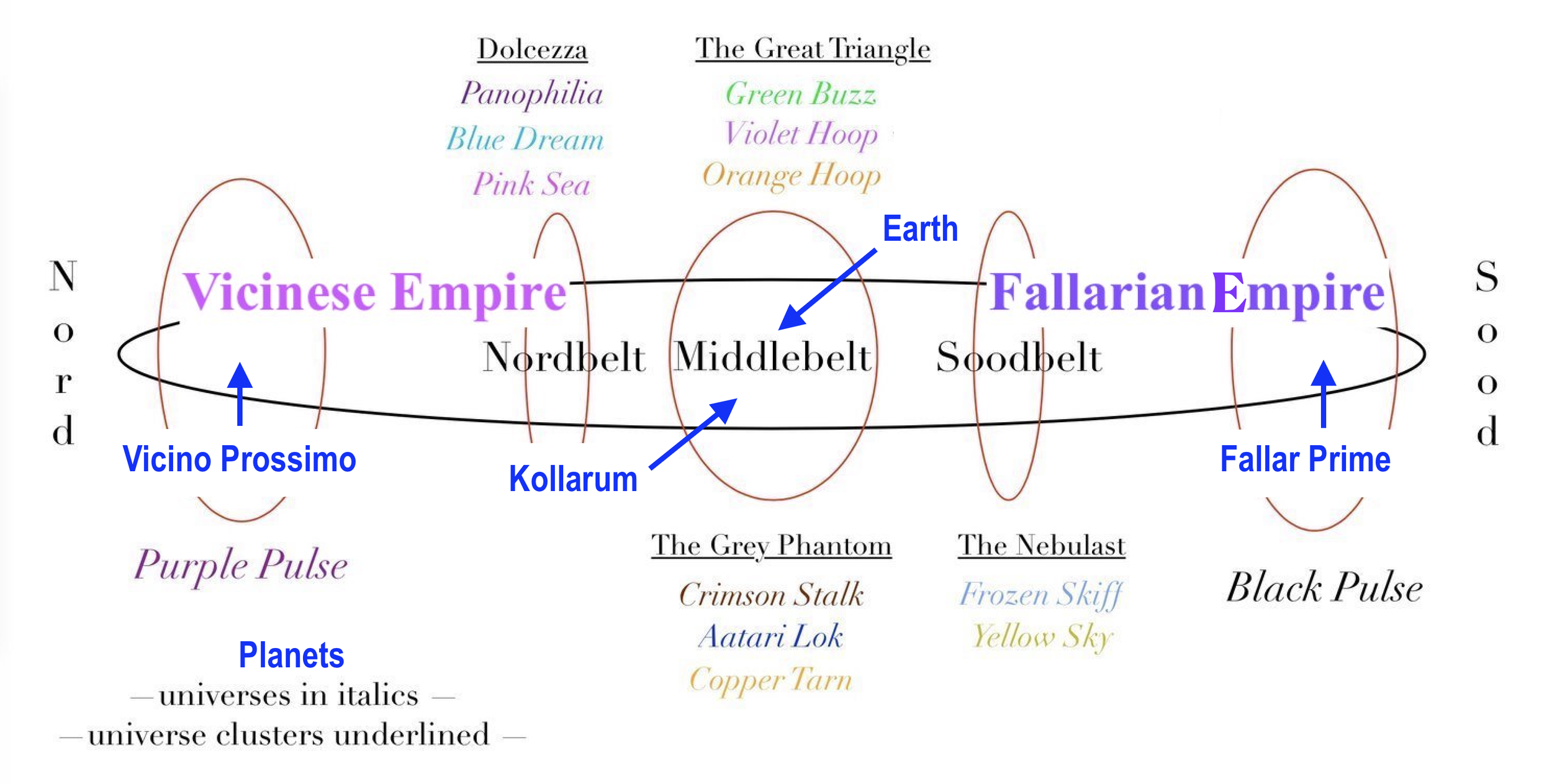
We see the other diplomat, Farenn, back when he was a student, sitting at a cafe in Vicino Concordia (the main city on the planet Vicino Prossimo, which is the home planet of the Vicinese Empire). Farenn’s presence in the cafe may seem innocuous enough. Yet the mere fact of him sitting there makes him very much like Strider, Tolkien’s hidden king in The Lord of the Rings.
We first see Strider sitting in the corner of a bar in the town of Bree. One might take him for a loafer, a ne’er-do-well with nothing better to do but sit with his legs stretched out before him, nursing his tankard of ale and holding his “long-stemmed pipe curiously carved.” A common sight perhaps, except that outside on the roads and rural highways red-eyed Nazguls fly up and down. Strider knows them well, in whatever form they take — black horses, birds of prey — always at the beck & call of the Dark Lord. At present the Nazguls are scouring the Shire, sniffing out the hobbit (Frodo) who has just stepped into the bar, and who sees Strider sitting in the shadows.
Farenn strides fearlessly into the lion’s den, into a city where security agents would shoot him if they knew where he came from: Fallar Prime. The reason Farenn dares to enter this den is that he wants to ally himself with someone in the Vicinese capital who shares his revolutionary aim, which is to eliminate the division that threatens to rip the cosmos in two. He wants to open the doors between the Vicinese and Fallarian empires, and if possible, take the doors themselves from their jambs. In sum, he’s looking for someone like Talfar.
❧
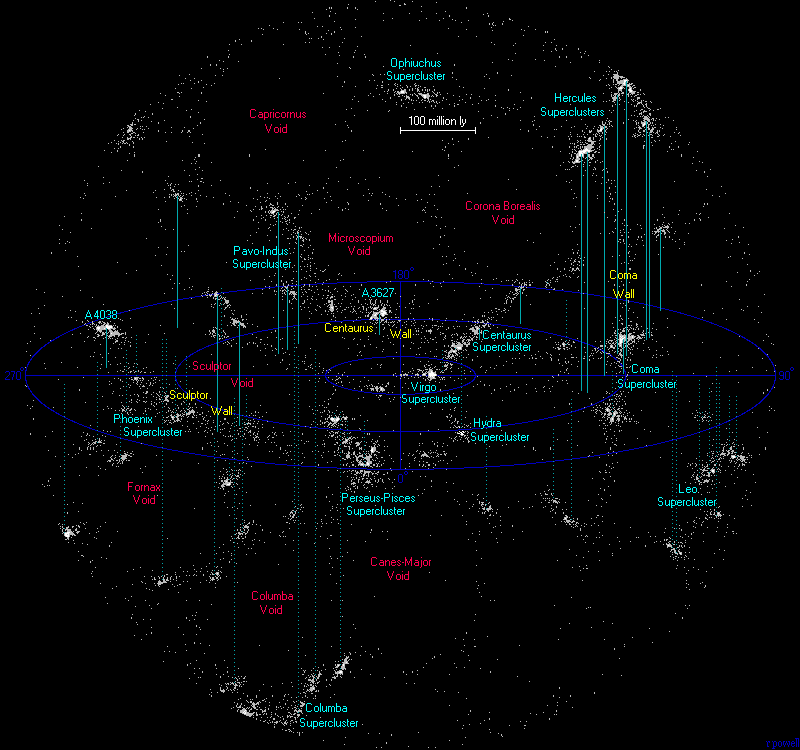
My romance is also set on a planet that’s hidden in the Local Void, that vast near-emptiness that stretches out from the edges of our own galaxy, the Milky Way, in the Virgo Supercluster:
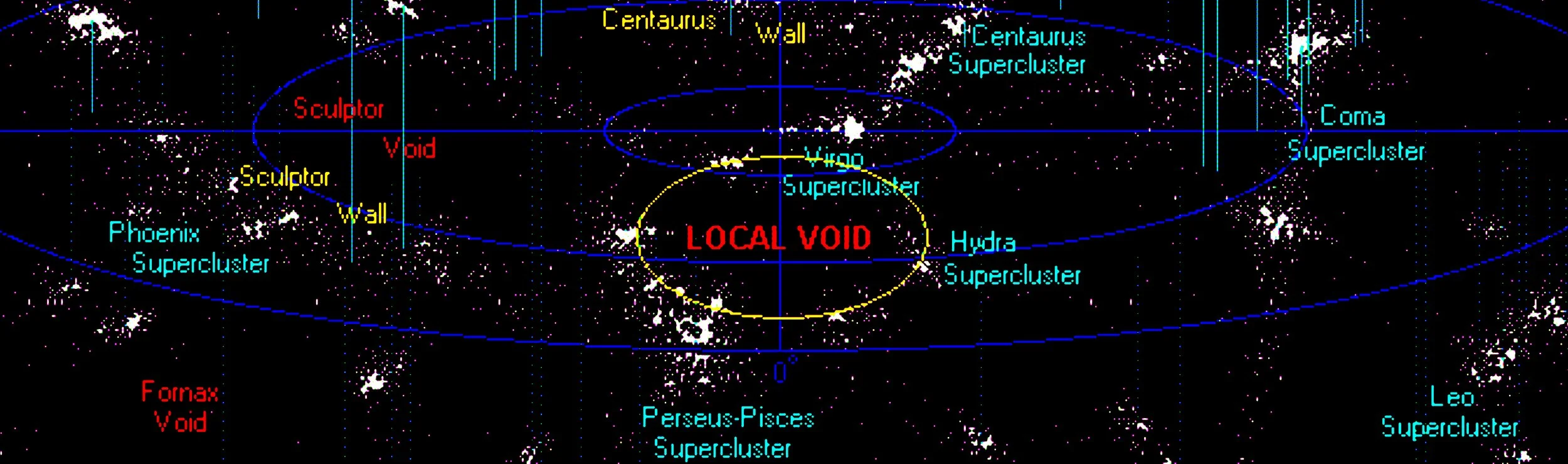
Detail from “Map of voids and superclusters within 500 million light years from Milky Way. The Local Void in the yellow circle. August 2016. Source; Author: Richard Powell. (From Wikimedia Commons, clipped and colour-enhanced by RYC)
On this planet we find ⭐️ Algotodo, the greatest master of algorithms ever known. Algotodo died a million years ago, and he’s now a copy of himself. He’s a fractal, live, algorithmic replica of the last great sage of the Ancient Vicinese Empire, which ruled The Purple Pulse universe a million years ago.
Algotodo sits at the end of a long dock in the middle of a green lake, which is in the centre of a large park, which is in the centre of the largest metropolitan area in the cosmos. 8.3 decillion inhabitants. The daddy of all cities: Algodad. The dock is invisible, so there’s no one to interrupt his obsessive quest for a doorway to the past.
Algotodo and its green lake exist on the fractal planet he created: Algoritmo, the elusive artificial Heaven that no one outside the planet has ever seen. The people on the planet call it Algoritmo, although everyone else refers to it as the Soul Star.

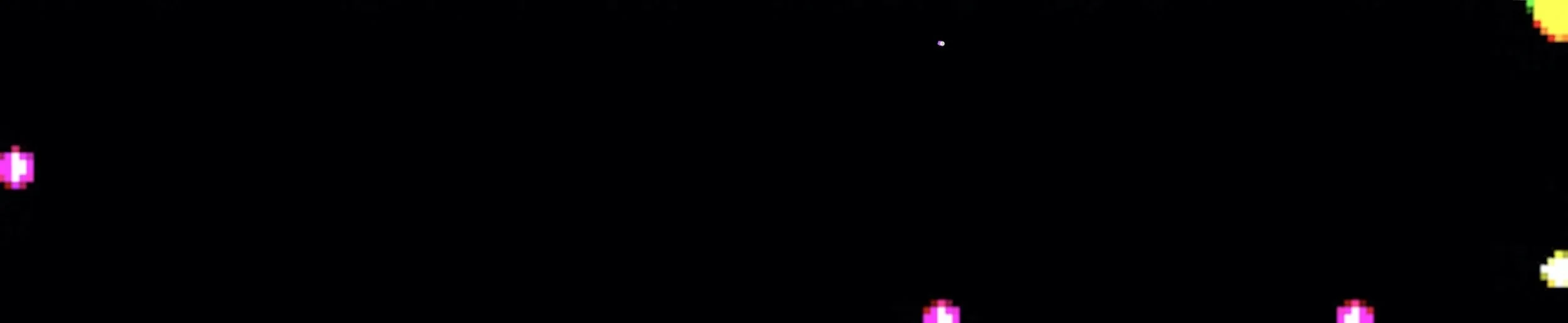
In the frames above I try to give an idea of where the Soul Star is. Yet the frames distort the situation. In fact, there’s no way you could see the planet, not even if I indicate exactly where it is with a tiny white and pink dot — as in the last frame above. The reason you’ll never see it isn’t because it’s cloaked, like a Romulan Bird-of-Prey. Nor is it because it’s a spiritual entity, cloaked in the etherial fabric of the Fifth Dimension. Rather, you can’t see it because it’s a tiny sphere one millimetre in diameter. And yet it contains a fractal of the entire universe, as well as fractals of every living being in the cosmos.
I know all of this sounds insane. But remember: it’s sci-fi, with an emphasis on the fi. It would make a real scientist throw himself from the Eiffel Tower. Yet there’s also a certain mad logic to it — which I’ll explain further in the Introduction and on various pages throughout my romance. For now, let’s go back to the algorithmic master who created the Soul Star in the first place. What’s he up to, so many years after he created the planet?
Algotodo spends his days trying to figure out how to break through the barrier of Space in order to penetrate the dimension of Time. His aim is to create a fractal, or perhaps a reverse fractal, that will allow him to go back more than a million years. Only then can he re-create the incarnation of Love itself, a simple farm girl named Wei. He remembers the moment he first saw her: she was wading through the rushes of a green lake, smiling up at the nerdy stranger, as if she were the sun itself.
Algotodo spends many of his days reading poetry about the souls of the dearly departed. He’s especially fond of Tennyson’s In Memoriam, where the poet says, “I falter where I firmly trod, / And falling with my weight of cares / Upon the great world's altar-stairs / That slope through darkness up to God.” On other days, he gets tired of moping around, and descends instead into the centre of the Soul Star. Beneath the surface of the planet are all the strata of cosmic time going back to one million BC, back to the moment he infracted the Soul Star. Yet he can’t get any further, can’t get back to before Green Lake was submerged, before Wei sank beneath the waters of the Great Deluge.
The words of Corinthians ring in his ears: “If I have the gift of prophecy and can fathom all mysteries and all knowledge, and if I have a faith that can move mountains, but do not have love, I am nothing.”
❧
Another main setting is Paris, where 💍 Albert the novice first struggles to accept the dogmas of the Catholic Church, and then struggles to understand the nature of the ring gifted to him by a talented actress. Albert eventually leaves the Church and becomes a professor of Philosophy, specializing in the field of Probability. As he stands at the front of a lectern in the Collège de France, he starts to wobble on his feet. His mind also starts to wobble — between the logical improbability and the unlikely possibility of the orange streak he sees beaming from the head of a man in the crowd.
Also in the crowd is the French actress Martine. Despite being able to have almost any man on the planet, she’s chosen Albert. Her heart glows candy-cane red as she sends waves of love into the currents of his heart. She wants him to break through his mental chains, so that he can see what he really wants, which she is convinced is her. She watches closely, as the ring she gave him starts to glow.
Years ago this same ring allowed her to know the exact moment her mother died. Yet this wasn’t a warm or endearing moment, like one might hope. Rather, it was a cold moment of intuition, one that suggests that the magic of telepathy isn’t just a white or benevolent magic. Not that we need to call Gandalf in, to save us from some insidious incarnation of Evil rising once more from the murk. No, the ring is just a conductor, or antennae if you will, of waves and beams we can’t see. If those waves are dark and chaotic, the ring will transmit them just the same. As with our bodies, our thoughts, and our lives, it’s the current that matters more than the conductor.
Having given the ring to Albert, she beams her love to him. In this sense, the ring is a symbol of her heart, yet its current is a magic that has no symbol. Martine suspects that her heart’s current is important in some grand cosmic way. She knows it has a deep power, like Virgil’s amor that conquers all. She also knows that if she deflects it at a certain angle — not away from herself, but rather along her self’s most fragmented line of combined thought and feeling — it seems capable of breaking through any barrier. What she doesn’t know is that this angle is the key to the algorithm sought by Algotodo, who is parsecs away, deep within a tiny sphere one millimetre in diameter, in the middle of a green lake.
❧
Icebergs
These five characters and settings — 🎲 Talfar in his hotel room, 🎲Farenn in a cafe, 💍 Albert & 💍 Martine in a lecture-hall, ⭐️ Algotodo on a green lake — are just the tip of the iceberg. Others sway slowly and crackle suddenly in the icy waters beneath:
💍 The quays next to the Latin Quarter, where Madame Dupont laments both her husband’s death and her existential belief that there’s no afterlife in which she can meet him again. Sitting in the auditorium where Albert lectures on probability, she has premonitions of immanent catastrophe …
🔮 The Pink Well, where a million years ago the Baulians swirl upwards like angry cubic piranhas from the deep …
🎲 Mount Voolcan, where burning shards shoot into the dark sky. Here, on the edge of a cliff, Farenn addresses the Council of Ferridian Priests. Among these Priests is Cagnazzo, who plays two major roles in my story. First: Cagnazzo engineers mass extinctions on the planet of Tarry Doom, in an attempt to measure the trajectory of departing souls (a trajectory Algotodo has programmed into every being in the cosmos). Cagnazzo knows the souls are directed toward the Local Void, but he can’t see exactly where they go!
Second: His experiment having failed, Cagnazzo sends his spy Dactalla to Aatari Lok in order to penetrate the security system that maintains the cosmic detente. Note: Cagnazzo takes his name from the devil in Dante’s Inferno who tortures corrupt politicians (or barattier). Later in the story, his pitchfork will poke into the rump of several North American politicians …
🎲 The tree-top ledges of the cafes of Vicino Concordia, where Talfar spends his afternoons reading and wondering what happened to his first love, Thalphemera. Meanwhile, Thalphemera is exploring beyond the cosmic border, way, way out there where ⭐️ the Looking-Glass Beings are …
⭐️ The outermost leagues of the outermost outer space, where Antiny sets out from his sunless realm into the darkness. After several million years of travelling through the dark — and after making up trillions of stories, and stories within stories, to occupy his mind on the long journey — Antiny picks up a faint signal coming from the mass extinction of souls on Tarry Doom …
💚 Rome, where the visions of Lucia, Claudia, & Sandra come together in the Eye of the Pantheon, where ⭐️ the gods funnel down onto the Earth …
🧚 The 2000 square-foot cedar apartment aboard The Luxorium, a spaceship run by gay aliens, onto which Prester John (an alienated priest from small-town Alberta) is beamed. Initially he’s terrified, but after taking a good look around, it feels like home …
🗽 The penthouse apartment on 5th Avenue, which is the home of Curtus, a full-time aesthete and part-time historian. Curtus looks out his window and down into the wide burning avenue. Orange beams are slicing through cars and buildings. Out of the corner of his eye he sees The New York Crimes, draped stylishly across a Louis XIV chair. The headlines read Trump and Putin Incinerate the ICC and The Baulians Are Here! Curtus turns around and looks longingly at the outline of his transexual lover on the bed. His, her rump looks like the curve of a macaron. He wonders how many macarons are left in the fridge …
🍎 The streets of Babylon three thousand years ago, where Moe comes up with a new religion, and where his Holy Bin of tablets rumbles and cracks over the rocky road of time …
🧚 The prairie farmhouse where Beatrice, her dress slipping off her shoulders, looks into a magic mirror and sees the outline of Prince Charming. From the vortex in the mirror, Antonio romances her with sweet words of love: “Now therefore, while the youthful hue / Sits on thy skin like morning dew” …
🧚 The whirlpool where Ragor sits, steam rising into the cold Alberta air. Looking across the street, Ragor watches as Baldric, the son of Antonio and Beatrice, grows up confused and afraid, between Antonio’s school of hard wandering rocks and Beatrice’s open sea of green eyes.
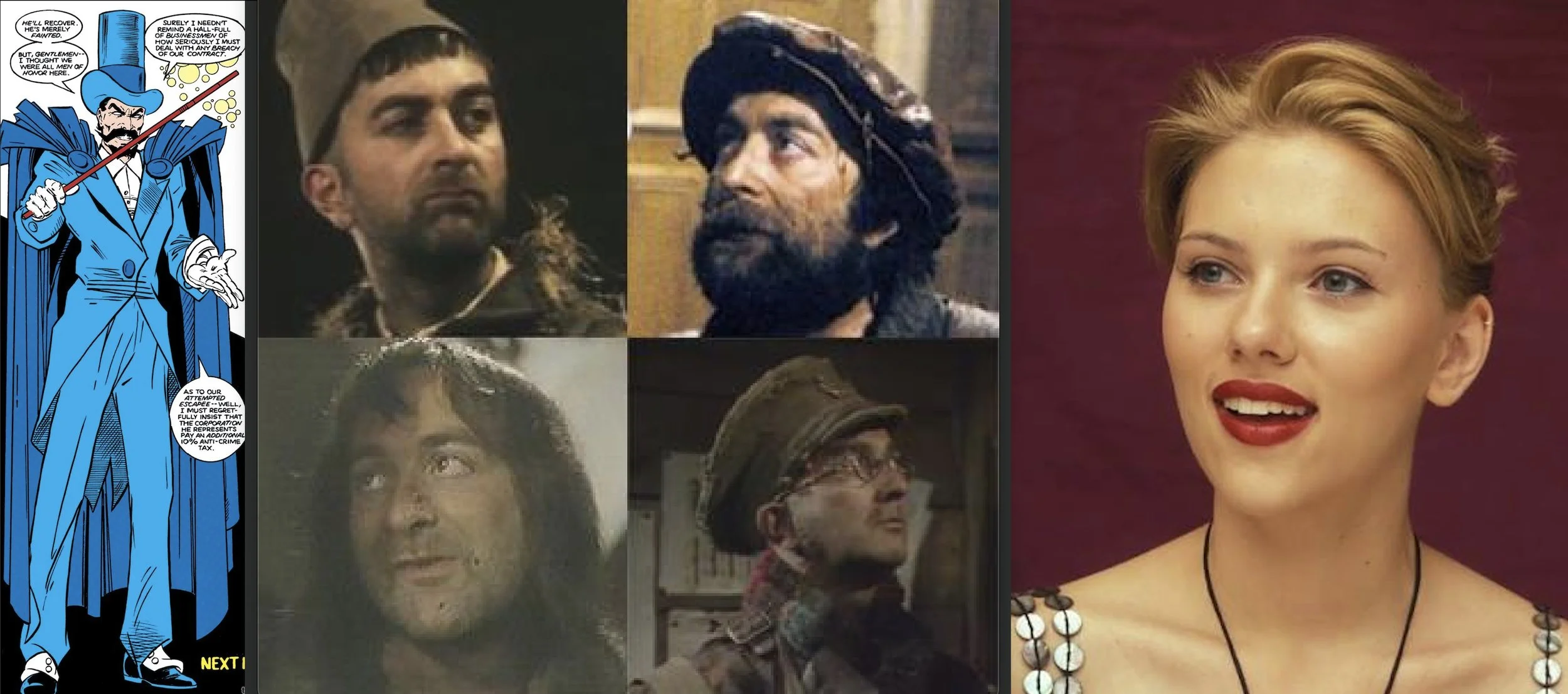
Left: https://villains.fandom.com/wiki/Wizard_(DC); Centre: Wikimedia (“Baldrick); Right: instagram.com/p/DOo0jyjCKOS/
Baldric, a would-be Odysseus, lies in doubt to deem himself a God or Beast. Ragor, a would-be Homer, follows him on his travels from Black Diamond to the mountains of Western Xinjiang. Everything Ragor sees in the wide world confirms his conviction that Charybdis lies on one side, and the open green sea lies on the other.
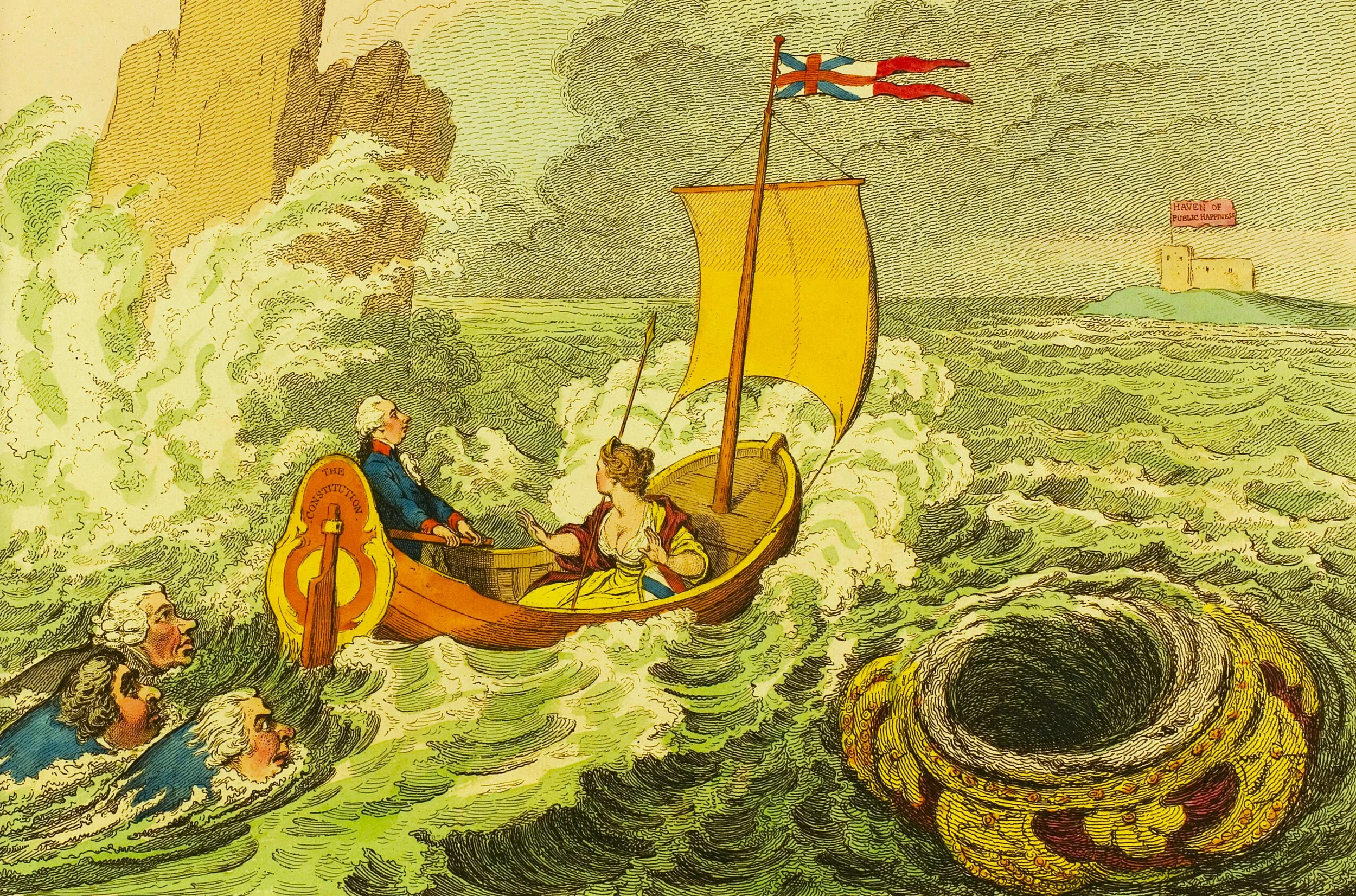
(From Wikimedia Commons:) The prolific James Gillray often included Classical nautical references in his contemporary political satires. Around the time of the French Revolution, Gillray depicted the British prime minister William Pitt as the wandering Odysseus, who pilots a small vessel holding the buxom Britannia through a dangerous strait toward the “Haven of Public Happiness.” Pitt attempts to steer between two conflicting forms of government: a whirlpool (Charybdis) on the right, symbolizing the crown and absolute monarchy, and a perilous rock with lurking monster (Scylla) on the left, representing democracy. 8 April 1793; Source.
Back in his whirlpool and reading Keats’ The Fall of Hyperion, Ragor notices that the mist rising from his whirlpool is tinted with yellow. Perhaps this is from the sulphurous pit across the street, or perhaps it’s from the yellow lights of the astronomical machine Antonio is pointing at the stars. Ragor suspects that Antonio is enacting the final stages of his plan ❧ to get revenge on his father (The Father), ❧ to destroy God’s latest incarnation, the insanely beautiful Beatrice (Our Lady of the Prairies), and ❧ to find the Soul Star in order to put an end to Hope once and for all.
✏️ This list of places and characters isn’t an exhaustive one. Icebergs are very large beneath the water, and one can’t always say where the water melts or where the current gets so cold that the iceberg is in fact growing. Yet before concluding the list, for now at least, I must include one more character as well as two more settings: ✏️ the bathtub in which Matthew tries to study, and the pool in which Matthew encounters creatures from all over the stars.
Matthew is the only character who speaks in the first person in my story. This is because he’s closer than all the other characters to being a reflection of myself. Indeed, it remains a mystery, even to me, whether he’s a main character or the creator of the stories, and the stories within the stories. In any case, like me, ❧ he’s a student of literature and a would-be writer. As a result, ❧ he’s always sitting in front of his computer. And like me, he’s always ❧ trying to understand the convoluted situations and scenarios of the world, ❧ trying to see see how they connect, and ❧ trying to make sense of it all — by which he means everything, from his own little confused life to the star walls that have no roof.
✏️ Matthew shares 🧚 Ragor’s tendency to dream and to bathe both literally and metaphorically in the symbolism of water. 💍 Albert shares this watery dream, albeit in the wine of the Eucharist; Algotodo also contemplates the theodicy of The Flood while sitting in the middle of Green Lake. I could go on (and on!), but it’s better not to drift too far into the icy currents, at least not yet.
Matthew contemplates the depths of waters early on while sitting in his bathtub, preparing for an exam. He also does this later in the story, after the Baulians have taken over the Earth: a sexy Baulomorph (a Baulian in a human body) is hired by the Baulians to be his French maid and to take him to a communal pool. This takes him into the strangest fantasies ever. It also takes him away from his computer screen, where he connects with two diplomats from the far ends of the comos…
That part of the story will explain itself in due course. For the moment, I’d like to leave Matthew in his bathtub in the district of Kitsilano, down the hill from UBC. Here Matthew is studying for his upcoming exam on the roots of the epic in Western literature. Having studied for 24 hours straight, his eyes start to close and he starts to drift into an epic vision in the warm water. His bathtub turns into a dream-mobile that sets sail from Iceland and ends up roaring down the Transcanada Highway. His journey re-enacts in part what he just read in the Eddas about Ragnarök, the Norse apocalypse. Loki and Hel steer his ship and everything is heading for war and disaster.
His eyes winking open, he consults his laptop, perched precariously on the tap. With one eye he sees his girlfriend step into the bath, and with the other he sees into Odin’s well. With his brain, he’s rehearsing an argument for next morning’s exam, an integrated web of ideas that connect the roots of the epic in Homer to the later poetry of Virgil and Dante. Yet the filaments of the web stretch north to the Eddas and east to Gilgamesh and the Mahabharata. All the while, his eco-feminist girlfriend is slipping her toes around his submerged thighs and telling him about polar ice-caps and the end of the world …
❧
Some might point out snippishly that north of Tuktoyaktuk the icebergs are shrinking. With a smug grin they’ll conclude that soon all my crazy stories will slip into the sea. That may be true, at least on Planet Earth. Yet my iceberg sails in the ocean of a distant planet that’s getting colder every year. It’s being pulled by an ocean current I can’t even see, let alone name. New plots and sub-plots are forking outward like frozen sheets of lightning from the bulky undercarriage. They spread out into the vast expanse of cold water that stretches for thousands of kilometres beneath the horizon.
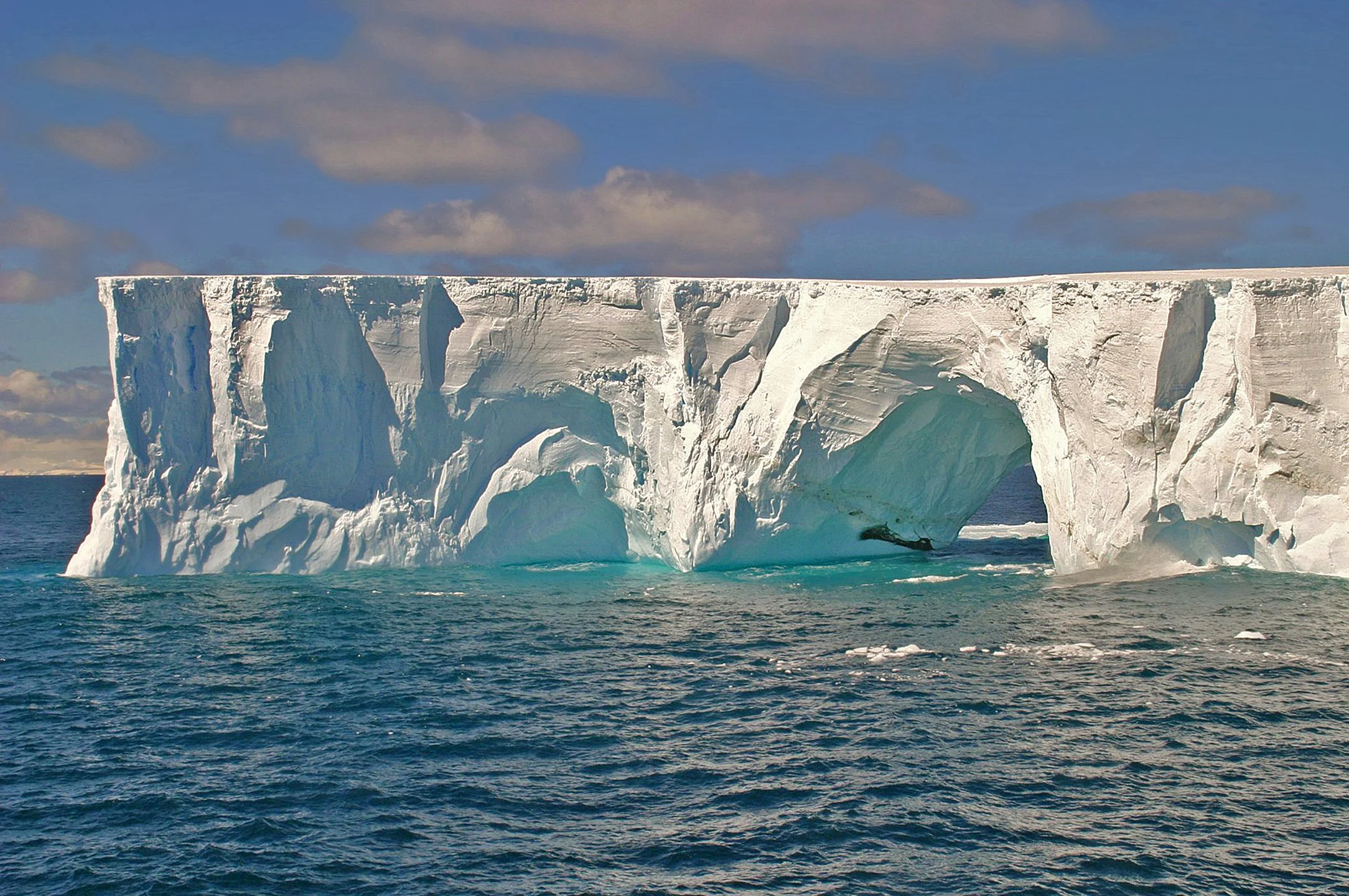
Flat iceberg (table iceberg). Icebergs that are formed from ice shelves are relatively flat and are typical of Antarctica. Seen in Bransfield Street (Antarctica). December 2005. Author: W. Bulach (Wikimedia Commons)
I suspect that I’m fated to suffer the fate of Balzac: the settings and characters will keep multiplying until my body collapses, even while I continue to clutch at Meaning on the icy deck of my own imagination. Above me the winter winds continue to blow, fed by the slow rotation of the planet and the irrational hope of Spring.
❧
Next: Introduction
Contents - Characters - Glossary: A-F∙G-Z - Maps - Storylines