
The Double Refuge 🍷 Prologue
The Battered Caravanserai
🍷
Think, in this batter'd Caravanserai
Whose Doorways are alternate Night and Day,
How Sultán after Sultán with his Pomp
Abode his destin'd Hour, and went his way.
— from the Rubaiyat of Omar Khayyam, most freely translated by Edward Fitzgerald
🍷
In The Double Refuge I explore the relation between doubt and belief. I argue that one can help in understanding the other, and also that one can be a refuge for the other: belief can be a refuge from existential alienation, and doubt can be a refuge from spiritual dogma. As the Persian poet Omar Khayyam said 900 years ago, the world’s a rough and dizzying place, a “battered Caravanserai / Whose Doorways are alternate Night and Day.” To live in this world, it helps to be flexible, one moment measuring it like an astronomer, the next moment rotating with it, like a dervish among the spinning atoms and stars.
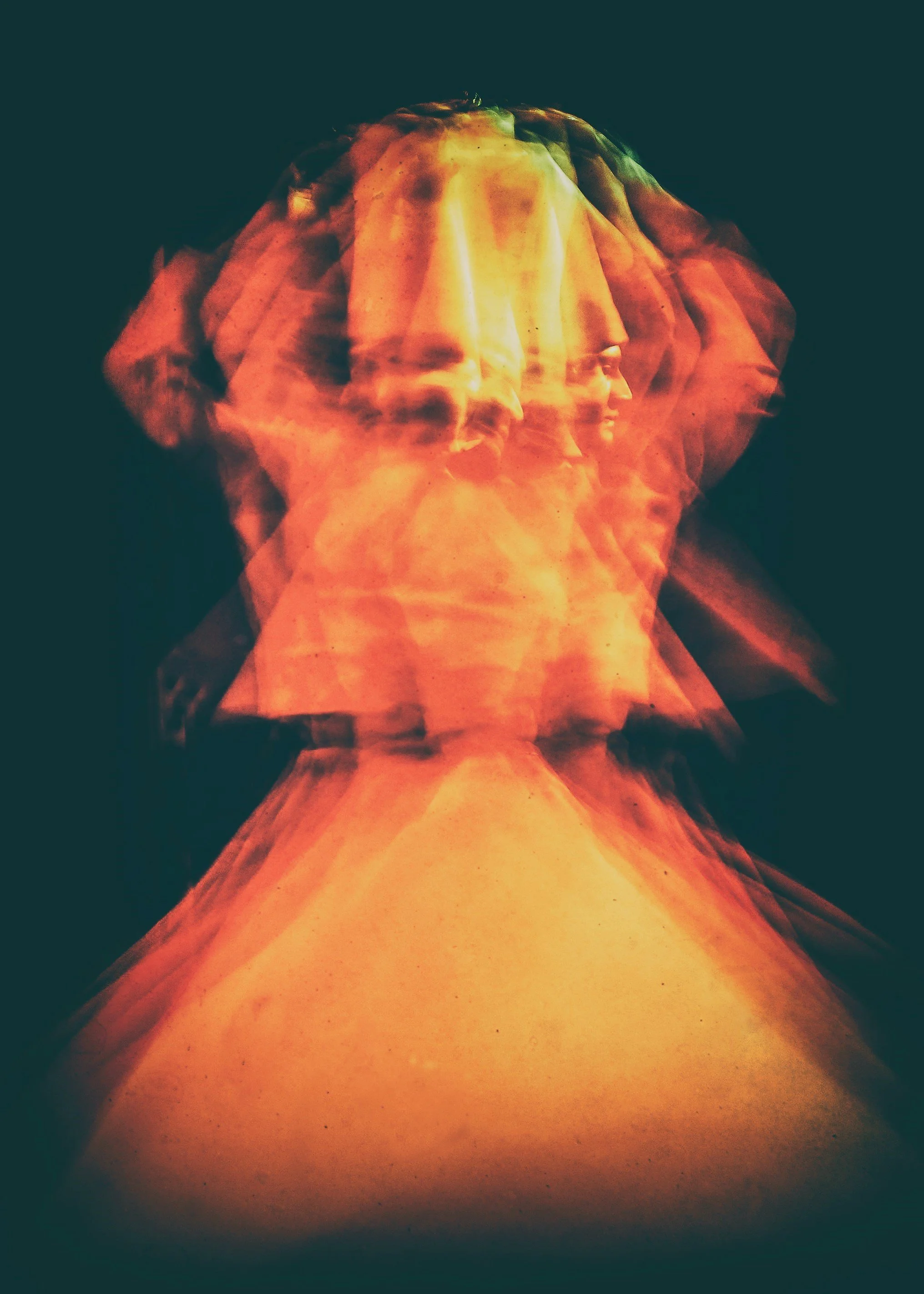
English: Sufi whirling is a form of physically active meditation which originated among Sufis and which is still practiced by the Sufi Dervishes. This is an image with the theme "Play" from: Egypt. March 2017, Author: Mona Abo-Abda. (From Wikimedia Commons)
In this 🍷Prologue to The Double Refuge, I’ll use Persian metaphors to suggest that doubt and belief are two sides of the same coin, just as the brain and the heart are two organs of the same body. Blaise Pascal argues that when we flip a coin we should bet that God exists rather than God doesn’t exist. I’ll argue a slightly different case: we can also let the coin keep spinning.
My coin keeps spinning in the air, as if tossed so high that it escapes the pull of gravity. Yet out there in outer space there are other celestial bodies that exert gravitational pull, and I can’t be sure that the coin won’t land on some faraway planet, fabulous or forlorn. Yet even if the coin does land on solid ground, it keeps spinning, at least in my head, magically, mysteriously, as if that pesky thing called gravity didn’t exist.
🍷
A hundred years after Khayyam, another Persian poet, Jalāl al-Dīn Muḥammad Rūmī, inaugurated the Mevlevi Order, the sect of Sufi mystics who dedicate themselves to union with God, to spinning the atoms of their being until they spin with the atoms of the infinite cosmos. In other words, the Whirling Dervishes.
While Rumi’s Sufism has a strong theological bent toward Islam — a point often overlooked by Western enthusiasts — it’s often universal in a way that transcends any particular religion. In many of Rumi’s texts (especially his monumental Masnavi) he stresses the theological certainties of Islam, and yet he also opens up wide spaces and wonderful paradoxes, bringing the doctrines down to earth and applying them in striking and unconventional ways.
For instance, Rumi often uses wine and drunkenness to symbolize spiritual intoxication. The mosque is a place of prayer, where people call up to Heaven, while the bar is a place of communion, a place where people lose their inhibitions and connect with each other. A sort of Heaven on Earth, a temple that has become a tavern. This doesn’t mean that Rumi condones drunkenness or hedonism. Rather, it means that he sees metaphor (wine) and extended metaphor (wine, tavern, clay cup, lips, and lover) as ways 🔺 to enlarge his appreciation of the world and 🔺 to rework the strict and iconoclastic forms of theology for which Islam is famous.
Coleman Barks renders one of Rumi’s poems in the following manner:
We have a huge barrel of wine, but no cups.
That’s fine with us. Every morning
we glow and in the evening we glow again.
— from “The Tavern: Whoever Brought Me Here Will Have to Take Me Home” in The Essential Rumi
The poem suggests that it doesn’t matter what we do exactly, whether or not we have actual cups to drink the wine. The huge barrel emanates a connection and love that warms our hearts nevertheless.
No doubt a closer look at the Persian words and symbolism could take us into a particular vineyard, cellar, and tavern of Islamic thought. I imagine feeling tipsy and looking down at a goblet glistening on a table in a caravanserai a hundred miles from the medieval city of Shiraz (in southern Iran). Yet I’d argue that the poem also has a more universal philosophical and religious implication. The exact form of worship doesn’t matter. Worship itself may not matter. What matters is the connection, the glow, the Love. I also imagine feeling tipsy and looking down at a glass of mondeuse blanche, a type of Shiraz, sparkling on a white tablecloth in a restaurant in Val d’Isère, snowflakes falling, always different, always the same, from the same night sky.
🍷
I said above that Barks renders Rumi’s poetry, rather than translates it. I said this because he reworks Rumi not from the original Persian, but from other people’s translations. Like Edward Fitzgerald over a hundred years before him, Barks is sometimes criticized for his inaccurate translations. I should note here that Fitzgerald admitted his translations were transmogrifications; although he worked from Persian originals, he took enormous liberties. Barks also takes liberties, and can’t claim to know the exact dimensions and subtleties of the original Persian. Yet I think it’s important to remember that everybody admits that it’s impossible to translate poetry, even from English to French, let alone Persian to English. To me, it’s important to recognize the qualifications of the translator and the accuracy of the translation, but what really matters, to me at least, is the quality of the final product.
Despite having been trained in literary criticism, and despite having turned my Ph.D thesis into a scholarly book (Stranger Gods, 2001), I value quality and insight more than rules about authenticity. Writers steal and recreate, slander and idealize all the time; just look at Shakespeare. If translators aim toward one thing and yet hit something slightly different, we can acknowledge their shortcomings and yet still appreciate what they found in the end. What linguists see, quite rightly, as a mistranslation (in which case my argument is a defence of the indefensible) poets see as a bridge from one linguistic cultural reality to another.
When Barks writes, A secret turning in us / makes the universe turn. / Head unaware of feet, / and feet head. Neither cares. / They keep turning, I’m less concerned with the accuracy of the poem’s translation than with the skill by which the English language is used to articulate the ideas. It’s of course interesting to know what Persian translators think of the translation, just as it’s interesting to read Omar Ali-Shah’s critique of Fitzgerald’s Rubaiyat alongside Shah’s own version of it. Yet by and large I don’t delve into these matters. I’d rather focus on the ideas and on the literary qualities. For instance, regarding Bark’s translation, I’d suggest Head unaware of feet, / and feet of head, rather than Head unaware of feet, / and feet head. To me, feet of head sounds better, and seems easier to process.
In the following translation of Rumi I’m less interested in Barks’ fidelity to Persian than in 🔺 the way that metaphors are linked — water to wheel, wheel to star & moon, moon to ocean, and wondering to celestial lights, and in 🔺 what this treatment of metaphor implies about psychological perception and philosophical meaning:
Inside water, a waterwheel turns.
A star circulates with the moon.
We live in the night ocean wondering,
What are these lights?
Note the absence of doctrine in the poem. Sufis like Rumi are dedicated religious mystics, deeply schooled in Islam, yet in their poetry they often transcend dogma. Instead of injunctions against paganism, and instead of diatribes against the vanity of logic, 🔺 Rumi uses metaphors which intrigue us (How is a waterwheel connected to a star or moon?), 🔺 he connects these with other metaphors, opening new ways of seeing the same things (Is the moon affecting the ocean tides? Are these tides our emotions? How is this wondering in the dark connected to water and light?), and 🔺 he questions the entire arrangement he just offered by asking what is the essential nature, the essential meaning, of his perception (What are these lights?).
🍷
My aim in The Double Refuge is to do something similar. I aim 🔹 to explore ways of seeing and experiencing reality, 🔹 to juxtapose and at times fuse these ways, and 🔹 to integrate questioning and wondering into the framework of our experience. In doing this, I aim to put experience before system, to put active doubt and active belief before doctrines — especially any doctrine that says never the twain shall meet.
🍷
I start with the proposition that earnest theological doctrines and atheist denials miss two interconnected points: 🔹 life can be lived on its own terms, and 🔹 moments of awareness and connection can outweigh creeds and philosophies. I also start with the assumption that if there is a God, He, She, or It already knows all about our reasons for praying, vowing, and denying. He surely takes these in, and does what He sees fit to do with them. Yet He appears, by the very fact of His perpetual non-appearance, to prefer that we work things out by ourselves. Of course we can praise Him, yet we can do this without ascribing some exclusive eternal meaning to our understanding of Him or the cosmos — be this understanding in the form of 🔺 our thoughts, 🔺 a holy book, 🔺 the words of a guru or saint, or 🔺 any of the 1001 religions and philosophies we’ve devised over the centuries. Maybe God sees living itself as worship, as meaningful. Maybe the gift of our lives — our varied thoughts, feelings, actions, and interactions — is in itself His form of Grace.
🍷
Next: 🍷 The Bread of Angels