

Waking Up
With Open Eyes
Martyrs - Earthland in 2026 - Chapter Overview
🌗
In this section I look at the way many of us were forced to wake up to what’s going on in the world. Many of us were shaken by the Russian invasion, and scrambled to find ways to cope with crisis overload. The second election of Donald Trump, with his ICE/tariff/War agenda, only made things worse.
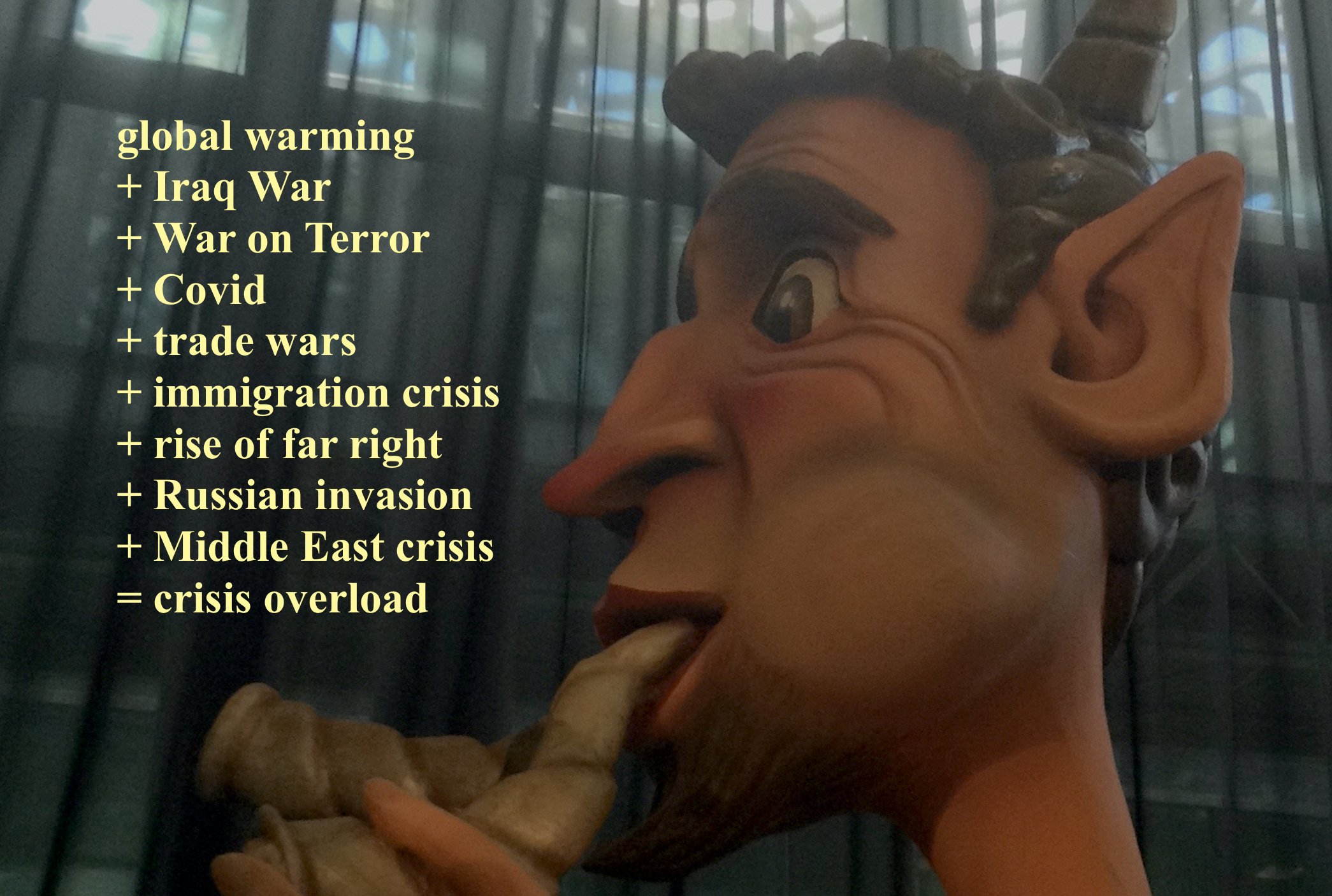
So far, the 21st century hasn’t exactly been The Age of Aquarius…
🌗
Martyrs
My basic idea throughout Waking Up is that we can’t ignore this war and yet we can’t let ourselves get overwhelmed by it either. We can, for instance, be awakened to the brutal realities of war when we read the poetry of Serhiy Zhadan, who describes “how despair, like a butcher, can rip out the entrails of the world” (from “Speak Now"). We can also see the resistance of brave Ukrainians as the resistance of martyrs, who die for everyone’s freedom. Yet we don’t need to descend into the soul-ripping turmoil they experience in order to grasp what they’re going through — or to be motivated to argue their case.

Warships in a Heavy Storm, by Ludolf Bakhuizen, in the Koninklijk Museum voor Schone Kunsten, Antwerp (Photo taken, clipped, and darkened by RYC).
We can find in Ukrainian experience a form of resistance and resilience to inspire us. Zhadan’s poetry gives us a weathered version of hope:

The two excerpts are from “…Speak Now” and “When So Much is Taken Away,” in How Fire Descends; New and Selected Poems, 2023. Please note that in the excerpts above I’ve condensed the lines.
🌗
Earthland in 2026
This section, Waking Up, is far more autobiographical than the other sections of Crisis 22. In it, I try to chronicle how I and others went from being more or less content with the world — sensing in the flow of decades an end to illiberal history — but were suddenly awakened by the shock of the old realities resurfacing: fanatical nationalism, open greed, hatred, and war.
Looking around the world today, I’m reminded of Shelley’s sonnet, “England in 1819.” Shelley’s poem gets at the pain and injustice of being led by a mad ruler and at the crazy policies the ruler enforces. Such a ruler today is Putin or Trump:
An old, mad, blind, despised, and dying king,—
Princes, the dregs of their dull race, who flow
Through public scorn, mud from a muddy spring,—
Rulers who neither see, nor feel, nor know,
But leech-like to their fainting country cling,
Till they drop, blind in blood, without a blow,—
A people starved and stabbed in the untilled field,—
An army which liberticide and prey
Makes as a two-edged sword to all who wield,—
Golden and sanguine laws which tempt and slay;
Religion Christless, Godless, a book sealed,—
A Senate—Time's worst statute unrepealed,—
Are graves from which a glorious Phantom may
Burst to illumine our tempestuous day.
At the moment I’m writing this paragraph (March 2026) we have a US President who seems to think he’s a king. Indeed, the protests against him were called NO KING protests. Trump has promoted all sorts of mad policies — from ICE raids and tariffs, to threatening to take over Greenland, to working with Israel in their attacks on Gaza and Iran.
In response to all this I wrote the prose poem below. In it 🔺 I refer to Shelley’s poem, 🔺 I contrast the harsh Old Testament Law to the Law of Love, Christ, and the Lamb, 🔺 I refer to Blake’s Tiger, who lies in wait for the Lamb (Blake asks, “Did He who made the Lamb make thee?”), 🔺 I allude to Fukuyama’s notion that we arrived at the end of history (the triumph of liberal democracy — a naive but wonderful thought), and 🔺 I quote from Keats’ “Ode to a Nightingale,” where the depressed poet yearns to drift off into the enchanted forest, led by the melodious song of the nightingale. In my poem, the bird is Macbeth’s crow and the forest is Mariupol, Gaza, Iran, Minneapolis, Sudan ….
Earthland in 2026
’Tis safer to be that which we destroy
Than by destruction dwell in doubtful joy. — Macbeth 3.2
We tried to change the law of Nature by calling it the Old Law, the remnant of God’s wrath that led to Sodom and Gaza.
That worked for a while. The Lamb’s wool covered our eyes so that we no longer recognized our closest kin (the Canaanite and Palestinian), the law of evolution, or what we are: the most violent animal on the face of the Earth.
We had almost convinced ourselves that a glorious Phantom had risen from our tempestuous day, and that Time, like History, had fixed itself in Light. We told ourselves the wolf would no longer creep from the forest onto the sunny grass. Yet on closer look, our shoes were caked with mud.
In numb terror, we gave our leaders the power to deal with evil things as they saw fit. We saw the banners on the wall — Make Autocracy Great Again! Hail Czar and Jimmy Crow! — and booked flights to Ibiza while the shadows lurched onto the field.
Now the Dream disintegrates before our eyes. Tracks lead every which way into the forest, where the Tiger waits in silence for the stillness of the night.
We strain to hear the notes of the nightingale, and to be half in love with easeful death. Yet all we hear is the rustling of the predatory bird:
Light thickens, and the crow
Makes wing to th’ rooky wood.
Good things of day begin to droop and drowse,
Whiles night’s black agents to their preys do rouse. —
Thou marvel’st at my words, but hold thee still.
Things bad begun make strong themselves by ill. — Macbeth 3.2
🌗
Chapter Overview
The next page, ⏳ The Ghost of Crises Past, compares my fears today with ❧ Shelley’s mix of pessimism and optimism in early 19th century England, and with ❧ my fears during the Cold War in the 1980s. ✈️ Dream Vacation 2005 is a nostalgic take on travelling in Russia. Ah, a Russia that could have been... ⛱️ Rip Van Winkle then illustrates how many of us went abruptly from 30 years of self-induced dreaminess to a present state of high anxiety — as if a siren blasted a tsunami alert while we were sitting comfortably on a Cuban beach smoking a cigar and drinking a rum and coke, in the early evening, as the sun set over the fine sands of Playas del Este…

Left: Playas del Este, Cuba. Right: “Kyiv after Russian missile strikes on 10 October 2022. Intersection of Volodymyrska Street and Taras Shevchenko Boulevard” (from Wikimedia; source page from State Emergency Service of Ukraine).
The next four pages are poetic, autobiographical, polemical, and fictional. 🥕 The Carrot, ❤️ Caritas, & 🌉 Jovanka on the Bridge look at how hard it is to go from enjoying life to thinking about politics and war. 🎸 The Algorithmics looks at the algorithmic technology that keeps some in a terrorized bubble and funnels their thoughts into intolerance and violence.
The final three pages focus on how we might cope with all this war and turmoil. ☯️ Both In and Out of the Game argues that we can’t ignore the Ukraine War, and yet we can’t let ourselves get swallowed by it either. Instead, we might, like Walt Whitman, try to remain “Apart from the pulling and hauling […] both in and out of the game.” ❄️ Political Modes of Being explores this engaging & escaping in Eliot, Keats, and Marcus Aurelius. 🏛️ Stoicism & Religion looks at the Stoicism of Marcus Aurelius and at religion which stands up to intolerance, authoritarianism, and injustice.
🌗
Next: ⏳ The Ghost of Crises Past